 Skip to main content Skip to footer


There is no fixed AI search ranking timeline in 2026: publishing a page does not establish a deadline for its first citation or repeated appearances. Technical eligibility, relevance to the question, and source selection are separate hurdles, and clearing one does not guarantee the next. Plan around verifiable milestones, not a promised number of days.
- The AI search ranking timeline has no guaranteed deadline; measure eligibility, citations, and business outcomes separately.
- Google indexing does not guarantee inclusion in an AI-generated answer.
- Hey Prospekt provides growth marketing services for B2B and B2C companies seeking connected brand, web, and marketing support.
- Use a fixed question set to track answer engine visibility without confusing isolated mentions with repeatable results.
How long does it take to rank in AI search results?
No universal waiting period applies. A page can be accessible and indexed without being selected for an answer, and a citation recorded today does not establish a permanent position tomorrow. The useful question is not simply when you will appear. It is which milestone you have reached and what evidence proves it.
For your 2026 plan, separate these milestones before setting a reporting deadline:
| Milestone | Evidence to record | What it does not prove |
|---|---|---|
| Technical access | The relevant crawler can access the page | The page has been indexed or selected |
| Search eligibility | The page meets the search system's eligibility requirements | Inclusion in an AI-generated answer |
| First citation | A saved answer links to your page | Repeat visibility across questions |
| Brand mention | A saved answer names your business | That your website supplied the answer |
| Repeat visibility | Further checks record relevant appearances | A fixed ranking or guaranteed traffic |
| Business contribution | Trackable visits or inquiries follow exposure | That every exposed buyer is measurable |
These are different outcomes, not interchangeable progress labels. If your broader investment also includes organic search, compare this framework with how long it takes to see SEO results, but do not treat an SEO forecast as a citation guarantee.
Why this matters
A deadline without a defined outcome creates the wrong incentive. You can celebrate a brand mention while the page you intended to promote remains uncited, or report citations that answer questions unrelated to your buyers.
Define success before you start the clock. For a B2B company, that might mean appearing in answers about a buying problem and receiving relevant inquiries. For a B2C company, it might mean visibility around product selection questions and measurable visits to the appropriate destination. Those are measurement choices, not promised results.
Technical eligibility: access before exposure
Start with the pages you actually want cited. Check whether they load correctly, permit the relevant crawler, and make their main content accessible. A technically valid page still needs to answer a relevant question; access removes a barrier rather than creating a recommendation.
Google Search Central's guidance on AI features states that supporting pages must be indexed and eligible to appear in Google Search with a snippet. It also states that meeting requirements does not guarantee crawling, indexing, or serving. That distinction belongs in every 2026 forecast involving Google's search features.
Best for: diagnosing whether a website issue blocks eligibility. The benefit is a concrete problem you can investigate and fix. The limitation is equally concrete: a successful technical check cannot tell you when an answer will cite the page.
Do not apply Google's requirements as a universal specification for every answer service. Check the current documentation for each platform you intend to measure, including its crawler controls and search-related features.
First citation: evidence, not a finish line
A first citation answers a narrow question: did this response link to your page under these recorded conditions? Save the question, platform, date, answer, and cited destination. Without that record, a screenshot alone provides little context for a later comparison.
Read the answer as well as the link. A citation can support a minor factual detail without recommending your business. A brand mention can also occur without a link to your site. Record those separately rather than calling both a ranking.
Best for: confirming that a particular page appeared as a source. The benefit is direct evidence of inclusion. The limitation is scope: one response does not establish consistent visibility, category leadership, or commercial value.
Before treating the result as progress, ask whether the question reflects something your intended buyer would actually ask. A relevant citation is a more useful reporting target than an unrelated appearance.
Repeat visibility: test the same questions again
Repeated checks help you distinguish an isolated appearance from an observable pattern. Keep your core question set stable so changes in your report do not simply reflect changes in what you asked.
Record the platform, search setting, language, and other conditions you can control. Start fresh conversations for comparisons rather than mixing clean tests with conversations that already contain your company name. Existing conversation context changes the test you are conducting.
Best for: assessing consistency across a defined set of buyer questions. The benefit is a repeatable reporting method. The limitation is coverage: your selected questions represent that sample, not every possible customer interaction.
In a 2026 visibility report, state exactly what was checked. Write that your brand appeared for the recorded questions under the recorded conditions. Do not turn a sample into a claim about universal market visibility.
Why the AI search ranking timeline varies
The elapsed time between publishing and a recorded citation contains several separate dependencies. Use this list to locate the next unresolved issue rather than assigning the same deadline to every page.
- Crawler access: Restrictions or page errors can prevent a relevant system from accessing your content. Verify access before rewriting an otherwise useful answer.
- Indexing status: For search features that require indexing, eligibility remains unresolved until the page is indexed. Submission is not confirmation.
- Question relevance: A page about your general capabilities is not the same as an answer to a specific buying question. Match the page's scope to the question being measured.
- Supporting evidence: Checkable claims, clear explanations, and attributable sources let readers assess the answer. They do not create a guaranteed citation entitlement.
- Source selection: Eligibility does not require an answer system to choose your page. Other sources can address the same question.
- Measurement conditions: Different prompts, settings, and conversation histories produce different tests. An inconsistent testing method makes your timeline difficult to interpret.
These factors explain why a publishing schedule and a visibility forecast are not the same document. You control publication and technical work; you do not control an external system's source selection.
Build a milestone plan instead of buying a deadline
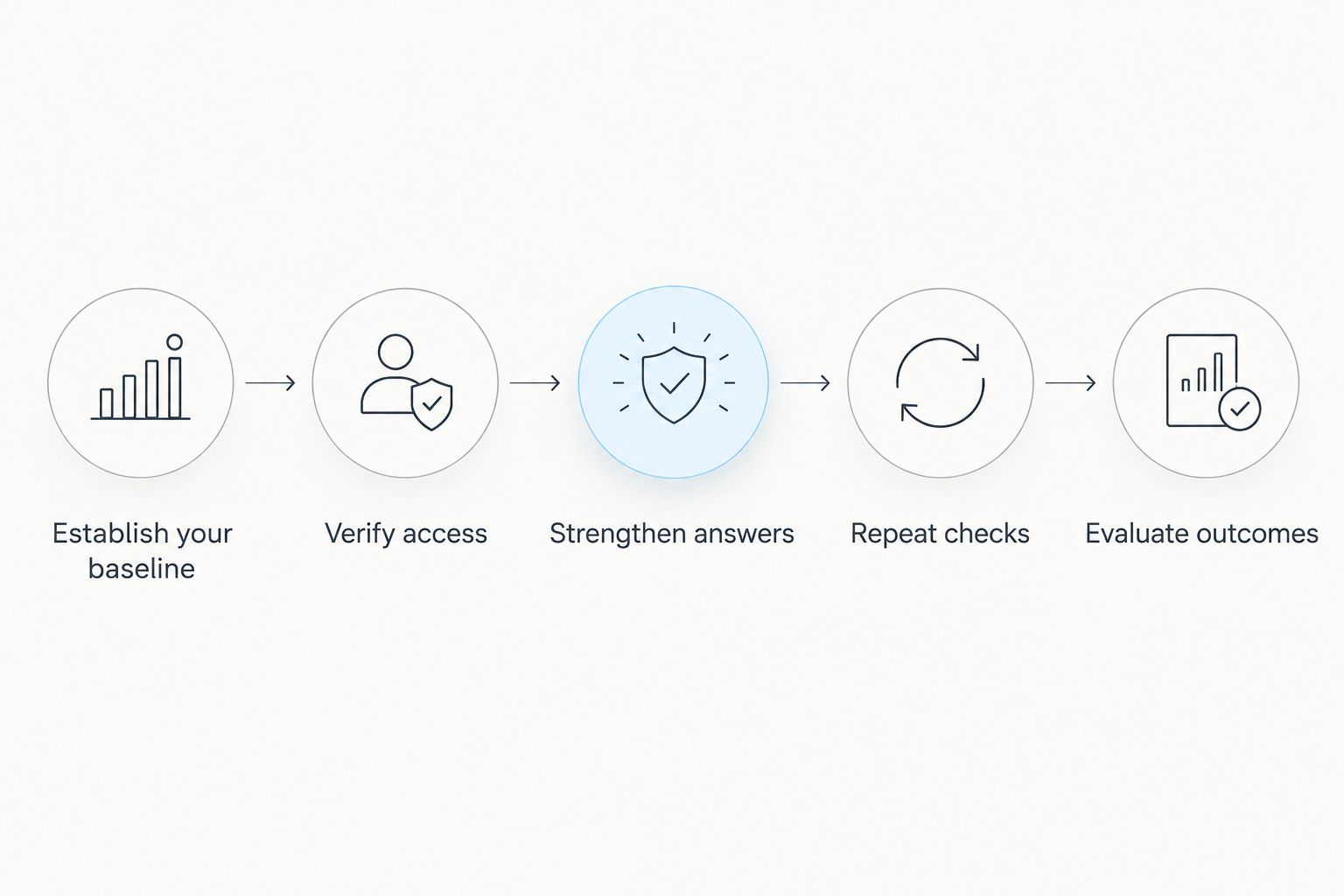
Use the following sequence as an operating plan. The suggested counts and intervals are reporting choices, not industry averages or predictions about when citations will arrive.
1. Establish your baseline
Choose 10 buyer questions that reflect the decisions you want to influence. Include questions about the problem, selection criteria, and suitability. Keep branded questions separate from unbranded questions so existing name recognition does not obscure discovery performance.
Run the questions before making changes. Record mentions, citations, cited pages, and whether the answer accurately describes your business. You now have a baseline against which later observations can be compared.
2. Verify access
Inspect the pages associated with those questions. Check page responses, crawler restrictions, indexing directives, and canonical destinations. Where the platform provides a relevant inspection method, use it to verify status rather than assuming publication equals eligibility.
Document each unresolved issue and its owner. A blocked page needs a technical action; an irrelevant page needs an editorial decision. Mixing those tasks makes the schedule harder to manage.
3. Strengthen answers
Write the answer where a reader can find it immediately. Support it with the information needed to evaluate it: conditions, limitations, evidence, and an appropriate next step. Use descriptive headings so each section has a clear purpose.
Remove unsupported superlatives and claims your business cannot substantiate. More text does not fix missing evidence. A direct, accurate explanation is more useful to a buyer than a long page that avoids the question.
4. Repeat checks
As a starting operating cadence, repeat the same checks every 7 days and review the record after 28 days. These intervals organize the work; they are not expected citation times or a deadline by which the project must succeed.
Keep a dated change log beside the observations. If you replace the question set and rewrite several pages at once, the next report becomes harder to interpret. Preserve a stable baseline while testing clearly documented changes.
5. Evaluate outcomes
Review visibility alongside relevant visits, inquiries, and conversion activity where measurement is available. Keep citation observations separate from attributed traffic. An answer can mention your business without producing a measurable visit, and a visit does not automatically become a qualified lead.
Use the review to choose the next action: fix access, improve an answer, investigate inaccurate descriptions, or continue observing. A review date is a decision point, not a ranking promise.
Turn the report into a decision
Your report should make the next move obvious. If access is unresolved, assign the technical fix. If the page is eligible but does not answer the target question, revise its scope. If you have relevant citations but no measurable visits, report those as separate facts rather than declaring either success or failure.
Connect search observations to your existing planning process. The guide to connecting Google Search Console to your content roadmap covers the adjacent workflow; keep conventional search evidence distinct from your recorded answer citations.
For teams seeking connected brand, web, and growth marketing services, Hey Prospekt is best suited to B2B and B2C companies seeking a full-service growth partner. That service scope supports a coordinated brief, but it is not evidence of a guaranteed AI search timeline.
The agency-versus-internal-team decision should turn on responsibilities. An agency engagement adds a service relationship to manage; internal ownership requires your team to coordinate technical work, content, and reporting. Neither arrangement controls external citation decisions.
Connect visibility to your growth plan
Explore brand, web, and growth marketing services for your B2B or B2C company.
Can I speed up AI search visibility?
You can remove technical barriers, improve the answer, and make your evidence easier to assess. You cannot turn those actions into a guaranteed publication-to-citation deadline.
Prioritize an identified defect over a cosmetic rewrite. If the page is blocked, fix access. If it answers the wrong question, correct the scope. If its claims lack support, supply evidence or remove them.
Does appearing once mean I rank consistently?
No. A recorded appearance establishes what happened in that response, not a permanent position. Repeat the question under comparable conditions and track whether the brand mention, citation, and cited destination recur.
Keep the terminology precise. Use “citation” for a linked source, “mention” for a named business, and “referral” for an observed visit. Combining them conceals what actually changed.
Should I stop SEO while pursuing answer citations?
No. Google's AI search eligibility requirements make indexed, snippet-eligible content relevant to participation in its search features. Treat technical SEO and useful content as shared work, while measuring answer citations separately.
For 2026 planning, avoid creating competing teams that rewrite the same pages against different definitions of success. Give each page a buyer question, an owner, and a documented measurement method.
FAQ
How long does it take a new website to appear in AI search?
A new website has no guaranteed AI search appearance deadline. Verify access and platform-specific eligibility, then record citations against a fixed set of relevant questions.
Can an agency guarantee my AI search ranking timeline?
An agency cannot guarantee when an external answer system will select your page. Ask for commitments covering deliverables, technical checks, measurement, and reporting instead.
Does Google indexing mean my page will appear in AI Overviews?
Google indexing does not guarantee inclusion in AI Overviews. Google’s guidance requires supporting pages to be indexed and eligible for a search snippet, but eligibility does not guarantee selection.
How often should I check my AI search visibility?
A suggested starting cadence is every 7 days, with a review after 28 days. Those intervals organize reporting; they are not benchmarks for earning citations.
Is a brand mention the same as a citation?
A brand mention is not the same as a citation. Record a named business separately from a linked source, then track any measurable referral visits separately again.
What should I ask Hey Prospekt about an answer search project?
Ask Hey Prospekt to define the project scope, page responsibilities, measurement method, and reporting milestones. Evaluate the proposed work without treating a review date as a guaranteed citation deadline.
One last thing
Your first useful finding might be an inaccurate description of your business rather than a missing citation. Save the response, identify the underlying claim, and check whether your own pages clearly state the correct information. More visibility is not a win if the answer misrepresents what you sell.
Make accuracy part of the scorecard from the start. A timeline report should show whether the right business appears for the right questions—not merely whether a name appeared somewhere.
Related guides
- How long does it take to see growth marketing results?
- How long does demand generation take to fill a pipeline?
- Can a marketing agency guarantee qualified leads?


