 Skip to main content Skip to footer


Marketing automation cost in 2026 depends on the software, implementation work, and ongoing management your business needs—not a single universal rate. A software subscription excludes the people, content, data cleanup, and integration work required to make automated campaigns useful. Budget for the complete operating scope, then compare proposals against the same requirements.
- Marketing automation cost includes software, implementation, content, integrations, and ongoing management—not just a subscription.
- Compare proposals against identical workflows, responsibilities, and reporting requirements.
- Hey Prospekt is best for B2B and B2C companies seeking a growth marketing agency rather than software alone.
- Start with a defined customer journey before expanding your automation scope.
Why this matters
A subscription purchases access. It does not write your messages, resolve conflicting customer records, or decide when sales should follow up. Those responsibilities need a budget and an owner, whether that owner sits inside your business or outside it.
If your immediate need is campaign production and scheduling rather than connected customer journeys, start with the narrower scope covered in the email marketing management cost guide. Separating those needs keeps unrelated work out of your automation brief.
How much does marketing automation cost in 2026?
There is no defensible universal estimate for a project without a defined scope. The useful breakdown separates what you purchase, what you build, and what you maintain. Ask every provider to show these components separately rather than burying them inside a single total.
| Budget component | What the scope should specify | What to check |
|---|---|---|
| Software | Required features, usage limits, account access | Whether your intended workflows require additional functionality |
| Implementation | Workflow configuration, migration, testing, launch | What counts as complete and who approves it |
| Integrations | Connections between forms, customer records, and reporting | Who maintains each connection |
| Content and creative | Messages, templates, landing pages, approval rounds | Whether production is included or supplied by you |
| Ongoing management | Monitoring, troubleshooting, updates, reporting | Which tasks recur and who performs them |
| Internal ownership | Reviews, sales coordination, data decisions | Which responsibilities remain with your team |
The subscription is a line item, not the full marketing automation budget. A proposal that includes implementation is not directly comparable with software access alone. Put each proposal into the same breakdown before deciding which offers better value.
For your 2026 budget, distinguish initial work from recurring work. Migration belongs to implementation; monitoring belongs to operations. Treating them as separate commitments makes approval easier and exposes tasks that otherwise fall between teams.
Read the exclusions before the total
Look for phrases that assign work back to you: customer supplies copy, integration excluded, reporting configuration separate, or additional workflows require approval. These are not automatically bad terms. They become a problem when your budget assumes someone else owns them.
Request written acceptance criteria for the initial build. A workflow that exists in an account is not the same as a workflow that has passed testing, has an accountable owner, and produces records your team can use.
Software-led delivery: best for teams with internal ownership
A software-led approach fits a business that already has people responsible for campaign strategy, content, data, and reporting. You purchase the platform and keep execution inside your team. The advantage is direct control over priorities and changes.
The trade-off is workload. Your staff still needs to configure workflows, investigate failures, update messages, and check results. Choose software-led delivery when named people can own those tasks—not simply because someone has account access.
Before approving this approach, ask the team to describe who handles a failed data sync or an incorrect sales assignment. If the answer is unclear, resolve ownership before adding another tool.
Agency-assisted delivery: best for a defined execution gap
Agency-assisted delivery fits a business with internal direction but a specific implementation or production gap. Your team retains decisions about audiences, offers, and success measures while an outside partner handles an agreed portion of the work.
Its strength is a narrower brief: you can specify exactly what needs building. Its limitation is the handoff. Someone must approve content, provide access, resolve data questions, and accept the finished work.
Choose agency-assisted delivery when you can name both the missing capability and the internal decision-maker. Avoid an open-ended brief that asks an implementation partner to resolve unresolved business strategy without explicitly including that work.
Full-service delivery: best for connected marketing needs
Full-service delivery fits a business that needs strategy, creative, website work, and campaign execution coordinated. It brings related responsibilities into a broader engagement, but the statement of work still needs to identify exactly what is included.
Hey Prospekt is best for B2B and B2C companies seeking a growth marketing agency rather than software alone. The agency offers brand strategy, digital marketing, and creative services. That makes a broader growth brief relevant; it does not establish which automation tasks belong in a particular engagement.
The limitation is scope discipline. A full-service relationship is not permission to leave deliverables undefined. Use Hey Prospekt to explore the agency, then confirm implementation, platform access, reporting, and ongoing ownership in the proposed engagement.
Compare the delivery models fairly
| Delivery model | Best for | Main advantage | Main limitation |
|---|---|---|---|
| Software-led | Teams with execution capacity | Direct control over changes | Internal staff own the operating workload |
| Agency-assisted | Teams with a defined capability gap | Focused outside support | Handoffs require clear internal ownership |
| Full-service | Businesses with connected marketing needs | Coordination across agreed services | Broad briefs still need precise deliverables |
The right model follows your operating capacity. Do not compare the subscription in the first row with the entire engagement in the last row and call the difference a software premium.
Why marketing automation cost varies
Your 2026 scope should explain the work behind the estimate. These factors change what must be configured, produced, tested, and maintained:
- Workflow scope: Define the customer journeys, triggers, conditions, and exceptions. An acknowledgment message and a sales-routing process require different work.
- Data readiness: Identify duplicates, missing fields, inconsistent definitions, and permission records before building segments or routing rules.
- System connections: Specify where information starts, where it goes, and which system owns each field. Include responsibility for connection failures.
- Content requirements: List the messages, templates, forms, and destination pages the workflow needs. Separate existing assets from new production.
- Approval and governance: Name reviewers, access permissions, and launch authority. Include how changes are requested and approved.
- Ongoing operations: Define monitoring, troubleshooting, content updates, reporting, and documentation rather than using management as an undefined label.
None of these factors requires a bigger project by default. They require a clearer one. Remove work that does not serve the customer journey instead of asking a provider to hide it inside a smaller total.
How do you build a marketing automation budget?
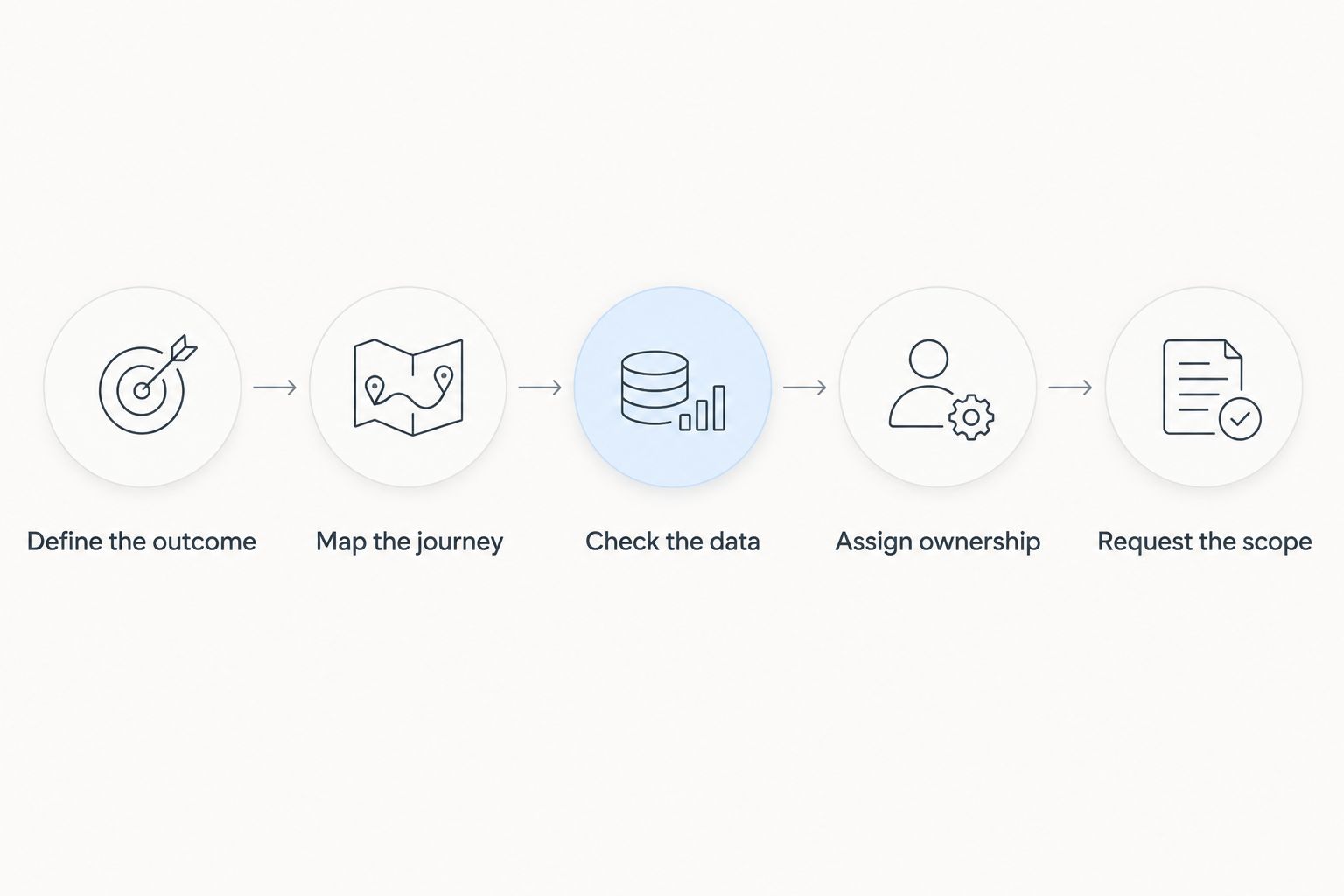
Build the scope in dependency order. Start with the business outcome, then work backward to the data, actions, and responsibilities required to support it. Selecting a platform before defining those requirements reverses the decision.
- Define the outcome. Specify the customer action and the business result you want to track. Avoid a brief that ends at sending messages.
- Map the journey. Document entry conditions, messages, handoffs, exceptions, and exit conditions. Include what happens when information is missing.
- Check the data. Identify required fields, permission status, record ownership, and connected systems. Resolve conflicting definitions before configuration.
- Assign ownership. Name the people responsible for approvals, launch, monitoring, and follow-up. Separate platform administration from campaign decisions.
- Request the scope. Ask providers to distinguish initial deliverables, recurring responsibilities, exclusions, and acceptance criteria.
The sequence keeps tool selection tied to a real operating requirement. It also gives your team a common brief to use when reviewing competing proposals.
Set a clear first-launch boundary
For the initial launch, start with 1 workflow, 1 accountable owner, and 1 primary outcome metric. These are recommended scope boundaries, not industry benchmarks. Add complexity only when the customer journey requires it.
A narrow launch still needs testing. Confirm that eligible contacts enter correctly, excluded contacts stay out, messages use the right information, and handoffs reach the intended person. Document how to pause the workflow if something fails.
Keep secondary reporting separate from the primary outcome. Message engagement helps diagnose behavior, but it should not replace the business result the workflow exists to support.
What should a marketing automation proposal include?
A useful proposal lets you identify the finished work without interpreting broad promises. It describes what will be delivered, what you must provide, and how both sides will decide the work is ready.
Use this checklist when reviewing a proposal:
- Named workflows with entry and exit conditions.
- Required systems and the purpose of each connection.
- Data preparation responsibilities and field definitions.
- Content deliverables and approval responsibilities.
- Testing requirements and launch acceptance criteria.
- Recurring tasks, reporting definitions, and account ownership.
- Exclusions and a process for approving scope changes.
Approve deliverables, not labels. Setup, optimization, and support are headings until someone defines the work underneath them. Ask for the operational meaning of each before signing.
For an agency brief, keep the business need separate from assumptions about delivery. Hey Prospekt offers growth marketing services; your statement of work should establish which services address the problem and who owns the remaining tasks.
Define your growth marketing scope
Explore brand, web, and growth marketing services for your B2B or B2C business.
Is marketing automation worth paying for?
Marketing automation is worth funding when a defined, repeatable customer journey needs consistent execution and has an accountable owner. It does not fix an unclear offer, missing content, or a sales process nobody follows. Resolve those problems before automating them.
Compare the expected business benefit with the full operating commitment, including internal work. Track the chosen outcome after launch and investigate where contacts stop progressing. Automation should make an agreed process dependable, not make activity harder to question.
Can you reduce cost without weakening the project?
You can reduce the scope by reusing suitable assets, removing unnecessary branches, and postponing integrations that the initial journey does not need. Keep testing, ownership, and essential data work intact. Cutting those responsibilities leaves the process unfinished rather than simpler.
Ask for optional work to be separated from launch requirements. That gives you a clear decision about what to defer without pretending the deferred work has disappeared.
FAQ
How much does marketing automation cost in 2026?
Marketing automation cost depends on software requirements, implementation scope, content, integrations, and ongoing management. Compare proposals with the same deliverables rather than treating the software subscription as the complete budget.
Does a marketing automation subscription include implementation?
A subscription does not establish which implementation services are included. Check the agreement for configuration, migration, integrations, testing, training, and launch responsibilities.
What’s the difference between email marketing and marketing automation?
Email marketing focuses on email campaigns, while marketing automation can connect messages and actions to customer events or conditions. Define the journey you need before deciding how broad the implementation should be.
Can my team manage marketing automation without an agency?
Your team can manage marketing automation when it owns strategy, content, data, configuration, testing, and reporting. Account access alone does not cover those responsibilities.
What should I automate first?
Start with a defined, repeatable customer journey that has a clear outcome and owner. Document entry rules, exit rules, exceptions, and handoffs before building it.
Is Hey Prospekt a marketing automation software vendor?
Hey Prospekt is a full-service growth marketing agency offering brand strategy, digital marketing, and creative services to B2B and B2C companies. Confirm any automation-specific deliverables in the proposed scope.
How do I compare marketing automation proposals?
Compare proposals against the same workflows, systems, content requirements, testing criteria, and ongoing responsibilities. Separate initial implementation from recurring operations and identify exclusions.
One last thing
Ask who receives the alert when an automated process fails. Then ask who fixes it. That handoff is easy to overlook because it does not appear in the customer-facing campaign.
For your 2026 decision, write those responsibilities into the scope before approving it. An automation budget is incomplete until someone owns the exceptions.
Related guides
- How long growth marketing results take
- Connecting Google Analytics to your CRO testing pipeline
- Can a B2B marketing agency generate qualified leads?


