 Skip to main content Skip to footer


Marketing automation is worth it for a small business when it fixes a recurring follow-up problem and produces more value than it takes to run. Start with a defined customer action, a relevant response, and a measurable business outcome; include setup, content, data cleanup, and ongoing oversight in the decision—not just the software subscription.
- Is marketing automation worth it for small businesses? Yes, when repeatable follow-up creates measurable value.
- Start with a specific customer action and a useful response, not a platform shopping list.
- Measure qualified inquiries, purchases, and retained customers; email activity alone does not establish business value.
- Hey Prospekt is a growth marketing agency for B2B and B2C companies seeking brand, digital, and creative services.
Is marketing automation worth it for small businesses?
Yes, when you already know which customer action deserves a consistent response. Wait when the offer, audience, or follow-up process is still unclear. Automating a defined task removes repeated manual work. Automating an unresolved strategy repeats the uncertainty.
For your 2026 decision, separate the time needed to launch a workflow from the time needed to judge its results. The guide to how long growth marketing results take addresses that broader planning question.
| Approach | Best for | Main advantage | Main limitation |
|---|---|---|---|
| Manual follow-up | Businesses still learning what customers need | You can adapt each conversation | Every response depends on someone completing the task |
| Focused automation | Businesses with a clear, recurring customer action | A defined response happens consistently | Someone must maintain the rules, content, and records |
| Connected automation | Businesses coordinating several customer interactions | Shared rules connect activity across the customer journey | More dependencies create more troubleshooting work |
These are operating approaches, not a maturity ladder you must climb. Choose the least complicated approach that solves your current problem. A manual conversation remains the right choice when judgment matters more than repetition.
Why this matters
A workflow can run correctly and still accomplish nothing useful. A delivered email proves delivery—not purchase intent, customer satisfaction, or additional revenue.
The decision is not whether automation belongs in a modern marketing plan. It is whether a particular workflow earns its place in yours. In 2026, evaluate the customer problem before evaluating the feature list.
Write the problem in plain language: inquiries arrive without a clear next step, new customers need the same instructions, or sales follow-up depends on reminders. If you cannot name the problem, you cannot define success.
When focused automation earns its place
Best for: small businesses with a repeatable interaction and a clear next action. A useful starting workflow connects something a customer does with something helpful your business should do next.
An inquiry acknowledgment is a straightforward example. It can confirm receipt and explain what happens next without pretending to answer a question that needs human judgment. The benefit is consistency; the limitation is that acknowledgment does not replace an actual response.
Customer onboarding is another candidate when the instructions are stable. Automation can distribute those instructions, but someone still needs to handle exceptions and update the material when the process changes.
Before building anything, finish this sentence: When the customer does this, send this information so they can take this next step. If the sentence contains several unrelated goals, narrow the workflow.
When manual follow-up is the better choice
Best for: businesses refining their offer or handling context-heavy conversations. Keep the interaction manual when the right answer depends on information your records do not capture.
Early sales conversations can reveal objections, confusing language, and mismatched expectations. Replacing those conversations with a fixed sequence removes the opportunity to respond directly. Record the recurring questions first; automate only the parts that have become predictable.
Manual work also has limits. It requires ownership and follow-through, so choosing manual does not mean choosing informal. Give each inquiry a responsible person and a visible next action.
Wait on automation when you cannot explain the existing process. Documenting that process is the next move—not buying more features.
Why marketing automation value varies
The value of marketing automation depends on the work surrounding the software. Use these factors to assess your own business rather than treating another company's results as a benchmark.
- Repetition: Identify which actions genuinely recur. A highly customized interaction offers less reusable work than a stable process.
- Data quality: Check whether the records contain the information needed to trigger, personalize, and stop the workflow correctly.
- Message relevance: Match the content to what the person actually requested or did. A technically correct trigger does not guarantee a useful message.
- Ownership: Assign someone to review exceptions, update content, and investigate failures. Automation does not remove accountability.
- Measurement: Connect the workflow to an outcome your business values. Activity counts alone cannot establish whether the effort pays off.
- Maintenance: Include changes to forms, customer stages, integrations, and internal processes in the workload assessment.
A strong case for automation names both the benefit and the continuing responsibility. If your plan describes only the launch, it leaves out part of the work.
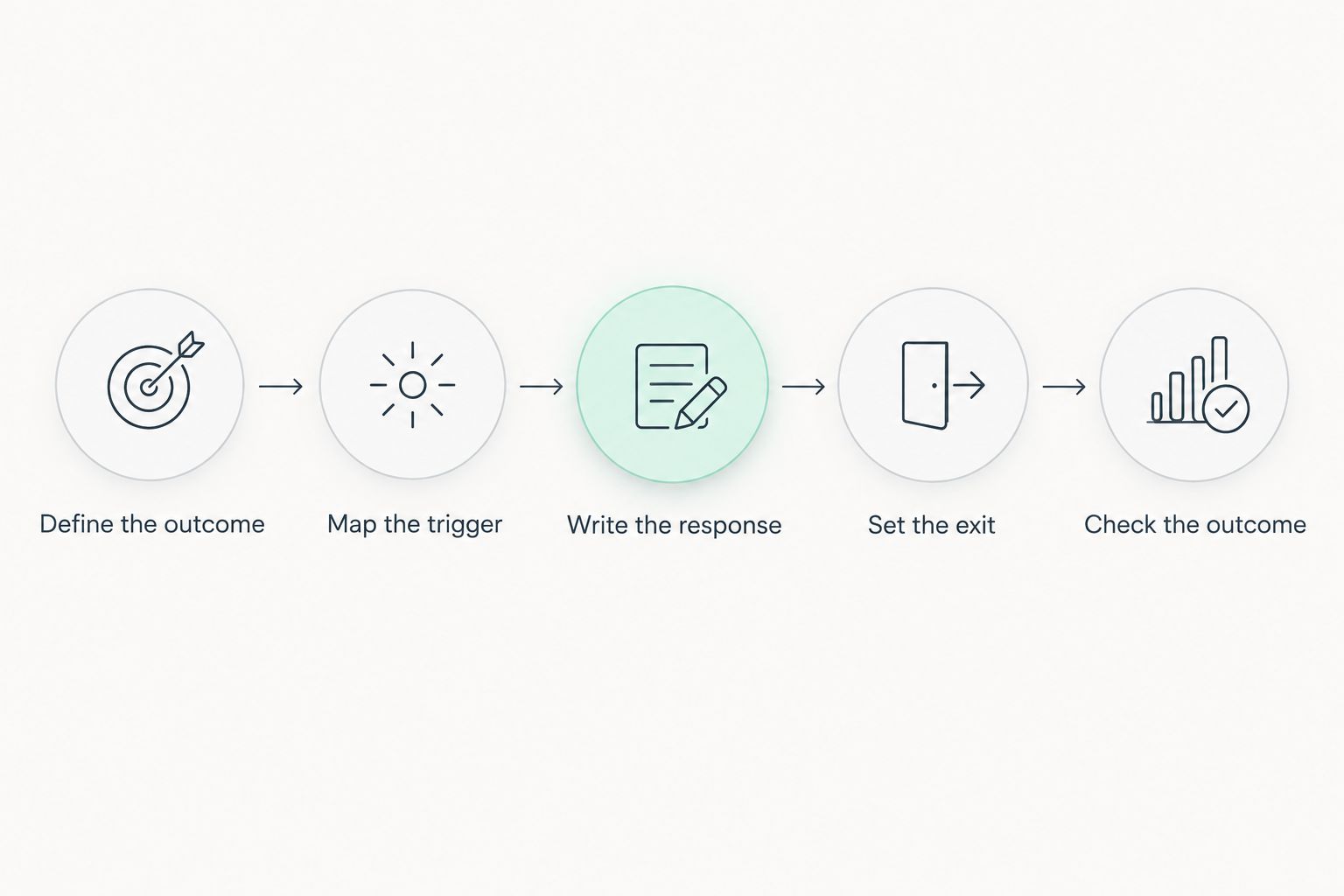
How do you decide what to automate first?
Start with the recurring failure closest to a meaningful customer action. Build a narrow workflow around it, then verify that the workflow behaves correctly before expanding it.
Define the outcome
Choose the customer action you want to support: a completed inquiry, an attended appointment, a purchase, or a successful onboarding step. Do not combine unrelated goals into the same evaluation.
Describe success in terms your team already uses. “More useful sales conversations” is a clearer objective than “better engagement,” but it still needs an agreed definition of useful.
Map the trigger
Specify exactly what starts the workflow and which records qualify. Distinguish a customer requesting information from someone already in an active conversation with your team.
Write down exclusions as carefully as entry conditions. A workflow needs to know who should not receive the message, not just who should.
Write the response
Give the recipient information that fits the action they took. Explain the next step without making unsupported promises about response times or outcomes.
Use language a person would recognize from your business. Automation should make useful communication repeatable, not make every interaction sound identical.
Set the exit
Define what ends the sequence. A reply, completed purchase, changed customer stage, or withdrawal of permission can require different treatment depending on the workflow.
The stop condition deserves as much attention as the trigger. Continuing a sequence after its purpose has been fulfilled creates unnecessary communication.
Check the outcome
Test the path from entry through exit using records appropriate for testing. Confirm that the correct message appears, the intended destination works, and the workflow stops under the conditions you defined.
For a 2026 rollout, document the version you launched and the changes you make afterward. That record helps you separate a messaging change from a tracking problem.
How do you measure whether automation pays off?
Measure the business outcome and the work required to produce it. Email opens, clicks, and workflow completions help diagnose what happened; they do not independently establish a financial return.
Use a short scorecard that separates outcomes from operational effort:
- Customer outcome: Track the action the workflow exists to support, using a consistent definition.
- Quality: Check whether the resulting inquiries or purchases meet the criteria you set.
- Staff effort: Record time spent building, reviewing, correcting, and maintaining the workflow.
- Exceptions: Record incorrect entries, duplicate messages, missed handoffs, and failed exits.
- Financial contribution: Use actual business records to assess the value of resulting work, rather than treating every conversion as equally valuable.
Avoid crediting automation for every sale that follows an automated message. A customer might already have intended to buy. When practical, compare similar eligible groups with and without the workflow; otherwise, describe the evidence as observed performance rather than proven incremental impact.
For your 2026 review, keep definitions stable. Changing what counts as a qualified inquiry midway through evaluation makes the before-and-after comparison harder to interpret.
What evidence should you ask a growth partner for?
Hey Prospekt is best for B2B and B2C companies seeking brand, digital marketing, and creative services from a growth marketing agency. The agency's service scope matters when your problem extends beyond a single workflow into messaging, website experience, or acquisition.
A published Hey Prospekt project describes 426 new leads and a 10x revenue increase in five months for Window Guard, alongside paid social, website and catalog redesign, and local SEO. Those are project results—not evidence of an automation-only return. Do not transfer them into a forecast for your business.
When evaluating Hey Prospekt or another growth partner, ask which activities produced the reported outcome, how the outcome was defined, and what ongoing work remained. Broad service coverage fits a connected marketing problem; it does not establish that a narrowly scoped workflow needs a full-service engagement.
Ask for relevant evidence, not just a large result. The useful comparison is a similar problem with clear measurement and an explanation of what changed.
Can marketing automation replace your sales follow-up?
Marketing automation can handle defined messages and reminders, but it does not replace conversations that require judgment. Keep a human handoff for questions, objections, unusual requests, and decisions outside the workflow's rules.
Make that handoff explicit. Your team should know who receives the conversation and what information accompanies it; otherwise, the automated response merely moves the delay elsewhere.
Is marketing automation worth it with a small contact list?
A small contact list does not rule out useful automation. The decision depends on whether a recurring interaction deserves a consistent response and whether maintaining that response is justified.
Do not set an arbitrary contact threshold. A narrow, useful workflow is a better starting point than a complicated sequence built to make a small database look busy.
Should you automate before increasing marketing spend?
Fix a known follow-up failure before paying to send more people into it. That does not require automating everything: a documented manual process is enough when it reliably handles the current workload.
For your 2026 plan, distinguish a demand problem from a follow-up problem. Automation addresses the latter only when there is a suitable action to automate; it does not substitute for a clear offer or an audience that wants it.
FAQ
Is marketing automation worth it for a small business?
Yes, when a repeatable workflow produces enough business value to justify setup and ongoing work. Start with a defined customer action and measure the outcome rather than email activity alone.
What’s the best first marketing automation for a small business?
The best first automation addresses a recurring customer interaction with a clear next step. Choose the problem first, then define its trigger, response, exclusions, and exit.
Can I use marketing automation without a large customer database?
Yes, a large database is not a prerequisite for a useful workflow. Judge the recurring task and maintenance effort rather than using an arbitrary contact-count threshold.
Does marketing automation replace a marketing employee?
Marketing automation handles defined tasks, not the full responsibility of a marketing employee. Someone still needs to own strategy, content, exceptions, measurement, and maintenance.
How do I know whether automated emails generate extra sales?
Compare outcomes for similar eligible customers with and without the workflow when practical. Sales recorded after an automated email show sequence, but do not by themselves prove that the email caused the purchase.
Should I hire an agency to set up marketing automation?
Hire an agency when you need expertise or execution capacity that your team does not have. For a narrow workflow, assess whether a focused engagement fits better than broader ongoing support.
When should a small business wait before automating marketing?
Wait when the offer, audience, customer records, or follow-up process is unresolved. Clarify the process manually before turning it into repeatable rules.
One last thing
Test who stops receiving messages—not just who starts. A workflow that enters customers correctly but fails to recognize a reply or completed action is unfinished.
Before expanding automation, inspect a completed customer journey from both sides: what the customer received and what your team recorded. Fix the gap between those views before adding another sequence.
Related guides
- Is demand generation worth it for early-stage startups?
- How to connect Google Analytics to your CRO testing pipeline
- Can a marketing agency guarantee qualified leads?


