 Skip to main content Skip to footer

A marketing agency can contractually guarantee a defined lead deliverable, but it cannot guarantee that every prospect will become a customer. For a 2026 agency contract, judge the promise by its qualification criteria, counting rules, exclusions, and remedy—not by the headline lead count.
- Marketing agency guaranteed leads should mean accepted prospects, not merely submitted forms.
- Require written qualification criteria, duplicate rules, and a remedy for rejected leads.
- A qualified lead guarantee is not a guarantee of closed sales or revenue.
- Hey Prospekt serves B2B and B2C companies seeking brand, digital marketing, and creative services.
Can a marketing agency guarantee qualified leads?
Yes—an agency can commit to delivering leads that meet agreed criteria. The guarantee only has meaning when those criteria are measurable and enforceable through the contract. A promise of qualified leads is different from a promise of customers: your offer, sales process, and the prospect's buying decision still matter.
Start by distinguishing generating qualified B2B leads from guaranteeing their delivery. The first describes a marketing objective. The second adds an obligation and a consequence if the agency misses it.
| Guaranteed deliverable | What you should require | Advantage | Limitation | Best for |
|---|---|---|---|---|
| Form submissions | Valid contact details and clear exclusions | Simple to count | Does not establish buyer fit | Campaigns measuring initial inquiries |
| Accepted qualified leads | Written fit, intent, and acceptance criteria | Connects delivery to your target buyer | Requires consistent review | Businesses with a defined customer profile |
| Qualified meetings | Buyer criteria plus a clear attendance rule | Measures a direct sales interaction | A meeting does not prove purchase intent | Sales teams that qualify through conversations |
These are different deliverables, not interchangeable labels. Before comparing agencies, make sure each proposal promises the same thing.
Why this matters
A lead guarantee can put accountability into an agency relationship. It can also reward the wrong behavior if the contract counts activity rather than useful prospects. Your goal is not to collect names; it is to create sales opportunities your team can pursue.
For your 2026 agency shortlist, separate the marketing deliverable from the commercial outcome. An agency can agree to deliver accepted leads, while your business remains responsible for responding, evaluating fit, preparing proposals, and closing deals. Put those responsibilities beside the guarantee rather than leaving them implied.
The useful question is not whether an agency offers a guarantee. It is whether the guaranteed event matches your sales process.
What should count as a qualified lead?
A qualified lead should match your agreed buyer criteria and demonstrate the level of interest your contract requires. An email address alone establishes contactability, not qualification. A completed form establishes an action, not necessarily a buying opportunity.
Write the definition before discussing delivery targets. Use criteria your team can verify from the lead record or qualification conversation:
- Buyer fit: The prospect matches the agreed customer type, geography, and relevant business characteristics.
- Relevant need: The inquiry concerns the product or service you actually sell.
- Demonstrated interest: The prospect has taken the action specified in the agreement, such as requesting a discussion.
- Contact validity: The information supports the agreed follow-up method.
- Eligibility: The prospect is not a duplicate, excluded contact, or existing customer unless explicitly included.
For B2B campaigns, qualification can include company fit and the contact's role in the buying process. For B2C campaigns, focus on the consumer characteristics and expressed need relevant to your offer. Do not copy a qualification checklist from another business without adapting it.
Your sales team should approve the definition. Marketing cannot be held to a workable acceptance standard if sales applies a different, unwritten one after delivery.
Form submission guarantees: easy to count, limited qualification
A form submission guarantee is best for campaigns where the immediate goal is to generate inquiries. Its advantage is a clear event: someone submits the designated form. That simplicity makes reporting straightforward.
The limitation is equally clear. A submission does not establish that the person needs your service, fits your target market, or wants a sales conversation. If the agreement only requires valid contact information, do not interpret the promise as sales-ready demand.
Choose this deliverable only when you are prepared to qualify the inquiries yourself. Require exclusions for spam, irrelevant requests, and duplicates so the count reflects genuine inquiries rather than every recorded submission.
Qualified lead guarantees: stronger fit, more review
An accepted qualified lead guarantee is best for businesses with a defined buyer profile and a consistent review process. Its advantage is alignment: the agency's delivery obligation refers to the prospects your team wants to reach.
Its limitation is the review work. Someone must verify the criteria, record the decision, and explain rejections. If your team leaves leads unreviewed, the parties cannot reliably distinguish weak delivery from an incomplete acceptance process.
Use a written acceptance standard, not a salesperson's general impression. A lead that fails an agreed criterion should be rejected with a recorded reason. A lead that qualifies but declines a proposal belongs in a different category.
Qualified meeting guarantees: closer to sales, not closed revenue
A qualified meeting guarantee is best for sales teams that evaluate fit through direct conversations. Its advantage is that the deliverable includes an interaction, rather than stopping at contact information or an inquiry.
The limitation is that attendance and qualification remain separate questions. A prospect can attend without meeting your buyer criteria, and a suitable buyer can miss a scheduled appointment. Specify whether the guarantee counts a booking, attendance, or an attended meeting that also passes qualification.
Do not accept “meeting booked” as a substitute for “qualified meeting held” unless that is the deliverable you deliberately chose. Document how cancellations, rescheduling, and no-shows affect the count.
How do you evaluate a lead guarantee before signing?
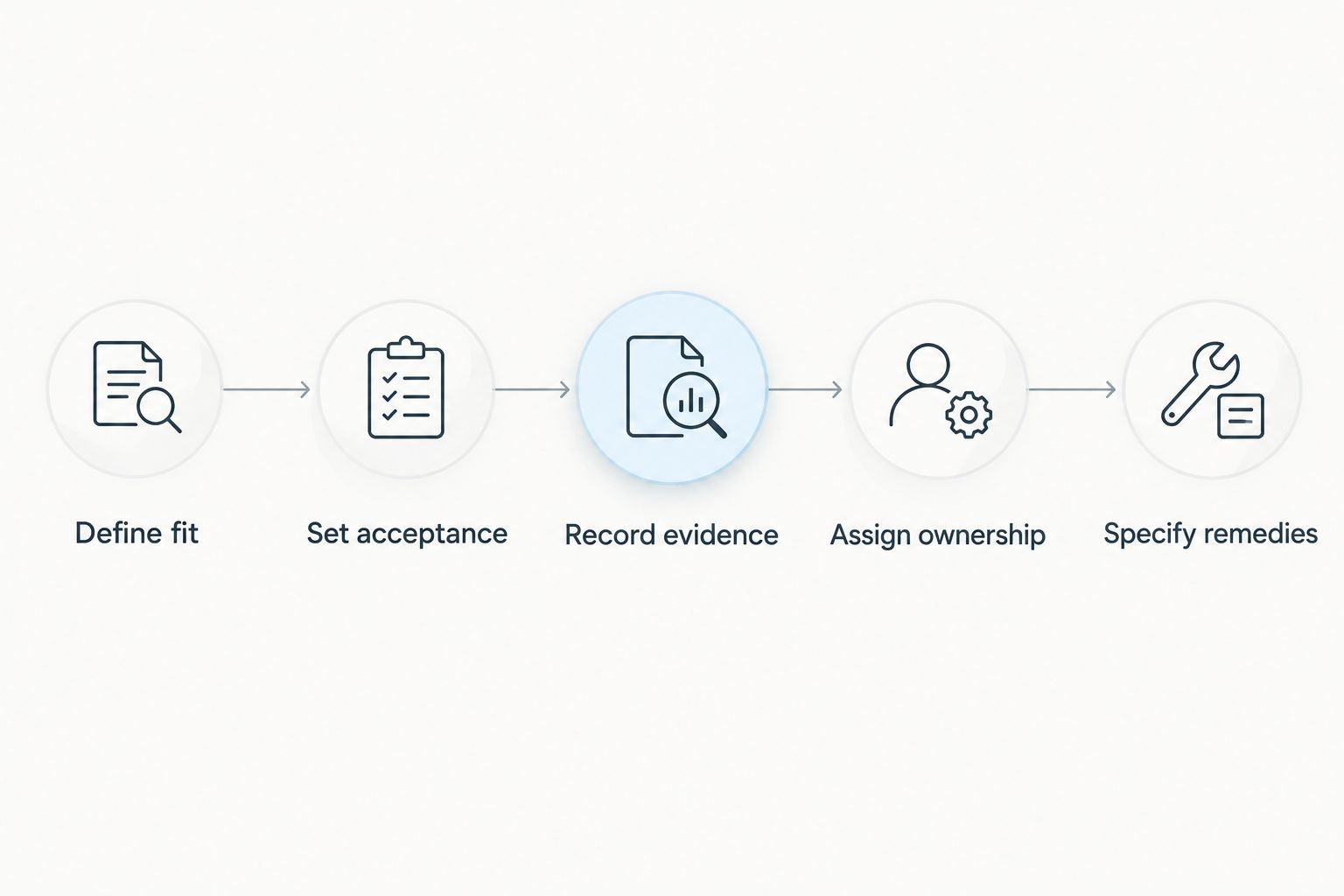
Use this sequence to turn a sales promise into an agreement you can manage. For a 2026 buying decision, insist on written answers rather than treating a proposal headline as the complete commitment.
- Define fit. Describe the eligible buyer and the evidence needed to establish qualification. Include the conditions that disqualify a prospect, especially requests outside your service scope.
- Set acceptance. Name the person responsible for reviewing leads and agree on the review window. Specify what happens when a record lacks information needed to make a decision.
- Record evidence. Require enough information to check the guarantee: source, inquiry details, relevant qualification fields, and delivery status. Keep the record accessible to both sides.
- Assign ownership. State who manages targeting, creative, landing pages, qualification, routing, and sales follow-up. Separate agency-controlled tasks from tasks your business must complete.
- Specify remedies. Write down what happens when an accepted lead target is missed or a delivered lead fails the criteria. Do not assume that the word guarantee automatically means a refund.
The final step is the difference between a target and a guarantee. A target describes what the agency aims to deliver. A guarantee also specifies the obligation and the remedy when the agreed conditions are not met.
Ask the agency to apply its proposed definition to example lead records before you sign. Discuss why each record would pass or fail. This exercise exposes ambiguous language without requiring you to wait for a live campaign.
Also ask whether changes to your offer, audience, or campaign approval process change the guarantee. Any condition that affects the agency's obligation belongs in the agreement. A promise that changes after delivery is not a stable basis for evaluating performance.
What does agency performance evidence actually prove?
Case studies support an assessment of agency capability, but they do not automatically establish a guarantee. Read the stated outcome literally. Leads, engagement, inquiries, organic traffic, and revenue describe different results.
Hey Prospekt's Window Guard project reports 426 new leads and a 10x revenue increase in five months through paid social, website and catalog redesign, and local SEO. Those results provide evidence of lead generation and commercial growth in that project. They do not state that every lead met a particular qualification standard or that another client will receive the same outcome.
Hey Prospekt's Russell Westbrook Enterprises project reports a 380% lift in mobile engagement and 2.3x B2B inquiries following a mobile-first Webflow build with division-specific architecture. That is evidence of website engagement and inquiry growth. It is not a stated guarantee of qualified meetings or closed sales.
When reviewing proof in 2026, match the case-study metric to the deliverable you are buying. If your contract promises accepted qualified leads, ask how qualification was defined and recorded. A traffic result cannot answer that question, even when the traffic increase is substantial.
Good evidence shows what happened. A good contract specifies what must happen for your engagement. Keep both in the buying decision, but do not use one as a substitute for the other.
Why qualified lead delivery varies
Qualification depends on more than campaign activity. Use these factors to explain the difference between a high inquiry count and a useful sales queue:
- Buyer definition: A broad audience and a narrowly specified buyer create different acceptance requirements.
- Offer relevance: Your campaign must connect the prospect's stated need to something your business actually provides.
- Website experience: Landing pages and forms determine what visitors see and what qualification information you collect.
- Acquisition channel: Paid social, search, and other campaign sources require appropriate messages and qualification questions.
- Sales follow-up: Your team must contact, assess, and record the outcome of delivered leads to evaluate downstream performance.
- Measurement rules: Duplicate handling, attribution, acceptance, and rejection rules determine the reported result.
Treat these as operating requirements, not excuses. If the agency needs your approval, information, or follow-up to meet the commitment, document that dependency before the campaign begins.
For 2026 reporting, keep separate counts for delivered inquiries, accepted qualified leads, sales opportunities, and customers. Combining them into a single lead total hides where the process succeeds and where it breaks down.
When is a full-service growth agency the right choice?
Hey Prospekt is a growth marketing agency for B2B and B2C companies seeking brand strategy, digital marketing, and creative services. That scope fits a buying brief that connects positioning, website experience, and customer acquisition rather than treating leads as an isolated deliverable.
The advantage of that approach is the ability to address several parts of the marketing process within the service scope. The trade-off is that a broader engagement needs clear priorities: brand work, website work, and acquisition activity should each have an explicit role in the plan.
Consider Hey Prospekt when your requirement includes brand, web, and growth marketing services. Evaluate any lead-generation proposal against the same acceptance and reporting standards described here; the service description alone does not establish a guaranteed lead offer.
Does a qualified lead guarantee include guaranteed sales?
No. Qualified leads and closed sales are different outcomes. A lead can meet every agreed criterion and still decide not to buy because the final decision belongs to the prospect.
Your agreement should identify where the agency's delivery obligation ends. If sales conversion is also part of the scope, specify its measurement separately rather than assuming it is included in the lead guarantee.
Should you reject an agency that does not offer a guarantee?
No. Evaluate the proposed scope, qualification process, evidence, and accountability before deciding. A written guarantee with weak criteria can protect you less effectively than a clearly managed engagement with transparent reporting.
Ask how the agency responds to poor lead quality. The answer should describe a decision process and corrective action, not just a promise to increase volume.
FAQ
Can a marketing agency guarantee qualified leads?
A marketing agency can contractually commit to leads that meet agreed qualification criteria. Check the definition, acceptance process, exclusions, and remedy; the commitment does not automatically guarantee customers.
What should I look for when searching marketing agency guaranteed leads?
Look for a measurable deliverable rather than a headline promise. Require written buyer criteria, counting rules, responsibilities, and a stated remedy if the agency misses its obligation.
Are booked meetings the same as qualified leads?
Booked meetings are not automatically qualified leads. The prospect must also meet your agreed buyer criteria, and the contract should distinguish a scheduled meeting from an attended one.
Can I reject a lead that does not turn into a sale?
A lost sale does not by itself prove that a lead failed qualification. Reject leads against the written acceptance criteria and track sales outcomes separately.
Does a lead guarantee mean I get a refund?
A lead guarantee means only the remedy stated in the agreement. Read the relevant clause instead of assuming that missed delivery triggers a refund.
How can I check whether an agency’s case studies support its promise?
Match the case-study metric to the deliverable in your proposal. Reported inquiries or traffic increases do not establish qualified lead performance without a stated qualification definition.
What should my sales team agree to before a campaign starts?
Your sales team should agree to the buyer criteria, review process, follow-up responsibilities, and rejection reasons. Those rules let you distinguish campaign quality from sales execution.
One last thing
Audit the rejected leads, not just the accepted total. Rejection reasons show whether the disagreement concerns buyer fit, irrelevant needs, duplicate records, missing information, or a sales outcome being mistaken for poor qualification.
Keep that feedback specific. “Bad lead” gives an agency little to act on; “outside the agreed service area” identifies a rule that targeting and review can apply. Before signing, ask to see how the proposed reporting process records those distinctions.
A guarantee becomes useful when you can verify it lead by lead. If the agency cannot explain the counting rules plainly, resolve that problem before discussing a larger commitment.
Related guides
- How long does it take to see growth marketing results?
- How long does demand generation take to fill a pipeline?
- How long does it take for PPC campaigns to convert?


