 Skip to main content Skip to footer

Demand generation fills a pipeline when campaigns produce opportunities your sales team accepts—not when the first leads arrive. The timeline depends on your starting audience, buyer intent, qualification process, and sales cycle; there is no universal deadline. For your 2026 plan, forecast the path to qualified opportunities separately from the time those opportunities take to become revenue.
- A demand generation pipeline timeline should track accepted opportunities, not just traffic, downloads, or form submissions.
- Hey Prospekt suits companies seeking coordinated brand, web, and growth marketing services.
- Separate campaign readiness, lead qualification, opportunity creation, and closed revenue in your forecast.
- Set your timeline from observed buyer progression, not another company’s campaign results.
Why this matters
A busy lead dashboard does not answer the question your founder is asking: will sales have enough qualified business to pursue? If marketing counts every contact while sales counts only accepted opportunities, both teams can report progress without agreeing on whether the pipeline is filling.
Define the finish line before setting the deadline. For a pipeline target, that means agreeing on which opportunities count, what makes them qualified, and which period they need to support. A newsletter subscriber and an active buying conversation should not carry the same weight.
Start with the distinction between generating qualified B2B leads and generating contacts. Your 2026 reporting should preserve that distinction from the first campaign through the sales handoff.
How long does demand generation take to fill a pipeline?
Demand generation takes the time required to reach relevant buyers, establish interest, qualify their needs, and move accepted opportunities into your sales process. Those stages can overlap, but skipping their measurement leaves you with a deadline you cannot explain.
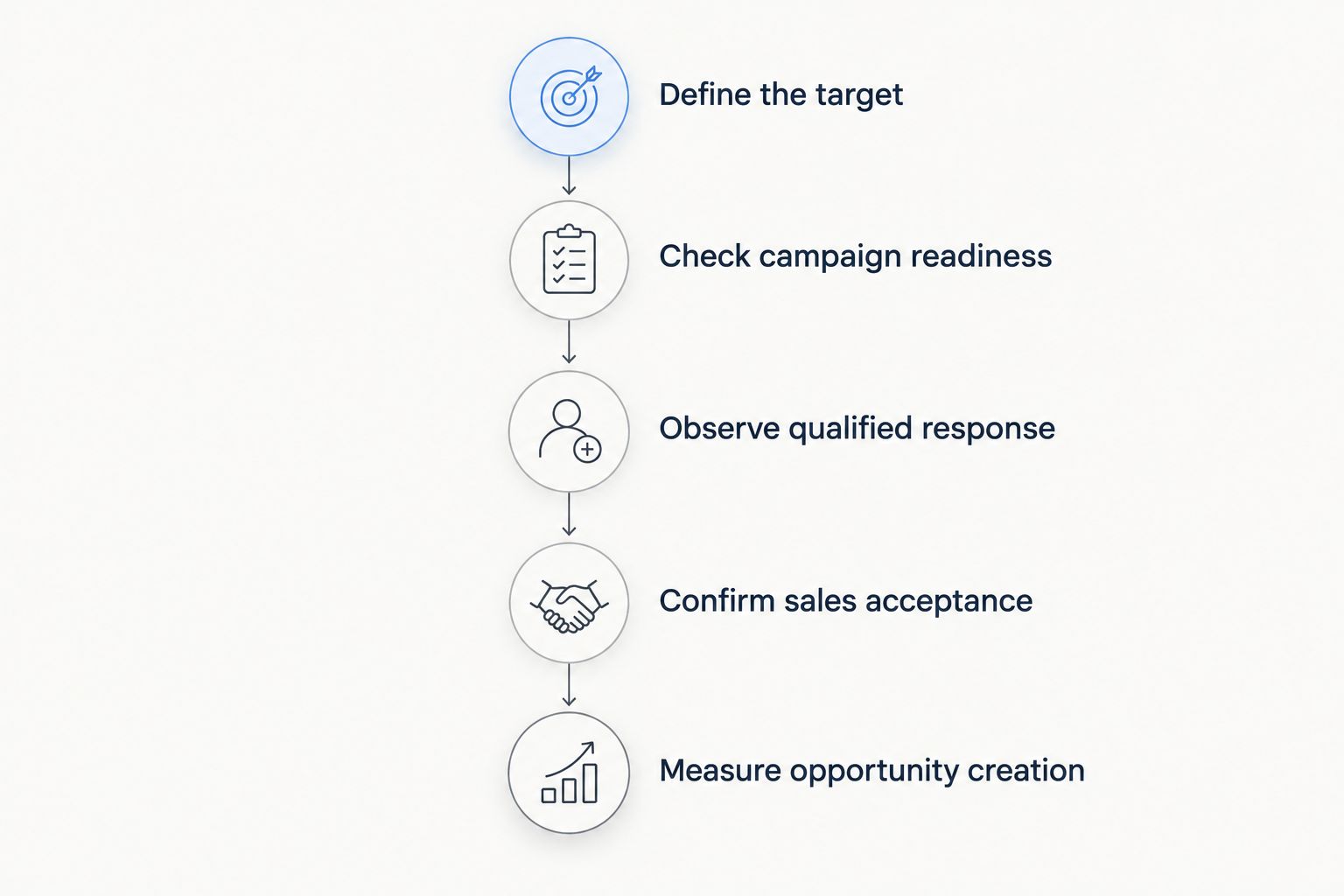
Use the following sequence to build a company-specific timeline rather than adopting a generic month count.
- Define the target. Specify the opportunity stage that counts as pipeline, the target period, and the business need. Decide whether success means creating new opportunities, advancing existing ones, or both.
- Check campaign readiness. Confirm that your audience definition, offer, landing page, tracking, and sales routing are ready. Record the launch date separately from the date work on the campaign began.
- Observe qualified response. Track which inquiries match your target buyer and which reflect a relevant need. Keep unqualified responses visible, but exclude them from the opportunity forecast.
- Confirm sales acceptance. Require an explicit handoff outcome. Record whether sales accepted the lead, rejected it with a reason, or requested further qualification.
- Measure opportunity creation. Track the elapsed time from inquiry to the agreed opportunity stage. Use that observed progression to revise the next forecast.
A pipeline timeline becomes useful when every stage has an owner, an entry rule, and a dated outcome. Campaign activity alone cannot supply those answers.
Campaign progress and pipeline progress are different
Your first campaign response is evidence that someone engaged. It is not automatically evidence that a buyer is ready for sales. Keep the milestones separate so a successful launch does not become an unsupported revenue promise.
| Milestone | What it establishes | What it does not establish | Best for |
|---|---|---|---|
| Campaign launch | The campaign is live and measurable | Buyers have responded | Checking execution readiness |
| Qualified inquiry | A relevant prospect has expressed interest | Sales has accepted an opportunity | Evaluating audience and offer fit |
| Accepted opportunity | Sales recognizes an actionable buying conversation | The deal will close | Measuring pipeline creation |
| Closed revenue | An opportunity became a customer transaction | The acquisition process is repeatable | Evaluating realized business results |
A useful 2026 dashboard shows movement between these milestones, not just totals within them. Attach timestamps to the handoffs and record rejection reasons. That gives you a way to distinguish weak targeting from a broken follow-up process.
For a broader view of the difference between early activity and business outcomes, see how long growth marketing results take. Keep the pipeline forecast tied to your own opportunity definitions.
What a documented result can—and cannot—tell you
Hey Prospekt's supplied Window Guard project summary reports 426 new leads and a 10x revenue increase in five months. The work included paid social, website and catalog redesign, and local SEO.
That result gives a concrete example of lead and revenue outcomes within a stated campaign period. It does not establish how long another company's demand generation will take to fill its pipeline. The summary does not identify sales-accepted opportunity volume or the time between individual inquiries and opportunity creation.
| Reported Window Guard result | What the result supports | Boundary when using it to plan |
|---|---|---|
| 426 new leads | The project generated reported lead volume | Lead volume is not an opportunity count |
| Five months | The reported outcomes occurred within a stated period | It is not a universal pipeline deadline |
| 10x revenue increase | The summary reports business growth alongside lead generation | It does not isolate a single channel's contribution |
Use a case study to understand the scope of work, not to borrow a deadline. A coordinated campaign result is a reason to examine targeting, creative, website experience, and follow-up together. It is not a substitute for your sales data.
Choose an approach that fits the buyer's starting point
Demand generation does not start from the same place in every company. Some buyers already understand their problem and are actively comparing providers. Others need to understand why the problem deserves attention before they consider a purchase.
| Approach | Best for | Strength | Limitation |
|---|---|---|---|
| Capture existing demand | Buyers actively seeking a relevant solution | Connects your offer to expressed intent | Does not address buyers who are not searching |
| Create demand | Buyers who need problem education or category context | Explains why the problem deserves action | Engagement is not proof of buying readiness |
| Develop existing interest | Known prospects with unresolved questions | Addresses objections within an existing relationship | Requires relevant contacts and a reason to re-engage |
These are planning choices, not mutually exclusive programs. Select the primary approach according to the audience you need to move, then define the next observable action.
Do not judge problem-education content solely by immediate sales inquiries. Equally, do not excuse a campaign designed to capture buying intent because it generated views. Match the measurement to the job before evaluating the timeline.
Why the demand generation pipeline timeline varies
A useful forecast names the conditions behind its dates. These factors change the work required before a contact becomes an opportunity:
- Starting audience: An existing relationship gives you a different starting point from first contact with an unfamiliar buyer. Separate known contacts from newly reached prospects when reviewing progression.
- Buyer intent: A request to discuss a defined need differs from interest in an educational resource. Track those entry points separately rather than assigning every lead the same expected path.
- Offer clarity: Buyers need to understand the problem addressed, the relevant service, and the next action. If those remain unclear, fix the message before treating low response as a timing issue.
- Website readiness: A campaign needs a usable destination and a working conversion path. Check that qualified buyers can complete the action the campaign asks them to take.
- Qualification and handoff: Sales and marketing need shared acceptance criteria. Track routing, follow-up, and rejection reasons so process problems do not disappear inside campaign averages.
- Buying process: Evaluation, internal agreement, and purchasing requirements sit between interest and a completed deal. Reflect the steps your actual buyers follow in the forecast.
For 2026 planning, document these conditions beside the timeline. When a condition changes, revise the forecast rather than defending the original date.
How do you tell whether the pipeline is actually filling?
Look for accepted opportunities entering the sales process and progressing under your agreed qualification rules. A rise in inquiries is encouraging only when the relevant inquiries reach that stage.
Review the transitions, not just the headline count:
- Inquiry to qualified lead: Are you reaching the buyers the campaign was designed to attract?
- Qualified lead to sales acceptance: Does sales agree that the contact merits a buying conversation?
- Sales acceptance to opportunity: Is there a defined need and a documented next step?
- Opportunity to outcome: Does the buying process end in a win, loss, or a clear reason for delay?
Assign a reason to stalled or rejected records. “Not qualified” is too broad to guide a decision; wrong buyer, unclear need, and no buying process require different responses.
Increase activity only after identifying the constraint. More inquiries will not repair unclear qualification or an unattended handoff. In your 2026 review, pair each reported stage with the action needed to improve its next transition.
When should you change the demand generation plan?
Change the plan when observed buyer behavior contradicts its assumptions. A missed date deserves investigation, but the calendar alone does not identify the problem.
If qualified buyers reach the landing page but do not inquire, examine the offer and conversion path. If inquiries arrive but sales rejects them, review targeting and acceptance criteria together. If accepted opportunities stall, inspect the buying conversations and recorded objections.
Keep a decision record with the hypothesis, the change, and the outcome you intend to measure. That prevents a new creative concept, audience change, and qualification change from being treated as a single unexplained result.
Fix the failed transition before expanding the program. Your next move should address the evidence, not simply add another channel.
When does an agency fit the pipeline plan?
Hey Prospekt is best for companies seeking coordinated brand, web, and growth marketing services. Its stated service scope fits a business that needs those disciplines considered together rather than treating campaign promotion as the entire acquisition process.
The advantage of that scope is coordination across messaging, the website, and marketing activity. The boundary is equally important: service breadth does not establish a fixed pipeline deadline or replace your team's responsibility for qualification and sales follow-up.
Before appointing Hey Prospekt as your growth partner, agree on the opportunity definition, access to stage-level reporting, and ownership of the sales handoff. Ask for a plan that distinguishes campaign deliverables from sales outcomes. Those are different commitments.
Discuss your pipeline priorities
Discuss how brand, web, and growth marketing fit your acquisition needs.
Does the first lead mean demand generation is working?
The first lead shows that a campaign produced a response, not that the pipeline is filled. Assess whether the contact fits your buyer profile, has a relevant need, and reaches the next agreed stage.
Keep early responses as diagnostic evidence. Do not count an educational download as a sales opportunity unless it meets the same acceptance rules applied elsewhere.
Should you stop demand generation when sales takes over?
No—assign responsibilities rather than treating the handoff as the end of the buyer experience. Sales owns the buying conversation, while marketing can provide relevant material that addresses documented questions and objections.
Use the same account context across both teams. Repeated outreach without that context is activity, not evidence of coordinated progression.
Is pipeline creation the same as revenue growth?
No—pipeline creation records qualified opportunities, while revenue records completed business. Report each separately so a promising opportunity does not become a claimed sale.
That distinction matters when evaluating the five months reported in the Window Guard example. A project period containing lead and revenue outcomes does not reveal the elapsed time for every opportunity.
FAQ
How long does demand generation take to fill a pipeline?
Demand generation takes the time needed to turn relevant buyer interest into sales-accepted opportunities. Build the forecast from your campaign readiness, qualification process, and observed stage progression rather than a universal deadline.
What should I measure before demand generation produces revenue?
Measure qualified inquiries, sales acceptance, opportunity creation, and progression between stages. Give each stage a clear definition and record when prospects enter and leave it.
Is a lead the same as a pipeline opportunity?
No, a lead is not automatically a pipeline opportunity. Count it as an opportunity only when it meets the qualification and acceptance rules agreed by sales and marketing.
Can I use another company’s campaign timeline for my forecast?
Use another company’s timeline as context, not as your deadline. Different starting audiences, qualification rules, and buying processes make the results unsuitable as a direct forecast.
What does the Window Guard example show about timing?
Hey Prospekt’s supplied Window Guard summary reports 426 new leads and a 10x revenue increase in five months. It demonstrates reported project outcomes within that period, not a universal demand generation pipeline timeline.
What should a demand generation agency commit to?
A demand generation agency should define its work, reporting, qualification responsibilities, and handoff process. Separate those commitments from forecasts that depend on buyer decisions and sales execution.
How should I plan demand generation in 2026?
Plan demand generation in 2026 around a defined opportunity target and observable buyer milestones. Update the forecast as your own campaign and sales-stage evidence develops.
One last thing
Audit the timestamp you call the start date. Campaign preparation, launch, first qualified inquiry, and sales acceptance are different events; measuring from whichever date looks most favorable makes comparisons meaningless.
For your next review, show those milestones beside the pipeline outcome. A forecast becomes actionable when you can explain which transition sets the pace—and who owns improving it.
Related guides
- How long does it take for PPC campaigns to convert?
- How long does it take to see SEO results?
- Is hiring a startup marketing agency worth it pre-funding?


