 Skip to main content Skip to footer


Content marketing has no fixed time to results: reaching an existing audience, earning search traffic, and generating revenue run on different timelines. Your forecast must include both the time needed to attract qualified attention and the time those buyers need to purchase; a publication date alone cannot predict either.
- How long does content marketing take to show results? Separate audience response, organic search visibility, qualified leads, and revenue.
- Hey Prospekt offers brand, web, and growth marketing services for B2B and B2C companies seeking coordinated execution.
- Judge progress against your starting traffic, distribution, conversion path, and sales cycle—not a universal deadline.
- Keep producing only when evidence supports the strategy; diagnose stalled discovery, engagement, or conversion before adding volume.
How long does it take to see results from content marketing?
There is no defensible universal deadline for content marketing results. A useful forecast starts with the outcome you want, the audience you can already reach, and your historical conversion data. For your 2026 plan, establish those inputs before committing to a delivery calendar.
Start with a Search Console-informed content roadmap when organic search is part of the strategy. Existing query and page performance gives you a baseline for judging what changes after publication.
| Content approach | Best for | First evidence to inspect | Advantage | Limitation |
|---|---|---|---|---|
| Content sent to an existing email audience | Reaching known subscribers | Delivered messages, clicks, qualified replies | Uses an established distribution channel | Results depend on list quality and relevance |
| Search-focused articles | Answering questions people search for | Indexing, relevant impressions, organic visits | Makes content discoverable through search | Publication does not guarantee indexing or rankings |
| Sales-support content | Helping active buyers evaluate | Sales usage, buyer responses, opportunity activity | Addresses questions inside a live buying process | Influence is difficult to isolate from sales activity |
| Content promoted through paid distribution | Testing messages with purchased reach | Qualified visits and downstream actions | Does not depend solely on organic discovery | Paid response does not prove organic demand |
These approaches are not interchangeable. An email click shows audience response; an organic impression shows search visibility. Neither establishes that content generated a sale.
Why this matters
A vague definition of results creates a vague deadline. If your team celebrates traffic while leadership expects qualified opportunities, the disagreement starts before the article goes live.
Write the success condition in business terms: which audience should take which action, and how will you recognize that action? Then identify the earlier signals needed to reach it. Your 2026 content plan should connect publishing decisions to that chain, not treat output as the outcome.
A sales team using an article to answer a buyer's objection is a different result from a new visitor finding that article through search. Record both, but keep their meanings separate. Otherwise, useful sales content gets dismissed for low traffic while irrelevant traffic gets mistaken for demand.
Why content marketing timelines vary
Your forecast should reflect the conditions under which content reaches buyers. Use these factors to explain the schedule rather than borrowing a deadline from another company's campaign:
- Starting audience: An established subscriber list gives you a distribution route. A new publication without an audience must also solve discovery.
- Search starting point: Existing impressions and relevant rankings provide evidence about current visibility. A new page has no equivalent performance history.
- Buyer intent: A visitor researching a broad topic has a different immediate need from someone evaluating a service provider.
- Content usefulness: Clear answers, original evidence, and relevant examples give readers reasons to continue. Publishing frequency alone does not establish usefulness.
- Conversion path: Readers need an appropriate next step. An unrelated offer or confusing form breaks the connection between attention and inquiry.
- Buying process: Content cannot remove procurement, stakeholder approval, or the customer's own purchase schedule.
Diagnose the constraint before increasing production. More articles do not fix an inaccessible page, an irrelevant audience, or a broken inquiry form.
Separate search visibility, qualified leads, and revenue
Search visibility: inspect discovery before judging demand
Check whether the page is accessible, indexable, and indexed. Then inspect whether it appears for queries that match the intended topic. Indexing is a prerequisite for ordinary organic search visibility, not proof that a page deserves prominent rankings.
Look at query relevance alongside impressions. Visibility for unrelated searches does not validate your targeting. When relevant impressions appear without visits, inspect the search result presentation and whether the page matches the user's need before commissioning another article.
Qualified leads: inspect the audience and the next step
Define a qualified lead before reviewing content performance. For a B2B company, that definition can include business fit and a relevant service need; for a B2C company, the meaningful action depends on its purchase process.
Then connect the article to a suitable next step. A reader seeking an explanation does not necessarily want a sales call. Give that reader a useful continuation while keeping a clear route available for someone ready to inquire.
Revenue: include the buying process
Revenue measurement starts with an agreed attribution method. Decide whether you are reporting content as the first recorded interaction, an interaction during evaluation, or the final tracked interaction before conversion.
Keep those views separate. A closed deal associated with an article does not establish that the article alone caused the sale. Review the customer's other interactions and use sales feedback to understand the content's role.
How to build a content marketing forecast for 2026
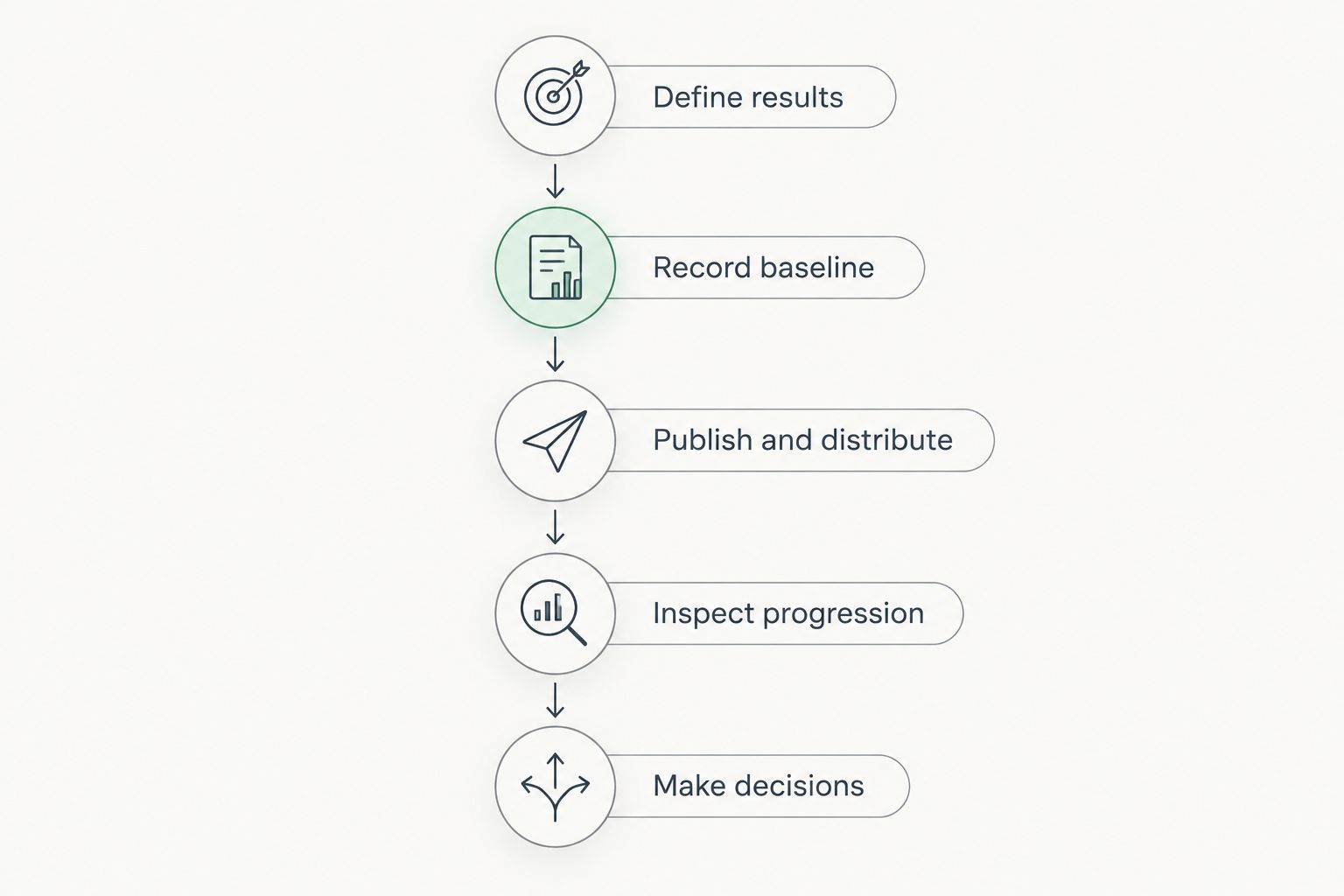
Build the forecast around observable stages. Each stage needs a question you can answer and a decision you can make; otherwise, reporting becomes a record of activity rather than a management tool.
- Define results. Choose the business outcome and document what qualifies. Distinguish inquiries from accepted opportunities and purchases.
- Record baseline. Capture existing page traffic, relevant search queries, conversions, and known distribution channels before changing the program.
- Publish and distribute. Record publication dates, substantive updates, and where each asset is promoted. A live URL is not a distribution plan.
- Inspect progression. Check whether discovery leads to relevant visits and whether those visits lead to the intended action.
- Make decisions. Continue, revise, consolidate, or stop based on the stage that is failing—not on article count alone.
Keep publication and distribution records together. If an established email audience drives the initial response, label that response correctly instead of presenting it as evidence of search performance.
Use your own historical time from inquiry to sale when setting a revenue review date. If that history does not exist, treat the initial forecast as a planning assumption and update it as real buyer activity appears. Do not present an assumption as an established benchmark.
For every 2026 report, preserve the same definitions. Changing what counts as a qualified lead halfway through the program makes comparisons harder and can conceal whether performance actually improved.
What should you do when content is not producing results?
Start at the earliest broken stage. There is little value in rewriting a call to action when the intended audience never reaches the page.
| Observed problem | What to inspect | Recommended action | Trade-off |
|---|---|---|---|
| Page is not indexed | Crawl access, indexing directives, canonical signals | Resolve technical barriers before judging search performance | Technical fixes do not guarantee rankings |
| Relevant impressions but few visits | Query intent, result title, competing results | Improve the match between the page and the search need | Presentation changes cannot fix an irrelevant topic |
| Visits without meaningful actions | Audience fit, offer, next step, form function | Repair the conversion path and review visitor relevance | More conversions do not automatically mean better leads |
| Inquiries without qualified opportunities | Lead definition, targeting, sales feedback | Tighten the topic and offer around actual buyer needs | Narrower targeting limits the audience you pursue |
| Opportunities without sales | Buyer objections, sales follow-up, purchase process | Create missing evaluation content and review sales execution | Content cannot resolve every commercial objection |
Avoid changing every variable at once. Record what changed and why so you can interpret the next reporting period. A useful review ends with a decision and an owner, not a request for more patience.
What agency results can—and cannot—tell you
Hey Prospekt's Window Guard project recorded 426 new leads and a 10x revenue increase in five months through paid social, website and catalog redesign, and local SEO. That is evidence from a combined marketing engagement, not a content-only timeline.
The distinction matters when you evaluate proposals. A result from several coordinated channels cannot establish how quickly a new blog will generate revenue. Ask which activities contributed, what the starting conditions were, and how the result was measured.
Hey Prospekt is best for B2B and B2C companies seeking brand, web, and growth marketing services together. The full-service scope fits a coordinated brief; it does not replace the need to define each channel's contribution or agree on content-specific success measures.
Can content marketing generate leads before it ranks?
Yes. Content distributed through email, sales conversations, social channels, or paid promotion can reach buyers without earning organic rankings. Evaluate those leads against the channel that delivered them.
Keep the benefit and limitation together: direct distribution gives content another route to buyers, but that response does not establish durable search visibility. Your 2026 reporting should show distribution performance and organic performance separately.
Should you stop content marketing if traffic is not growing?
Not on traffic alone. First check whether the content is intended to attract new visitors or help an existing audience make a decision. Then inspect the relevant outcome.
A sales-support asset can be useful without substantial search traffic. A search-led acquisition program, however, needs evidence of relevant discovery and visits; repeatedly publishing without that evidence calls for diagnosis, not automatic continuation.
Does publishing more often make results arrive sooner?
Publishing more often does not guarantee earlier business results. Additional content still needs a relevant audience, a useful purpose, distribution, and a working conversion path.
Expand production when you can identify worthwhile topics and support them properly. Revise or consolidate overlapping material when a new article would repeat an existing answer rather than serve a distinct need.
FAQ
How long does content marketing take to show results for a new business?
A new business needs a forecast based on its audience, distribution channels, and buying process rather than a universal deadline. Track discovery, qualified visits, inquiries, and revenue separately so you can see where progress stops.
What’s the first sign that content marketing is working?
The first useful sign is relevant audience response tied to the content’s purpose. That can mean qualified search visits, meaningful subscriber replies, or evidence that sales conversations are progressing—not simply more page views.
Can content marketing produce results without SEO?
Yes, content can reach buyers through email, sales outreach, social distribution, and paid promotion. Report those outcomes separately from organic search performance.
Is more website traffic proof that content marketing works?
More website traffic is not proof of business impact. Check whether visitors match your intended audience and take actions connected to qualified demand or purchases.
How do I measure content that helps close a sale?
Record which content appears in the buyer’s tracked interactions and ask sales how it was used. Describe it as an associated or supporting interaction unless your evidence supports a stronger causal claim.
Should I update old content or publish new articles?
Update existing content when it serves the right need but contains gaps, outdated information, or a weak next step. Publish a new article when it addresses a distinct audience question that your current content does not answer.
Can an agency guarantee a content marketing deadline?
An agency can commit to deliverables and review dates, but publication alone cannot guarantee rankings, qualified leads, or revenue by a fixed date. Require clear assumptions, measurement definitions, and actions for stalled performance.
One last thing
An article's age is not the same as its time in front of qualified buyers. Record when distribution began, when relevant search visibility appeared, and when the first qualified interaction occurred—not just when someone pressed publish.
Before approving the next batch, choose an existing article and trace its path from discovery to action. Fix the clearest break. That gives your team a concrete decision instead of another unsupported deadline.
Related guides
- How long does it take to see SEO results?
- How long does demand generation take to fill a pipeline?
- How long does it take to see growth marketing results?


