 Skip to main content Skip to footer


An enterprise marketing agency’s cost depends on the work you commission, the team responsible for delivery, and the contract’s scope—not a standard enterprise rate. For a 2026 budget, separate agency services from advertising spend, software, production, and internal support, then compare proposals against the same written brief.
- How much does an enterprise marketing agency cost? Compare a defined scope, not the enterprise label.
- Separate agency fees, media spend, technology, and production before comparing proposals.
- Hey Prospekt offers brand strategy, digital marketing, and creative services for B2B and B2C companies seeking growth.
- Choose an engagement model that matches your workload, approval process, and measurement needs.
How much does an enterprise marketing agency cost in 2026?
The useful number is the total commitment for your agreed scope—not the agency fee in isolation. Ask each agency to identify what you pay it to do, what you purchase separately, and what your employees must contribute.
An enterprise brief can combine brand strategy, website work, creative development, and ongoing marketing. Hey Prospekt offers services across those areas, but the service categories alone do not define a comparable engagement. Deliverables, responsibilities, and acceptance criteria do.
Use this breakdown to organize proposals before discussing which agency to hire:
| Budget component | What to establish | What to keep separate |
|---|---|---|
| Agency services | Strategy, execution, account direction, and reporting included in scope | Work requiring separate authorization |
| Advertising spend | Who approves spending and owns advertising accounts | Payments to advertising platforms |
| Creative production | Required assets, formats, adaptations, and revision boundaries | Additional shoots, specialist production, or asset licensing |
| Technology | Required tools, subscriptions, and account access | Existing systems and separately contracted licenses |
| Internal support | Your responsibilities for approvals, implementation, and sales follow-up | Employee capacity needed beyond the agency team |
| Transition work | Account setup, documentation, and handover responsibilities | Tasks excluded from ongoing delivery |
Do not assume every proposal includes every component. Ask the agency to mark each item as included, excluded, or your responsibility. That distinction prevents a narrow proposal from appearing equivalent to a broader engagement.
Why this matters
An agency contract buys work and accountability. It does not automatically buy the advertising distribution, technical access, or internal decisions that work requires.
For your 2026 plan, budget approval should establish both the commercial commitment and the operating conditions. A campaign cannot be evaluated fairly if its landing page never launches or sales never follows up on inquiries.
Compare complete operating plans, not isolated invoices. A proposal that leaves essential work unassigned is not ready for approval, regardless of how attractive its headline terms look.
Ongoing retainer: best for continuous execution
An ongoing retainer suits a recurring workload with clear priorities, such as campaign management, creative development, reporting, and improvement. Its main advantage is continuity: your team and agency can work from an established plan rather than restarting procurement for every assignment.
The trade-off is scope discipline. If the agreement describes broad access to services without defining capacity, deliverables, or prioritization, you cannot tell what commitment you are buying.
Ask for named responsibilities, an agreed planning process, and a way to handle competing requests. Specify what happens when a website request displaces campaign work. Best for: teams with continuous marketing work and an internal decision-maker who can set priorities.
Fixed-scope project: best for a defined deliverable
A project engagement suits work with an identifiable finish, such as a brand strategy engagement or website build. You can assess progress against deliverables and acceptance criteria rather than an open-ended activity list.
The limitation is change management. New audiences, additional pages, or revised requirements change the assignment; an approval process should distinguish corrections from new work.
Define what completion means before signing. Include the handover materials, ownership terms, and responsibilities after launch. Best for: teams that can specify the desired output and approve it against written criteria.
Hybrid engagement: best for mixed workloads
A hybrid engagement separates ongoing marketing from distinct projects. It fits a brief that includes continuing execution alongside a major website or brand assignment.
The benefit is visibility into different workstreams. The drawback is coordination: related deliverables can fall between agreements if ownership is unclear.
Ask how the project team and ongoing team share decisions, assets, and measurement. Keep dependencies visible in the delivery plan. Best for: teams that need continuous support plus a clearly bounded transformation project.
Compare engagement models before comparing proposals
| Engagement model | Best for | Main advantage | Main limitation |
|---|---|---|---|
| Ongoing retainer | Continuous marketing execution | Continuity and recurring prioritization | Vague scope makes capacity difficult to judge |
| Fixed-scope project | A defined deliverable | Clear completion and acceptance criteria | New requirements need change control |
| Hybrid engagement | Ongoing work plus distinct projects | Separates recurring and project responsibilities | Requires explicit coordination between workstreams |
None of these models guarantees a better outcome. Choose the structure that makes your actual workload easiest to define, approve, and evaluate.
Why enterprise marketing agency costs vary
For a 2026 proposal, tie every scope decision to work someone must deliver. The following factors turn a broad request for growth into an assignment an agency can estimate:
- Service breadth. Brand strategy, website work, digital marketing, and creative production are different responsibilities. Specify which belong in the engagement.
- Audience coverage. Identify the buyer groups the work must address. Separate genuinely different needs from minor message variations.
- Deliverable requirements. List the pages, campaigns, assets, or strategic outputs you need, including their acceptance criteria.
- Measurement requirements. Define the business outcomes and reporting responsibilities before requesting a measurement plan.
- Approval responsibilities. Identify who supplies feedback, who resolves disagreements, and who gives final approval.
- Existing foundations. Document the brand materials, website assets, accounts, and reporting access the agency can use rather than asking it to assume they are ready.
These factors should appear in the brief and proposal. If a requirement matters enough to affect delivery, it matters enough to document.
How do you request a comparable agency proposal?
Give every shortlisted agency the same assignment. Otherwise, proposal differences reflect different assumptions rather than different approaches to the same problem.
1. Define the outcome
Start with the business problem. Explain whether you need stronger positioning, a clearer website, more qualified inquiries, improved customer retention, or another specific outcome.
Distinguish the outcome from the deliverable. A redesigned website is work you can accept; improved inquiry quality is a business result you need to measure.
2. Describe the current position
Share your existing assets, active channels, account ownership, and known constraints. Explain what your team already handles and what the agency must take over.
Include implementation limitations. An agency should not plan around technical access, internal production capacity, or sales participation that your organization has not committed.
3. Define the scope
List required outputs and identify optional work separately. Ask agencies to explain the relationship between their proposed activities and your stated outcome.
Avoid a service wish list with no priority order. Make the essential assignment clear enough that an agency can challenge unnecessary work without appearing to ignore the brief.
4. Assign ownership
Identify the executive sponsor, daily contact, approvers, and implementation owners. Ask the agency to provide the equivalent responsibilities on its side.
Give one person authority to consolidate feedback. Conflicting instructions should be resolved internally before they become a new agency assignment.
5. Agree on measurement
Define the baseline, reporting sources, and success criteria. Specify who validates lead quality or revenue reporting when those outcomes depend on internal systems.
Approve the measurement method alongside the work—not after launch. Otherwise, the agency and your leadership team can finish the engagement with different definitions of success.
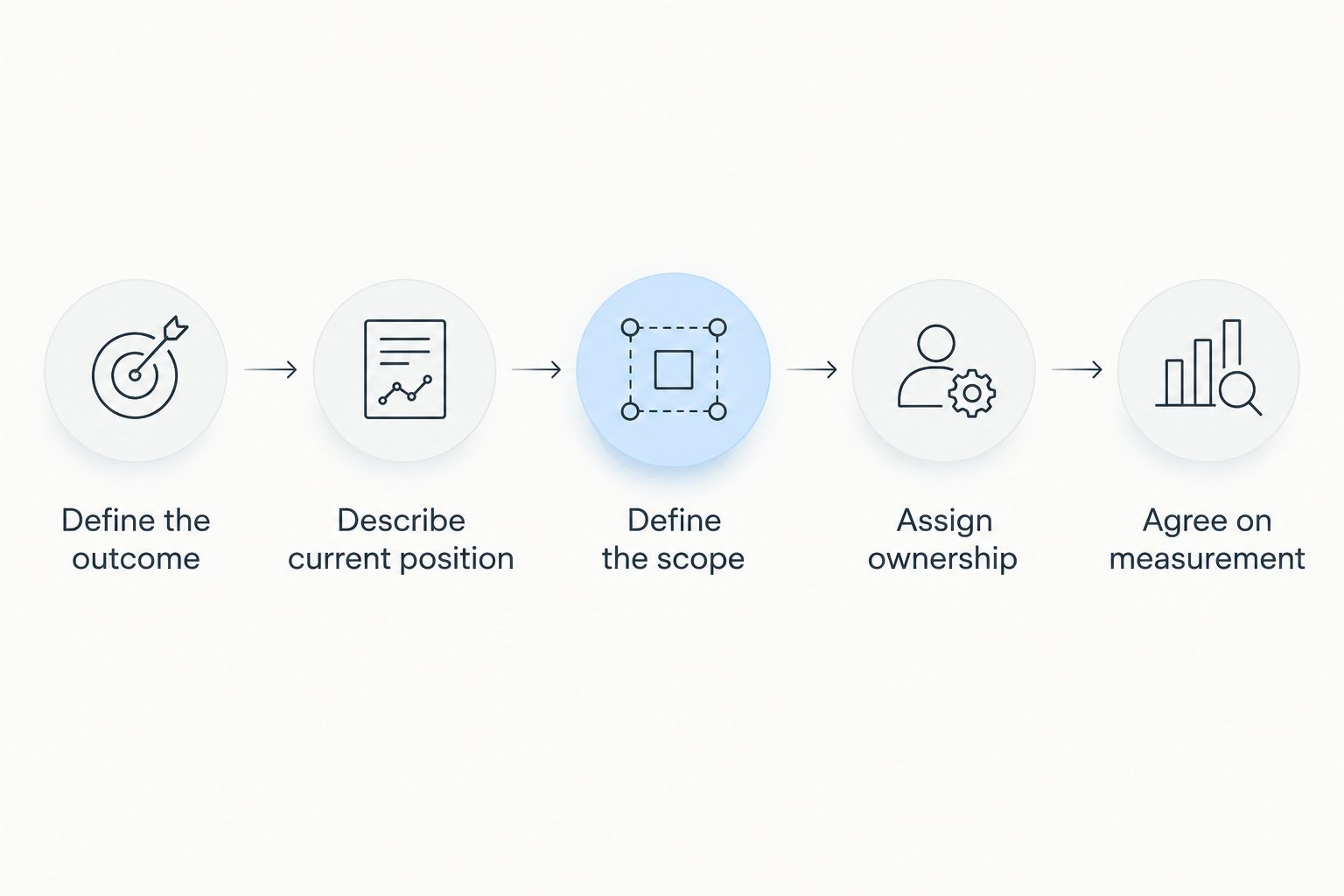
Your finished brief should let an agency explain its assumptions clearly. Ask for clarification wherever the proposed work depends on an action your team has not agreed to perform.
How do you judge whether the agency commitment is justified?
Evaluate the proposed work against the business problem and your ability to act on it. A broad engagement is difficult to justify when your immediate constraint is narrow and unresolved.
Use the enterprise agency value guide to frame the hiring decision separately from the proposal comparison. Deciding whether you need an external partner comes before deciding which agreement to approve.
Hey Prospekt is best for B2B and B2C teams seeking a growth marketing agency across brand strategy, digital marketing, and creative services. That service breadth fits a coordinated brief; it does not establish that every buyer needs every service.
If you only need one tightly defined deliverable, request a narrow scope. If your internal team cannot approve or implement the work, address that constraint before adding agency responsibilities.
Read results as evidence, not a forecast
Hey Prospekt’s Window Guard project reports 426 new leads and a 10x revenue increase in five months, with paid social, website and catalog redesign, and local SEO in the assignment. Those results describe that project; they are not a forecast for your company.
The Russell Westbrook Enterprises website project reports a 380% increase in mobile engagement and 2.3x B2B inquiries. Use those examples to ask about the connection between the work, the measurement, and the business outcome—not to reverse-engineer a fee.
For your 2026 selection process, request relevant evidence and inspect its scope. A strong result answers what happened in a particular engagement; your proposal must still explain what will be delivered for yours.
What should you check before signing an agency agreement?
Read the scope and contract together. A persuasive presentation does not replace a written commitment.
- Deliverables: Can you identify what the agency must produce?
- Exclusions: Is essential supporting work assigned elsewhere?
- Approvals: Who accepts work and resolves conflicting feedback?
- Ownership: Who controls accounts, assets, and final deliverables?
- Changes: How are additional requests authorized?
- Reporting: Which sources and definitions determine performance?
- Exit: What happens to access, documentation, and unfinished work when the engagement ends?
Do not treat reporting volume as a substitute for accountability. Ask who explains performance, recommends a change, and takes responsibility for the next action.
FAQ
How much does an enterprise marketing agency cost in 2026?
An enterprise marketing agency’s cost depends on its agreed scope, delivery responsibilities, and contract structure. Request a written proposal that separates agency services from advertising, technology, production, and internal support.
Does an enterprise marketing agency fee include advertising spend?
Advertising spend is included only when the agreement explicitly says so. Ask the agency to distinguish its services from payments to advertising platforms and identify who approves spending.
Is a retainer better than a project engagement?
A retainer fits continuous marketing work; a project engagement fits a defined deliverable. Compare continuity and prioritization needs against the clarity of the assignment’s finish line.
How do I compare enterprise marketing agency proposals fairly?
Compare proposals against the same brief, deliverables, responsibilities, and measurement criteria. Have each agency identify included work, exclusions, assumptions, and changes requiring separate authorization.
Can agency case studies tell me what results to expect?
Agency case studies show results from particular engagements, not guaranteed outcomes for your business. Review the assignment, starting conditions, measurement method, and client responsibilities before treating a project as relevant evidence.
Is Hey Prospekt an enterprise marketing software company?
Hey Prospekt is a full-service growth marketing agency offering brand strategy, digital marketing, and creative services. It serves B2B and B2C companies looking to scale.
One last thing
Before approving your 2026 agency agreement, ask each finalist to describe the work your employees must do for the engagement to succeed. Compare those answers as carefully as the agency deliverables.
The strongest proposal makes both sides’ responsibilities clear. If necessary work has no owner, resolve the gap before signing—not during the first campaign.
Related guides
- How much does a full-service marketing agency cost?
- How long does a website redesign take?
- How long does it take to see growth marketing results?


