 Skip to main content Skip to footer


An email marketing campaign shows positive ROI when the profit it generates exceeds the full cost of running it—not when the first opens, clicks, or orders appear. There is no universal number of days: your buying cycle, audience readiness, campaign costs, and measurement method determine the timeline. For your 2026 plan, separate early engagement, attributed revenue, and proven incremental profit before deciding whether email is paying back.
- How long does an email marketing campaign take to show ROI? Until incremental profit exceeds the full campaign investment.
- Email marketing ROI requires profit measurement; opens, clicks, and attributed revenue do not establish payback.
- Hey Prospekt serves B2B and B2C companies seeking a growth marketing partner across brand, digital, and creative services.
- Set your evaluation window around the buying cycle, then compare equally mature customer groups.
How long does an email marketing campaign take to show ROI?
Email marketing reaches positive ROI when incremental profit exceeds campaign costs. A campaign can produce an order before it recovers its investment, and an email platform can attribute revenue without proving that email caused the purchase.
Use these milestones to distinguish progress from payback:
| Milestone | What it establishes | What it does not establish |
|---|---|---|
| Delivery and engagement | Messages reach recipients and generate observable responses | Revenue or profitability |
| Attributed conversion | A reporting system connects an order or lead to email | Whether the conversion would have happened anyway |
| Closed revenue | An order or completed sale produces revenue | Profit after fulfillment and campaign costs |
| Positive incremental ROI | Additional profit exceeds the email investment | That the same result will repeat across audiences |
The correct evaluation window follows the purchase decision you are trying to influence. A campaign designed to generate sales conversations needs a different review process from one asking existing customers to reorder.
For context across channels, see how long growth marketing results take. Keep the email decision tied to its own economics rather than borrowing another channel's deadline.
Why this matters
Judging email too early risks cutting a campaign before its sales opportunities close. Judging it only by attributed revenue risks funding activity that captures credit without creating enough additional profit.
Your 2026 reporting should answer separate questions: Is the campaign functioning? Are recipients taking commercially useful actions? Has the resulting profit covered the investment? Do not make one metric answer all three.
Why the time to email ROI varies
These factors determine what must happen before you can make a credible profitability decision:
- Audience readiness. Previous customers, active prospects, and unfamiliar subscribers enter with different purchase histories and levels of intent. Evaluate them separately.
- Buying cycle. A completed purchase and a request for a sales conversation sit at different points in the revenue process. Lead-generation reporting must follow opportunities through to closed business.
- Starting condition. Authentication, permission records, tracking, and usable customer data affect whether you can launch and evaluate the campaign properly.
- Campaign economics. Creative, management, software, and implementation all belong in the investment calculation. Revenue must cover more than the act of sending.
- Conversion volume. Sparse results make it harder to distinguish a useful pattern from an isolated order. Avoid treating a small number of outcomes as a stable forecast.
- Measurement design. Attribution settings and the treatment of repeat purchases change what a report credits to email. Incrementality requires a comparison that addresses what would happen without the campaign.
These are planning inputs, not excuses for an open-ended engagement. Ask whoever owns email to identify the current constraint, the next observable milestone, and the decision that follows.
Which campaign should you evaluate first?
Choose the campaign that matches your business problem and available customer data. Do not choose solely because a campaign type sounds fast.
| Campaign approach | Best for | Useful evidence | Main limitation |
|---|---|---|---|
| Promotional email | An opted-in audience with a relevant purchase opportunity | Completed purchases and contribution after campaign costs | Attributed orders can include purchases that would happen anyway |
| Abandoned-checkout follow-up | Shoppers who started but did not complete checkout | Completed orders compared with an appropriate unmessaged group | Recovering a checkout does not automatically prove incremental profit |
| Welcome sequence | New subscribers who need a clear next step | Progression toward purchase or a qualified sales conversation | Subscriber interest is not the same as purchase readiness |
| B2B nurture | Prospects who need education and sales follow-up | Qualified opportunities, closed business, and contribution | Open opportunities are not realized ROI |
| Repeat-purchase email | Existing customers with a relevant reason to buy again | Additional purchases and contribution by customer group | Existing buying behavior can inflate attributed results |
Evaluate each campaign against its intended commercial outcome. A nurture sequence should not fail because it lacks immediate checkout revenue, but it should not receive credit for profit while its opportunities remain open.
For retention activity, watch whether email changes purchasing behavior rather than merely appearing before purchases. For acquisition activity, include the relevant acquisition investment when evaluating the combined program.
How do you build a defensible ROI timeline?
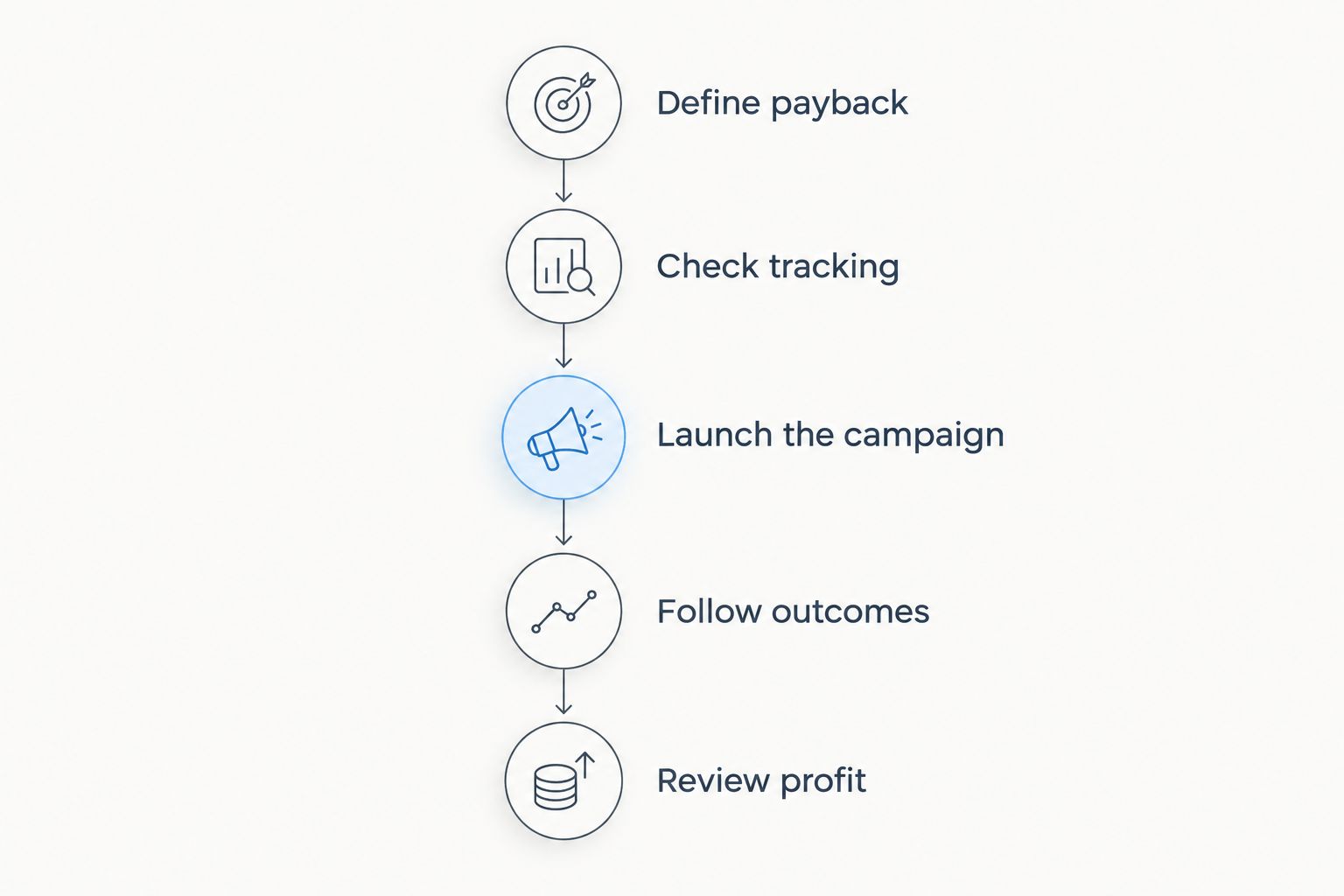
Start with measurement, then work through the buying journey. A deadline without these steps is a calendar promise, not a business case.
Define payback
Write down the outcome that counts: a completed order, a closed contract, or another realized revenue event. Then define the costs and margin treatment used to calculate profitability.
A useful formula is:
Email ROI = (incremental contribution before email costs − email campaign costs) ÷ email campaign costs.
Express the result as a percentage when reporting. Keep the cost definitions consistent so the same expense is not subtracted twice.
Check tracking
Confirm that campaign identifiers survive the path from message to landing page to transaction or customer record. Complete a test conversion and inspect the resulting records rather than assuming the reporting connection works.
For lead generation, carry the source information into the sales process. A form submission is not enough if you cannot connect it to the eventual outcome.
Launch the campaign
Choose a defined audience, a specific action, and a clear destination. Record the launch conditions so you can interpret results without reconstructing the campaign later.
Check permission and suppression rules before sending. A larger audience is not a substitute for an appropriate audience.
Follow outcomes
Track recipients through the full decision path. For sales-led businesses, record whether opportunities advance, close, or stall; for transactional businesses, account for cancellations and returns in the financial result.
Match your review window to the outcome. Do not compare a newly contacted group with an older group that has already had time to purchase.
Review profit
Reconcile the revenue records with the campaign investment and contribution calculation. Where practical, use a properly designed holdout to assess the difference between messaged and unmessaged groups.
If you cannot establish incremental impact, label the result as attributed performance. That distinction keeps a useful directional report from becoming an unsupported profitability claim.
Your 2026 evaluation plan should name the owner of each step. Tracking failures, incomplete sales records, and undefined costs require different fixes; grouping them under weak email performance hides the actual problem.
What should you measure before ROI is visible?
Use leading indicators to diagnose the campaign, not to declare victory. Each indicator should point to a specific inspection or decision.
- Delivery problems: Check authentication, list quality, sending configuration, and rejection information before rewriting the offer.
- Clicks without conversions: Inspect the destination, message match, form or checkout experience, and tracking continuity.
- Leads without opportunities: Review targeting, qualification criteria, and the handoff to sales.
- Opportunities without closed business: Examine sales progression and loss reasons before blaming the email subject line.
- Revenue without profit: Reconcile contribution and total campaign investment before increasing activity.
An engagement improvement is useful when it helps explain a commercial result. It is not a financial return by itself.
Avoid treating opens as definitive evidence that a person read or considered the message. Email privacy features and automated activity complicate that interpretation; downstream actions provide a stronger basis for business decisions.
When should you change or stop the campaign?
Change the campaign when the evidence identifies a failing step, not simply because an arbitrary deadline arrives. Fix broken measurement immediately. Evaluate the offer and audience when the conversion path works but commercially useful actions do not follow.
Use a decision log for your 2026 reviews. Record what changed, why it changed, the outcome you expect to affect, and when that outcome becomes observable.
Keep the change specific. If you replace the audience, offer, landing page, and message together, you lose the ability to identify which change explains the result.
Stop or redesign a campaign when mature outcomes do not support its economics. Do not keep extending the evaluation window without identifying what evidence remains outstanding and how it would alter the decision.
Does hiring an agency make email ROI appear sooner?
An agency does not remove your buying cycle or guarantee profitable demand. Evaluate an agency on the work it owns, the measurement it establishes, and how clearly it connects activity to business outcomes.
Hey Prospekt is best for B2B and B2C companies seeking a full-service growth marketing partner across brand, digital, and creative. That scope fits a broader business problem; a narrowly defined email task calls for a tightly scoped brief.
You can review Hey Prospekt when assessing that broader fit. Before engaging any partner, require agreement on responsibilities, data access, campaign costs, and the distinction between attributed revenue and incremental profit.
Define your growth brief
Discuss your goals, buying cycle, and measurement priorities before setting campaign expectations.
Can email show revenue before it shows positive ROI?
Yes—email-attributed revenue can appear before campaign costs are recovered. Evaluate contribution after the relevant expenses rather than treating the revenue total as profit.
Should you wait for the full buying cycle before making changes?
No—fix technical failures and clear conversion barriers as soon as you identify them. Wait for sufficiently mature business outcomes before making the final profitability judgment.
Is B2B email ROI measured differently from ecommerce email ROI?
The profitability principle is the same, but the conversion path differs. B2B evaluation must connect leads to closed business, while ecommerce evaluation must connect orders to contribution after relevant adjustments.
FAQ
How long should I run an email campaign before judging ROI?
Run the evaluation long enough to observe the intended buying outcome and reconcile its profit against campaign costs. Set that window from your actual buying cycle rather than a universal benchmark.
Does the first sale mean my email campaign is profitable?
No—the first sale proves a transaction occurred, not that email recovered its investment. Calculate contribution and account for the full campaign cost before declaring positive ROI.
What’s the difference between email revenue and email ROI?
Email revenue is the sales value credited to email; email ROI measures the return relative to campaign investment. Attributed revenue also does not establish whether the campaign caused additional sales.
Should I use open rates to decide whether email is working?
No—open rates alone do not establish commercial performance. Use downstream actions, completed sales, and contribution to evaluate business impact.
Can a small email list generate positive ROI?
Yes—list size alone does not determine profitability. Audience relevance, buying behavior, contribution, and campaign costs determine whether the investment pays back.
Can an agency guarantee when my email campaign will become profitable?
An agency cannot establish a credible profitability date without your campaign economics, buying cycle, and measurement assumptions. Require a defined evaluation plan rather than a guaranteed payback claim.
Who is Hey Prospekt best suited for?
Hey Prospekt is suited to B2B and B2C companies seeking brand strategy, digital marketing, and creative services from a full-service growth marketing agency. Scope any email-related engagement around the specific work and outcomes you need.
One last thing
Your strongest-looking email campaign is not necessarily your most valuable one. A campaign aimed at customers already ready to buy can collect substantial attribution without creating equivalent additional profit.
Before expanding your 2026 email budget, ask: What evidence would show these purchases happened because of the campaign? That question separates a revenue report from an investment decision.
Related guides
- How long does demand generation take to fill a pipeline?
- How long does CRO testing take to show results?
- Is marketing automation worth it for small businesses?


