 Skip to main content Skip to footer


An influencer marketing campaign starts producing measurable activity when creator content goes live, but business results depend on what you count: attention, qualified traffic, purchases, or sales opportunities. There is no single reliable duration for every campaign in 2026; separate preparation time from live performance, then judge conversions against your own buying cycle rather than a promised calendar deadline.
- How long does an influencer marketing campaign take? Separate preparation, live performance, and conversion measurement before setting deadlines.
- Use creator reach to assess distribution, not to claim revenue impact.
- Judge purchases and qualified leads against your buying cycle and agreed attribution window.
- Hey Prospekt serves B2B and B2C companies seeking brand strategy, digital marketing, and creative services together.
Why this matters
A campaign can launch on schedule and still be too early to judge on revenue. It can also attract attention without moving buyers toward a purchase. Those are different problems, and they need different decisions.
For your 2026 plan, define the result before choosing the reporting deadline. If influencer activity sits inside a broader acquisition plan, distinguish its milestones from the wider growth marketing results timeline. A creator publishing content is a delivery milestone, not proof that your entire marketing program is working.
How long does an influencer marketing campaign take to show results?
The useful answer is a sequence, not a universal number of weeks. You need to know when content will publish, when the audience can respond, and when that response becomes a business outcome.
Use these 3 checkpoints to build the campaign schedule:
- Launch readiness: Creators, deliverables, approvals, destinations, and measurement are ready. This checkpoint measures whether the campaign can run as planned.
- Audience response: Published content produces observable reach, engagement, or site visits. This checkpoint measures whether distribution and messaging are generating a response.
- Business outcome: Visitors purchase, submit qualified inquiries, or progress through your sales process. This checkpoint measures whether the response supports the campaign objective.
Do not combine these into a single deadline. A launch delay requires a production fix; weak traffic requires a distribution or message review; weak conversion requires a closer look at audience intent and the destination.
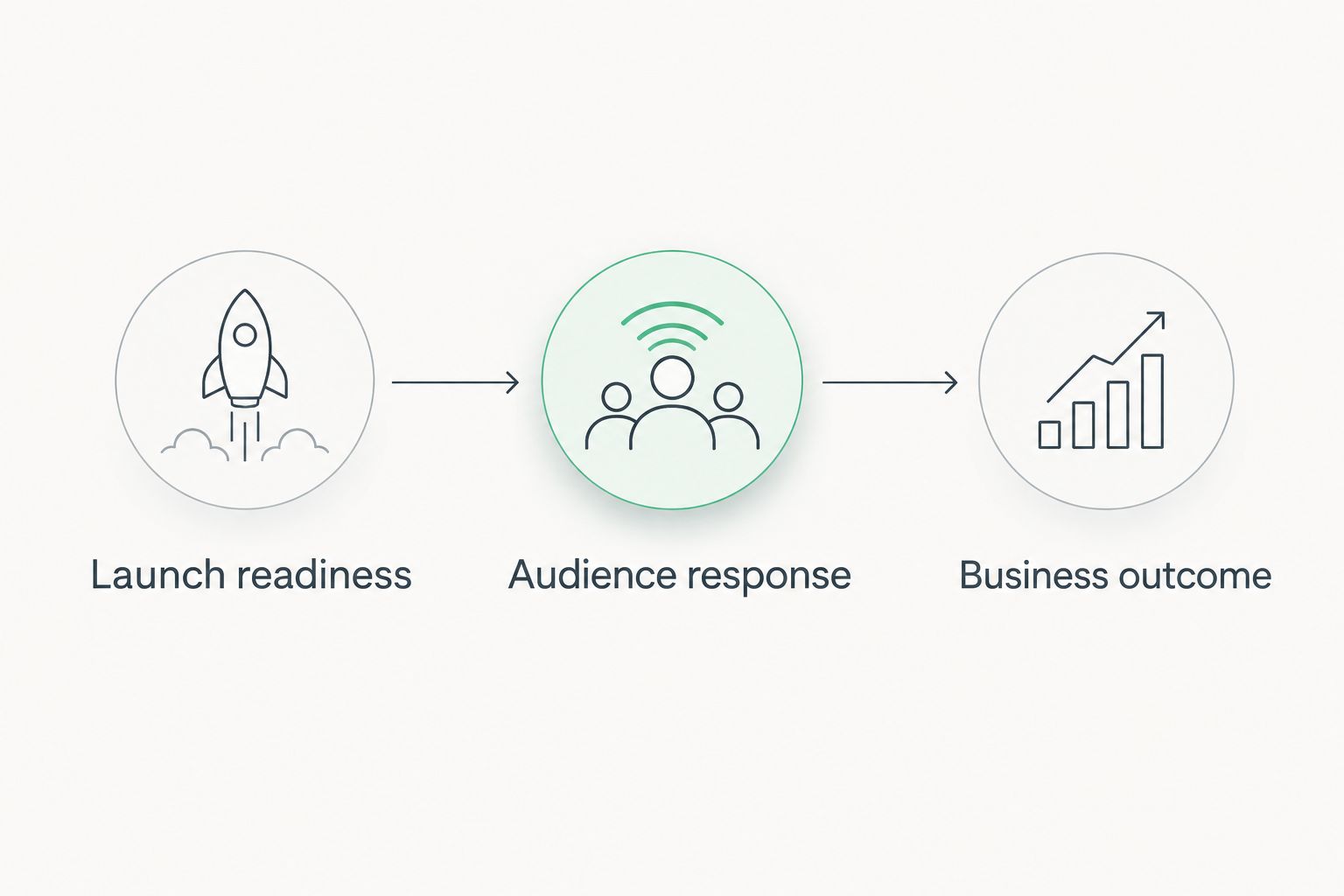
A useful campaign report states which checkpoint has been reached. It should not describe a completed posting schedule as a completed revenue test.
Awareness results: judge distribution and message response
For an awareness campaign, evaluate whether the intended audience encountered the content and responded to the message. Reach and impressions describe exposure; comments, saves, and shares provide additional context about the response. None establishes a purchase by itself.
Inspect the content, not just the totals. Questions about the product suggest a different response from comments focused entirely on the creator. Record what people understood, misunderstood, or wanted explained.
Best for: testing whether a creator can introduce your message to the intended audience. The advantage is direct visibility into content response. The limitation is that exposure alone does not establish commercial impact.
In your 2026 reporting, label awareness results as awareness results. Do not translate a large view count into a revenue claim without supporting purchase evidence.
Purchase results: separate clicks from completed orders
For a purchase-focused campaign, the relevant sequence is content exposure, site visit, product evaluation, and completed order. Track those stages separately so you can identify where the response stops.
A creator-specific link helps identify tagged visits. A creator-specific code provides another purchase signal, but neither captures every influence on a buying decision. Someone can encounter content and return through a different route; a code can also circulate beyond its original placement.
Best for: campaigns with a clear purchase destination and a measurable checkout event. The advantage is a direct commercial outcome. The limitation is that attributed orders do not, by themselves, prove those orders would not have happened otherwise.
Check the destination before replacing the creator. A message that promises one thing and a product page that explains another creates a problem that extra posting does not solve.
B2B results: distinguish inquiries from qualified opportunities
For a B2B campaign, a form submission is an intermediate result when the business objective is qualified pipeline. Track whether the person fits your target customer, whether the inquiry is relevant, and whether sales accepts the opportunity.
Use your actual sales process to set the review window. If buyers need internal approval or several conversations before signing, evaluate early inquiries separately from closed business. Do not borrow a consumer checkout deadline for a consultative sale.
Best for: campaigns designed to introduce expertise and generate relevant business conversations. The advantage is visibility into buyer interest. The limitation is that lead volume can look strong while qualification remains weak.
Compare the result you want before comparing timelines
| Campaign objective | Best for | Useful evidence | Main limitation |
|---|---|---|---|
| Awareness | Testing audience and message fit | Reach, impressions, relevant engagement | Exposure does not establish sales |
| Direct purchase | Measuring a defined checkout action | Tagged visits and completed orders | Attribution does not prove incremental impact |
| B2B inquiry | Starting relevant sales conversations | Qualified inquiries and accepted opportunities | Submissions do not equal qualified pipeline |
The table is a measurement choice, not a ranking. Choose 1 primary outcome, then use the other signals to explain why that outcome did or did not happen.
Why influencer campaign timing varies
Your schedule depends on the work required before publication and the decisions required after exposure. Build your 2026 timeline around these dependencies rather than treating every campaign as the same assignment.
- Creator coordination: Outreach, agreement on deliverables, and publishing commitments must be resolved before you can rely on a launch date.
- Production requirements: A demonstration, interview, or product experience requires different preparation from a straightforward mention.
- Approval process: Unclear feedback ownership and unresolved claims leave publication dependent on revisions.
- Buying process: A direct purchase and a purchase requiring internal approval have different conversion paths.
- Measurement setup: Tagged links, tested events, and lead-source capture determine which responses you can identify.
- Campaign objective: Measuring exposure requires different evidence from measuring qualified pipeline or completed purchases.
Assign 1 accountable owner to each dependency. The goal is not to make every task instantaneous; it is to make the next action and decision-maker explicit.
A timeline with named dependencies is useful even before exact publication dates are agreed. It shows what must happen next instead of presenting an unsupported finish date.
How do you set a realistic review schedule?
Start with the decision you need to make. Then work backward to the evidence that decision requires.
Before launch: define the measurement rules
Write down the primary outcome, the event that records it, the source of the report, and the attribution window. The attribution window is the period during which your reporting system credits an interaction with a conversion; it is a measurement rule, not proof of causation.
Record the planned posting dates and confirm access to the required creator reporting. Test the destination and conversion event before sending traffic. A broken event turns an otherwise visible response into an avoidable reporting gap.
After publication: verify delivery and tracking
Confirm that the agreed content is live, the destination works, and tagged visits appear as expected. Resolve implementation errors before interpreting a missing conversion as audience rejection.
Review the actual post alongside the brief. If the message, audience, or call to action differs from the agreed plan, document that difference before comparing performance.
At the outcome review: make a specific decision
Use the agreed measurement window and the maturity of the buying process to decide whether to continue, revise, or stop. Separate observed outcomes from conclusions that the evidence cannot establish.
Do not move the success criteria after seeing the results. If the original goal was qualified inquiries, an engagement increase is useful context—not a substitute outcome.
What should you change when results are slow?
Diagnose the stage that is failing before asking for more content. Additional posts repeat the same problem when the underlying issue remains unchanged.
| Observed problem | Check first | Next move |
|---|---|---|
| Content has not published | Outstanding deliverables and approvals | Resolve the specific launch dependency |
| Content gets attention but little traffic | Message, destination visibility, and call to action | Clarify the next step and verify links |
| Visits arrive without purchases | Message-to-page fit and checkout tracking | Inspect the destination and conversion path |
| Inquiries arrive without qualification | Audience fit and inquiry criteria | Tighten targeting and qualification rules |
| Reported results conflict | Attribution rules and event definitions | Reconcile measurement before changing creative |
Avoid changing the creator, message, destination, and measurement rules simultaneously. You lose the ability to identify which change explains the next result.
For a 2026 campaign review, preserve a record of what changed and when. Compare content only after accounting for differences in objectives, destinations, and reporting definitions.
When does a full-service growth partner fit?
Hey Prospekt is best for B2B and B2C teams seeking brand, web, and growth marketing together. Its stated services include brand strategy, digital marketing, and creative services—a relevant scope when the challenge extends beyond getting creator content published.
The advantage of that scope is access to related disciplines within a full-service engagement. The trade-off is scope fit: a team needing only creator sourcing should confirm the specific deliverables rather than assume a broader agency engagement matches that assignment.
Review Hey Prospekt against the work you actually need. Ask who owns the creator brief, destination, reporting definitions, and next decision; confirm responsibilities before setting campaign expectations.
Should you wait for sales before changing the campaign?
You should not wait for sales to fix a broken link, missing event, or incorrect message. Those are observable execution problems. Fix them as soon as you identify them.
You should, however, distinguish an incomplete buying process from failed demand. A qualified inquiry still being evaluated is not the same as an irrelevant inquiry, and neither should be reported as closed revenue.
Does campaign length mean the same thing as time to results?
Campaign length describes the agreed activity period; time to results describes when the chosen outcome becomes observable. They are different clocks.
Keep publication dates, reporting dates, and business-outcome reviews visible in the same plan. That prevents a campaign ending administratively before the team has completed its outcome review.
FAQ
How long does an influencer marketing campaign take to show results?
An influencer marketing campaign produces measurable audience activity after content goes live, while purchases and qualified opportunities follow the buyer’s decision process. Separate preparation, audience response, and business outcomes instead of using a universal deadline.
Can an influencer campaign generate sales immediately?
An influencer campaign can generate a purchase after someone encounters the content and completes checkout, but immediate sales are not guaranteed. Use completed orders rather than views or clicks to establish that a sale occurred.
Should I measure an influencer campaign from the contract date?
Measure preparation from the agreed project start and live performance from actual publication. Recording both dates prevents production time from being confused with audience-response time.
What’s the best metric for an influencer campaign?
The best metric is the primary business outcome agreed before launch. Use reach for distribution, completed orders for purchases, and qualified opportunities for a pipeline objective.
How do I know whether the creator or my website is the problem?
Compare the stages between content exposure and conversion. Weak traffic directs attention toward the message and next step; traffic without conversion directs attention toward audience intent, destination quality, and tracking.
Does Hey Prospekt work with B2B and B2C companies?
Hey Prospekt serves B2B and B2C companies with brand strategy, digital marketing, and creative services. Confirm the responsibilities and deliverables needed for your campaign before agreeing on its timeline.
One last thing
The last post is not automatically the last result. Schedule the outcome review when the relevant buyer response can be assessed—not simply when the final deliverable is approved.
Before signing off on your 2026 campaign plan, ask for a plain-language decision rule: what evidence supports continuing, what triggers a revision, and what justifies stopping? That rule makes the timeline actionable.
Related guides
- Can influencer marketing work for B2B companies?
- How long does social media marketing take to show results?
- How long does demand generation take to fill a pipeline?


