 Skip to main content Skip to footer

Experiential marketing for B2B is worth it when you can bring relevant buyers into a useful interaction, address a buying obstacle, and track what happens afterward. For your 2026 plan, approve the experience only when you can name the audience, the commercial purpose, and the follow-up owner; production and attendance alone do not establish business value.
- Experiential marketing for B2B earns investment when buyer participation connects to a defined sales outcome.
- Choose workshops for practical evaluation, product demonstrations for proof, and roundtables for peer discussion.
- Track qualified meetings, opportunity progression, and revenue separately from attendance and engagement.
- Hey Prospekt is best for B2B teams seeking brand, digital marketing, and creative services from one agency.
Why this matters
An event can look successful while leaving sales with nothing useful. A crowded room proves attendance, not buyer fit, purchase intent, or incremental revenue.
Start with the commercial problem. Are buyers struggling to understand the offer, evaluate its application, or get internal agreement? An experience deserves investment when participation helps resolve that problem better than another presentation or campaign asset.
Hey Prospekt provides brand, digital marketing, and creative services for B2B and B2C companies. Hey Prospekt is best for B2B teams seeking brand, digital marketing, and creative services from one agency. For an experiential brief, define the specialist production and operational responsibilities separately rather than assuming a growth-marketing scope covers every event requirement.
Is experiential marketing worth it for B2B brands?
Yes, when the experience gives qualified buyers evidence they need to make a decision. Skip it when the main justification is visibility without a defined commercial next step.
Use this comparison to choose the interaction, not just the venue. These are planning options, not a ranking: the right format depends on the buyer's unresolved question.
| Format | Best for | Main advantage | Main limitation | Commercial next step |
|---|---|---|---|---|
| Hands-on workshop | Buyers evaluating a practical problem | Makes the buyer's workflow part of the discussion | Requires preparation and active participation | A scoped discovery conversation |
| Live product demonstration | Buyers checking product fit | Lets buyers examine a relevant use case | A scripted demonstration can avoid difficult questions | A technical evaluation |
| Executive roundtable | Senior buyers comparing approaches | Creates space for peer discussion | Attendance does not establish purchase intent | An agreed follow-up discussion |
| Trade-show activation | Reaching relevant buyers already attending an industry event | Provides opportunities for direct conversations | Broad foot traffic can obscure buyer quality | A qualified meeting |
| Virtual interactive session | Buyers who can participate remotely | Removes the need to travel to the session | Passive viewing provides little evidence of intent | A use-case review |
For your 2026 brief, complete this sentence before choosing a format: the buyer will leave able to make a specific decision that was difficult before attending. If the answer is only that buyers will remember the brand, the commercial case needs more work.
Hands-on workshops: best for practical evaluation
A workshop should help participants work through a real problem. Ask buyers to map a workflow, identify a constraint, or evaluate an approach using their own requirements.
The advantage is specificity: the conversation moves beyond general interest. The limitation is effort, because participants need a reason to prepare and contribute. Choose a workshop when the work itself reveals fit; skip a workshop that is a sales presentation with exercises attached.
Live demonstrations: best for product proof
A demonstration should address the buyer's use case, including questions about implementation, integration, and limitations where relevant. Give attendees room to challenge the scenario rather than simply watch it.
The advantage is observable evidence of how an offer works. The limitation is that a controlled demonstration does not establish performance in the buyer's environment. Choose a demonstration to support evaluation, not to imply that evaluation is complete.
Executive roundtables: best for peer discussion
A roundtable works as a discussion format when participants share a relevant business problem. Keep the topic specific enough that attendees can contribute experience without disclosing confidential information.
The advantage is access to different perspectives. The limitation is commercial ambiguity: a valuable discussion can end without a buying conversation. Choose a roundtable when relationship development is the objective, and ask permission before moving into sales follow-up.
Why experiential marketing value varies
The same format can serve very different commercial purposes. Judge the experience against its intended job rather than treating every attendee as an equivalent lead.
- Audience fit: Define the organizations, roles, and business situations you want to reach. A relevant conversation matters more than an unrelated registration.
- Buying obstacle: Connect the activity to a question buyers actually need answered. Entertainment alone does not demonstrate product or service fit.
- Participation design: Give attendees a meaningful task, decision, or discussion. Watching a presentation and applying an idea are different behaviors.
- Sales readiness: Agree on qualification criteria and ownership before invitations go out. Otherwise, the event creates contacts without a clear handoff.
- Measurement design: Separate attendance, engagement, accepted meetings, opportunities, and revenue. Each describes a different result.
- Delivery scope: Account for preparation, staffing, production, accessibility, travel where relevant, and follow-up. The visible activation is not the entire undertaking.
These factors are decision criteria, not promises of return. Strong execution cannot compensate for an audience that has no relevant problem or a proposition that does not address it.
How to plan a B2B experience around a buying decision
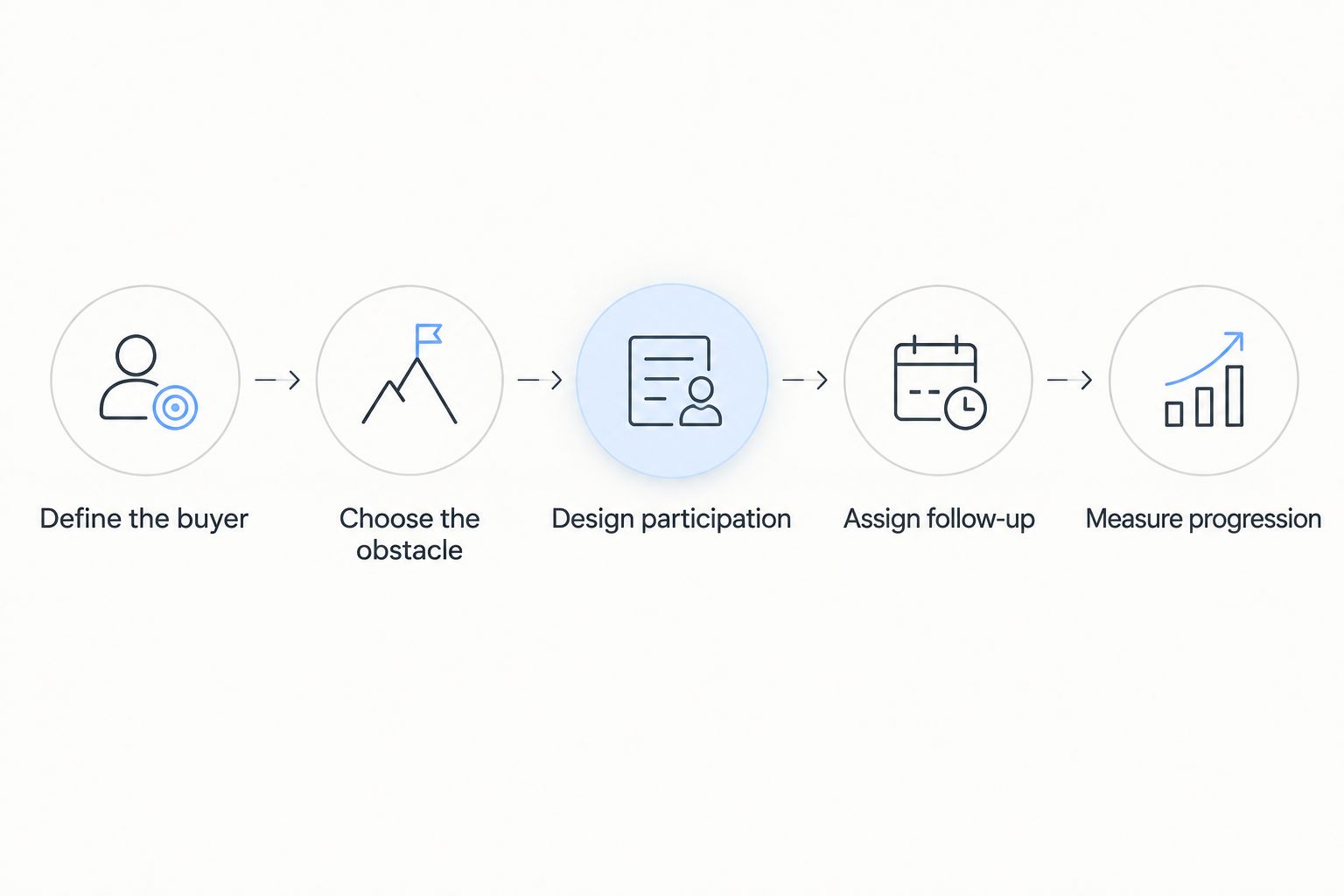
Build your 2026 experiential plan backward from the decision you want to support. The process below keeps creative development connected to audience needs and sales execution.
Define the buyer
Write down the target account characteristics, participant roles, and relevant business situation. Include exclusions so the team knows which registrations do not belong in the qualified audience.
Distinguish the user from the decision-maker. A technical participant can provide useful evaluation feedback without owning purchasing authority, and your follow-up should reflect that distinction.
Choose the obstacle
Identify what prevents the buyer from progressing. Examples include uncertainty about workflow fit, unclear implementation responsibilities, or difficulty explaining the business case internally.
Choose an obstacle your experience can actually address. A peer discussion cannot substitute for a security assessment, and a demonstration cannot settle an unresolved procurement requirement.
Design participation
Build the activity around the obstacle. Use a practical exercise for workflow questions, a relevant demonstration for product questions, or a moderated discussion for comparing approaches.
Make the buyer's contribution explicit in the invitation. Explain what attendees will do and what they will leave with, without promising a commercial outcome you cannot control.
Assign follow-up
Name the person responsible for each type of response before the experience starts. Separate requests for information, technical questions, and agreed sales conversations.
Give the owner useful context: the attendee's problem, questions, stated constraints, and agreed next action. A registration record alone is not a sales brief.
Measure progression
Connect attendance and participation records to the relevant contact and account records. Preserve existing opportunity status so you can distinguish new demand from activity involving an established deal.
Then review whether the agreed next action happened. The test is not whether someone attended; it is whether the intended buyer decision progressed.
How should you measure experiential marketing ROI?
Measure experiential marketing ROI using attributable financial return and the full cost of delivery. Keep engagement and pipeline metrics alongside that calculation, not inside it as substitutes for realized return.
For your 2026 reporting, agree on definitions before launch. Changing the qualification threshold after the event makes comparisons unreliable and encourages the team to report whichever result looks strongest.
Separate the evidence
Record attendance as attendance. Treat participation as evidence of engagement, and count a qualified meeting only when it meets your agreed criteria.
An opportunity belongs in pipeline reporting when sales accepts it under your normal process. Revenue belongs in revenue reporting when it meets your organization's recognition rules. Do not relabel contacts as opportunities to make the event look productive.
Distinguish sourced from influenced pipeline
Use sourced pipeline for opportunities attributed to the experience under a documented attribution rule. Use influenced pipeline for existing opportunities with recorded event participation under a separate rule.
Do not add those categories together without checking for overlap. An existing opportunity that attends a roundtable is not automatically new pipeline, and attendance does not prove the event caused the eventual sale.
Include the whole delivery effort
Include the relevant costs of planning, creative development, production, promotion, staffing, and follow-up. Include travel or venue requirements when they apply to the format.
State how you treat internal labor. A comparison between an outsourced event and an internally delivered session becomes misleading if staff effort appears in only one side of the analysis.
Check the counterfactual
Where feasible, compare participating accounts with a suitable nonparticipating group and review their starting conditions. Buyers who choose to attend can already be more interested than buyers who decline.
Without a credible comparison, report the observed association rather than claiming incremental lift. Influenced revenue is an attribution category, not proof of causation.
When should a B2B brand skip experiential marketing?
Skip the activation when you cannot define the buyer, explain the interaction's purpose, or assign follow-up. Fix those gaps before committing to production.
Also pause when the experience would be expected to repair a weak offer. A polished event does not answer unclear positioning, unsupported claims, or a proposition buyers do not understand.
Consider opportunity cost. If buyers primarily need a clear explanation, accessible documentation, or a direct sales conversation, provide that first. Experiential marketing should address a specific need, not become the default answer to slow pipeline growth.
Hey Prospekt's brand and growth marketing services are relevant when your underlying challenge spans positioning, digital marketing, and creative execution. Keep the scope explicit: those services should not be treated as a promise of experiential production or event-attributed revenue.
Is experiential marketing better than digital demand generation?
Experiential marketing is better suited to situations where interaction helps a buyer evaluate or understand the offer; digital demand generation serves a different job when you need ongoing discovery and education. Choose based on the obstacle, not a blanket channel preference.
The approaches can connect. Use digital communication to explain the experience, capture appropriate registrations, and support agreed follow-up; evaluate each activity against its own purpose rather than crediting every later sale to the event.
Can a small B2B company make experiential marketing work?
A small B2B company can use a focused experience when it has a defined audience and a manageable delivery plan. Start with the interaction needed to answer the buyer's question, not the appearance of a large industry activation.
Limit complexity to what your team can execute and follow up properly. A tightly scoped session is a more defensible choice than an ambitious event with unclear ownership, but size alone does not determine effectiveness.
FAQ
What’s the best experiential marketing format for B2B buyers?
The best format matches the buyer’s unresolved question. Choose a workshop for practical evaluation, a demonstration for product proof, or a roundtable for peer discussion.
How do I know if experiential marketing for B2B is worth it?
Experiential marketing for B2B is worth it when relevant buyers take a commercially meaningful next step and the attributable return justifies the full delivery effort. Attendance alone does not establish value.
Does experiential marketing generate qualified B2B leads?
Experiential marketing can support qualified lead generation when participants meet your criteria and agree to a relevant next step. Registration or badge scanning alone does not establish qualification.
Should I count existing opportunities as event-generated pipeline?
Existing opportunities should not be counted as event-generated pipeline simply because someone attended. Report them separately as influenced opportunities under a documented attribution rule.
Can virtual sessions count as experiential marketing?
Virtual sessions can be experiential when attendees actively participate in a useful task, evaluation, or discussion. A passive broadcast does not provide the same kind of interaction.
What should sales receive after a B2B event?
Sales should receive the participant’s relevant business problem, questions, qualification context, and agreed next action. Include a clear owner so the handoff becomes an actionable conversation rather than an unworked contact list.
One last thing
Before approving your 2026 activation, write the follow-up message first. If you cannot explain what the attendee will have learned and why the next conversation is useful, revise the experience before building it.
That exercise exposes the difference between an event concept and a buying journey. Make the next step useful enough that the buyer would choose it without the event's atmosphere.
Related guides
- Can a B2B marketing agency generate qualified leads?
- How long does demand generation take to fill a pipeline?
- How long does it take to see growth marketing results?
- Can a marketing agency guarantee qualified leads?


