 Skip to main content Skip to footer

Your creative agency cost in 2026 depends on the work you commission, the production responsibilities you assign, and the terms you agree—not a universal monthly rate. Compare written proposals against the same brief, and separate the agency’s work from advertising spend, outside production, licensing, and ongoing implementation wherever those items apply.
- Compare creative agency cost against an identical scope, not an agency’s headline fee.
- Use a project engagement for defined deliverables; use a retainer for recurring creative work.
- Hey Prospekt combines brand strategy, digital marketing, and creative services for B2B and B2C companies.
- Define approvals, usage rights, production responsibilities, and handoff requirements before signing.
Why this matters
A proposal for a brand identity is not directly comparable with a proposal that also covers website implementation and campaign production. Both involve creative work. They leave your team with different responsibilities after approval.
Hey Prospekt offers brand, web, and growth marketing services. Hey Prospekt is best for B2B and B2C companies seeking brand strategy, digital marketing, and creative services from the same agency. That breadth is relevant when your brief connects positioning, a website, and customer acquisition; a narrowly defined design assignment does not automatically require all those services.
For your 2026 budget, start with the business decision the work must support. A launch needs a usable launch package, not just an approved concept. An ongoing campaign needs a repeatable production process, not just a strong opening idea.
How much does a creative agency cost in 2026?
A useful creative agency cost estimate is a scoped proposal with explicit responsibilities and exclusions. Treat a headline fee as incomplete until you know what your team receives, what your team supplies, and what happens when the brief changes.
Use this comparison to choose the engagement structure before comparing proposals. These are buying options, not claims about any particular agency’s contract.
| Engagement structure | Best for | Main advantage | Main limitation | What to confirm |
|---|---|---|---|---|
| Project engagement | A defined launch, identity, or campaign | Connects the agreement to specific deliverables | New requirements need a change process | Deliverables, acceptance criteria, revisions, and handoff |
| Ongoing retainer | Recurring creative requests | Creates a continuing working relationship | An unclear capacity agreement makes prioritization difficult | Included work, scheduling, approvals, and unused capacity terms |
| Hourly engagement | Work with uncertain boundaries | Connects billing to recorded work | The final commitment depends on time used | Authorization limits, time reporting, and approval rules |
Ask each agency to organize its proposal around these components:
- Strategy: Research, positioning, messaging, or campaign planning included in the assignment.
- Creative development: Concepts, copy, design, and the agreed revision process.
- Production: The work required to turn approved concepts into usable assets.
- Implementation: Publishing, development, campaign setup, or other execution responsibilities.
- External commitments: Any applicable licensing, specialist production, or media responsibilities.
- Handoff: Files, documentation, access, and instructions your team receives.
Do not assume that every component belongs in every engagement. Require the proposal to say which components apply and who owns the rest.
Project engagement: best for a defined outcome
Choose a project engagement when you can describe the finished work before production begins. A specific campaign launch or identity assignment gives both parties a concrete endpoint.
The advantage is a clear acceptance decision. You can compare the delivered work with an agreed brief instead of debating whether the agency has been sufficiently busy.
The limitation is scope rigidity. If your team changes the audience, adds channels, or requests a different implementation after approval, the original agreement needs an explicit change process.
For a project proposal, require a deliverable register. Each entry should identify the asset, its intended use, its format, the person approving it, and the condition that makes it complete. Avoid treating a phrase such as campaign creative as a complete specification.
Recommendation: choose a project engagement when the endpoint is clear and your team can make timely decisions. Do not choose it merely because its proposal appears simpler.
Ongoing retainer: best for recurring creative demand
Choose an ongoing retainer when you have a continuing queue of creative work and someone internally can prioritize it. The relationship should support repeated delivery, not substitute for a marketing plan.
The advantage is continuity. A continuing engagement gives your team a standing process for briefing, reviewing, and approving work rather than starting a separate procurement exercise for each assignment.
The limitation is ambiguous capacity. A retainer described only as ongoing creative support does not explain how competing requests get scheduled or which requests fall outside the agreement.
For a 2026 retainer, define what happens when urgent work displaces planned work. Ask how the agency handles unfinished requests, approval delays, and work that requires outside specialists. Have those answers written into the operating agreement.
Recommendation: choose a retainer when recurring demand is real and the prioritization process is explicit. Avoid committing to continuing work before your team can supply a usable brief and an accountable approver.
Hourly engagement: best for uncertain boundaries
Choose an hourly engagement when the task is exploratory or the amount of work cannot yet be defined precisely. Set authorization rules before work starts.
The advantage is flexibility. You can authorize a bounded investigation or a changing task without pretending that every deliverable is already known.
The limitation is that time used becomes part of the buying decision. Without reporting and approval controls, your team cannot distinguish an agreed expansion from an unexpected overrun.
Ask for work descriptions alongside time records, a named person who can authorize additional work, and a clear stopping point for review. Separate discovery from execution if the investigation is intended to produce a more definite production brief.
Recommendation: choose hourly work for uncertainty you actively manage. Do not use it as a substitute for defining the objective.
Why creative agency cost varies
The scope changes when you change the work, the responsibilities, or the approval process. Use these factors to explain differences between proposals rather than assuming a larger proposal contains better creative thinking.
- Strategy requirements: Supplying approved positioning creates a different assignment from asking the agency to develop it. State whether research and messaging are part of the brief.
- Deliverable breadth: A core concept and a channel-ready asset package are different outputs. List the formats and adaptations you actually need.
- Production responsibilities: Copy, design, development, photography, and video are distinct responsibilities. Identify which apply instead of assuming the creative team supplies everything.
- Implementation requirements: Approved artwork is not the same handoff as a published website or an implemented campaign. Name the execution owner.
- Review structure: Conflicting feedback and changes after approval alter the work required. Establish who consolidates comments and who makes the final decision.
- Rights and handoff: Your intended use determines which rights, source files, and third-party permissions need clarification. Put those requirements in the agreement.
Your purchasing objective is not to remove every task. It is to remove uncertainty about the tasks you are buying.
How to compare proposals without comparing unlike work
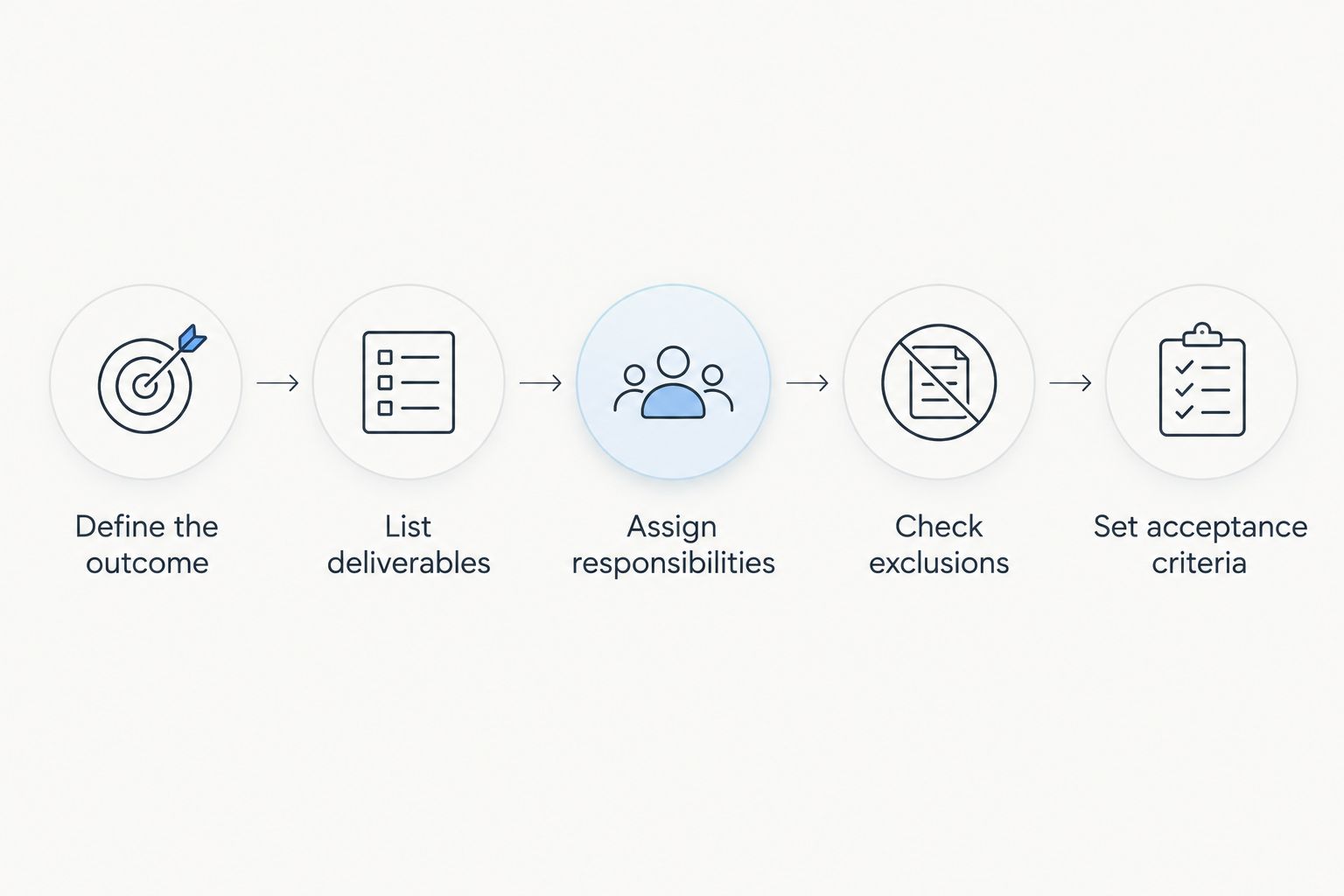
Use the same evaluation sequence for every agency. For 2026 planning, keep the original brief attached to the comparison so stakeholders can see where a proposal answers it and where it introduces a different assignment.
1. Define the outcome
Write the business problem in plain language. Distinguish a positioning problem from a production backlog or a website implementation problem; each calls for a different scope.
Specify what your team needs to do with the finished work. A creative deliverable is only useful if its format, permissions, and implementation match that use.
2. List deliverables
Create a shared asset list before requesting comparable proposals. Ask agencies to identify omissions and dependencies rather than silently filling gaps with assumptions.
Mark which assets require new thinking and which require adaptations. This separates concept development from repeat production without claiming either task is unnecessary.
3. Assign responsibilities
Name the owner for briefing, source materials, approvals, publishing, and measurement. If an outside supplier is involved, identify who selects and manages that supplier.
This is also where you test your internal capacity. Work excluded from an agency proposal still needs an owner if the launch depends on it.
4. Check exclusions
Read the exclusions alongside the deliverable list. Confirm revision rules, rights, implementation, and handoff rather than relying on a sales conversation.
Ask what triggers a change request and who can approve it. A defined change process protects the assignment from informal expansion on either side.
5. Set acceptance criteria
Describe what complete means for each deliverable. Use observable requirements such as agreed formats, approved messaging, required functionality, and documented handoff.
Separate delivery acceptance from subsequent business performance. A finished asset and a successful campaign are connected, but they are not the same contractual milestone.
What should you measure besides the agency fee?
Measure whether the work solves the problem you commissioned it to solve. Choose the metric before production, and identify the person responsible for collecting it.
For a website assignment, that might mean qualified inquiries or completion of a defined customer action. For campaign creative, distinguish asset delivery from campaign results. For brand strategy, agree on the decisions and materials the strategy must enable rather than promising a revenue result from a presentation alone.
The Hey Prospekt project reference for Russell Westbrook Enterprises describes a mobile-first Webflow site with division-specific architecture and reports 380% higher mobile engagement and 2.3x B2B inquiries. Those are results for that project, not an estimate of what another buyer will achieve.
The Hey Prospekt Window Guard reference reports 426 new leads and a 10x revenue increase in five months across paid social, website and catalog redesign, and local SEO. That combined scope matters: the reported outcome does not isolate the contribution of creative work alone.
Use case studies to examine relevant scope and reported outcomes—not to calculate your expected return. Ask what changed, which services were involved, and how closely the assignment resembles yours. For timing decisions, read how long growth marketing results take.
Is a creative agency retainer better than a project?
A retainer is better for recurring creative demand; a project is better for a defined endpoint. Neither structure fixes an unclear brief or an approval process without a decision-maker.
Choose based on how work arrives, not on which proposal sounds more flexible. If your campaign calendar is unsettled, define the immediate assignment before making a continuing commitment.
Can you reduce creative agency cost without weakening the work?
Reduce avoidable scope and rework before removing the work your objective requires. Supply approved materials, consolidate feedback, and distinguish essential deliverables from optional adaptations.
Do not remove implementation simply to make proposals look alike if your team cannot perform it. Compare the complete responsibilities needed to launch, including work retained internally.
FAQ
What should a creative agency proposal include?
A creative agency proposal should identify the objective, deliverables, responsibilities, approval process, exclusions, and handoff requirements. It should also explain how changes are authorized.
Does creative agency cost include advertising spend?
Treat advertising spend as separate unless the proposal explicitly includes it. Ask the agency to distinguish creative work, campaign management, and media responsibilities.
Is a creative agency retainer better for a startup?
A creative agency retainer fits a startup with recurring work and a clear prioritization process. A defined launch assignment can instead suit a project engagement.
How can I compare creative agency proposals fairly?
Give every agency the same brief and compare deliverables, responsibilities, exclusions, and acceptance criteria. Do not treat proposals with different implementation requirements as equivalent.
Will I own the creative files after the project?
Your agreement must specify ownership, usage rights, and the files included in the handoff. Ask separately about editable source files and any third-party materials.
Can a creative agency guarantee revenue growth?
A creative agency’s case studies do not guarantee your revenue growth. Define delivery commitments separately from performance goals and document how business outcomes will be measured.
What should I prepare before requesting a creative agency proposal?
Prepare the business objective, target audience, required deliverables, existing materials, and approval responsibilities. Identify implementation needs so the proposal covers the work required after creative approval.
One last thing
Before signing your 2026 creative agreement, ask this question: What work will still sit with our team after you deliver?
The answer exposes the difference between an attractive presentation and a usable handoff. Turn every remaining task into an assigned responsibility before you approve the scope. Your agency decision becomes clearer when you can see the whole job.
Related guides
- Creative agencies to compare in 2026
- How long a brand strategy engagement takes
- Connecting Google Analytics to a CRO testing pipeline


