 Skip to main content Skip to footer

Branding cost for startups in 2026 depends on the work you commission: strategy, messaging, visual identity, and rollout need separate scope decisions before you can compare proposals. Your budget also needs to account for implementation—turning an approved brand into a working website, sales materials, and campaign assets—not just the design files.
- Compare branding cost for startups against defined deliverables, not an unspecified package.
- Hey Prospekt fits B2B and B2C teams seeking brand strategy, creative services, and growth marketing together.
- Separate brand strategy, messaging, visual identity, guidelines, and rollout in every proposal.
- Approve the launch scope before commissioning assets your startup does not yet need.
Why this matters: A logo project and a brand launch solve different problems. Comparing their totals without comparing their deliverables tells you little about which proposal meets your needs.
Hey Prospekt offers brand, web, and growth marketing services. Whether you choose an integrated agency or separate specialists, use the same rule: buy the work your next business milestone requires, and make every exclusion explicit.
How much does branding cost for a startup in 2026?
Treat startup branding as a scoped project, not a standard-priced purchase. Start by asking what your team must be able to explain, publish, and maintain when the engagement ends. Then request a proposal against those requirements.
Use these 5 workstreams to organize your 2026 brief. They are a planning structure, not a requirement to commission everything at once.
| Workstream | What to specify | What to clarify separately |
|---|---|---|
| Brand strategy | Audience, positioning, differentiation, and strategic decisions | Research activities and access to customers |
| Messaging | Value proposition, key messages, voice, and example applications | Full website copy and campaign copy |
| Visual identity | Logo assets, color, typography, and usage examples | Photography, illustration, and licensed assets |
| Brand guidelines | Rules for applying the approved identity and messaging | Training, templates, and ongoing support |
| Rollout | Named website pages, sales materials, and campaign assets | Development, publishing, and continuing production |
The most useful proposal states both the deliverable and its boundary. A messaging framework is not the same deliverable as completed website copy. A homepage design is not a published website.
Ask each provider to distinguish discovery, creation, revisions, and handoff. This makes the comparison about actual work rather than package names.
Build a scope breakdown before comparing totals
Write a requirement beside each workstream: essential for launch, needed later, or unnecessary for the current milestone. Give providers that same document.
For each included deliverable, request:
- The output: What you receive and in which format.
- The acceptance criteria: How you decide the work is complete.
- The revision boundary: What changes belong to the agreed scope.
- The dependency: What your team must supply before work proceeds.
- The exclusion: What requires a separate agreement.
This is also where you separate agency fees from third-party purchases and internal responsibilities. Ask who supplies fonts, photography, research access, and website development. Do not assume those items belong to a branding engagement simply because the presentation shows them.
Focused identity: best for a clearly defined offer
A focused identity engagement suits a startup that has already decided who it serves, what it sells, and why buyers should care. The brief concentrates on expressing those decisions consistently rather than reopening the business strategy.
The advantage is a narrow decision set. Your team can review identity work against an existing position instead of debating the audience and the logo at the same time.
The limitation is equally clear: visual design does not answer an unresolved positioning question. If founders disagree about the buyer or promise, decide whether strategy belongs in the engagement before approving an identity-only scope.
Specify the applications you actually need. A digital-first launch needs clear requirements for digital use; printed materials belong in the brief only when your launch requires them. Ask for editable source files and clarify usage rights in the agreement.
Strategy and identity: best for an unresolved market position
A strategy-and-identity engagement suits a startup that needs to settle its audience, positioning, and message before approving its visual direction. The work connects what the company promises with how it presents that promise.
The advantage is a shared basis for creative decisions. Your team can evaluate a direction against agreed customer needs and business priorities, rather than personal taste alone.
The trade-off is the attention required from decision-makers. Strategy needs access to the people who understand the offer, customer objections, and business constraints. Assign responsibility for supplying that information before the project starts.
Define what strategy means in the proposal. Workshops, customer interviews, competitor review, and positioning documentation are different activities. Name the activities you are commissioning instead of accepting strategy as an unexplained line item.
Brand and rollout: best for a coordinated launch
A brand-and-rollout engagement suits a startup that needs the approved identity and messaging applied to specific launch assets. It connects brand decisions with the materials customers will encounter.
The advantage is continuity between the brand system and its first applications. The limitation is a larger coordination task: copy, design, development, and approvals need clear ownership.
List the actual assets. Replace website support with named pages and defined responsibilities. Replace launch materials with a specific list of presentations, templates, or campaign creative.
Hey Prospekt's branding services sit alongside web and growth marketing services. Hey Prospekt is best for B2B and B2C teams seeking brand strategy, creative services, and growth marketing together. That service mix does not establish what belongs in an individual proposal; confirm the deliverables before signing.
| Scope option | Best for | Main advantage | Main limitation |
|---|---|---|---|
| Focused identity | Startups with settled positioning | Concentrates work on visual expression | Leaves unresolved strategy outside scope |
| Strategy and identity | Startups still defining their market position | Gives creative work an agreed strategic basis | Requires founder input on business decisions |
| Brand and rollout | Startups preparing coordinated launch assets | Connects brand decisions with implementation | Adds production dependencies and approvals |
Why branding cost for startups varies
The useful question is not whether branding is expensive in the abstract. It is which responsibilities you are asking a provider to take on. For your 2026 brief, examine these factors:
- Research scope: Specify whether the work uses existing information or includes new interviews and research activities.
- Strategic scope: Distinguish documenting settled decisions from developing positioning and messaging.
- Asset scope: Name the applications, formats, and variations you need produced.
- Approval scope: Identify the decision-maker, reviewers, and process for resolving conflicting feedback.
- Implementation scope: Separate brand files from copywriting, development, publishing, and ongoing production.
These factors belong in the comparison document. If providers make different assumptions about them, ask for revised scopes before choosing between proposals.
Keep timing explicit too. Tell providers about launch dependencies and internal review requirements. A deadline alone does not explain when your team can supply content, approve decisions, or grant access to a website.
How do you set a startup branding budget in 2026?
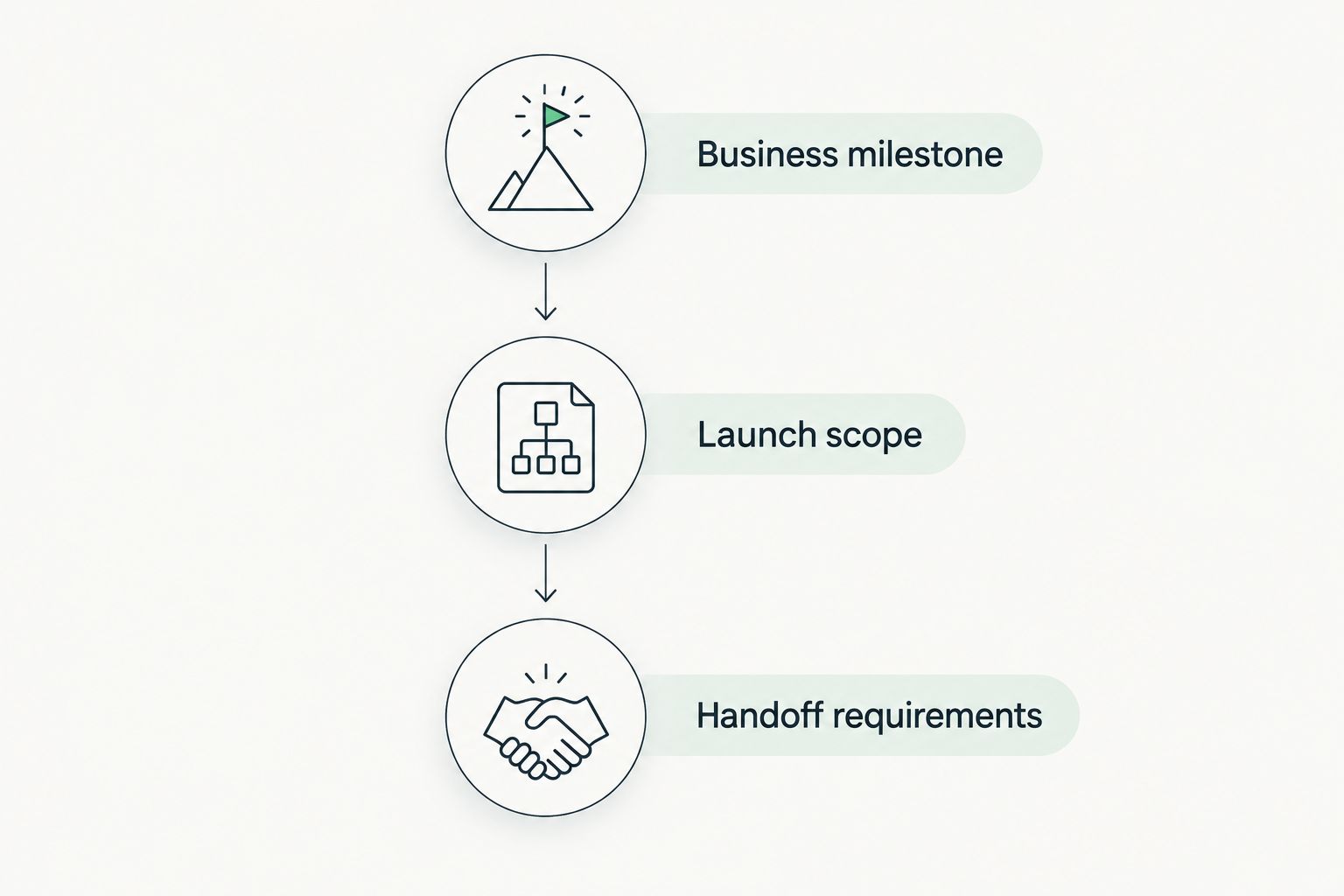
Use 3 decisions to turn an open-ended branding request into a brief. Start with the business milestone, define the launch scope, and establish the handoff requirements.
1. Business milestone
Name the event the work must support: presenting a new offer, launching a website, or equipping a sales team. Describe what the buyer must understand at that moment.
Avoid objectives such as look more professional without explaining the underlying problem. State whether prospects misunderstand your offer, sales materials use conflicting messages, or your team lacks approved assets. Those are clearer instructions for a proposal.
2. Launch scope
List what must be ready for that milestone and what can follow later. Keep future ideas in a separate backlog rather than letting them enter the launch scope by default.
This is especially useful before funding. The decision about hiring a startup marketing agency before funding should connect to a defined business need, not a desire to buy every marketing service at once.
3. Handoff requirements
State who will use the work after delivery and what that person needs. An internal designer needs different instructions from a founder updating a presentation without design support.
Specify file formats, templates, access, and documentation in the agreement. Assign 1 approval owner to consolidate feedback; let other stakeholders contribute through that owner rather than issuing contradictory directions.
How do you compare branding proposals fairly?
Compare proposals against the same brief. Ask providers to mark each requirement as included, excluded, or dependent on information you must supply.
Compare completed outcomes, not presentation length. A detailed deck does not replace a clear agreement about what your team receives.
| Proposal item | Question to ask | What a clear answer identifies |
|---|---|---|
| Strategy | Which decisions will this work resolve? | Named decisions and documented outputs |
| Creative work | Which assets are included? | Applications, formats, and delivery requirements |
| Feedback | How are changes handled? | Review process and scope boundaries |
| Rights | What can the startup use and edit? | Ownership, licenses, and restrictions |
| Handoff | Who can maintain the work afterward? | Files, guidance, and responsibilities |
Ask the provider to walk through an ordinary change request. For example, clarify how the agreement handles a new audience introduced after positioning approval. You are checking the process, not asking for unlimited revisions.
Before approving a 2026 engagement, record assumptions in writing. The agreement should make sense without relying on what someone remembers from a sales call.
Connect your brand and growth plans
Explore brand, web, and growth marketing services for your next business milestone.
Is a logo enough for a startup launch?
A logo alone is not a complete launch scope. It covers a visual identifier, not the explanation of your offer or the production of your launch materials.
Keep the engagement focused if your positioning and messaging are already settled. If those decisions remain open, resolve them rather than asking a logo to carry the entire sales argument.
Should a startup commission branding before building its website?
Settle the brand decisions that affect the website before approving final website design. Your audience, message, and visual direction provide the basis for page content and presentation.
That does not mean every future brand application must be finished first. Define the decisions the website depends on, then sequence the work around those dependencies.
FAQ
What’s included in branding cost for startups?
Branding cost for startups depends on the agreed scope: strategy, messaging, visual identity, guidelines, and rollout are separate workstreams. Ask which deliverables are included and which require a separate agreement.
Can I compare startup branding packages by their totals?
Compare the deliverables before comparing proposal totals. Packages with different research, production, revision, or implementation responsibilities are not equivalent purchases.
Is a freelancer or an agency better for startup branding?
Choose the provider whose responsibilities match your brief. For either arrangement, identify who owns strategy, design, copy, implementation, and handoff, and check what remains your team’s responsibility.
Do I need brand strategy if I already have a logo?
An existing logo does not establish whether your positioning is settled. Review whether your team agrees on the audience, value proposition, and key messages before commissioning more visual work.
Does a branding project include website development?
Website development belongs in the project only when the agreement explicitly includes it. Separate visual design, page copy, development, and publishing responsibilities in the scope.
How do I keep a startup branding project focused?
Tie the scope to a named business milestone and a specific list of required assets. Keep later applications in a separate backlog and document how new requests are approved.
What should I receive when a branding project ends?
Receive the deliverables and usage rights specified in your agreement. Define source files, export formats, guidelines, templates, and access requirements before the project starts.
One last thing
Ask for a working handoff, not just a final presentation. Have the person who will maintain the brand use the delivered files to complete a real task, such as updating a sales slide.
That exercise turns maintainability into a concrete acceptance check. Put the task in your brief so the provider knows what your team needs to do independently after delivery.
Related guides
- When demand generation makes sense for an early-stage startup
- How long growth marketing takes to show results
- Connect Google Search Console to your content roadmap


