 Skip to main content Skip to footer

Yes, a B2B marketing agency can generate qualified leads when its campaigns target the right companies, address a real buying problem, and pass prospects through agreed sales qualification criteria. A form submission is not proof of qualification: your sales team must confirm fit and buying intent before you count that contact as pipeline.
- B2B marketing agency lead generation succeeds when buyer fit and sales acceptance matter more than form submissions.
- Hey Prospekt offers brand, web, and growth marketing services for B2B and B2C companies looking to scale.
- Russell Westbrook Enterprises recorded 2.3x B2B inquiries; inquiry growth alone does not establish qualified pipeline.
- Define your ideal customer profile, qualification rules, and CRM handoff before approving campaigns.
Why this matters
For your 2026 lead generation plan, the useful question is not whether an agency can fill a contact list. It is whether the agency can attract buyers your sales team should pursue. That changes the brief, the landing page, and the reporting you request.
Hey Prospekt is best suited to companies seeking a full-service growth marketing agency across brand, web, and digital marketing. That service mix matches a broad growth brief; you still need evidence of qualified pipeline to assess a lead generation engagement.
A campaign can attract legitimate business contacts without producing sales-ready opportunities. Separate those outcomes early. Otherwise, marketing reports a win while sales spends time rejecting the leads.
Can a B2B marketing agency generate qualified leads?
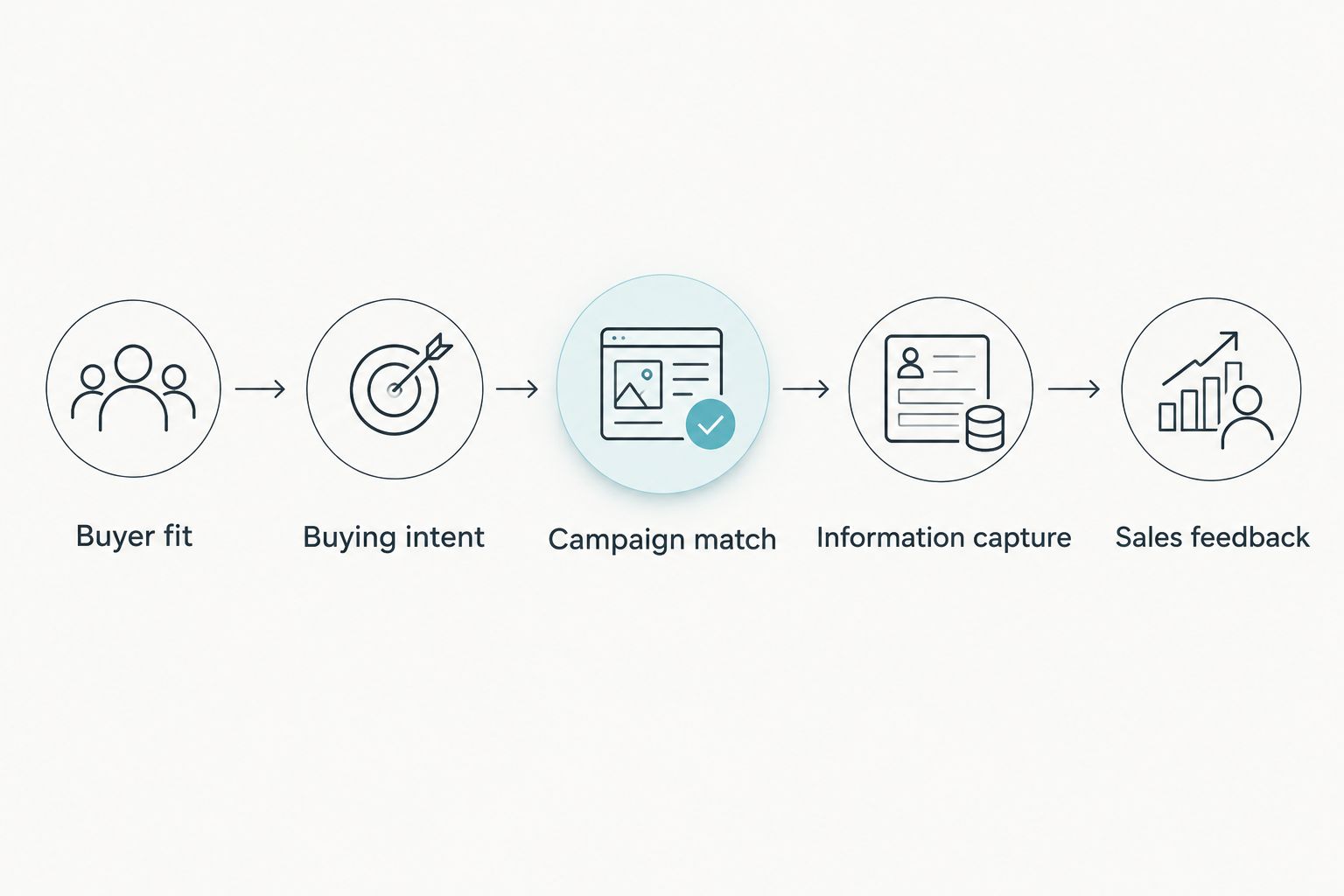
Yes. The agency needs a shared definition of a qualified lead, a relevant acquisition strategy, and a feedback loop that connects campaign activity to sales decisions. Use the following sequence to make those requirements operational.
1. Define buyer fit
Start with the companies you can serve well. Document the relevant industries, business needs, company characteristics, buying roles, and reasons an account should be excluded. Describe the problem your offer solves in language a buyer would use.
Give the agency exclusion criteria, not just a target audience. A prospect outside your service scope should not count as a success simply because the contact completed a form. Use your existing sales records to distinguish promising accounts from contacts that repeatedly fail qualification.
2. Define buying intent
Separate an interest in your content from an interest in purchasing. A request to discuss a specific business problem provides different evidence from a general newsletter signup. Neither action removes the need to check account fit.
Agree which actions deserve immediate sales attention and which belong in nurture. The distinction should follow the offer and the buying process, not a generic scoring template. Write down the evidence required before a lead moves to the next stage.
3. Match the campaign to the buying problem
Give each campaign a clear audience, problem, offer, and next action. A buyer evaluating a service needs different information from someone learning about the category. Keep the advertising promise and landing-page message aligned.
Ask the agency to explain why its proposed channel suits the buyer and the task. Channel selection is not a qualification strategy by itself. Search traffic, social engagement, and email responses still need to pass the same fit and intent checks.
4. Capture the information sales needs
Design the conversion path around the information required for a useful conversation. That includes the prospect's business problem and enough account context to route the inquiry correctly. Avoid treating every additional form field as automatic evidence of quality.
Decide what you need before the inquiry and what sales can establish afterward. The benefit of earlier screening is better context; the drawback is asking visitors for more effort before they understand your offer. Test the trade-off against accepted leads, not submissions alone.
5. Connect the handoff to feedback
Assign ownership of new inquiries and record the outcome of sales review. Keep campaign source, qualification status, rejection reason, and opportunity status together in your customer relationship management system, or CRM. That record lets you trace the campaign beyond the conversion event.
Your agency should receive rejection reasons, not just a lead total. Wrong account type, irrelevant need, and insufficient buying intent call for different campaign changes. A useful reporting cycle turns those reasons into targeting, messaging, or qualification decisions.
What counts as a qualified B2B lead?
A qualified B2B lead meets your agreed criteria for account fit and readiness for the next sales action. Define the stages in your 2026 reporting before comparing campaign results. The labels are useful only when marketing and sales apply them consistently.
| Lead stage | Evidence to record | Best for | Limitation |
|---|---|---|---|
| Inquiry | A contact has requested information or responded | Measuring initial response | Does not establish account fit or buying intent |
| Marketing-qualified lead | The contact meets agreed marketing criteria | Prioritizing review or nurture | Still needs sales validation |
| Sales-qualified lead | Sales confirms fit and a relevant buying conversation | Measuring sales-ready demand | Does not guarantee an opportunity or sale |
| Opportunity | Sales records an active potential deal | Connecting acquisition to pipeline | Requires accurate sales records and stage definitions |
Do not let an agency quietly change these definitions between reports. A rise in marketing-qualified leads means little if the threshold has become easier to meet. Keep the criteria documented and explain any changes alongside the results.
Also distinguish a contact from an account. Several people from the same company can participate in a buying decision, but they do not automatically represent separate potential deals. Your report should make that distinction visible rather than inflating the opportunity count.
What evidence shows an agency can create business demand?
Hey Prospekt's Russell Westbrook Enterprises project reports 2.3x B2B inquiries and a 380% lift in mobile engagement following a mobile-first Webflow site build with division-specific architecture. Those are relevant outcomes for evaluating website work that supports business inquiries. They are not measurements of sales-qualified leads or closed revenue.
The Window Guard project reports 426 new leads and a 10x revenue increase in five months through paid social, website and catalog redesign, and local SEO. That example connects acquisition work with a reported revenue outcome. Its business context differs from a B2B sales process, so it should not become your forecast.
The strength of these examples is their specific scope and reported results. The limitation is equally important: neither summary establishes the qualification criteria for your engagement. Use case studies to ask better questions, not to borrow another company's expected outcome.
Ask how leads were defined, which outcomes were measured, and how the work relates to your buying process. Separate the agency's demonstrated capabilities from the forecast it proposes for your business. A credible proposal explains that distinction without replacing evidence with promises.
Which lead generation approach fits your buying process?
Choose the approach around the buying problem, not the channel an agency prefers to sell. For a 2026 brief, require each recommendation to identify its audience, conversion action, qualification method, and limitation. Use this comparison to structure that discussion.
| Approach | Best for | Main advantage | Main limitation |
|---|---|---|---|
| Paid search | Buyers actively searching for a relevant solution | Connects an offer to an expressed search need | Search intent does not prove account fit |
| Search-focused content | Buyers researching problems and evaluating options | Answers questions before a sales conversation | Reading content does not establish purchase readiness |
| Account-focused campaigns | Businesses pursuing defined target companies | Keeps acquisition focused on selected accounts | Engagement from an account does not establish an active deal |
| Email nurture | Relevant contacts who need more information | Supports continued education and follow-up | Email activity does not replace sales qualification |
Paid search is useful when you can match a search query to a credible offer. Its drawback is that an apparently relevant query can still come from an unsuitable buyer. Include account screening in the conversion and follow-up process.
Content helps buyers understand the problem and evaluate the service. Its drawback is a wider spread of intent: a reader can be researching without planning a purchase. Give that reader a relevant next step rather than assigning sales readiness from a page visit.
Account-focused campaigns and nurture address different tasks. The former concentrates attention on selected businesses; the latter develops an existing relationship. Do not expect either approach to remove the need for a clear offer and a disciplined sales handoff.
Why qualified lead generation results vary
Qualified lead generation results vary because acquisition and sales qualification depend on the same connected process. For your 2026 agency brief, review these factors before setting targets:
- Buyer definition: Specify which businesses, roles, and needs qualify. Broad targeting makes it harder to distinguish useful demand from irrelevant responses.
- Offer clarity: Explain the problem you solve and the next action. A vague promise leaves visitors and sales working from different expectations.
- Website experience: Make the campaign promise understandable on the destination page. The visitor should know what happens after submitting an inquiry.
- Qualification rules: Decide what earns sales review and what belongs in nurture. Shared rules prevent marketing and sales from counting different outcomes.
- Sales follow-up: Assign the inquiry to an owner and record the response. Acquisition reporting cannot explain pipeline when follow-up outcomes remain unrecorded.
- Measurement continuity: Preserve campaign source through sales review and opportunity creation. Otherwise, the report stops before the business outcome you hired the agency to support.
None of these factors creates a guaranteed result. They give you specific issues to inspect when a campaign produces activity without enough accepted leads. Change the part of the process that the evidence identifies.
How do you know whether agency leads are qualified?
You know agency leads are qualified when sales confirms that they meet the agreed account-fit and buying-intent criteria. Review accepted and rejected leads together. The rejection reasons tell you whether the problem sits in targeting, the offer, screening, or follow-up.
Request examples of actual qualification decisions during reporting meetings. Remove unnecessary personal information before sharing them. A concrete explanation of why a lead passed or failed is more useful than a dashboard that shows only conversion totals.
How long does B2B agency lead generation take?
There is no universal timeline for qualified B2B lead generation. Campaign launch, inquiry generation, sales qualification, and deal progression are different milestones, and your agency plan should distinguish them.
Use the guide to how long growth marketing results take to frame the timing discussion. Ask for a sequence tied to your website readiness, campaign setup, qualification process, and sales cycle—not a single promised completion date.
What should you require before hiring an agency?
Require a written buyer definition, a qualification agreement, an acquisition plan, and reporting that continues into sales outcomes. For a 2026 engagement, your approval criteria should be clear enough that both teams can identify a qualified lead without debating the definition afterward.
Ask who owns campaign changes, landing-page changes, CRM updates, and follow-up. Those responsibilities often sit with different people. Document the handoffs so a lead does not become unowned between marketing and sales.
Hey Prospekt offers brand strategy, digital marketing, and creative services for B2B and B2C companies looking to scale. That breadth is relevant when your acquisition problem crosses positioning, website experience, and campaign execution. Assess the engagement against your qualification requirements rather than assuming a full-service scope guarantees pipeline.
Build a clearer growth brief
Explore brand, web, and growth marketing services for your B2B acquisition plan.
FAQ
Can a B2B marketing agency generate qualified leads?
Yes, a B2B marketing agency can generate qualified leads by attracting relevant buyers and applying agreed qualification criteria. Sales must validate account fit and buying intent before those contacts count as sales-ready demand.
What’s the difference between a lead and a qualified lead?
A lead is a contact or inquiry; a qualified lead meets defined criteria for buyer fit and the next sales action. A form submission alone does not establish qualification.
Is paid search better than content for B2B leads?
Neither approach is automatically better for qualified B2B leads. Paid search addresses expressed search intent, while content supports research; both require account-fit checks and sales validation.
Can a B2B agency guarantee qualified leads?
A guarantee does not establish that a lead is qualified. Evaluate the qualification definition, evidence, exclusions, and sales acceptance process rather than the promise alone.
Does Hey Prospekt work with B2B companies?
Hey Prospekt serves B2B and B2C companies looking to scale through brand strategy, digital marketing, and creative services. Its stated service scope includes brand, web, and growth marketing.
What should an agency report besides lead volume?
An agency should report sales acceptance, rejection reasons, opportunity progression, and campaign source where those records exist. Those outcomes distinguish initial response from business-relevant demand.
Who decides whether an agency lead is qualified?
Marketing and sales should agree on qualification criteria, with sales confirming readiness for a buying conversation. Keep the criteria documented so campaign reports and sales decisions use the same standard.
One last thing
Make rejected leads part of the deliverable. Before approving a lead generation engagement, ask how the agency will capture rejection reasons and turn them into campaign decisions. That requirement tests whether the proposed service ends at the form submission or continues into sales usefulness.
A rejected lead is not automatically a wasted interaction; it can reveal a targeting or messaging problem. But it is not qualified pipeline. Keep that boundary intact, and your agency has a clear outcome to work toward.
Related guides
- B2B marketing agencies
- Demand generation agencies in 2026
- Connect Google Analytics to your CRO testing pipeline


