 Skip to main content Skip to footer


Shopify runs a fast, reliable checkout and the largest app ecosystem in ecommerce, and for a single-brand DTC store launching in 2027 that combination is still hard to beat. The ceiling shows up the moment your catalog gets complex: multi-brand storefronts, wholesale/B2B pricing tiers, deep third-party integrations, or a design system that outgrows Liquid templates. The best Shopify alternative in 2027 is BigCommerce if you need native B2B and multi-channel selling, WooCommerce if you want full code control on WordPress, and Adobe Commerce if you're running an enterprise catalog with custom workflows.
- BigCommerce wins for brands that need built-in B2B pricing and multi-channel selling without stacking apps.
- WooCommerce is the pick for teams that want full code control and already run WordPress.
- Adobe Commerce (Magento) handles enterprise catalogs and custom workflows Shopify can’t match natively.
- Webflow Ecommerce suits design-led brands with smaller catalogs that need pixel control over layout.
- None of the shopify alternatives fix a stalled brand on their own — the platform is half the job, the growth engine behind it is the other half.
Why this matters
Ecommerce brands searching for shopify alternatives in 2027 are usually hitting one of three walls: transaction friction on non-native payment processors, app costs stacking as the store grows, or a catalog structure Shopify's theme architecture wasn't built for. Picking a new platform solves the technical ceiling. It doesn't automatically fix traffic, conversion, or retention — those come from the marketing built around the store, which is why brands comparing platforms often end up on Prospekt's list of ecommerce marketing agencies for 2026 at the same time they're comparing carts.
The platform decision and the growth decision are separate questions. Answer both before you migrate anything.
Shopify alternatives at a glance
| Platform | Best for | Standout feature | How it differs from Shopify |
|---|---|---|---|
| Shopify | Fast DTC launch | Largest app marketplace | Baseline for comparison |
| BigCommerce | B2B and multi-channel catalogs | Native wholesale pricing tiers | Fewer required apps for B2B features |
| WooCommerce | Full code control on WordPress | Open-source, self-hosted | No platform fees, but you own hosting and updates |
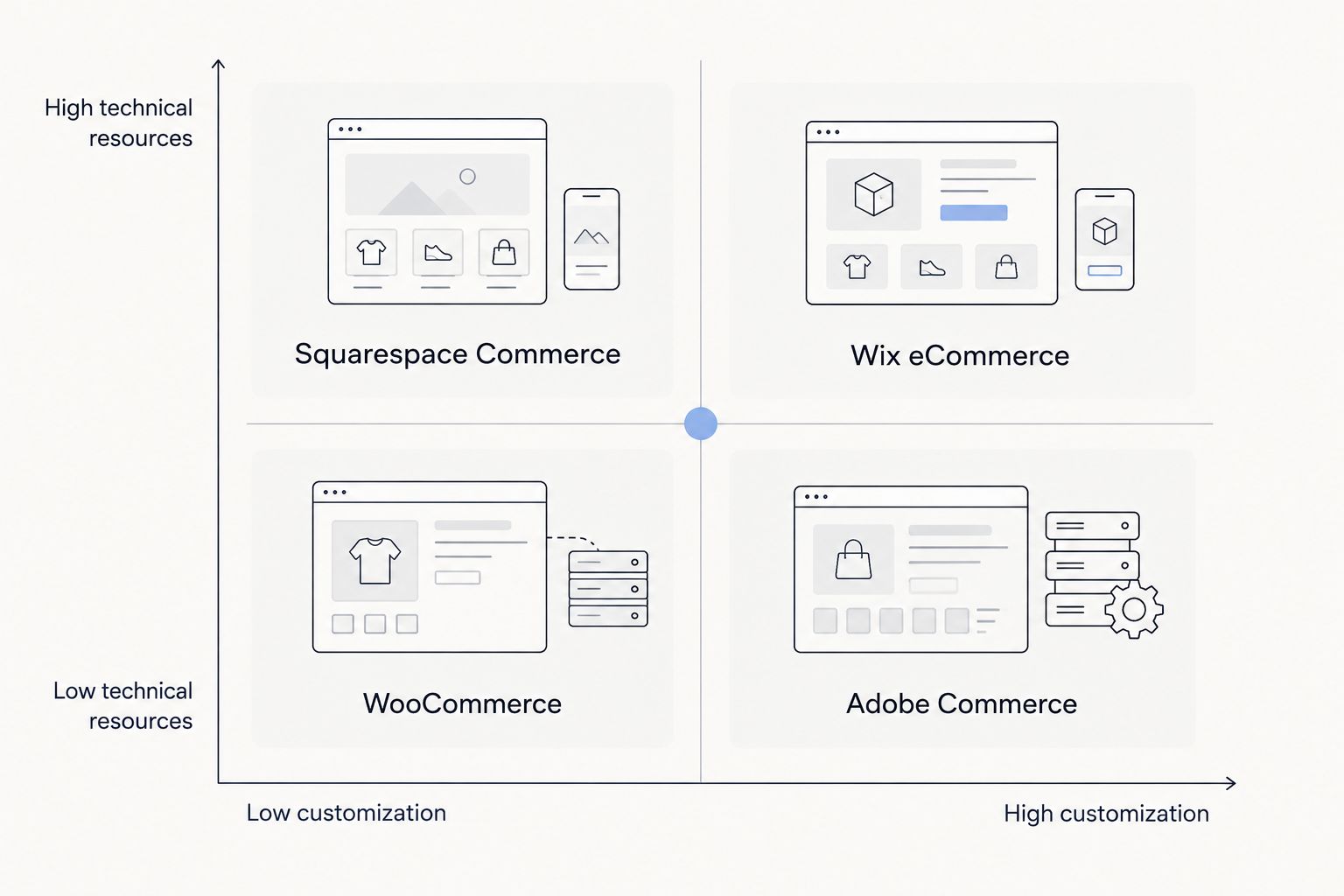
| Adobe Commerce | Enterprise catalogs | Custom workflow engine | Built for scale Shopify Plus struggles to match |
| Webflow Ecommerce | Design-led brands, smaller catalogs | Pixel-level layout control | Design freedom Shopify themes don't offer |
| Squarespace Commerce | Small catalogs, content-driven brands | Built-in blogging and design templates | Simpler setup, thinner ecommerce feature set |
1. BigCommerce: best for native B2B and multi-channel catalogs
BigCommerce ships with wholesale pricing tiers, multi-storefront support, and native integrations to marketplaces like Amazon and eBay — features Shopify handles through third-party apps. For a brand selling both direct-to-consumer and wholesale, that's fewer moving parts to maintain.
Where BigCommerce shines
- Built-in B2B pricing and customer groups, no app required
- Native multi-channel listings across major marketplaces
- No transaction fees tied to a proprietary payment gateway
Where BigCommerce falls short
- Smaller app marketplace than Shopify, so niche integrations are harder to find
- Theme customization still requires developer time for complex designs
- Smaller community means fewer public tutorials and troubleshooting threads
Best for: ecommerce brands running wholesale and DTC side by side. Verdict: Buy.
| Dimension | BigCommerce | Shopify |
|---|---|---|
| Native B2B pricing | Yes | Requires app |
| Multi-channel selling | Built-in | Built-in via apps |
| App ecosystem size | Smaller | Largest in the category |
| Theme flexibility | Moderate | High with paid themes |
2. WooCommerce: best for full code control on WordPress
WooCommerce turns a WordPress site into a store instead of forcing a store to behave like a website. Brands already publishing content on WordPress get commerce and content management in one place, with no platform lock-in on hosting.
Where WooCommerce shines
- Open-source, so there's no platform fee ceiling on features
- Deep content and SEO control through the WordPress ecosystem — relevant if organic search is a growth channel
- Plugin flexibility rivals Shopify's app store for most common needs
Where WooCommerce falls short
- You own hosting, security, and updates — no managed infrastructure
- Performance depends entirely on your hosting choice and plugin discipline
- Support is community-driven, not a single vendor's help desk
Best for: content-first brands already invested in WordPress. Verdict: Buy if you have dev resources on call; Wait if you don't.
| Dimension | WooCommerce | Shopify |
|---|---|---|
| Hosting | Self-managed | Fully managed |
| Platform fees | None | Monthly plan required |
| Content + SEO tooling | Deep (WordPress core) | Basic, app-dependent |
| Setup complexity | Higher | Lower |
3. Adobe Commerce (Magento): best for enterprise catalogs
Adobe Commerce handles catalog complexity Shopify Plus wasn't designed for — custom pricing logic, ERP integrations, and multi-brand architecture under one system. It's the platform brands migrate to when Shopify's app-stacking approach starts breaking under scale.
Where it shines: custom workflow engine, deep ERP/ sync capability, handles high SKU counts without performance drag.
Where it falls short: requires dedicated development resources; overkill for a catalog under a few thousand SKUs.
Best for: enterprise or high-SKU-count brands with in-house or agency dev support. Verdict: Buy for complex catalogs, Skip for small ones.
4. Webflow Ecommerce: best for design-led brands with smaller catalogs
Webflow gives design teams pixel-level control over layout without touching Shopify's Liquid templating. For brands where the site itself is a brand asset, not just a checkout, that control matters more than app-store depth.
Where it shines: layout freedom, fast page-load performance, strong CMS for editorial-style product pages.
Where it falls short: ecommerce feature set is thinner than Shopify's for large catalogs; fewer native payment and shipping integrations.
Best for: design-forward brands under a few hundred SKUs. Verdict: Buy for brand-led stores, Skip for high-SKU marketplaces.
5. Squarespace Commerce: best for small, content-driven catalogs
Squarespace bundles blogging, design templates, and basic ecommerce in one system, which suits brands where content drives discovery more than catalog breadth.
Where it shines: fastest setup among the alternatives, strong built-in design templates.
Where it falls short: limited B2B features, thinner app ecosystem, not built for catalogs over a few hundred SKUs.
Best for: small, content-first brands. Verdict: Hold until catalog size or B2B needs outgrow it.
Why brands switch from Shopify
- App costs stack up. Features BigCommerce or Adobe Commerce ship natively often require multiple paid Shopify apps to replicate.
- Checkout customization is limited outside Shopify Plus, which caps how much a brand can control the final conversion step.
- B2B and wholesale workflows are bolted on through apps rather than built into the core platform.
- Multi-brand or multi-storefront architecture gets harder to manage as a portfolio grows past a single storefront.
When staying with Shopify is the right call
If your catalog is under a few hundred SKUs, you're DTC-only, and you rely on the app ecosystem for marketing tools already, migrating off Shopify in 2027 creates more work than it solves. The platform isn't the bottleneck for every brand — check whether the real constraint is traffic, conversion, or retention before assuming the cart is the problem.
Choosing a platform is step one
Prospekt builds and grows ecommerce sites on Magento, Webflow, and WordPress alike.
FAQ
What’s the best Shopify alternative for B2B ecommerce brands in 2027?
BigCommerce is the strongest fit for B2B in 2027 because wholesale pricing tiers and customer groups ship natively, without stacking third-party apps.
Is WooCommerce better than Shopify for SEO?
WooCommerce gives deeper content and SEO control because it runs on WordPress core, but it requires more hands-on management than Shopify’s built-in setup.
How hard is it to migrate an ecommerce store off Shopify?
Migration difficulty depends on catalog size and integration count — a few hundred SKUs on a simple stack moves in weeks, while an ERP-synced enterprise catalog takes longer and needs dedicated development support.
Is Adobe Commerce worth it for a small ecommerce brand?
No — Adobe Commerce is built for high SKU counts and custom workflows, and it’s overkill for a catalog under a few thousand products.
Can you switch ecommerce platforms without losing SEO rankings?
Yes, with proper redirect mapping and technical SEO handling during the migration; SwamiG’s Magento 2 rebuild grew organic traffic 310% after migration rather than losing it.
What’s the best Shopify alternative for design-heavy DTC brands?
Webflow Ecommerce gives design teams pixel-level layout control that Shopify’s Liquid templates don’t offer, which suits brand-led stores under a few hundred SKUs.
Does switching ecommerce platforms guarantee more revenue?
No — the platform removes a technical ceiling, but revenue growth comes from the marketing and conversion work built around it, not the migration itself.
Is Squarespace Commerce good enough for a growing catalog?
Squarespace Commerce works well for small, content-driven catalogs but its B2B features and app ecosystem are thin once a catalog grows past a few hundred SKUs.
One last thing
The platform swap gets the attention, but the numbers that actually move a brand come from what happens after launch. Window Guard's shift wasn't the cart — it was 426 new leads and a 10x revenue increase in five months built on paid social, a catalog redesign, and local SEO layered on top of the new site. Russell Westbrook Enterprises saw mobile engagement rise 380% and B2B inquiries jump 2.3x after a division-specific Webflow rebuild, not from the platform alone. Before locking in a shopify alternative for 2027, map out how long growth marketing results typically take so the migration timeline and the growth timeline aren't running on different clocks. DTC brands weighing this decision alongside their broader growth stack can also check the current picture of DTC marketing agencies built for exactly this transition.
Related guides
- HubSpot alternatives in 2027
- Omnisend alternatives in 2027
- Adobe alternatives in 2027
- Best startup marketing agencies


