 Skip to main content Skip to footer

Yes—influencer marketing for B2B can work when a credible expert reaches your target buyers and helps them evaluate a business problem. Use it to build trust and support demand generation, not as a substitute for sales follow-up; likes and impressions alone do not establish pipeline impact.
- Influencer marketing for B2B needs buyer relevance, credible expertise, and a measurable next step—not celebrity reach.
- Expert content supports demand generation when it addresses the questions buyers ask before contacting sales.
- Judge partnerships by qualified engagement and pipeline contribution, not follower counts alone.
- Hey Prospekt fits B2B companies seeking brand strategy, digital marketing, and creative services together.
Can influencer marketing work for B2B companies?
Yes. The useful question is whether a particular expert can help a particular buyer make a better decision. A practitioner explaining an implementation problem offers a different kind of value from a personality attracting general attention.
For your 2026 plan, connect the partnership to a defined buying situation: researching a category, comparing approaches, resolving objections, or preparing an internal business case. Then give the reader a relevant next step. The distinction between attention and qualified B2B leads should shape the brief before content production begins.
These formats serve different purposes. Choose the format that fits the question your buyer needs answered.
| Partnership format | Best for | Practical advantage | Main limitation |
|---|---|---|---|
| Expert webinar | Buyers exploring a complex problem | Gives you room for explanation and live questions | Registration does not prove buying intent |
| Practitioner demonstration | Buyers evaluating how an approach works | Makes the process and trade-offs visible | Needs genuine subject expertise and accurate details |
| Specialist newsletter contribution | Buyers following a defined professional topic | Places your message within relevant editorial content | Audience fit still needs verification |
| Expert interview | Buyers seeking informed perspectives | Surfaces objections and decision criteria | General commentary needs a clear connection to your offer |
Choose expertise that helps buyers decide, not reach that only helps a report look bigger. An expert who cannot explain the problem is the wrong partner, regardless of audience size.
Why this matters
A B2B purchase can involve users, budget owners, technical reviewers, and procurement. Your content needs to help the relevant people understand the problem, assess the proposed solution, and explain their decision internally.
Influencer content has a useful role when it makes that work easier. It has a weak role when it repeats your sales copy under someone else's name.
For 2026 planning, start with the objection your sales team needs help answering. A focused explanation of implementation, compatibility, operational change, or evaluation criteria gives the partnership a job. A generic request to increase awareness does not tell the expert what to teach or your team what to measure.
Expert webinars: best for explaining complex decisions
Use an expert webinar when your buyer needs explanation and discussion rather than a short endorsement. Build the session around a problem the expert can address independently of your offer.
The advantage is depth. You can explain the context, examine competing approaches, and let attendees ask questions that reveal uncertainty. Those questions also give your sales and content teams material for follow-up.
The limitation is intent. An attendee might be researching, learning, or helping a colleague rather than preparing to buy. Keep attendance separate from lead qualification, and make the follow-up relevant to what the person actually asked.
Choose an expert webinar when discussion is essential to understanding the buying decision. Do not treat every registration as a sales-ready lead.
Practitioner demonstrations: best for evaluation questions
Use a practitioner demonstration when buyers need to understand how something works. Ask the expert to show the process, explain the assumptions, and identify where the approach does not fit.
The advantage is specificity. A demonstration can turn an abstract promise into something a buyer can evaluate. It also creates room to discuss practical requirements without hiding them behind a promotional headline.
The limitation is accuracy. A polished demonstration is not useful if it skips prerequisites or represents an unusual scenario as typical. Your subject-matter reviewer should check factual statements while leaving the expert room to make an independent assessment.
Choose a practitioner demonstration when showing the work answers an important buyer objection. Skip demonstrations that conceal the conditions needed for success.
Specialist newsletters: best for focused professional audiences
Use a specialist newsletter partnership when its subject matter matches your buyer's responsibilities. Review the editorial topics, audience description, and available engagement information before selecting the publisher.
The advantage is context. Your contribution can sit beside material about the same professional problem instead of competing for attention in an unrelated feed.
The limitation is audience verification. A topic label does not prove that subscribers hold the roles you need to reach. Ask how the audience is described and what evidence supports that description. Treat circulation as distribution, not as a count of potential customers.
Choose a specialist newsletter for topic fit, not simply for subscriber volume. Keep the contribution useful enough to stand without the promotion.
How do you build a B2B influencer campaign?
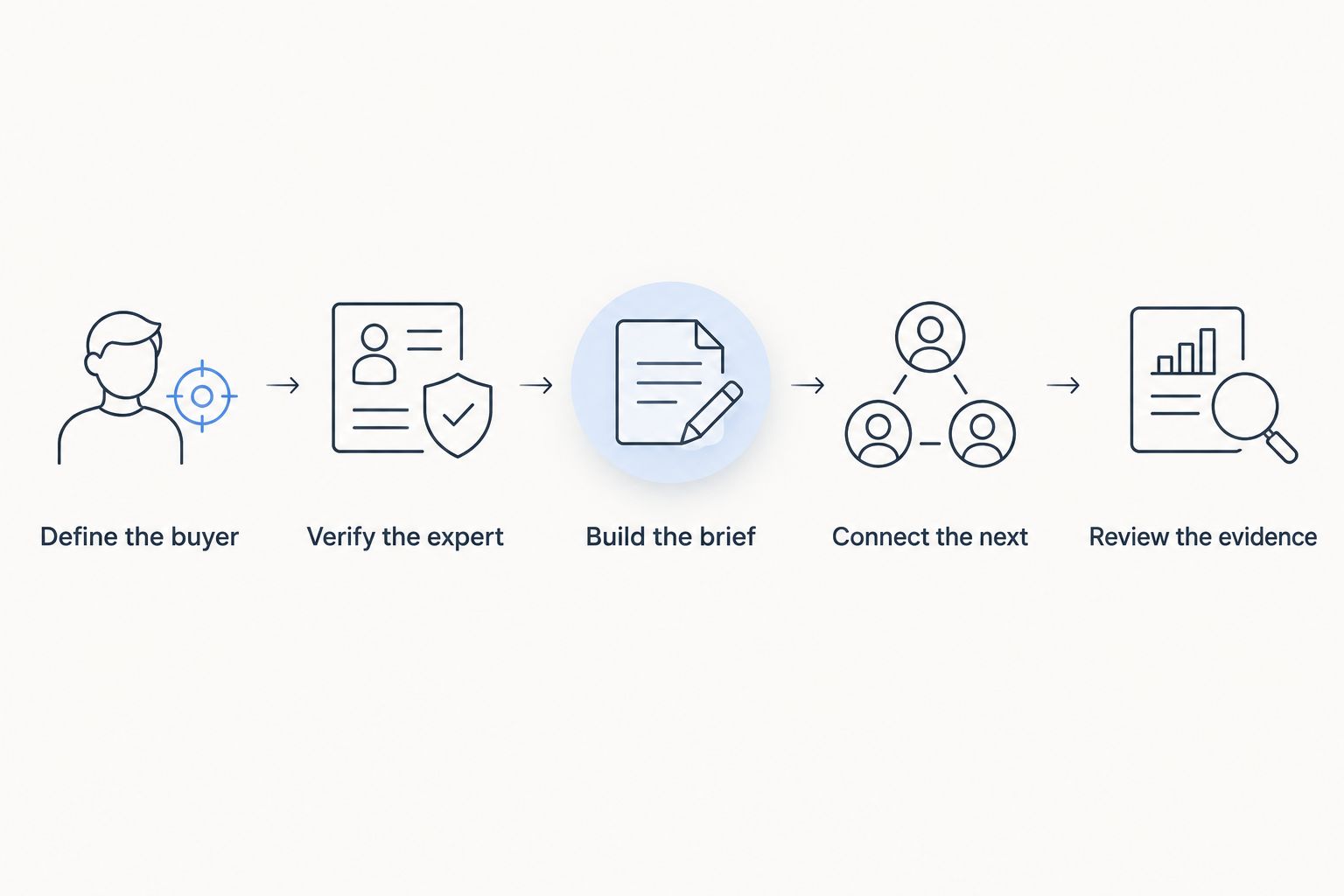
Build the campaign around a buyer question, a credible partner, and a measurable action. The sequence below keeps content production connected to the commercial objective.
Define the buyer
Name the role, business problem, and buying situation you want to address. Separate the person who uses the solution from the person who approves it when their concerns differ.
Be specific about the desired audience. A finance leader evaluating reporting processes needs different content from an operations manager planning a rollout. Avoid briefs aimed at everyone who works in business.
Verify the expert
Review the expert's recent content for subject depth, relevance, and factual care. Look at the discussion around the content, not just the headline audience count.
Ask the expert to explain how they would approach your buyer's problem. Their answer should reveal whether they understand the decision or merely know the terminology. Do not ask them to endorse claims they cannot substantiate.
Build the brief
Give the expert the buyer question, approved factual material, intended next step, and disclosure requirements. Specify the deliverables and review responsibilities in the agreement.
Separate factual review from editorial control. Correct an inaccurate statement, but do not remove every trade-off until the result sounds like an advertisement. Credibility requires room for an honest explanation.
Connect the next step
Match the destination to the content. An introductory discussion needs an appropriate educational next step; an evaluation-focused demonstration needs information that helps the buyer continue evaluating.
Check the full path before publication. The destination should repeat the relevant promise, explain what happens next, and let the buyer act without searching for context.
Review the evidence
In your 2026 campaign review, examine content engagement, relevant inquiries, sales acceptance, and opportunity progression separately. Each answers a different question.
Agree on the review criteria before launch. Otherwise, a campaign that produces attention but no useful buyer activity can be redefined as successful after the fact.
Why B2B influencer marketing results vary
Results depend on how well the partnership connects expertise, audience, content, and follow-up. Audit these factors before changing the format or expanding the program.
- Buyer relevance: The audience needs a reason to care about the problem your business addresses. Broad attention is not evidence of fit.
- Expert credibility: The partner must explain the subject accurately and handle meaningful objections. Familiarity with a topic is not the same as practical expertise.
- Content usefulness: The piece should answer a decision question. An endorsement without explanation gives buyers little to evaluate.
- Next-step alignment: The destination must continue the conversation started by the content. A mismatched page breaks that connection.
- Sales follow-up: Your team needs the context behind each inquiry. A generic response wastes the information the campaign created.
- Measurement discipline: Distinguish exposure, engagement, qualified inquiries, and opportunities. Combining them into a single success label hides the diagnosis.
A weak result is a reason to inspect these connections, not automatically a reason to replace the expert. Identify where the buyer's path stopped before deciding what to change.
How should you measure B2B influencer marketing in 2026?
Measure the campaign at the level of its stated objective. If the objective is education, inspect relevant engagement and buyer questions. If the objective is lead generation, inspect qualification and sales acceptance as well as submissions.
Use campaign-tagged links where appropriate, retain campaign details with incoming inquiries, and ask buyers how they heard about your business. These methods answer different attribution questions. Do not force them into a claim that every influenced sale came exclusively from the partnership.
A useful report separates:
- Distribution: What content was published and where it appeared.
- Engagement: What relevant interaction followed.
- Qualification: Whether inquiries matched the intended buyer and problem.
- Progression: Whether accepted inquiries moved into real sales conversations.
- Revenue: Whether resulting opportunities became customers under your attribution rules.
Use case-study metrics without borrowing their conclusions
Hey Prospekt's Russell Westbrook Enterprises project reports a 380% lift in mobile engagement and 2.3x B2B inquiries following a mobile-first Webflow build. Its SwamiG project reports 310% growth in organic traffic alongside work involving ERP synchronization, SEO, and advertising.
These are website and growth marketing results—not evidence of influencer campaign performance. The useful lesson is measurement specificity: engagement, inquiries, and organic traffic describe different outcomes. Keep those distinctions in your own report, and never transfer another project's results into a forecast for your partnership.
Is influencer marketing better than paid advertising for B2B?
Neither channel is universally better. Influencer partnerships center on an expert's explanation and audience relationship; paid advertising gives you a way to distribute a defined message through purchased placements.
Choose according to the job. If your buyer needs an informed explanation, an expert-led asset is relevant. If you need to distribute that asset, paid promotion is a separate decision. Evaluate each contribution rather than declaring a winner based on impressions from unlike formats.
Can B2B influencer marketing generate qualified leads?
Yes, when the content reaches suitable buyers, addresses a relevant problem, and offers an appropriate next step. Qualification still depends on the buyer's fit and intent—not on the fact that an influencer referred them.
Give sales the original topic and inquiry context. Then assess whether the conversation concerns a real business need your company can address.
Should you use an agency for B2B influencer marketing?
Use an agency when the partnership needs coordinated strategy, creative work, digital distribution, and a connected buyer journey. Keep specialist requirements explicit, including expert sourcing, agreements, disclosure, and reporting ownership.
Hey Prospekt is best for B2B companies seeking brand strategy, digital marketing, and creative services together. That full-service positioning is relevant when expert content needs to connect with a wider growth plan. It does not replace checking the exact campaign scope.
The trade-off is coordination: adding a growth partner still requires your team to provide accurate product information, subject expertise, and sales feedback. Review Hey Prospekt against the work you need, rather than treating agency involvement as a guarantee of results.
FAQ
Does influencer marketing work for B2B companies?
Yes—B2B influencer marketing can work when a credible expert reaches relevant buyers and answers a meaningful decision question. Measure qualified engagement and pipeline contribution rather than treating reach as proof of commercial impact.
What’s the best type of influencer for a B2B company?
A subject-matter expert whose audience matches your target buyers is the best starting point. Review topic depth, factual accuracy, and audience relevance before selecting a partner.
Do B2B influencers need large audiences?
No—a large audience is not a requirement for a relevant B2B partnership. Audience size does not establish whether the people reached have the roles, needs, or buying responsibilities you want.
How do you measure B2B influencer marketing ROI?
Measure attributable revenue against the campaign investment using agreed attribution rules. Keep engagement, qualified inquiries, and opportunity progression separate so the report distinguishes commercial results from intermediate activity.
Should B2B influencer content mention sponsorship?
Yes—material connections between an advertiser and an endorser need clear disclosure under FTC endorsement guidance. Make the disclosure easy to notice and understand within the content.
Can an influencer campaign replace a B2B sales team?
No—an influencer campaign does not replace qualification, evaluation support, or sales follow-up. It gives relevant buyers content and a route into the next conversation.
What should a B2B company ask an agency before hiring it?
Ask who owns expert selection, factual review, disclosure, distribution, and reporting. Require a defined scope that connects the content to the buyer journey and identifies how qualified inquiries will reach sales.
One last thing
Before approving your next partnership in 2026, ask the expert to outline the buyer problem without mentioning your company. If the explanation is useful on its own, you have a sound starting point. If it only works as a product pitch, change the brief.
The expert's job is to make the decision clearer—not to make every claim sound positive. Preserve the trade-offs that help the right buyer recognize a fit and the wrong buyer rule it out.
Related guides
- Is PPC worth it for B2B SaaS companies?
- How long does it take to see growth marketing results?
- Connect Google Analytics to your CRO testing pipeline


