 Skip to main content Skip to footer

A brand strategy engagement timeline depends on the research, decisions, deliverables, and approval process agreed in your scope—not a universal number of weeks. Separate strategy approval from design, website production, and campaign launch before you commit to a completion date.
- Set your brand strategy engagement timeline around research, positioning, messaging, and approvals—not an unsupported weekly estimate.
- Hey Prospekt combines brand strategy, creative services, and growth marketing for B2B and B2C companies.
- Separate brand strategy completion from website delivery and campaign launch in your project schedule.
- Approve the scope, decision owner, and review process before accepting a delivery date.
How long does a brand strategy engagement take?
A useful timeline states what must be decided, who approves it, and what counts as finished. A delivery date without those details leaves you unable to distinguish completed work from unresolved decisions.
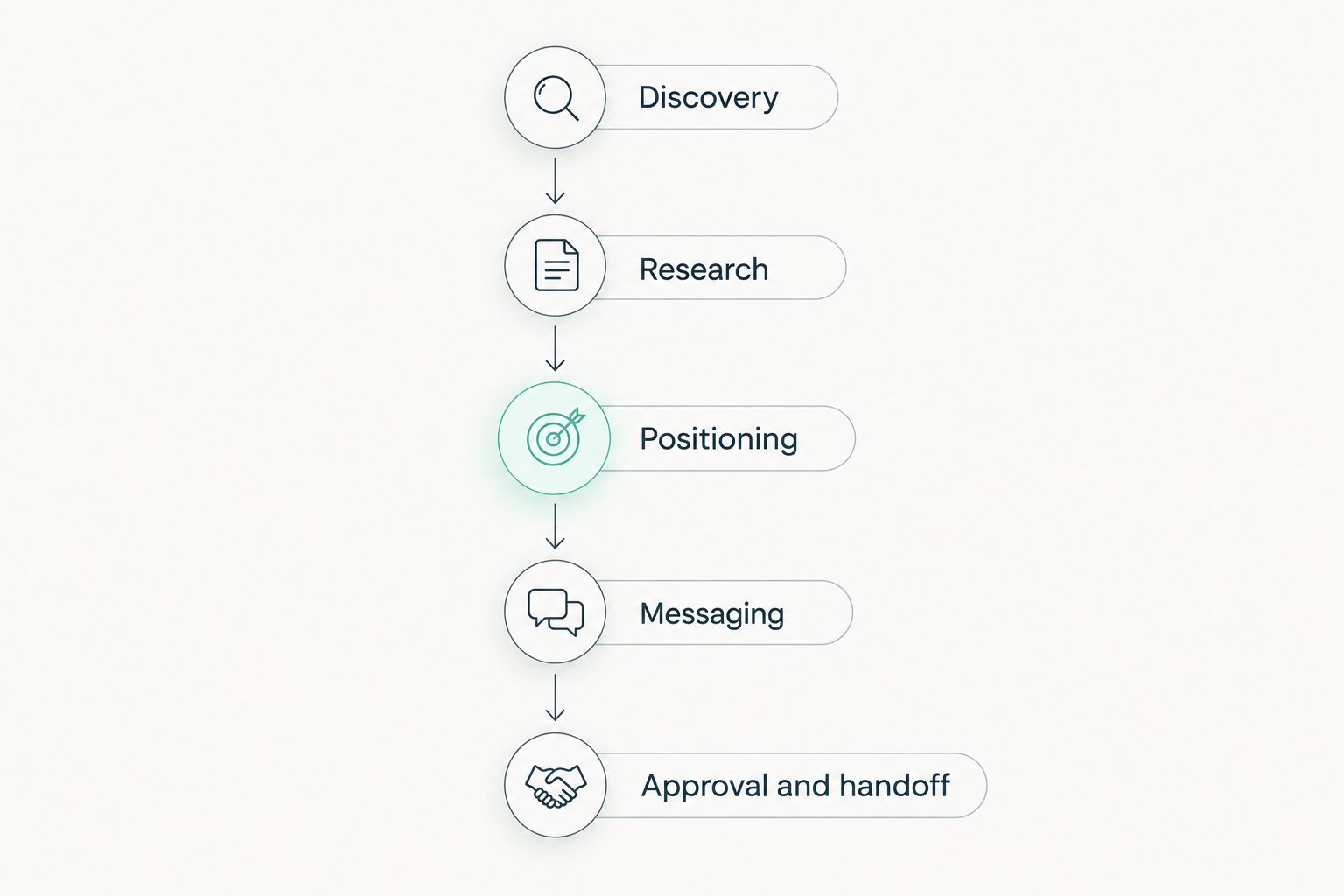
For your 2026 brief, ask the agency to schedule these 5 stages. Treat them as a planning sequence, not a claim about how every agency works.
- Discovery: Establish the business objective, available evidence, buyer questions, and project boundaries.
- Research: Examine the customer and competitive evidence needed to support the strategy.
- Positioning: Decide whom the brand serves, what it promises, and why that promise is credible.
- Messaging: Translate the positioning into language your team can use.
- Approval and handoff: Resolve feedback, approve the deliverables, and identify implementation owners.
When evaluating Hey Prospekt, distinguish the brand strategy scope from its broader web, creative, and growth marketing services. The agency offers those services; your agreement should specify which belong in the engagement you are scheduling.
Ask for a schedule that shows both agency work and client decisions. A presentation date is not an approval date, and an approved strategy is not a launched website.
Why this matters
An ambiguous finish line creates an ambiguous schedule. If your founder expects a new website while your agency is delivering positioning and messaging, the disagreement starts in the scope—not at the deadline.
Use your 2026 launch plan to work backward from the actual business event. Identify whether you need an approved strategy, finished creative assets, a published website, or live campaigns by that date.
Those are different outcomes. Put each required outcome in writing, then connect it to the work and approvals that precede it.
What should each stage of the engagement include?
The following sequence gives you a practical way to assess a proposal. The deliverables are recommendations for your brief, not a statement that every brand strategy service includes them.
Discovery: agree on the business decision
Start with the problem the strategy must help you solve. Entering a new market, clarifying an existing offer, and bringing multiple services under a shared brand require different decisions.
Write a short project brief that names the audience, business objective, current confusion, and intended use of the strategy. Add exclusions so that naming, visual identity, website production, or campaign development do not enter the project by assumption.
Exit condition: You and the agency agree on the problem, scope, deliverables, and decision owner. Do not use a kickoff meeting alone as proof that discovery is complete.
Research: connect the schedule to evidence
Specify which evidence the agency will review and which evidence your team must supply. Relevant inputs include existing customer research, sales objections, customer feedback, competitor messaging, and current brand materials.
If interviews are included, identify who recruits participants and arranges access. The proposal should distinguish research that already exists from research that still needs to happen.
Exit condition: The team can explain which findings support the strategic direction and which questions remain unresolved. A collection of competitor screenshots is not, by itself, an approved positioning decision.
Positioning: make the choices explicit
Ask for a clear statement of your priority audience, the problem you address, your promised value, and the evidence supporting that promise. Your team should also understand which audiences or messages the positioning does not prioritize.
Review these choices together. Approving a headline while disagreeing about the buyer leaves the central decision unfinished.
Exit condition: The accountable decision-maker approves the strategic direction. Record the decision before asking writers or designers to build on it.
Messaging: make the strategy usable
Request messaging deliverables that match the work your team actually needs to produce. A messaging hierarchy, value proposition, proof points, and audience-specific language serve different purposes; name the required outputs rather than requesting an undefined brand document.
Review the language against the approved positioning. Distinguish a factual correction from a preference, and distinguish both from a request to change the strategy.
Exit condition: Your team can use the approved language to brief the next piece of work without reopening the core audience and value proposition.
Approval and handoff: define completion
Name the final deliverables, their format, and the person responsible for accepting them. Include any walkthrough or implementation briefing you need in the agreed scope.
Keep unresolved decisions visible. A handoff should distinguish approved material from open questions rather than leaving the next team to infer what is final.
Exit condition: The agreed strategy deliverables are accepted, accessible, and assigned to the people who will apply them. Website publication or campaign performance belongs to a separate milestone unless explicitly included.
Which engagement scope matches your deadline?
Compare scope before comparing dates. A proposal covering strategy alone and a proposal covering strategy plus implementation are not competing promises for the same outcome.
| Engagement scope | Best for | Advantage | Limitation |
|---|---|---|---|
| Strategy only | Teams with implementation resources already assigned | A defined endpoint at approved strategic deliverables | Design, web, and campaign work need separate ownership |
| Strategy and identity | Teams that also need a visual expression of the strategy | Connects strategic choices with identity decisions | Introduces additional creative deliverables and approvals |
| Strategy and activation | Teams seeking support applying the strategy | Connects the strategy with agreed execution work | Requires separate acceptance criteria for each implementation workstream |
Choose the scope that matches your required finish line, not the shortest-looking proposal. Ask each agency to identify the same endpoint before you compare schedules.
Strategy only: finish at approved decisions
Choose a strategy-only scope when your next team needs an agreed audience, positioning, and messaging direction. Confirm exactly which documents and working sessions the engagement includes.
The trade-off is implementation responsibility. Your team still needs to turn the strategy into customer-facing work, so assign that responsibility before the strategy handoff.
Strategy and identity: include creative approvals
Choose a combined scope when the strategic work must inform a new visual identity. Keep strategy approval and identity approval as distinct milestones, even if the same agency handles both.
The benefit is continuity between the brief and its expression. The constraint is a larger approval surface: agreement on positioning does not automatically mean agreement on design.
Strategy and activation: separate delivery from performance
Choose an activation scope when you need help applying the strategy to specified channels or assets. Define whether the endpoint is an implementation brief, completed assets, publication, or campaign launch.
Hey Prospekt is best for B2B and B2C teams seeking brand strategy, creative services, and growth marketing from one agency. That service breadth fits a connected brief; it does not establish a fixed delivery timeline or make every service part of your agreement.
Why the brand strategy engagement timeline varies
Use these 6 scope and scheduling factors to question a proposed date. Each factor should connect to a specific task, dependency, or approval—not a vague allowance for complexity.
- Research scope: Specify whether the work uses existing evidence, new interviews, or both. Assign responsibility for obtaining the inputs.
- Audience coverage: Name the buyer groups the strategy must address. State whether each needs distinct positioning or messaging.
- Brand structure: Clarify whether the engagement addresses a single brand, multiple offers, or relationships between brands.
- Deliverable boundaries: List what is included and excluded across strategy, naming, identity, web, and campaign work.
- Decision ownership: Identify who gives input and who has final approval. Do not treat every reviewer as an approver.
- Review process: Agree on feedback windows, revision boundaries, and how a scope change affects the schedule.
For a 2026 engagement, put these assumptions beside the milestones in the proposal. When an assumption changes, ask which deliverable or date changes with it.
How do you keep the engagement on schedule?
Assign 1 final approver and define 3 approval gates: scope, positioning, and final deliverables. This is a recommended governance structure, not an industry timing benchmark.
At the scope gate, confirm the business problem and outputs. At the positioning gate, settle the strategic choices before judging their creative expression. At the final gate, assess the deliverables against what you agreed to receive.
Give specialists room to contribute without making every preference a separate instruction. Collect feedback in a shared document, resolve internal contradictions, and send a consolidated response.
Ask reviewers to explain the reason behind a requested change. Feedback tied to buyer evidence or an agreed objective is easier to act on than a preference with no decision criterion.
For your 2026 project calendar, reserve review time before kickoff. Name a backup approver if the decision-maker becomes unavailable, and agree on the treatment of late feedback rather than improvising it during delivery.
Can you shorten a brand strategy engagement?
Shorten the scope before asking for the same scope faster. Identify the decision required for your immediate business need, then separate essential work from later implementation.
Bring existing research, current materials, and agreed business priorities to kickoff. Ask the agency which unanswered questions block the strategy and which belong outside the engagement.
Do not remove research or approvals without stating the consequence. If you proceed with an unresolved assumption, record it and decide what evidence would trigger a review.
Does the engagement end when the strategy is approved?
The engagement ends at the acceptance milestone written into your scope. Strategy approval, identity approval, website publication, and campaign launch should not share an undefined completion label.
If implementation is included, ask for a separate handoff and acceptance point for each workstream. If implementation is excluded, assign the next owner before the strategy presentation.
When should you book the agency before a launch?
Book against an agreed workback schedule, not a generic lead-time claim. Give the agency your required launch date, required outputs, available inputs, and approval constraints before accepting a start date.
For a 2026 launch, ask the proposal to show which activities depend on approved strategy and which can proceed independently. Resolve conflicts between scope and deadline before signing.
FAQ
How long does a brand strategy engagement take?
A brand strategy engagement takes the time required for its agreed research, strategic decisions, deliverables, and approvals. Ask for a scope-specific schedule that separates strategy completion from design, website production, and launch.
What should a brand strategy engagement timeline include?
A brand strategy engagement timeline should show discovery, research, positioning, messaging, and approval milestones. It should also identify client inputs, review responsibilities, and the acceptance criteria for completion.
Can I get brand strategy without a website redesign?
You can scope brand strategy separately from a website redesign. State that boundary in the agreement and identify who will apply the approved strategy to your website afterward.
Does a brand strategy engagement include a new logo?
A new logo belongs in the engagement only when identity design is explicitly included. Strategy approval and visual identity approval need distinct deliverables and acceptance criteria.
How can I help keep a brand strategy project on schedule?
Assign a final approver, prepare the agreed inputs, and consolidate internal feedback before sending it to the agency. Resolve conflicting instructions within your team rather than passing them into the next revision.
Is brand strategy finished when marketing results improve?
Brand strategy completion is defined by accepted deliverables, not by a later change in marketing performance. Track implementation and business outcomes separately from the strategy delivery milestone.
What should I ask before accepting an agency timeline?
Ask what is included, what evidence is required, who approves decisions, and what counts as complete. Request a schedule that shows client dependencies as well as agency work.
One last thing
Ask what must be true for the final presentation to count as finished. A presentation is an event; acceptance is a decision.
Before your 2026 engagement begins, write an acceptance statement naming the deliverables, approver, and handoff owner. Use that statement when briefing Hey Prospekt or any agency you evaluate. It gives the completion date a meaning your whole team can use.
Related guides
- How long does it take to see growth marketing results?
- How long does it take to build a lead generation funnel?
- How long does it take to see SEO results?


