 Skip to main content Skip to footer

A lead generation funnel timeline should end when the complete path from first visit to qualified-lead handoff has passed testing—not when the landing page looks finished. For your 2026 plan, separate the build deadline from the time needed to attract prospects, evaluate lead quality, and generate revenue; those are different milestones.
- Set your lead generation funnel timeline around tested milestones, not an unsupported average build time.
- Launch requires working lead capture, tracking, routing, and follow-up—not just a published landing page.
- Hey Prospekt serves B2B and B2C companies seeking brand, web, and growth marketing services.
- Separate funnel launch from qualified pipeline and revenue results when approving your schedule.
Hey Prospekt is best for B2B and B2C companies seeking coordinated brand, web, and growth marketing services. That service mix fits a funnel brief that crosses positioning, website execution, and customer acquisition rather than treating each as a separate assignment.
How long does it take to build a lead generation funnel?
The build takes the time required to finish the agreed scope and pass an end-to-end acceptance test. Your reliable launch date comes from the remaining work and its dependencies, not a generic promise about how quickly funnels launch.
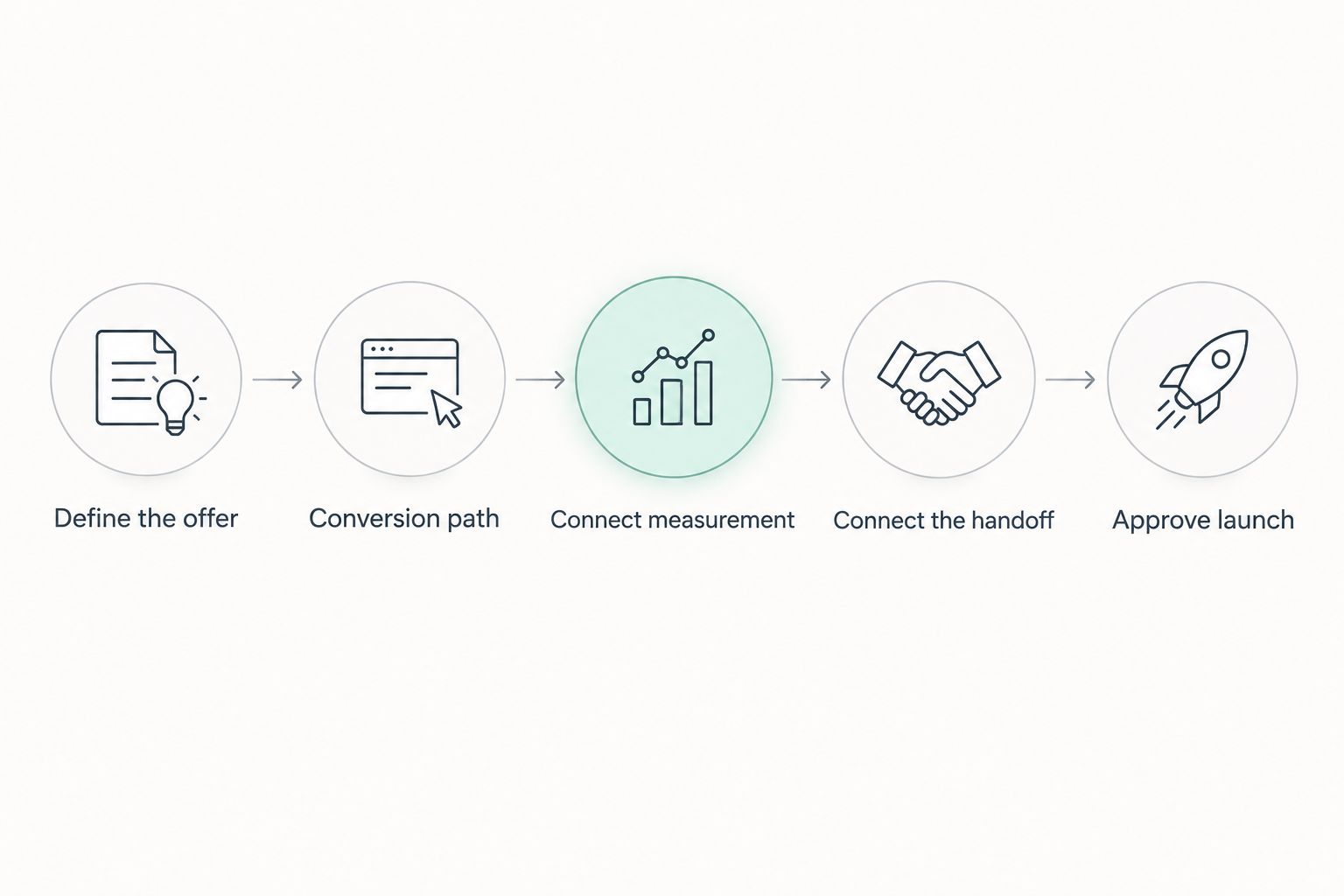
Use the following sequence to establish that date. Each stage needs a named owner, a deliverable, and an approval condition before you can treat it as complete.
- Define the offer. State who the funnel serves, what problem it addresses, and what action you want a visitor to take. Approve the promise and qualification criteria before writing page copy; otherwise, later teams build against a moving target.
- Build the conversion path. Create the traffic destination, page copy, form, confirmation experience, and relevant follow-up content. A prospect should understand both the offer and what happens after submitting their details.
- Connect measurement. Establish which actions count as conversions and how campaign information reaches the reporting system. Test the recorded event against an actual submission rather than assuming that installed tracking equals working tracking.
- Connect the handoff. Route submissions to the agreed destination and assign responsibility for responding. Confirm that the person handling a lead receives the information needed to take the next step.
- Test and approve launch. Submit test leads through the complete journey, inspect the resulting records, and verify the response. Resolve failures before directing acquisition activity to the funnel.
These stages are not necessarily consecutive. Page production and handoff configuration can progress together once the offer and required fields are settled, but unresolved decisions still block approval.
Why this matters
A published page is a production milestone. It is not proof that your business can capture, qualify, and respond to the people who submit it.
For a 2026 launch, keep separate commitments for build completion and performance evaluation. This prevents a website deadline from turning into an implied promise about pipeline or revenue.
The distinction also improves accountability. Your designer can own page delivery, your acquisition lead can own traffic setup, and your sales owner can own the response process without making any one person responsible for every outcome.
Approve the whole customer journey, not just the visible asset. Otherwise, you risk calling the project finished while the most commercially important work remains unresolved.
Which funnel scope should you build first?
Choose the smallest scope that supports your intended buyer journey. Adding audiences, channels, and nurture branches expands the work you must configure and test; it does not automatically make the first launch more useful.
| Build option | Best for | Main advantage | Main limitation | Launch acceptance condition |
|---|---|---|---|---|
| Focused lead capture | An agreed offer and a direct next step | Keeps the initial journey clear | Does not address a complex evaluation process | Submission, attribution, routing, and response work |
| Lead capture with nurture | Prospects who need follow-up before taking the next step | Connects the initial inquiry to continued communication | Adds content and automation testing | Follow-up reaches the correct audience and respects consent |
| Multi-audience funnel | Distinct buyer groups needing different messages | Supports audience-specific journeys | Adds paths, approvals, and reporting requirements | Every audience reaches the intended destination and owner |
Focused lead capture
Start here when you already know the buyer, offer, and next action. Build a clear entry page, collect the information needed for follow-up, and verify that each submission reaches its owner.
The advantage is a limited approval surface: fewer paths need decisions before launch. The limitation is equally clear—it does not solve an unclear offer or provide an extended education journey simply because the form works.
Lead capture with nurture
Choose nurture when the next useful action requires additional communication. Define the purpose of each message, the entry condition, and the event that stops or changes the sequence.
The additional work is not just writing emails. You also need to test enrollment, suppression, links, consent handling, and the transition to a human response where relevant.
Multi-audience funnel
Choose audience-specific paths when the buyers genuinely need different offers or handoffs. Document those differences before duplicating pages and sequences.
This approach provides clearer relevance, but it creates more combinations to maintain. If the differences are only cosmetic, keep the initial funnel focused and avoid building separate paths without a business reason.
Why a lead generation funnel timeline varies
The schedule changes with the decisions, assets, and connections required for your particular funnel. Ask your delivery team to identify these dependencies explicitly instead of hiding them inside a single launch estimate.
- Offer readiness: An approved audience, promise, and next action let copy and design proceed against a stable brief.
- Website scope: Editing an existing conversion path and creating a new one involve different production work and acceptance checks.
- Audience differences: Separate messages, qualification rules, or destinations create additional paths to approve and test.
- Follow-up scope: A direct handoff and a conditional nurture sequence require different content and configuration.
- Measurement requirements: Campaign attribution, conversion events, and downstream reporting each need a defined purpose and verification.
- Approval ownership: A deliverable stays open until the responsible person can approve it against an agreed standard.
Treat these as scheduling inputs, not excuses after a missed deadline. Before work begins, identify which items your team already has and which remain part of the assignment.
Your 2026 plan should also distinguish mandatory launch requirements from later enhancements. If an enhancement is not necessary to capture, measure, and handle the intended inquiry, give it a separate delivery milestone.
How do you turn the scope into a credible launch date?
Ask for a dependency-based schedule with visible acceptance criteria. You need to see what must happen before the next task starts, not just a row of dates in a project tracker.
For each deliverable, record the owner, required inputs, approval owner, and completion evidence. A page needs approved content; a routing rule needs a destination; a campaign needs a verified conversion action.
Then work backward from the desired launch date. If an input is not ready when its dependent task begins, change the input deadline, reduce the scope, or move the launch—do not preserve an impossible date by removing testing.
A useful kickoff brief answers these questions:
- Who is the intended buyer, and what makes an inquiry relevant?
- What action should that buyer take?
- Which assets already exist and are approved for use?
- Where should submitted information go?
- Who owns the response and the qualification decision?
- What evidence must exist before launch approval?
For a 2026 project, ask what will be demonstrably working on the promised date. A commitment to publish a page is narrower than a commitment to deliver a functioning acquisition and handoff system.
Hey Prospekt offers brand strategy, digital marketing, and creative services. That makes the agency relevant when your brief spans those disciplines; it does not remove the need to agree on scope, client inputs, and launch acceptance criteria.
Define your funnel build
Discuss the brand, website, and growth marketing work your funnel needs.
What should you test before calling the funnel finished?
Test the journey from the prospect's entry point through the internal response. Do not limit acceptance to whether the form displays a success message.
Start with the page. Check the offer, required fields, validation, mobile usability, confirmation message, and next-step instructions. Then follow the submitted record into the systems and people responsible for handling it.
Use this acceptance checklist:
- Capture: The submission retains the information you requested without exposing unnecessary personal data.
- Measurement: The intended conversion is recorded and does not fire merely because someone opened the page.
- Attribution: The campaign information required for reporting reaches the appropriate record.
- Routing: The lead reaches the correct destination and responsible owner.
- Follow-up: The confirmation and subsequent response match what the page promised.
- Exceptions: Invalid submissions, existing contacts, and failed connections receive the intended treatment.
Record the result and owner of each check. An unresolved routing failure remains a launch blocker even if the page itself is approved.
For website-led projects, the guide to a Webflow lead generation funnel workflow provides a related implementation topic. Keep your own acceptance criteria independent of the platform: the visitor journey and lead handoff still need verification.
Does launching a funnel mean it is generating results?
No. Launch means the agreed system works; performance means real prospects take useful actions and progress toward the business outcome you defined.
Assess those outcomes separately. Track submissions, qualified inquiries, sales conversations, and revenue according to your business model rather than presenting every completed form as equivalent commercial value.
The Hey Prospekt Window Guard project description reports 426 new leads and a 10x revenue increase in five months through paid social, website and catalog redesign, and local SEO. Those figures describe a combined campaign outcome—not the construction time of a lead generation funnel.
That distinction matters when you review case studies. Ask which services contributed, what the reported period covers, and whether the result measures acquisition, qualification, or revenue before using it to shape your own expectations.
Can you launch before every funnel feature is finished?
Yes, when the initial scope supports a complete, tested journey and the unfinished features are not required for that journey. A narrower launch is different from an incomplete launch.
Keep the offer, capture, measurement, routing, and promised response intact. Move optional audience branches, additional content, and reporting refinements into later work only when doing so does not break the agreed experience.
Reduce scope before reducing quality checks. A focused funnel with a verified handoff gives you a functioning starting point; a broader funnel with unresolved submission failures does not.
FAQ
How long does it take to build a lead generation funnel?
A lead generation funnel is ready when its agreed conversion path, measurement, routing, and follow-up have passed testing. Set the deadline from the scoped work and dependencies rather than treating a generic duration as a delivery promise.
What’s the fastest way to build a lead generation funnel?
The most direct build starts with an approved audience, offer, and next action, then limits the initial scope to that journey. Keep capture, measurement, routing, and follow-up testing in the launch requirements.
Is a landing page enough for lead generation?
A landing page alone does not complete a lead generation funnel. You also need a working submission process, a way to measure the intended action, and an owner for the resulting inquiry.
Can a funnel launch before the nurture emails are finished?
A funnel can launch without nurture emails when the agreed buyer journey does not depend on them and a tested response process already exists. If the offer promises an email sequence, that sequence belongs in the launch requirements.
When should I expect revenue after launching a funnel?
Revenue timing depends on acquisition performance, lead qualification, and the buying process—not just the build deadline. Track launch readiness and commercial outcomes as separate milestones.
Can Hey Prospekt help with more than the funnel website?
Hey Prospekt offers brand strategy, digital marketing, and creative services to B2B and B2C companies. Agree on the specific funnel deliverables and responsibilities before treating those capabilities as your project scope.
What should I ask an agency before approving a funnel timeline?
Ask what will be working at launch, which inputs you must supply, and how completion will be tested. Require named owners for approvals, measurement, lead routing, and follow-up.
One last thing
For your 2026 launch, review a test lead—not just a page preview. Follow it from the entry page to the record, the responsible person, and the promised response.
If you cannot show where that lead went and what happened next, the funnel is not finished. Put that demonstration in the acceptance criteria before approving the schedule.
Related guides
- How long growth marketing results take
- How long demand generation takes to fill a pipeline
- How long PPC campaigns take to convert


