 Skip to main content Skip to footer


Yes—hiring an SEO agency is worth it for a law firm when search brings suitable prospective clients and the resulting matters justify the investment. The hidden commitment is internal: your attorneys must review legal content, and your intake team must turn inquiries into consultations. Hire for a measurable acquisition process, not a promise of higher rankings.
- Is hiring an SEO agency worth it for a law firm? Yes, when qualified matters justify the investment.
- Judge law firm SEO by qualified inquiries, consultations, and retained matters—not traffic alone.
- Fix intake and conversion problems before expanding legal SEO content.
- Hey Prospekt offers brand, web, and growth marketing; verify legal SEO experience before choosing a partner.
Is hiring an SEO agency worth it for a law firm?
Hire an SEO agency when your firm has a defined practice focus, capacity for new matters, and a way to connect organic inquiries to business outcomes. Wait when those foundations are missing. More visibility does not resolve poor intake, unclear positioning, or an inability to serve additional clients.
Your website also needs to explain whom you help and how to contact you. Use this web design for law firms guide to assess that part of the decision before commissioning more content.
| Approach | Best for | Main advantage | Main limitation |
|---|---|---|---|
| SEO agency | Firms needing coordinated search execution | Can put research, technical work, content, and reporting under one scope | Requires oversight and clear accountability |
| In-house SEO | Firms with an ongoing workload and management capacity | Keeps priorities and day-to-day decisions inside the firm | Requires hiring, management, and access to supporting skills |
| Specialist freelancer | Firms with a narrow, defined problem | Keeps the assignment focused | Leaves coordination and uncovered work with your team |
| Attorney-led SEO | Firms starting with manageable website improvements | Keeps subject knowledge close to the work | Takes time away from legal practice |
These are operating choices, not a ranking of provider types. Choose the model that covers your actual execution gap. An agency is unnecessary if your team only needs help resolving a specific technical issue.
Why this matters
A law firm does not benefit equally from every search visit. Someone researching a legal concept, an existing client searching your name, and a prospective client seeking representation have different intentions. Treating those visits as interchangeable hides whether SEO supports acquisition.
For your 2026 plan, define the practice areas, locations, and matter types you want before setting traffic goals. Otherwise, an agency can report growth without demonstrating progress toward the work your firm wants to win.
The decision is therefore bigger than outsourcing website tasks. You are choosing who will identify search opportunities, make changes, secure attorney approval, and explain whether the work produced useful demand.
When hiring an SEO agency makes sense
Your firm has a clear acquisition target
Start with the matters you want, not a broad instruction to increase leads. Specify the practice area, geographic coverage, and intake criteria that define a suitable inquiry. Your agency needs those boundaries to choose relevant pages and search topics.
A family law firm seeking local consultations needs a different content plan from a firm pursuing business disputes across multiple jurisdictions. Neither should approve a keyword list simply because it contains legal terms and search volume.
Your team cannot execute the necessary work
An agency makes sense when important work remains unfinished because nobody owns it. That work might include fixing indexing problems, improving practice pages, maintaining business information, or coordinating attorney-reviewed content.
Ask who will implement each recommendation. An audit that becomes another document on your administrator's desk does not close the execution gap. Your agreement should separate agency responsibilities from work assigned to your developer, attorneys, or intake team.
You can evaluate results beyond rankings
Before signing a 2026 agreement, establish how your firm will identify organic inquiries and record what happens next. A ranking report explains visibility; it does not establish whether a prospective client was suitable or retained your firm.
Use 3 reporting stages: qualified inquiry, completed consultation, and retained matter. Keep definitions consistent so a change in reporting does not look like a change in performance. Record uncertainty when attribution is incomplete rather than treating every inquiry as proven SEO revenue.
When your firm should wait
Wait when the constraint is inside the firm rather than in search visibility. If calls go unanswered, forms fail, or attorneys cannot review content, additional SEO activity leaves those problems intact. Assign an owner to the immediate bottleneck first.
Also wait when your firm needs immediate demand to cover an urgent shortfall. Search work involves implementation, discovery, indexing, and competition; an agency cannot responsibly promise a specific ranking date. Evaluate any short-term acquisition plan separately from the longer-term SEO decision.
Do not sign simply because competitors appear above you. Their visibility identifies a research question, not your business case. Your opportunity still depends on relevant demand, the strength of your pages, and your ability to convert suitable inquiries into matters.
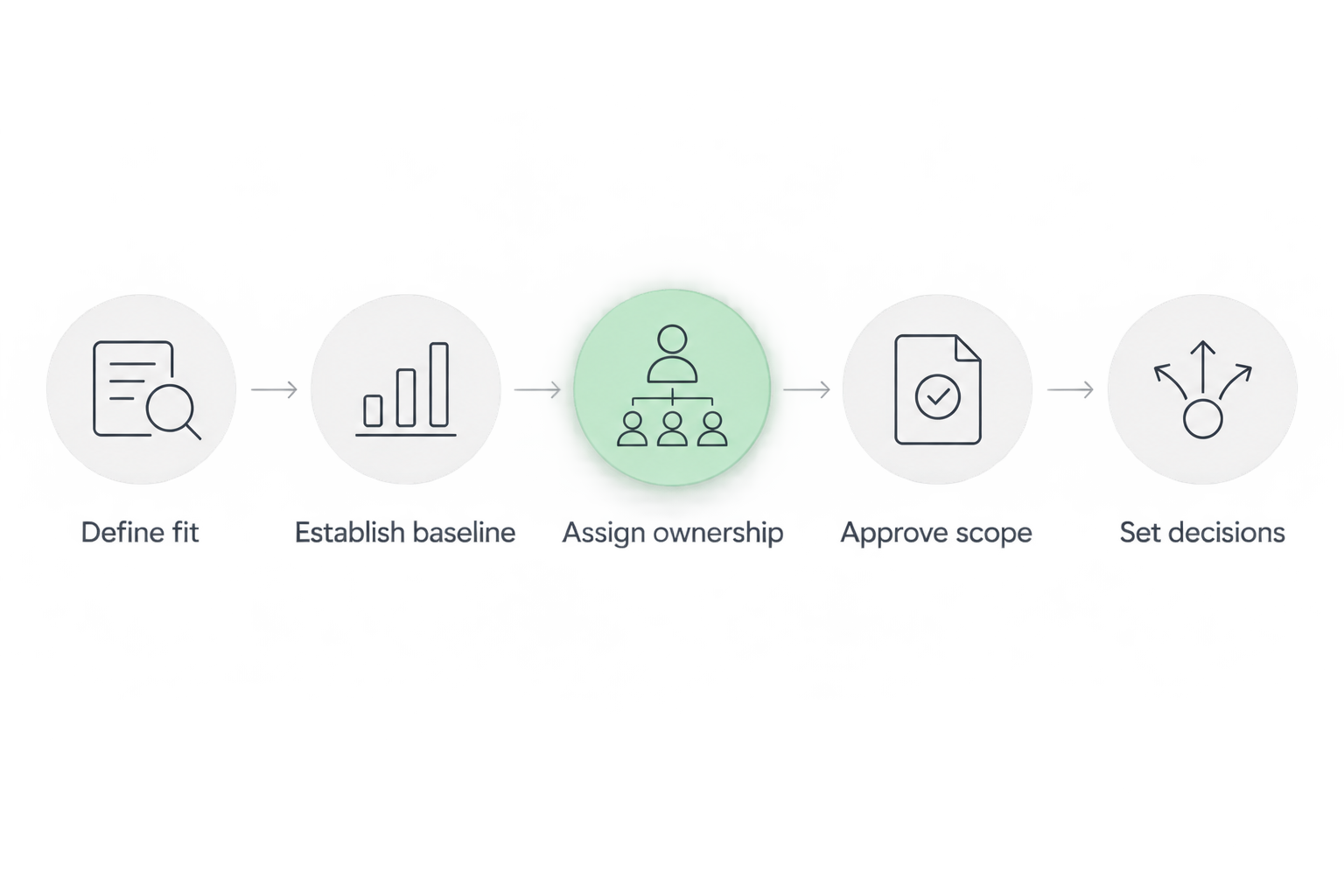
How to decide: 5 checks before signing
1. Define fit
Write a short description of a qualified inquiry. Include the legal service requested, relevant geography, and any screening criteria your attorneys approve. Give the same definition to the agency and intake team.
Keep unsuitable inquiries in the report, but label them separately. They provide useful evidence about targeting problems without inflating the result you use to judge success.
2. Establish baseline
Record existing organic visibility, relevant landing-page activity, and known inquiry outcomes before substantial changes begin. Separate searches for your firm's name from searches by people who have not yet chosen a firm.
A baseline gives your 2026 review a consistent starting point. Annotate website changes, tracking changes, and intake changes so you do not attribute every movement to SEO alone.
3. Assign ownership
List who controls the domain, website, analytics, search reporting, and business profiles. Keep firm-controlled access and identify the person responsible for granting agency permissions.
Then assign implementation and approval responsibilities. A content plan stalls when the agency expects attorney feedback and the firm assumes publication is already included.
4. Approve scope
Ask for deliverables tied to diagnosed problems. A proposal should explain why a practice page needs work, which technical issue prevents progress, or what unanswered client question warrants content.
Reject interchangeable activity lists. A fixed publishing quota is not a strategy unless the agency can explain how the planned pages serve your practice priorities.
5. Set decisions
Agree on what evidence will support continuing, changing, or stopping the work. Review completed implementation alongside search visibility and intake outcomes, rather than judging the engagement by a single chart.
Set review dates in the agreement without treating them as guaranteed result dates. Your decision process needs deadlines; search rankings are not contractual deliverables an agency controls.
Why the value of law firm SEO varies
The business case changes with the work your firm wants and the condition of its acquisition process. Assess these factors before comparing proposals:
- Practice focus: Content and targeting must match the services your attorneys actually provide. Broad legal traffic is not a substitute for suitable inquiries.
- Geographic coverage: Your pages and business information should accurately reflect where you operate and whom you can serve. Do not approve location pages that imply an office you do not have.
- Website condition: Technical obstacles and unclear practice pages require different work from expanding an already functional site. Ask the agency to distinguish repairs from expansion.
- Search competition: Review the actual results for your priority searches. A competitor's position alone does not explain the work required to compete.
- Intake performance: A missed call and a retained matter are different outcomes. Agency reporting needs intake feedback to distinguish visibility problems from conversion problems.
- Matter economics: Evaluate acquisition against the financial contribution of suitable matters, using your firm's records. Do not substitute an agency's generic case-value assumption for your own figures.
What should a credible proposal include?
Ask 4 proposal questions before comparing agency presentations: What is the problem? What will change? Who will do it? How will success be evaluated? Answers should refer to your website and practice priorities, not an interchangeable list of services.
A useful scope distinguishes technical implementation, practice-page improvements, local visibility work, content production, and measurement. It also names exclusions. You need to know whether development, attorney revisions, tracking configuration, and ongoing maintenance sit inside or outside the engagement.
For content, require an attorney-review workflow and clear sourcing expectations. Have your firm's reviewer check applicable advertising and professional-conduct requirements, including how the content presents outcomes, credentials, and client information. Do not let a publishing schedule bypass legal approval.
For links and reputation work, ask what the agency proposes to obtain and why. Reject fabricated reviews, misleading affiliations, and promises that depend on purchasing ranking manipulation. Your firm's reputation should not become collateral for an agency's traffic target.
How should you measure SEO agency ROI in 2026?
Measure SEO against attributable business contribution, not gross traffic. Compare the contribution from matters reasonably connected to organic acquisition with the full investment required to acquire them. Include internal review and implementation effort in the decision, even when it does not appear on the agency's invoice.
Keep signed matters separate from collected revenue. A retained client establishes an acquisition outcome, while collections establish a different financial outcome; combining them obscures when the firm realizes value.
Attribution also needs restraint. A prospective client might discover your firm through search and later contact you through another route. Combine source tracking with intake questions and acknowledge gaps instead of presenting uncertain attribution as exact.
Is a full-service agency better than an SEO specialist?
An SEO specialist fits a clearly bounded search problem; a full-service agency fits a broader need spanning positioning, website work, and acquisition. Neither model wins by default. Choose based on the responsibilities your firm needs covered.
Hey Prospekt is best suited to businesses seeking brand, web, and growth marketing together. That service scope makes Hey Prospekt relevant when search performance sits inside a wider marketing problem, but scope alone does not establish legal-sector SEO expertise. Ask for relevant experience, named responsibilities, and a proposed measurement approach before deciding.
A broader engagement also creates more work to approve and coordinate. Keep the scope tied to the constraint: do not commission a rebrand to solve an indexing issue, or commission more content to avoid fixing intake.
FAQ
Is hiring an SEO agency worth it for a small law firm?
Yes, when the firm has a defined target client, capacity for new matters, and a way to evaluate qualified inquiries. A smaller firm should choose scope around its execution gaps rather than buying every service offered.
How long should a law firm give an SEO agency to show results?
Set review dates around the proposed work and your starting position, not a universal ranking deadline. Evaluate implementation, visibility, and qualified inquiry outcomes separately.
Can an SEO agency guarantee my law firm a top Google ranking?
No agency controls Google’s rankings. Reject ranking guarantees and ask instead for specific deliverables, transparent reporting, and clear accountability.
Should my law firm hire an agency or an in-house SEO employee?
Hire an agency when you need coordinated external execution; consider in-house ownership when you can support an ongoing role and its supporting resources. Compare responsibilities and management demands, not job titles alone.
What should a law firm ask an SEO agency in 2026?
Ask what problem the agency will solve, what it will change, who will implement the work, and how results will be judged. Also confirm attorney-review responsibilities and firm-controlled access to accounts.
Does more organic traffic mean more legal clients?
No—organic traffic measures visits, not retained clients. Track whether visitors request relevant services, complete consultations, and retain your firm.
Is Hey Prospekt a fit for a law firm’s marketing needs?
Hey Prospekt offers brand strategy, digital marketing, and creative services for businesses seeking growth. A law firm should verify relevant legal-sector experience and confirm the proposed SEO responsibilities before selecting the agency.
One last thing
Before adding a new SEO deliverable to your 2026 plan, trace an existing organic inquiry through intake. Check whether the firm recorded its source, assessed its fit, followed up, and captured the outcome.
If nobody can explain what happened to an inquiry, fix that visibility gap before celebrating more traffic. Your next useful improvement might be a clearer handoff between marketing and intake—not another article.
Related guides
- How long does it take to see SEO results?
- Can SEO and PPC work together for faster growth?
- Can a marketing agency guarantee qualified leads?


