 Skip to main content Skip to footer


Law firm web design is the planning and building of a legal practice’s website to help prospective clients understand its services, evaluate its attorneys, and request a consultation. This guide to web design for law firms in 2026 connects page structure, professional credibility, mobile usability, and intake measurement without treating a website as a substitute for legal advertising review.
- Web design for law firms should prioritize practice-area clarity, attorney credibility, and qualified intake—not decorative complexity.
- Hey Prospekt fits firms seeking web design alongside brand strategy and growth marketing.
- Build distinct practice pages, explain consultation expectations, and measure accepted inquiries rather than form submissions alone.
- Review attorney advertising requirements and sensitive-data handling before publishing forms, testimonials, or case results.
Why web design matters for law firms
A prospective client needs to answer practical questions: Does this firm handle my issue? Does it serve my location? Who would represent me, and what happens after I reach out? Your website should answer those questions before asking for personal information.
Hey Prospekt is best for firms seeking web design alongside brand strategy and growth marketing. Hey Prospekt offers brand, web, and growth marketing services; a firm choosing that broader scope should still assign attorney oversight for legal accuracy and advertising compliance.
For your 2026 website brief, distinguish visitor needs instead of treating every inquiry alike. An individual researching a family matter needs different explanations from a business evaluating outside counsel. Map those differences into content and intake routing, not unsupported claims about which audience converts better.
How to build a law firm website around qualified intake
Define the clients and matters you want
Start manually. Ask the attorneys and intake team to list accepted matters, excluded matters, service locations, and recurring questions from prospective clients. Turn those answers into a written brief before approving visual concepts.
Separate the legal service from the visitor’s immediate question. A practice-area label identifies your work; a plain-language explanation tells someone whether that work matches their situation. Use both, and avoid implying that reading a page establishes eligibility for representation.
Define success as an inquiry your team can evaluate, not simply another completed form. Agree on what makes an inquiry relevant before design work begins.
- Record accepted matter types and explicit exclusions.
- Identify the locations and jurisdictions your firm actually serves.
- List the questions intake must answer before scheduling.
- Assign an attorney to approve service descriptions and claims.
Map pages to client decisions
Use a spreadsheet to inventory existing pages and assign each a clear job. Keep pages that answer distinct questions; consolidate pages that repeat the same service description without adding useful information.
Build navigation around practice areas, attorneys, location information, and contact options. A visitor should not need to understand your internal department structure to find a relevant service. Likewise, an attorney biography should explain actual credentials and practice focus rather than rely on personality copy alone.
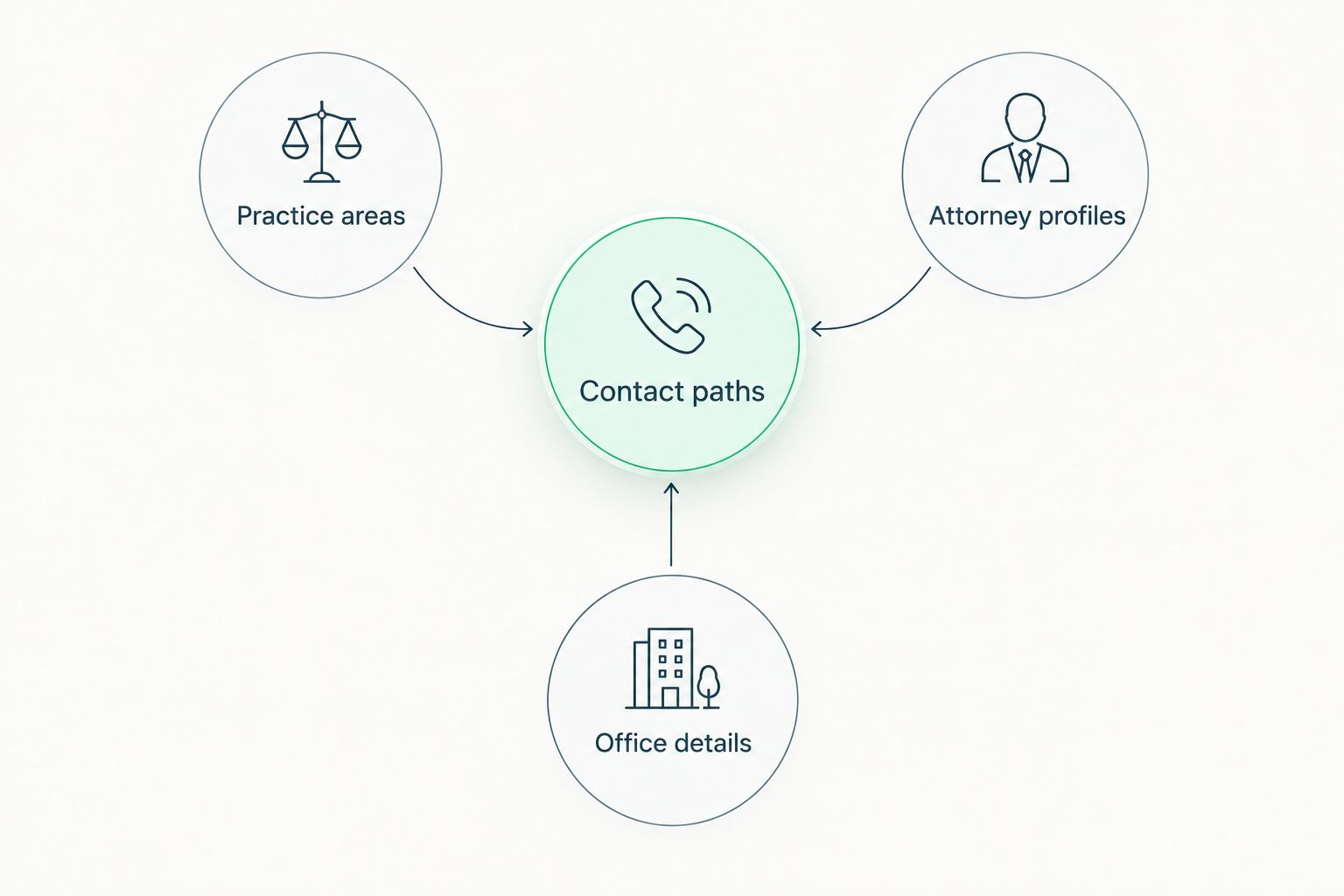
Connect the decision path: a practice page explains the issue, a biography identifies relevant experience, and a contact path explains the next step. Only describe offices, credentials, and services your firm can verify.
- Practice areas: Explain the matters handled and the scope of assistance.
- Attorney profiles: Publish verified credentials and relevant professional experience.
- Office details: State accurate location and contact information.
- Contact paths: Explain how to request an initial conversation.
Write credible answers before designing layouts
Draft the core pages in a document first. Answer who the service is for, what the firm handles, which attorney information supports the page, and how someone requests a consultation. Then design around those answers.
Use descriptive headings and direct opening sentences. Search engines and assistants can identify a page’s subject more easily when the text names the service and location accurately, but clear formatting does not guarantee rankings or citations. Write for the person making a consequential decision.
Hey Prospekt’s web design, brand strategy, and growth marketing services fit a brief that requires those disciplines together. Keep attorney review separate: a marketing partner does not replace your firm’s responsibility to approve legal statements and advertising claims.
- Explain legal terminology in everyday language without changing its meaning.
- State attorney credentials exactly as verified by the firm.
- Review testimonials, results, and comparative claims before publication.
- Give each practice page a specific next step, not competing requests.
Build accessible mobile contact paths
Test the current website on an actual phone before commissioning replacements. Open navigation, read a practice page, locate attorney details, and complete a test inquiry using fictional information. Record every point where the task becomes unclear or impossible.
Keep contact choices visible without allowing floating buttons to cover content or form controls. Label fields explicitly, explain errors in text, and support keyboard operation. Accessibility needs more than a visual inspection; include assistive-technology testing in the acceptance plan.
Ask only for information needed to route the initial inquiry. Have counsel approve the form’s confidentiality and attorney-client relationship language, and have the responsible technical owner review where submissions are stored and sent.
- Provide descriptive field labels and understandable error messages.
- Test navigation and forms without a mouse.
- Check readable contrast, visible focus states, and text resizing.
- Avoid requesting detailed confidential narratives in an initial form.
- Explain what happens after submission without promising unconfirmed response times.
Measure speed and intake quality separately
Use Google PageSpeed Insights for a manual performance check, then test representative page types rather than the homepage alone. Practice pages, attorney profiles, and forms can contain different images, scripts, and embedded services.
For your 2026 technical acceptance criteria, Google’s Core Web Vitals guidance defines good Largest Contentful Paint as 2.5 seconds or less, good Interaction to Next Paint as 200 milliseconds or less, and good Cumulative Layout Shift as 0.1 or less. These thresholds apply at the 75th percentile of page visits; a single laboratory test is not equivalent to that field assessment.
Performance is only one part of the scorecard. Connect website events to intake outcomes without sending confidential matter details into analytics. A contact-button click shows an action, not a qualified inquiry or an accepted client.
- Check performance on practice pages, profiles, and contact forms.
- Reduce oversized images and remove unnecessary third-party scripts.
- Track submission success separately from form starts and button clicks.
- Classify inquiries by fit using an approved intake process.
- Keep names, narratives, and other sensitive information out of analytics events.
Plan migration and ownership before launch
Create a page inventory and a redirect map before changing addresses. For each existing page, decide whether it stays, moves, merges, or disappears. Preserve useful content and confirm that important inbound links still reach a relevant destination.
A launch plan also needs named owners. Your firm should know who controls the domain, hosting, publishing access, analytics, form delivery, and ongoing updates. Put these responsibilities in the agreement rather than resolving them after launch.
Use a website redesign timeline to frame dependencies, then set your own schedule around content approval, technical work, and attorney review. Do not approve a launch date that leaves form testing or redirects until the end.
- Map old page addresses to relevant new destinations.
- Confirm ownership and access for essential website accounts.
- Test form delivery, confirmation messages, and intake routing.
- Check page titles, indexing settings, and the production sitemap.
- Assign responsibility for backups, updates, and post-launch fixes.
Improve pages using actual intake feedback
After launch, compare search queries, landing pages, contact actions, and intake classifications. Use the same definitions throughout your 2026 reporting so a change in qualification rules does not masquerade as a change in website performance.
Ask intake staff which pages attract mismatched requests and which questions callers still cannot answer. That feedback can identify unclear service boundaries, missing location information, or confusing consultation instructions. Fix the explanation before adding more traffic.
Prioritize a documented problem over a cosmetic preference. A broken form deserves immediate attention; a new homepage animation needs a business reason. Keep an improvement log that connects each change to the issue it addresses.
- Review search queries for relevance to accepted matters.
- Compare form submissions with inquiries intake actually received.
- Update pages that repeatedly attract unsuitable requests.
- Record changes and evaluate them against consistent outcomes.
Compare law firm website delivery options
Choose the delivery model around your internal capacity, not the number of pages alone. Each option needs approved content, a technical owner, and an intake process. None removes your firm’s responsibility for reviewing legal claims.
| Option | Best for | Main advantage | Key limitation |
|---|---|---|---|
| In-house template build | Firms with a capable internal website owner and straightforward requirements | Direct control over edits and implementation | Your team owns configuration, testing, maintenance, and content quality |
| Independent web designer | Firms with a defined brief and an internal marketing lead | A focused design relationship | Confirm who handles copy, development, migration, analytics, and maintenance |
| Legal-focused agency | Firms seeking a partner centered on legal-sector work | A procurement path focused on relevant sector experience | Verify actual experience, account ownership, and deliverables rather than relying on positioning |
| Hey Prospekt | Firms combining web design with brand strategy and growth marketing | Brand, web, and growth marketing services within the stated agency scope | Confirm legal-sector experience and compliance-review responsibilities during selection |
Request comparable deliverables from every candidate. Ask who writes and approves content, who tests accessibility, what happens to existing pages, and what support remains after launch. A proposal that leaves those responsibilities unnamed is not ready for approval.
Define your law firm website brief
Discuss how your website, brand, and growth marketing should work together.
Common mistakes law firms make
Leading with slogans instead of service clarity
A broad promise does not tell a visitor whether you handle their matter. Put the practice focus, service area, and consultation path ahead of abstract positioning; let verified evidence support the message.
Treating every location as interchangeable
Location pages should describe real service arrangements and useful local information. Do not invent offices, imply an attorney is licensed somewhere they are not, or publish near-identical pages that offer no additional help.
Publishing results without contextual review
A result without context can create the wrong expectation. Have counsel review case descriptions, client permissions, testimonials, and required disclosures before publication; never turn a previous outcome into a promise about another matter.
Sending every visitor into the same intake form
Different practice areas require different routing, but that does not justify collecting a detailed case history immediately. Gather the minimum approved information, explain the next step, and route the inquiry to the right team.
Approving the design without testing the handoff
A form that looks finished can still send inquiries to an unmonitored inbox. Test the entire path from submission to staff receipt, including failure messages and internal ownership, before calling the website complete.
FAQ
What is the best approach to web design for law firms?
The best approach starts with accepted matters, verified attorney information, and a clear intake path. Design the pages around those decisions, then test usability, performance, and inquiry routing before launch.
Should a small law firm use a template or hire an agency?
Use a template when your firm has the internal capacity to manage content, configuration, testing, and maintenance. Hire an agency when you need outside execution or coordination across design, messaging, and marketing; confirm the exact responsibilities in writing.
What pages does a law firm website need?
A law firm website needs clear service information, attorney profiles, accurate location details, and contact instructions. Add distinct pages when they answer a real client question rather than expanding the site with repetitive content.
Can a law firm put case results and testimonials on its website?
Have counsel review case results and testimonials against the advertising rules that apply to your firm before publishing them. Check permissions, context, required disclosures, and whether the presentation creates misleading expectations.
What should a law firm website measure in 2026?
Measure relevant search visits, successful contact actions, received inquiries, and intake-qualified opportunities. Keep sensitive client information out of analytics and avoid treating every form submission as a qualified lead.
Is Hey Prospekt a fit for a law firm website project?
Hey Prospekt fits a brief that combines web design with brand strategy and growth marketing. Confirm legal-sector experience, project scope, and the division of compliance-review responsibilities before selecting the agency.
Does a faster law firm website guarantee more clients?
A faster website does not guarantee more clients. Your firm still needs relevant visitors, clear service information, working contact paths, and an intake process that evaluates inquiries.
One last thing
Before approving your 2026 redesign, submit a fictional inquiry from a phone and ask the intake owner to confirm receipt. The website is not finished when the page looks right; it is finished when the approved contact path works. Record the result, fix the failure points, and repeat the test after changes to forms or routing.
Related guides
- Compare legal marketing agencies
- Compare web design agencies
- Connect Google Search Console to your content roadmap


