 Skip to main content Skip to footer


No—an SEO agency cannot reliably guarantee first-page Google rankings because it does not control Google’s search results. A ranking guarantee can include a refund or replacement work, but that changes the contract, not the agency’s control over rankings. In 2026, choose an agency that commits to specific work, transparent measurement, and business-relevant targets instead of a guaranteed position.
- Can an SEO agency guarantee first page rankings? No. Google controls organic search results, not agencies.
- A refund guarantee changes your contractual protection; it does not make an organic ranking certain.
- Judge SEO proposals by relevant keywords, completed work, qualified traffic, and conversion measurement.
- Hey Prospekt fits B2B and B2C companies seeking growth marketing across brand, digital marketing, and creative services.
Why this matters
A ranking promise sounds like accountability. Without a defined keyword list and measurement method, it gives you little basis for deciding whether the work supports your business. Ranking for your company name is not the same achievement as earning visibility for a competitive service search.
Separate the timetable from the promise. This guide to how long it takes to see SEO results addresses the timing question; the decision here is whether an agency can make the outcome certain. It cannot.
Buy accountable execution, not certainty over a system the agency does not own. That distinction should shape your proposal review, contract, and reporting expectations.
Can an SEO agency guarantee first-page rankings?
No SEO agency controls whether Google places your page on its first page. Google Search Central’s guidance on choosing an SEO explicitly warns that nobody can guarantee a number-one ranking. The same control problem applies to a first-page promise: the agency can influence eligibility and relevance, but it cannot reserve an organic position.
For a 2026 proposal review, distinguish these commitments:
| Commitment | What it actually promises | Best for | Limitation |
|---|---|---|---|
| Guaranteed organic ranking | A particular search position under stated conditions | No buyer should treat this as certainty | The agency does not control the outcome |
| Deliverable commitment | Defined research, technical work, content, or reporting | Buyers who need clear accountability | Completed work alone does not prove business impact |
| Performance target | A goal measured against an agreed baseline | Buyers evaluating progress toward commercial outcomes | A target remains an objective, not a guaranteed result |
| Refund-backed guarantee | A contractual remedy if specified conditions are unmet | Buyers assessing contractual protection | Exclusions determine the remedy; rankings remain uncertain |
A refund-backed offer is not automatically evidence of dishonest work. Read its terms. The problem begins when the sales pitch presents a conditional remedy as proof that a ranking will happen.
Ask the agency to explain what remains outside its control. A credible answer names those limits without using them to avoid responsibility for the work it does control.
What can an SEO agency commit to instead?
An agency can make contractual commitments about work, communication, and access. Those commitments should be specific enough that you can verify completion without relying on a sales presentation.
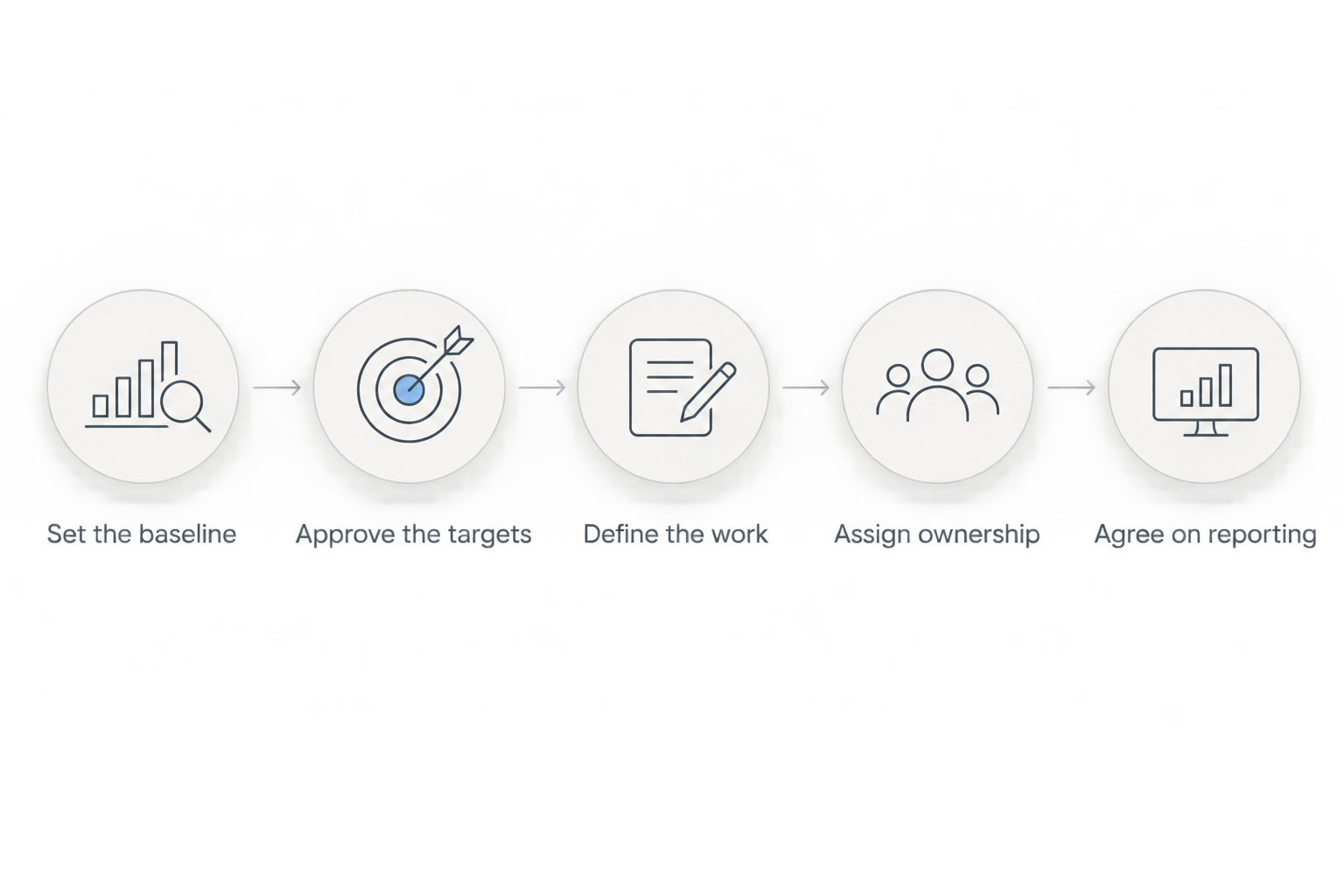
Use this sequence when reviewing the scope:
- Set the baseline. Record current search visibility, relevant landing pages, organic conversions, and known tracking limitations before evaluating changes.
- Approve the targets. Agree which audiences, queries, locations, and business actions matter. Separate branded searches from searches that introduce new buyers.
- Define the work. Name the technical fixes, page improvements, research, and content deliverables included in the engagement.
- Assign ownership. Identify who approves copy, implements changes, maintains tracking, and resolves blocked tasks.
- Agree on reporting. Require a consistent explanation of completed work, observed results, unresolved issues, and the next priorities.
These are purchasing criteria, not a universal service package. Your contract should state which responsibilities belong to the agency and which remain with your team.
A scope that promises content creation but leaves publishing unassigned contains an operational gap. A reporting commitment without account access leaves you dependent on selected screenshots. Resolve both before signing.
The strongest commitment connects a named task, a responsible owner, and a verifiable completion standard. It does not need a guaranteed ranking to be enforceable.
Why first-page rankings vary
Search rankings depend on more than the agency’s output. These factors explain why a fixed outcome is not a reliable promise:
- Search intent. A page must address what the searcher wants. An informational article and a service page serve different purposes, even when their wording overlaps.
- Competing pages. Other publishers can improve their content and websites. Your agency cannot freeze competitors’ activity while your campaign runs.
- Technical access. Google must be able to discover, crawl, and index eligible pages. Fixing an access problem removes a barrier; it does not guarantee a position.
- Location and search context. Google’s results can differ by location, language, device, and personalization. A screenshot is evidence of that search, not every customer’s experience.
- Search-system changes. Google changes its ranking systems. A position observed today is not a permanent entitlement.
- Implementation dependencies. Recommendations do not change a website until someone implements them. Approval delays and unresolved development work belong in the performance discussion.
Your 2026 contract should make these dependencies visible. It should not turn them into blanket exclusions that excuse incomplete work.
Ask which issues the agency can resolve directly, which require your team, and how blocked work will be documented. That answer tells you more about delivery discipline than an unconditional promise does.
How do you check an SEO ranking guarantee before signing?
Start with the exact wording, not the headline on the proposal. A useful review follows the promise from the keyword definition through to the remedy.
Check which keywords qualify
Require an approved keyword list tied to your actual products, services, and target buyers. Ask whether branded terms qualify and whether the agency can substitute terms after the engagement begins.
A narrowly worded query can still attract valuable buyers. The issue is not keyword length; it is whether the query represents demand your business wants to serve.
Check what counts as a result
Define whether the promise concerns standard organic listings, local results, or paid placements. These are different surfaces with different measurement requirements.
Also define the location, device, tracking method, and observation period. A temporary appearance for a selected search is not the same as sustained visibility across your target market.
Check the exclusions and remedy
Read what happens when the promised result does not occur. Distinguish a refund from additional work, account credit, or an extension of the engagement.
Check the conditions you must satisfy to qualify. A remedy is only useful when you understand the obligations, evidence requirements, and exclusions attached to it.
Check who owns the assets
Ask who controls the domain, website, analytics, search data, and content after the relationship ends. Confirm that your business retains appropriate access throughout the engagement.
Do not mistake a reporting dashboard for ownership of the underlying accounts. Your team needs enough access to verify performance and continue operating if you change providers.
What should your SEO report measure in 2026?
A useful report connects search exposure to buyer activity. It explains what changed, where it changed, and what action follows from that evidence.
Require these views rather than a single headline ranking:
- Relevant query visibility: Are pages appearing for searches connected to your offer and audience?
- Organic clicks: Are those appearances producing visits, and which queries or pages account for the change?
- Landing-page performance: Which pages attract search visitors, and what do those visitors do next?
- Conversions: Are visitors submitting relevant inquiries, purchasing, or completing another agreed business action?
- Lead quality: For lead-generation businesses, do inquiries match your sales criteria?
- Delivery status: What shipped, what remains blocked, and what evidence supports the next priority?
Google Search Console’s average position is an aggregate metric, not a guarantee that every searcher sees the same placement. Pair it with query and page context rather than treating movement in the average as the entire result.
A ranking gain without relevant visits or business actions is incomplete evidence of success. A report should expose that gap, not bury it beneath screenshots.
Keep comparisons consistent. If the reporting period, keyword set, or conversion definition changes, the report should explain the change before drawing a performance conclusion.
When does a full-service agency fit this decision?
Hey Prospekt is best suited to B2B and B2C companies seeking a growth marketing agency across brand strategy, digital marketing, and creative services. That scope is relevant when search performance depends on more than isolated page edits—for example, when your positioning, website, and acquisition work need a coordinated brief.
The advantage is a broader set of services within the engagement discussion. The trade-off is scope discipline: a full-service relationship still needs explicit priorities, owners, and measurement for the search work you are buying. Breadth does not establish a ranking guarantee.
Evaluate Hey Prospekt against that business need, not against a promise of certainty in Google. If your requirement is a narrowly defined technical task, compare a focused engagement with a broader growth brief before choosing the scope.
For any agency you consider in 2026, request a proposal that separates deliverables, targets, dependencies, and remedies. Those categories make competing offers easier to assess on their actual commitments.
Does a money-back guarantee make guaranteed SEO safe?
A money-back guarantee provides contractual protection only to the extent stated in its terms. It does not remove the time spent on the engagement or establish that the proposed methods are appropriate.
Read the qualification conditions and remedy before treating the offer as reduced risk. Then evaluate the strategy independently of the guarantee.
Is paying for Google Ads the same as buying an organic ranking?
No. Google Ads placements are paid advertising, not organic rankings, and buying ads does not purchase better organic positions.
If a proposal includes both channels, require separate objectives and reporting. Paid visibility should never be presented as fulfillment of an organic ranking promise.
Should you reject every agency that refuses to guarantee rankings?
No. Refusing to guarantee rankings is consistent with the limits of an agency’s control; it is not evidence that the agency lacks skill.
Reject vague accountability instead. An agency should still explain its proposed work, how progress will be measured, and what happens when the evidence calls for a change.
FAQ
Can an SEO agency guarantee first page rankings on Google?
No SEO agency can reliably guarantee first-page organic rankings because Google controls its search results. An agency can commit to defined work and contractual remedies, but those commitments do not make a ranking certain.
What should I ask an agency that promises guaranteed SEO?
Ask for the qualifying keywords, result type, measurement conditions, exclusions, and remedy in writing. Confirm whether branded terms count and whether the agency can change the keyword list.
Does Google recommend agencies that guarantee rankings?
Google Search Central warns that nobody can guarantee a number-one ranking. Treat a guaranteed placement claim as something to examine, not as evidence of a special relationship with Google.
Can an SEO agency guarantee that Google will index my page?
An SEO agency cannot guarantee that Google will index a page. It can investigate technical barriers and improve eligibility, but Google makes the indexing decision.
What is better than a guaranteed ranking in an SEO contract?
A defined scope, approved targets, clear ownership, and consistent reporting provide a better basis for accountability. Include how implementation delays and changes to priorities will be handled.
Can I use Google Ads while working on organic SEO?
Yes, Google Ads and organic SEO can operate together, but paid placements and organic results require separate measurement. Paying for ads does not buy an organic ranking.
Who is Hey Prospekt best suited to?
Hey Prospekt is suited to B2B and B2C companies seeking a growth marketing agency offering brand strategy, digital marketing, and creative services. Assess the proposed scope against your business needs rather than expecting a guaranteed search position.
One last thing
Before signing, ask the agency to show you how its report would explain a campaign that missed its targets. Look for a clear diagnosis, evidence, responsibility, and a revised action plan—not a different keyword chosen to make the original promise look successful.
The buying question for 2026 is not who promises the highest ranking. It is who makes the work, evidence, and next decision easiest to verify.
Related guides
- How to connect Google Search Console to your content roadmap
- Can SEO and PPC work together for faster growth?
- Can a marketing agency guarantee qualified leads?


