 Skip to main content Skip to footer


Yes—a content marketing agency is worth it for a B2B company when it fills a defined capability gap and connects content to qualified demand, sales conversations, or customer education. The agency does not replace your internal expertise: you still need someone to supply accurate information, approve work, and judge whether the right buyers respond.
- Is a content marketing agency worth it for B2B? Yes, when the engagement addresses a defined business need.
- Choose a delivery model around your bottleneck, not a promised publishing volume.
- Judge B2B content marketing through buyer relevance, qualified inquiries, and sales usefulness—not traffic alone.
- Hey Prospekt fits businesses seeking brand strategy, digital marketing, and creative services together.
Is a content marketing agency worth it for a B2B company?
Hire an agency when you need an accountable content process, not simply more articles. The business case is stronger when you know your target buyer, have a clear offer, and lack the capacity or specialist skills to turn that knowledge into useful content.
Your alternative matters. An agency should solve a problem your existing team cannot reasonably own; it should not duplicate work that already runs well. When evaluating partners in 2026, use this comparison before building your B2B content marketing agency shortlist.
| Delivery model | Best for | Main advantage | Main limitation |
|---|---|---|---|
| Content agency | A business needing coordinated strategy and delivery | Can place planning, production, distribution, and reporting under a shared scope | Still requires internal expertise and clear accountability |
| In-house team | A business needing continuous access to product and customer knowledge | Keeps daily priorities and editorial decisions close to the business | Hiring and management remain your responsibility |
| Freelance specialists | A business with an internal content leader and a specific execution gap | Lets you assign defined work to relevant specialists | Coordination and strategic ownership stay with your team |
These are delivery models, not quality guarantees. A well-managed freelance arrangement is a better choice than an agency engagement with vague ownership.
Why this matters
A publishing calendar is not a business case. Before approving a content engagement in 2026, identify the buyer decision your content needs to support: understanding a problem, comparing approaches, evaluating your company, or making an internal purchasing case.
That decision should shape the assignment. A technically accurate implementation guide serves a different purpose from an introductory article; treating both as interchangeable blog output makes evaluation harder.
Buy a solution to a content bottleneck—not a larger calendar.
When an agency is the right choice
Best for: businesses missing coordinated execution. Choose an agency when you need several activities to work together and nobody internally owns the whole process.
For example, your sales team might know the questions buyers ask, while marketing lacks the capacity to interview experts, commission drafts, review search intent, publish pages, and distribute finished work. Ask prospective agencies to show who owns each activity in the proposed scope.
The advantage is a defined delivery structure. The drawback is that the structure only works when your team provides access, feedback, and approvals. Outsourcing production does not outsource responsibility for your claims.
Recommendation: choose an agency when the missing capability is a managed process.
When keeping content in-house is better
Best for: businesses needing close, continuous subject expertise. Keep editorial ownership inside the company when content depends on frequent product changes, sensitive customer information, or decisions that require direct access to technical teams.
Internal ownership gives you control over priorities and factual review. It also leaves recruitment, capacity planning, editing, and performance management with your company.
An external partner can support research or production without owning the entire program. Define that boundary before asking for proposals, rather than discovering it during revisions.
Recommendation: keep strategy in-house when access to internal knowledge determines the work.
When freelance specialists are enough
Best for: businesses with a capable internal editor. Use freelance specialists when you already know what to publish, why it matters, and how the finished work will reach buyers.
A specialist assignment can cover writing, editing, design, or another clearly bounded task. The benefit is a focused brief; the limitation is that someone on your side must connect individual assignments to the broader plan.
Do not expect a writing assignment to include positioning, distribution, analytics, and sales alignment unless those responsibilities are explicitly agreed.
Recommendation: choose freelancers when execution—not ownership—is the gap.
Why the value of a content agency varies
An agency engagement earns its place through fit. These factors determine what the partnership must accomplish:
- Buyer clarity. Name the roles and business problems you want to reach. A broad audience description leaves too much room for irrelevant topics.
- Offer clarity. Explain what you sell and why a buyer would choose it. Content cannot accurately communicate an offer your team has not defined.
- Expert access. Assign people who can answer substantive questions and verify claims. Briefs alone do not supply firsthand knowledge.
- Delivery scope. Separate research, writing, design, publishing, distribution, and measurement. Confirm which responsibilities belong to the agency.
- Website readiness. Check that relevant pages explain the offer and give interested readers a clear next action. An article should not lead to a dead end.
- Measurement ownership. Decide who connects content activity to inquiries and sales feedback. A report without an owner does not create accountability.
For your 2026 evaluation, use these factors as proposal questions rather than assuming every agency includes them. Compare written commitments, not service labels.
How do you evaluate an agency before signing?
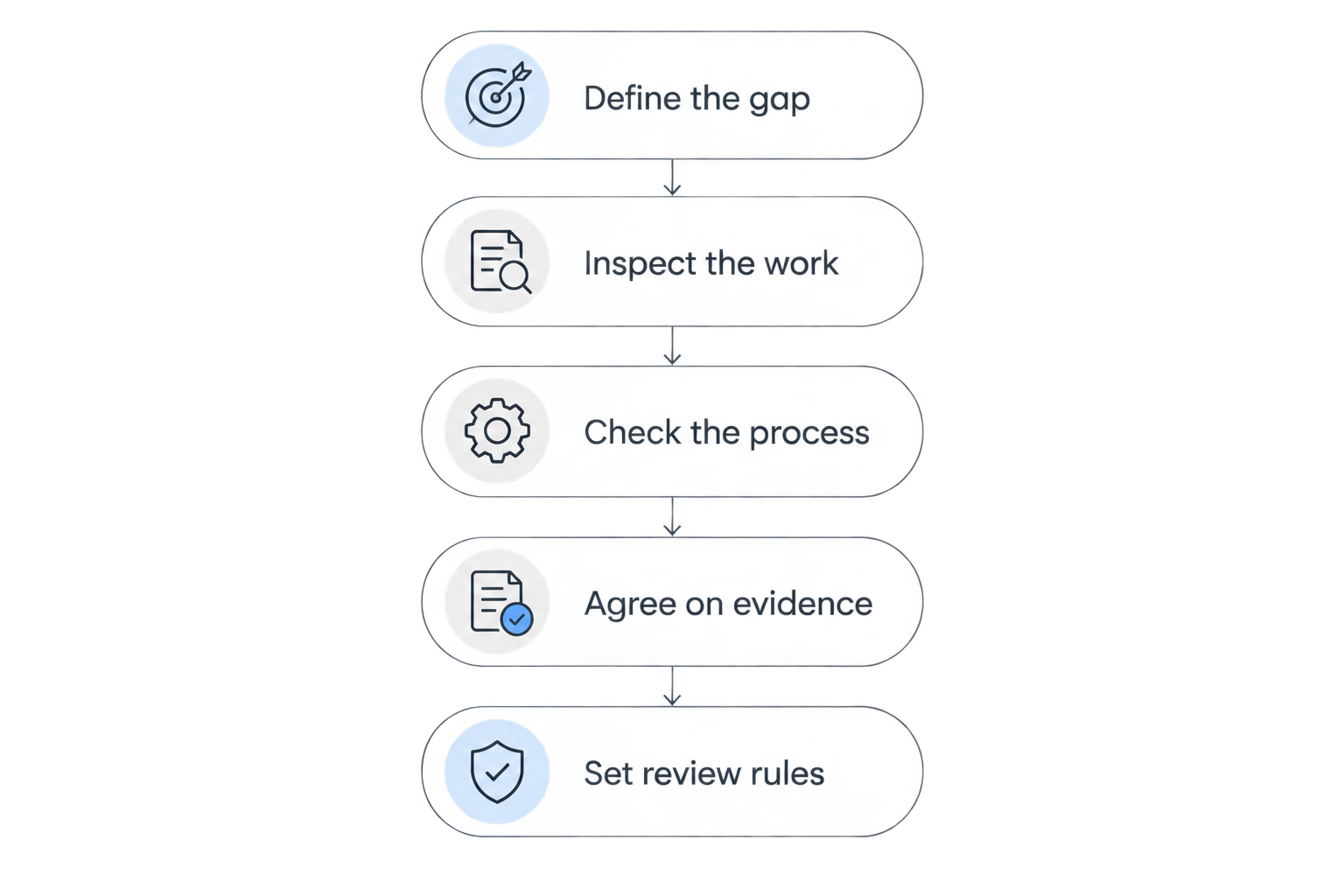
Use a short decision process that starts with the business problem and ends with an explicit review agreement. Ask candidates to demonstrate their thinking against your situation, not deliver an unpaid content strategy.
Define the gap
Write down the problem in operational terms. “Our technical experts have useful answers, but nobody turns them into publishable material” is a workable brief; “we need more visibility” needs further definition.
Identify what already works, too. An agency should explain what it would preserve rather than assuming every existing page needs replacement.
Inspect the work
Request examples relevant to the buyer problem, subject complexity, or deliverable you need. Ask what the agency actually owned in each example.
A polished page demonstrates presentation, but it does not establish who researched it, reviewed its accuracy, or managed its distribution. Separate those contributions.
Check the process
Ask how the team gathers expert input, checks claims, handles revisions, and resolves conflicting feedback. Confirm who makes the final editorial decision.
Look for a process your team can support. A proposal dependent on unavailable executives is not ready to execute, regardless of how strong the sample work looks.
Agree on evidence
Define success measures before work begins. Include signals of audience relevance, content use, and commercial response rather than treating publication as the final outcome.
Ask the agency to distinguish observed results from interpretation. A reader visiting an article before becoming a lead establishes a recorded interaction—not proof that the article alone caused the inquiry.
Set review rules
Agree on when to review performance and what each review will decide. Match those decisions to your own sales cycle, publishing history, and available evidence.
Set conditions for changing direction. Irrelevant inquiries call for a different response from qualified readers who encounter an unclear contact process.
What should you measure besides traffic?
Traffic is evidence of visits, not evidence of buyer fit. Build your 2026 content scorecard around the job each asset is supposed to perform.
For discovery content, review whether the page appears for relevant searches and attracts the intended audience. For evaluation content, examine the questions it answers and the next actions readers take. For sales-support material, ask whether your sales team uses it and what objections remain unanswered.
Separate these reporting levels:
- Delivery: Did the agreed work ship, pass review, and reach the intended channels?
- Audience response: Are relevant people finding and engaging with the material?
- Commercial response: Are qualified inquiries, sales conversations, or documented customer interactions connected to that work?
Do not collapse these levels into a single success claim. Consistent delivery establishes that the process operates; it does not establish financial return.
When evaluating return, compare attributable business value with the full cost of the engagement, including your team's contribution. Keep content-influenced opportunities separate from content-sourced opportunities so the same result does not receive misleading credit.
Where does a full-service growth partner fit?
Hey Prospekt is best for businesses seeking brand strategy, digital marketing, and creative services together. That scope is relevant when your content brief intersects with positioning, website communication, and broader marketing execution.
The trade-off is scope discipline. A broader engagement needs clear priorities so content work does not become an undefined collection of requests. If your only need is a tightly briefed writing assignment, compare that narrower requirement with a freelance arrangement.
For Hey Prospekt, as for any agency you assess, request a proposal that identifies the content deliverables, review responsibilities, distribution work, and evidence used to judge progress. A full-service description is not a substitute for an agreed content scope.
Define your content marketing brief
Discuss the business gap, required services, and responsibilities before choosing an engagement.
How long should you give a content agency to prove its value?
Tie the review period to your sales cycle, starting position, and agreed work—not a universal deadline. You can assess research quality, editorial accuracy, and delivery before you have enough evidence to assess commercial results.
Set expectations separately for operational progress and business outcomes. For more context, read how long content marketing takes to show results.
Can a content agency guarantee qualified B2B leads?
An agency cannot control every condition required to produce a qualified lead. Your offer, targeting, website, qualification rules, and sales follow-up remain part of the outcome.
Ask for accountability over the work the agency controls and transparency about the results it observes. Treat an unconditional outcome promise as a reason to inspect the terms, not as evidence of capability.
FAQ
Is a content marketing agency worth it for a small B2B company?
Yes, when a small B2B company has a defined content need and enough internal capacity to support the engagement. If nobody can provide expertise or approve work, resolve that constraint before outsourcing production.
Should I hire a content agency or an in-house marketer?
Hire an agency for a defined delivery scope; hire internally when you need continuous ownership close to the business. Compare the actual responsibilities each option will cover rather than treating the job title as the deciding factor.
Can I use freelance writers instead of an agency?
Yes, freelance writers fit businesses that already own content strategy, editing, and distribution internally. Assign coordination explicitly so separate writing assignments do not become disconnected output.
What should a B2B content agency proposal include?
A B2B content agency proposal should define the audience, business objective, deliverables, responsibilities, review process, and measurement approach. It should also explain what your team must provide and what falls outside the scope.
How do I know whether content marketing is working?
Judge content marketing against the job assigned to each asset and the quality of the response it receives. Review delivery, audience relevance, and commercial evidence separately instead of using traffic as a substitute for business value.
Is Hey Prospekt a fit if I need more than content?
Hey Prospekt offers brand strategy, digital marketing, and creative services to B2B and B2C companies. It fits an evaluation where those needs overlap; confirm the specific content responsibilities in the proposed engagement.
What should I ask a content agency in 2026?
Ask a content agency in 2026 how it will obtain expert input, verify claims, distribute work, and evaluate business relevance. Request clear ownership for each responsibility and an explanation of what the reporting can actually establish.
One last thing
Ask a prospective agency what it would choose not to publish. Then ask why.
The answer exposes its priorities: buyer relevance, useful evidence, and a credible connection to your offer—or simply filling a calendar. For your 2026 decision, require a reason behind each proposed topic before approving the production plan.
Related guides
- Can a B2B marketing agency generate qualified leads?
- Connect Google Search Console to your content roadmap
- Can one agency manage paid and organic channels?


