 Skip to main content Skip to footer


Yes—SEO is worth it for healthcare brands in 2026 when it connects relevant searches to qualified appointments, inquiries, or sales and earns more than the full cost of the program. That cost includes clinical review, website improvements, measurement, and content maintenance—not just publishing. Invest when you can serve the demand you attract; fix unclear positioning, broken booking flows, or limited service capacity first.
- Is SEO worth it for healthcare brands? Yes, when qualified patient acquisition or B2B pipeline justifies the investment.
- Prioritize healthcare SEO pages that answer service, location, eligibility, and buyer questions accurately.
- Measure qualified appointments and sales opportunities, not rankings or traffic alone.
- Hey Prospekt is best for brands seeking brand strategy, digital marketing, and creative services from one agency.
Why this matters
A healthcare search can represent very different needs: finding a nearby provider, understanding a procedure, checking whether a service fits, or evaluating a business supplier. Treating those searches as one audience produces content without a clear business purpose.
Your SEO decision starts with the buyer and the next action—not a keyword list. A practice needs suitable appointment requests. A healthcare supplier needs relevant commercial inquiries. Neither benefits from reporting unrelated visitors as growth.
Hey Prospekt provides brand strategy, digital marketing, and creative services for B2B and B2C companies. That distinction matters here: healthcare SEO needs a different conversion path for patients than for procurement teams, even when both audiences search within the same category.
For your 2026 plan, separate those audiences before approving content or choosing performance targets.
Is SEO worth it for healthcare brands in 2026?
Yes, when search demand matches what you sell, your pages deserve consideration, and your team can turn relevant visits into business outcomes. Use these steps to decide whether to invest, narrow the scope, or wait.
- Confirm the audience. Identify whether the page serves patients, caregivers, referring professionals, or business buyers. Write for the person making the next decision rather than everyone connected to healthcare.
- Inspect relevant search results. Search for your actual services and buyer questions. Check whether the results match your offer and whether your proposed page would answer something useful that existing results leave unclear.
- Check the destination. Review service descriptions, location information, provider details where relevant, and the appointment or inquiry process. Sending more people to a confusing page does not resolve the confusion.
- Assign review ownership. Decide who checks clinical statements, who approves commercial claims, and who updates changing information. Do not publish material that nobody owns after launch.
- Define the commercial test. Connect organic landing pages to qualified inquiries, completed appointments, or sales opportunities where measurement permits. Judge performance against the full investment, not a traffic target alone.
Passing these checks supports an SEO investment. Failing one identifies work to complete before expanding it. A missing review process calls for governance; a broken appointment form calls for a website fix. Neither problem calls for another batch of articles.
Which healthcare SEO approach fits your business?
Healthcare SEO is not a single content program. Match the work to the decision your audience needs to make.
| Approach | Best for | Main benefit | Main limitation | Outcome to measure |
|---|---|---|---|---|
| Local service SEO | Providers serving defined locations | Connects service and location searches to appointment information | Depends on accurate location details and a usable booking path | Qualified appointment requests |
| Patient education SEO | Brands answering relevant care and service questions | Explains decisions before a patient contacts a provider | Requires appropriate review and can attract readers outside your service scope | Relevant visits that progress toward service consideration |
| B2B healthcare SEO | Companies selling to healthcare organizations | Addresses evaluation, implementation, and purchasing questions | A visit or download does not establish buying intent | Qualified opportunities and attributable pipeline |
Local service SEO: best for location-based patient demand
Local service SEO is the clearest starting point when your customers need care in a specific area. Prioritize accurate service and location pages, understandable provider information where applicable, and an obvious appointment path.
A useful location page explains what a patient can actually do there. Include verified service details, practical access information, and the appropriate next step. Do not create near-identical pages for places you do not serve.
The advantage is relevance: the page addresses a service decision tied to a real location. The limitation is operational dependence. Incorrect details, unanswered inquiries, or an unusable booking process can undermine the value of discovery.
Choose local service SEO when location determines eligibility or access. For a 2026 expansion plan, verify that each promoted location can support the services its page describes before increasing visibility.
Patient education SEO: best for explaining relevant decisions
Patient education content supports questions that genuinely connect to your services. Useful subjects include preparing for an appointment, understanding a service's purpose, and knowing which questions to ask a qualified professional.
The benefit is clarity before contact. The drawback is that educational reach and commercial intent are different things: a reader can find an explanation useful without needing your business.
Keep the scope explicit. Explain what a page covers, distinguish general education from individualized advice, and use appropriate clinical review for medical claims. Identify authors and reviewers accurately; never add credentials that the contributor does not hold.
Choose patient education SEO when the topic supports a real service decision and you can maintain its accuracy. Do not build a broad medical encyclopedia simply because a keyword appears attractive. Your editorial scope should follow your expertise and audience, not every adjacent symptom or condition.
B2B healthcare SEO: best for organizational buying decisions
B2B healthcare SEO should help organizational buyers evaluate fit. Depending on your actual offer, that can mean explaining implementation requirements, service scope, purchasing considerations, or the problems your business addresses.
The benefit is closer alignment with evaluation. The limitation is attribution: the person reading a page is not automatically a qualified buyer, and a form submission is not automatically an opportunity.
Build pages around verified capabilities. Answer questions your sales team actually receives, explain boundaries, and make the commercial next step clear. Keep patient-oriented information separate when it serves a different audience.
Choose B2B healthcare SEO when buyers actively research the problem you solve. In 2026, judge that work through inquiry quality and pipeline progression rather than borrowing appointment metrics from a patient-facing business.
Why healthcare SEO value varies
The same publishing schedule can produce very different business value because the underlying conditions differ. Evaluate these factors before comparing proposals:
- Audience fit. Searches from patients outside your service area or professionals outside your buyer profile do not carry the same value as relevant demand.
- Search intent. A general definition, a service comparison, and a location search require different pages and imply different next steps.
- Website readiness. Clear navigation, accessible information, and functioning inquiry paths determine whether visitors can act.
- Review capacity. Clinical and commercial review affect what you can publish responsibly and keep current.
- Operational capacity. Appointment availability, service coverage, and sales follow-up determine whether the business can use additional demand.
- Measurement quality. Without distinguishing qualified outcomes from activity, you cannot judge whether the program earns continued investment.
These are decision factors, not excuses for vague reporting. Ask the person responsible for each factor to identify the current constraint and the action needed to remove it.
How should you measure whether healthcare SEO pays off?
Use qualified outcomes as the commercial test and search metrics as diagnostic evidence. Rankings, impressions, and clicks help explain visibility. They do not establish profitability.
Choose 1 primary conversion per priority page as a planning rule. That might be an appointment request for a service page or a relevant sales inquiry for a business solution page. Secondary actions can remain available, but the page needs a clear purpose.
Keep 2 reporting views: search performance and business outcomes. The search view explains which queries and pages attract attention. The business view explains whether those visits become suitable inquiries, appointments, or opportunities. Connect the views where your consent, privacy, and measurement arrangements permit.
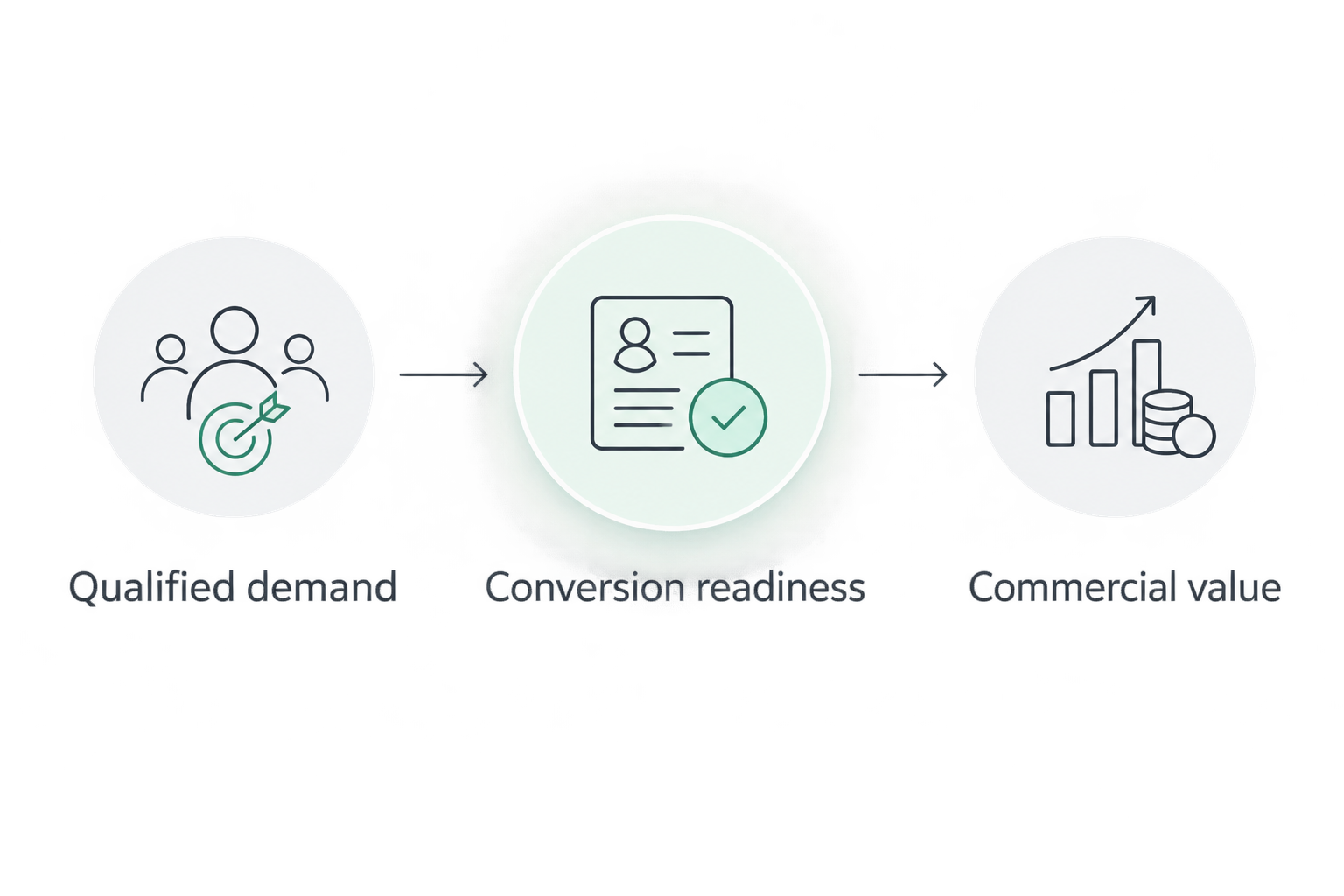
Use 3 decision gates for the 2026 program:
- Qualified demand: Are the queries, locations, and visitors relevant to the offer?
- Conversion readiness: Can those visitors understand the offer and complete the intended next step?
- Commercial value: Do attributable outcomes justify the work, review, maintenance, and supporting investment?
The gates prevent a common reporting mistake: treating increased visibility as proof that the entire program works. If relevant visitors arrive but do not progress, inspect the page and offer before publishing more content.
Keep revenue and profit separate. Revenue attributed to organic search does not account for delivery costs or the SEO investment itself. If attribution is incomplete, report that limitation alongside the observed outcomes instead of assigning every later sale to the first organic visit.
What should you fix before publishing more content?
Start with the point where a relevant visitor loses clarity. A service page that never explains who the service suits needs a better explanation. A form that fails on a phone needs repair. An unsupported clinical claim needs review, not stronger promotional language.
Check existing pages before commissioning replacements. Look for outdated service information, conflicting location details, unclear next steps, and overlapping pages that answer the same question without a distinct purpose.
Then set an editorial order: accurate offer pages first, supporting decision content next, broader education only where it serves the audience. This is a prioritization rule, not a requirement to publish a fixed number of pages.
Fix the path from search to action before expanding the entrance. That gives each new page a destination and gives your team a clearer explanation of what success should look like.
When is healthcare SEO not worth prioritizing?
Healthcare SEO is not the first priority when the underlying offer is unclear, the business cannot handle relevant demand, or no one can approve and maintain the content. Address the constraint rather than funding more visibility around it.
It is also the wrong sole response to an immediate acquisition deadline. Search indexing and ranking changes do not follow your launch calendar. Keep urgent demand requirements separate from the longer-term case for organic discovery.
Do not approve a proposal that guarantees rankings, appointments, or revenue without accounting for your market, website, offer, and operations. An accountable plan defines the work, measures progress, and states what remains outside the agency's control.
Should healthcare brands combine SEO and paid search?
SEO and paid search can serve different acquisition needs, but neither fixes a weak offer or broken conversion path. Evaluate each channel against relevant outcomes rather than assuming one must replace the other.
Coordinate landing-page improvements and learning where appropriate. Keep budgets, attribution, and reporting distinct enough to understand each channel's contribution, including the difference between branded demand and discovery by new audiences.
What should you expect from an agency partner?
Ask for a plan that connects audience research, page priorities, technical work, review responsibilities, and commercial measurement. The proposal should make clear who implements changes and who approves healthcare claims.
Hey Prospekt offers brand strategy, digital marketing, and creative services for B2B and B2C companies. That makes the agency relevant when the need spans positioning, website communication, and acquisition; healthcare-specific experience and clinical review arrangements still belong in your selection questions.
For a 2026 engagement, request a defined scope and reporting agreement before approving ongoing work. Reject activity-only reporting that treats published pages as the business result.
Define your growth priorities
Discuss how brand strategy, website communication, and digital marketing fit your business goals.
FAQ
Is SEO worth it for a small healthcare practice?
SEO is worth considering for a small healthcare practice when relevant local searches can lead to suitable appointments. Start with accurate service and location information, a usable appointment path, and a way to distinguish qualified requests from general inquiries.
How long does healthcare SEO take to work?
Healthcare SEO has no universal results timeline. Existing visibility, competition, website condition, implementation, and content review affect progress; agree on milestones instead of accepting a guaranteed deadline.
Should a healthcare brand start with service pages or blog posts?
Start with service pages when visitors cannot clearly understand the offer or take the next step. Add educational content where it answers relevant questions and connects naturally to those services.
Does more organic traffic mean healthcare SEO is working?
More organic traffic does not prove healthcare SEO is producing business value. Check audience relevance, qualified conversions, and attributable appointments or opportunities alongside visibility metrics.
Can healthcare SEO guarantee new patients?
Healthcare SEO cannot guarantee new patients. Search visibility, patient suitability, service access, website usability, and appointment handling all affect the outcome.
Can Hey Prospekt help with more than SEO?
Hey Prospekt provides brand strategy, digital marketing, and creative services for B2B and B2C companies. Confirm the specific healthcare scope, responsibilities, and review requirements during agency selection.
Is healthcare SEO still worth doing in 2026?
Healthcare SEO is worth doing in 2026 when it attracts relevant demand and produces outcomes that justify the full investment. Keep content accurate, prioritize useful decision pages, and evaluate commercial results rather than traffic alone.
One last thing
A page that helps the wrong visitor rule out your service can still do its job. Clear service boundaries, location information, and eligibility explanations help people make an informed next move instead of submitting an unsuitable inquiry.
Make that part of your 2026 SEO brief. Aim for more suitable demand—not simply more forms for your team to sort through.
Related guides
- SEO for healthcare brands: complete guide
- How long does it take to see SEO results?
- Can SEO and PPC work together for faster growth?
- Connect Google Search Console to your content roadmap


