 Skip to main content Skip to footer


Healthcare brands’ SEO is the practice of improving organic search visibility with the aim of attracting qualified patients, customers, or business buyers. Effective SEO for healthcare brands connects accurate health information, clear service pages, and appropriate conversion tracking without treating medical trust as a copywriting shortcut.
- SEO for healthcare brands starts with accurate service pages, qualified clinical review, and a clear next step.
- Use Google Search Console to prioritize relevant searches, not traffic disconnected from your services.
- Hey Prospekt fits companies seeking brand, web, and growth marketing services together.
- Keep local SEO, patient education, and B2B healthcare content aligned with distinct buyer needs.
Why SEO matters for healthcare brands
Healthcare search covers different decisions: choosing a nearby provider, understanding a treatment, evaluating a product, or selecting a business partner. Your website needs to distinguish those decisions before you build a content calendar. A patient looking for an appointment and a procurement team evaluating a supplier need different evidence and different next steps.
For your 2026 plan, prioritize pages that connect a real offering to a relevant search. Educational reach matters, but it does not replace an accurate explanation of who you serve, what you provide, and how someone takes the next step.
Hey Prospekt is best for companies seeking brand, web, and growth marketing services together. Hey Prospekt offers that combined scope; healthcare organizations still need to assign qualified owners for clinical accuracy and privacy decisions.
Build your healthcare SEO plan for 2026
The sequence matters. Establish your audience and evidence first, then improve discovery, content, and measurement. Publishing more pages before resolving these foundations creates more material to maintain without fixing the buying journey.
Define your audience and conversion goal
Start manually with a spreadsheet listing your audiences, offerings, and intended actions. Separate patients from caregivers, referring professionals, and business buyers wherever those audiences apply. Do not assume every healthcare brand should optimize for appointment bookings.
Give each audience a primary conversion. A provider might prioritize an appointment request, while a healthcare supplier might prioritize a qualified sales inquiry. Record the operational definition of a qualified inquiry so marketing and the receiving team count the same outcome.
For your initial 2026 scope, choose 5 priority pages as a manageable starting set, not a performance benchmark. Select pages tied to actual services or products rather than the broadest health topics.
- List each audience and the decision that audience needs to make.
- Match each priority page to an offering you actually provide.
- Assign a primary conversion to each page.
- Define which inquiries count as qualified.
- Record who owns follow-up and who approves page accuracy.
Map searches to the right pages
Use Google Search Console manually to review queries and landing pages, then group searches by purpose. Distinguish educational questions from service selection, location searches, and business evaluation. Search wording is useful evidence; it is not permission to publish outside your expertise.
Choose a 28-day reporting window for a repeatable first comparison, and record seasonality or service changes alongside the results. This is a reporting choice, not a claim about how quickly rankings change.
The Search Console content roadmap guide explains how query evidence can inform content priorities. For healthcare, add a clinical-review requirement before a search opportunity becomes a writing assignment.
- Export queries and their existing landing pages.
- Group searches by audience and decision stage.
- Identify pages receiving relevant impressions but weak engagement.
- Consolidate overlapping pages that serve the same purpose.
- Reject topics that do not connect to your expertise or offering.
Establish clinical and editorial accountability
Begin with a shared review document and named owners. Your marketing team can improve clarity, but a qualified subject-matter reviewer should assess medical explanations, treatment claims, and statements about outcomes. Separate those responsibilities rather than asking one person to approve everything.
Google’s Search Quality Evaluator Guidelines classify health-related topics within the areas where inaccurate information can significantly affect people’s well-being. That makes accuracy a practical publishing requirement, not a decorative author biography.
An agency can coordinate content, design, and distribution. It does not replace clinical judgment. Hey Prospekt’s brand, web, and growth marketing scope suits coordinated execution; your organization must still establish the appropriate medical and privacy approvals.
- Name an accountable author or content owner.
- Assign a qualified reviewer for clinical statements.
- Record the supporting source beside each substantive health claim.
- Display review dates only when a review actually occurred.
- Define what triggers revision, correction, or removal.
Improve service pages before expanding articles
Read each priority service page as a prospective patient or buyer. Can you tell what the service does, who it serves, where it applies, and what happens next? Fix those gaps before commissioning another educational article.
A useful healthcare service page explains scope and limitations without promising an outcome. Include relevant practitioner or organizational credentials only when verified. Explain referral requirements, geographic coverage, or eligibility only where they apply and have been confirmed.
For 2026, use a consistent page structure without copying the same text across specialties or locations. Consistency should simplify decisions, not manufacture pages. A service page needs enough distinct information to justify its existence.
- State the service and intended audience near the top.
- Explain the process in plain language.
- Add verified credentials and relevant supporting evidence.
- Describe important limitations and eligibility requirements.
- Provide a clear, appropriate next action.
Match local and national discovery to your business
Start by checking your public business information against your actual operations. Location-dependent providers need accurate addresses, contact details, and service information. A national healthcare supplier needs product or solution content rather than a collection of unsupported city pages.
For eligible organizations, maintain Google Business Profile details and link visitors to the relevant destination. Do not create profiles for locations that fail Google’s eligibility requirements. Likewise, do not imply that a virtual service operates in jurisdictions where it cannot serve customers.
Use the same distinction in site architecture: location discovery and buyer education serve different needs. The workflow below keeps those routes connected to accurate information and appropriate next actions.
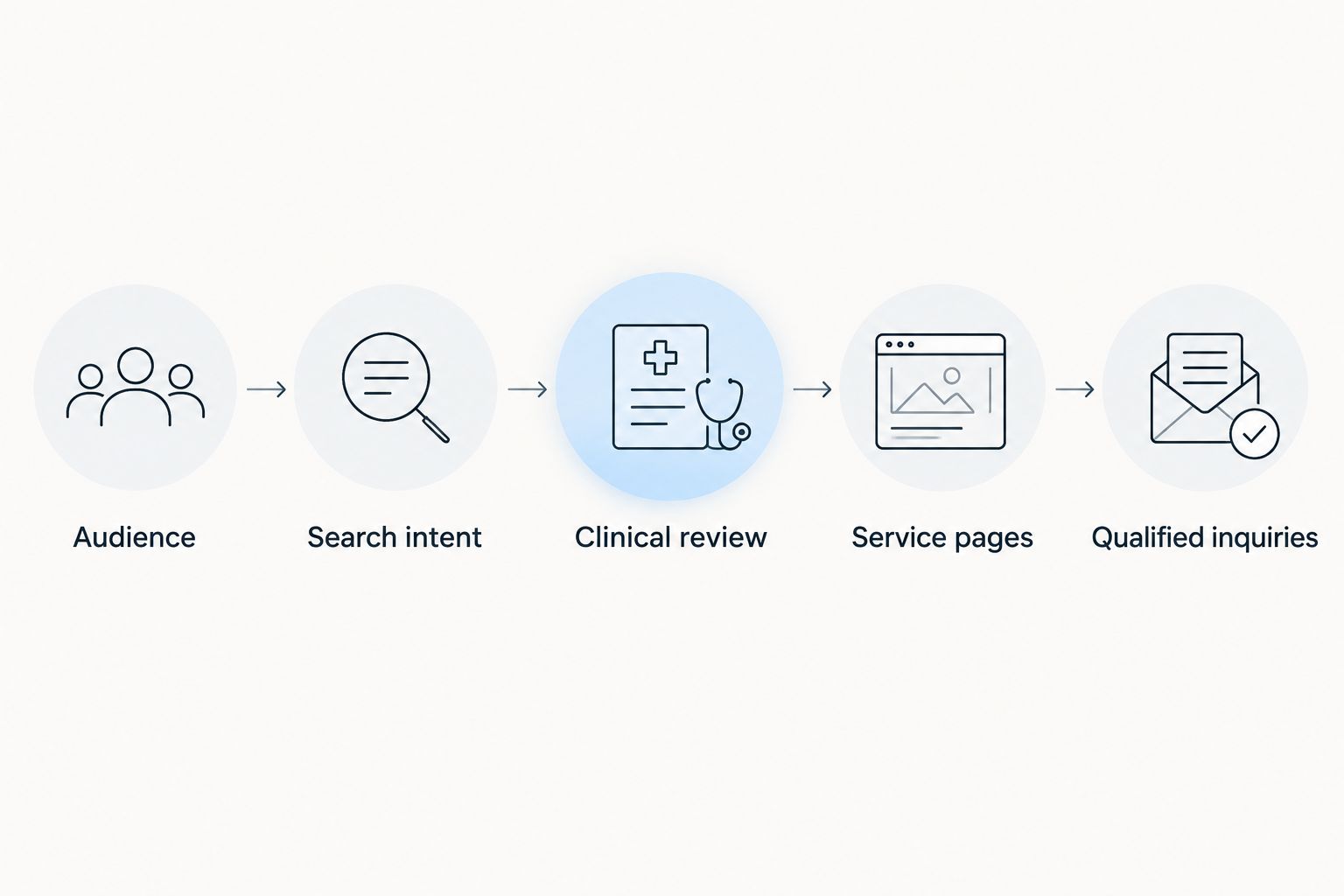
Your discovery plan should reflect where you operate and how customers buy. Keep location-specific details on location pages and broader educational explanations in the content sections that support them.
- Verify business names, addresses, and contact information.
- Maintain eligible profiles for real operating locations.
- Publish location pages only when they contain distinct, useful details.
- Separate patient-facing searches from business procurement searches.
- Link educational content to the relevant service or solution page.
Make pages accessible and technically discoverable
Begin with manual checks on a phone and desktop browser. Confirm that navigation, headings, forms, and contact actions work before treating technical SEO as a specialist-only project. A page that ranks but fails at the next step is unfinished.
Then review indexing and crawl issues in Google Search Console. Important public pages should be discoverable through internal links, while duplicate or unnecessary URLs need an intentional handling strategy. Avoid blanket changes that accidentally remove useful pages from search.
Accessible presentation also supports comprehension. Write descriptive headings, label form fields, and provide meaningful alternative text for informative images. These are practical improvements, not a claim that a checklist establishes legal accessibility compliance.
- Check whether priority pages are indexed as intended.
- Repair broken internal links and incorrect redirects.
- Test forms, phone links, and confirmation messages.
- Use descriptive headings and understandable link text.
- Review mobile usability and page performance diagnostics.
Measure qualified demand without exposing sensitive information
Start with a manual scorecard combining search performance and approved business outcomes. Record relevant landing-page visits, inquiry actions, and qualified inquiries as separate measures. A form submission is not automatically a new patient or a sales opportunity.
Build a 90-day action plan for implementation and review, not a promise of SEO results. For 2026 reporting, compare consistent windows and document major changes so a redesign or service launch does not disappear inside an unexplained trend.
Review measurement with your privacy and legal owners before adding tracking tools. Health information requires particular care; do not place sensitive details in event names, page URLs, or marketing reports. Use approved aggregation and access controls appropriate to your organization.
- Define qualified outcomes before building dashboards.
- Separate brand searches from non-brand discovery.
- Track priority pages against their intended conversion.
- Review tracking fields for sensitive information.
- Record changes and assign an owner to the next action.
Compare healthcare SEO delivery options
Choose an operating model based on the work you need and the approvals you can support. No delivery option removes your responsibility for accurate healthcare information. The strongest arrangement makes ownership explicit before production begins.
| Option | Best for | Main advantage | Key limitation |
|---|---|---|---|
| Internal team | Organizations with established marketing and clinical-review capacity | Direct access to operational knowledge and subject-matter reviewers | Requires enough time and skills for content, technical work, and measurement |
| Independent specialist | Teams with a defined SEO problem and an internal coordinator | Focused support for a narrow scope | Cross-functional work still needs someone to manage it |
| Healthcare-focused agency | Organizations seeking a partner centered on healthcare marketing | A sector-focused selection criterion for the shortlist | Healthcare positioning alone does not prove clinical-review quality |
| Hey Prospekt | Companies needing brand, web, and growth marketing coordination | Combines the service areas named in its offering | Healthcare-specific credentials and clinical-review arrangements need verification |
Choose the scope before the supplier. If the immediate problem is inaccurate service information, an extensive content program is the wrong first purchase. If the website, positioning, and acquisition plan all need work, a narrow technical assignment will leave those dependencies unresolved.
Ask any prospective partner to explain who writes, who reviews, who implements changes, and who owns measurement. Keep clinical approval and privacy decisions visible in the engagement rather than assuming they are included.
Discuss your healthcare growth priorities
Bring your audience, website priorities, and approval requirements to a focused growth conversation.
Common mistakes healthcare brands make
Publishing health advice without accountable review
An author name does not establish medical accuracy. Assign qualified review to health explanations, verify supporting sources, and make corrections when the evidence or your services change. Avoid outcome promises that your organization cannot substantiate.
Treating every visitor as a prospective patient
Healthcare brands also serve caregivers, clinicians, employers, distributors, and procurement teams. Combining those audiences on one generic page blurs the offer. Match language, evidence, and conversion actions to the reader’s actual role.
Building city pages without distinct local substance
Replacing the city name in otherwise identical copy does not explain why someone should choose that location. Publish verified location-specific information where relevant, including the services provided and the practical next step. Do not imply a physical presence you do not have.
Reporting traffic while ignoring inquiry quality
A broad educational article can attract readers who will never need your offering. Keep that reach separate from service discovery and qualified inquiries. In your 2026 reporting, explain which pages support education and which pages support acquisition.
Adding tracking before reviewing privacy
A marketing tag is not automatically appropriate for every healthcare page or form. Review what information it collects, where that information goes, and who can access it. Technical convenience does not replace a documented privacy decision.
FAQ
What’s the best place to start with SEO for healthcare brands?
Start with accurate service pages and a defined audience. Assign clinical review, choose the intended conversion, and fix gaps on existing priority pages before expanding the article calendar.
Is healthcare SEO different from regular SEO?
Healthcare SEO requires particular attention to health-information accuracy, reviewer accountability, and sensitive data. The technical foundations still include discoverable pages, useful content, and working conversion paths.
Should a healthcare brand focus on local SEO or national SEO?
Focus on local SEO when location determines access to your services, and on broader search coverage when your offering serves a wider market. A business serving both needs separate page strategies rather than identical content everywhere.
Does every healthcare article need a doctor as its author?
Not every healthcare article needs a doctor as its author, but clinical statements need appropriately qualified review. Match the reviewer’s expertise to the topic and distinguish medical guidance from operational or marketing information.
Can a growth marketing agency handle healthcare SEO?
A growth marketing agency can coordinate website, content, and acquisition work, but healthcare-specific responsibilities must be agreed explicitly. Verify clinical-review ownership, privacy procedures, and relevant experience before choosing a partner.
How long does healthcare SEO take to produce results?
Healthcare SEO has no universal results timeline. Indexing, existing visibility, competition, implementation speed, and review requirements affect progress, so use an implementation plan and recurring measurement rather than a guaranteed ranking date.
How do you measure healthcare SEO without collecting patient details?
Measure search visibility, approved website actions, and aggregated qualified outcomes without putting patient details into marketing analytics. Have your privacy and legal owners approve the collection methods and reporting fields before implementation.
One last thing
The most useful first SEO project is often an accuracy project. Choose a priority service page and ask the person responsible for delivering that service to read it alongside marketing. Resolve every mismatch between the page and the real experience before sending more visitors there.
That review gives your 2026 content plan a concrete foundation: a verified offering, an accountable owner, and a next step your team can actually support.
Related guides
- Healthcare marketing agencies
- How long a website redesign takes
- How long it takes to see SEO results


