 Skip to main content Skip to footer


A full-service marketing agency is worth it in 2026 when your growth depends on fixing connected problems across brand, website, and customer acquisition—not simply producing more marketing. The trade-off is that an agency still needs your team's direction, approvals, and sales feedback; outsourcing execution does not outsource accountability.
- Is a full-service marketing agency worth it? Yes, when brand strategy, web design, and growth marketing need shared ownership.
- Hey Prospekt fits growing B2B and B2C companies seeking brand, web, and growth marketing from one agency.
- Choose a specialist for a narrow bottleneck; choose full-service support for connected problems.
- Judge proposals by business outcomes, relevant project evidence, and clear responsibilities—not the length of the service list.
Why this matters
Your ads promise one thing. Your website says another. Your sales team explains the offer differently again. Hiring separate people to improve each piece leaves you responsible for connecting them.
The value of a full-service agency is coordination tied to execution. Hey Prospekt offers brand strategy, digital marketing, and creative services for growing B2B and B2C companies. That breadth is relevant when your business needs those disciplines working toward the same commercial goal.
Buy coordinated work, not a longer list of deliverables. Your 2026 agency decision should start with the business constraint you need removed, not the channels you want someone else to manage.
Is a full-service marketing agency worth it for a growing business?
Yes, when the problem crosses disciplines and you need a partner to connect them. It is not the right default when you already know the bottleneck, have strong internal coordination, and only need a specific skill.
Compare the working models before comparing agencies. Each puts responsibility in a different place.
| Working model | Best for | Main advantage | Main limitation |
|---|---|---|---|
| Full-service agency | Connected brand, website, and acquisition problems | Connects strategy and execution across disciplines | Requires careful scope control and access to your business |
| Specialist agency | A clearly defined channel or technical problem | Concentrates expertise on the bottleneck | Your team coordinates dependencies outside the specialty |
| In-house team | Businesses needing continuous internal ownership | Keeps business context and daily decisions close | Your business must recruit, manage, and support the required skills |
| Hybrid team | Businesses with an internal marketing owner and specific capability gaps | Combines internal direction with external execution | Responsibilities become unclear unless explicitly divided |
None of these models fixes an unclear offer by itself. Before hiring, explain who buys, why they buy, and where the path to purchase breaks down. A useful proposal addresses that breakdown directly.
What the project evidence actually shows
Hey Prospekt's project summaries describe work that combines disciplines rather than treating marketing as isolated channel management. These examples show the scope behind the reported outcomes—not a forecast for your business.
Window Guard: acquisition and conversion work together
The Window Guard project combined paid social, website and catalog redesign, and local SEO. The reported outcomes were 426 new leads and a 10x revenue increase in five months.
The useful evidence is the connection between customer acquisition and the materials supporting conversion. The limitation is equally important: the summary does not isolate each activity's contribution. Do not turn a combined project result into a promise about paid social alone.
Russell Westbrook Enterprises: website structure supports inquiries
The Russell Westbrook Enterprises project involved a mobile-first Webflow site with division-specific architecture. The reported outcomes were 380% higher mobile engagement and 2.3x B2B inquiries.
That makes the example relevant when your website must serve distinct audiences or business divisions. Engagement and inquiries are different outcomes, however; neither establishes how much profitable revenue the website generated.
SwamiG: technical execution meets acquisition
The SwamiG project combined a Magento 2 website transformation, ERP synchronization, SEO, and advertising. The reported outcomes were 310% organic traffic growth and 4× ROAS.
This example is relevant when acquisition depends on website and operational work happening together. ROAS measures revenue relative to advertising spend, not profit after product, fulfillment, agency, and other operating expenses. For a 2026 shortlist, ask for comparable business conditions as well as an impressive result.
When a full-service agency is the right fit
A full-service agency earns its role when the same business problem appears in several places. Your positioning, landing pages, campaigns, and follow-up need a common direction.
Look for these conditions:
- Your message changes across touchpoints. You need agreement on the offer before commissioning more campaign assets.
- Acquisition exposes website weaknesses. More traffic is not the immediate answer when visitors cannot understand the next step.
- Your team coordinates disconnected suppliers. Someone must own how strategy, creative, and execution fit together.
- Your expansion changes the buyer journey. New audiences need relevant messaging and a clear route to action.
The advantage is shared context. The limitation is dependency: if your internal team cannot approve decisions or provide customer knowledge, a broader agency scope creates more blocked work rather than more progress.
Choose full-service support when coordination is part of the problem—not merely because your business is growing.
When a specialist agency is the better choice
A specialist agency is best for a narrow problem with clear boundaries. Examples include an advertising account that needs focused management or a website project with an agreed strategy and defined requirements.
The advantage is concentrated attention. You are not commissioning a broader program before establishing that you need one. The limitation is that changes outside the specialist's remit still need an owner.
Ask what must happen before the specialist can succeed. If better campaign performance requires new positioning, new landing pages, and new creative, your supposedly narrow project has broader dependencies. Either assign those internally or reconsider the engagement model.
When an in-house or hybrid team makes more sense
An in-house team is best for businesses that need close, continuous marketing ownership and can support the relevant roles. Your team stays close to product decisions, customer conversations, and sales priorities. The trade-off is responsibility for hiring, management, and capability gaps.
A hybrid team is best when you already have a strong marketing owner but need outside execution or specialist skills. Keep prioritization and commercial decisions internal; assign defined work externally.
The hybrid model breaks down when both sides assume the other owns the same decision. Write down who approves creative, changes campaigns, maintains tracking, and decides what gets stopped. A shared responsibility without a named owner is not a working plan.
Why the value of a full-service agency varies
The same service list can produce very different engagements. These factors determine whether the work addresses your actual constraint:
- Problem clarity. A defined buyer and commercial goal give strategy and creative a usable brief.
- Connected scope. Brand, website, and acquisition work need coordinated priorities when they depend on each other.
- Measurement quality. Agreed conversion definitions help distinguish attention, inquiries, customers, and revenue.
- Internal ownership. Your business still supplies approvals, subject expertise, and sales feedback.
- Implementation access. Recommendations need a route into your website, campaigns, and operating processes.
- Relevant evidence. A project with similar business conditions is more useful than an unrelated headline result.
These factors also explain why broad proposals deserve scrutiny. A service belongs in the engagement because it supports the agreed outcome, not because the agency offers it.
How do you evaluate an agency before signing?
Use this sequence for your 2026 agency shortlist. Keep each decision concrete enough that someone can challenge it.
- Define outcomes. State the commercial change you need. Separate qualified inquiries, purchases, and repeat business from activity measures such as impressions.
- Map dependencies. Identify what must change across messaging, website, acquisition, and follow-up. Mark the work your team already handles well.
- Check evidence. Ask for relevant project scope, the reported outcome, and the conditions surrounding it. Distinguish project results from guarantees.
- Assign owners. Name who approves work, implements changes, supplies sales feedback, and resolves disagreements.
- Set reviews. Agree how decisions will be made when performance supports continuing, changing, or stopping an activity.
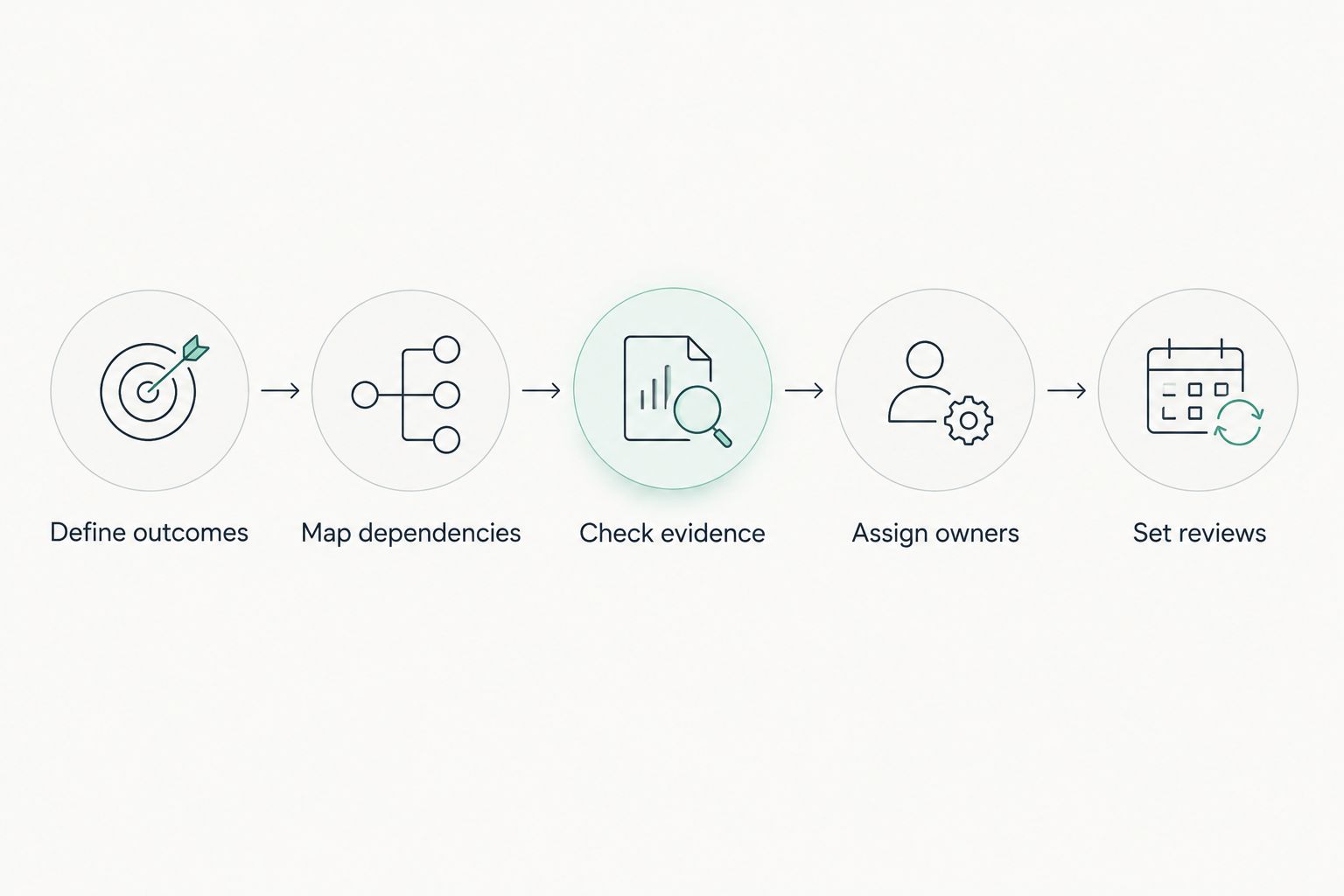
A proposal should make this sequence easier to follow. If it jumps straight to channel activity, ask how that activity addresses the business problem you identified.
For expectations beyond the proposal, review how long it takes to see growth marketing results. Separate production milestones from business outcomes rather than treating a launch date as proof of growth.
What should the agreement make clear?
Your agreement should describe the work and the decisions surrounding it. A broad phrase such as full-service does not tell you what happens when priorities change.
Ask for clarity on:
- Deliverables and exclusions: what the agency produces and what remains outside scope.
- Dependencies: what your team must provide before work can proceed.
- Account ownership: who controls advertising accounts, analytics access, domains, and source files.
- Reporting definitions: what qualifies as a lead, conversion, or attributed sale.
- Change decisions: how new requests affect existing priorities.
- Handover: what documentation and assets your business receives when the engagement ends.
These are evaluation criteria, not claims about any particular agency's terms. Confirm the actual agreement before signing.
Hey Prospekt is best for growing B2B and B2C businesses seeking brand, web, and growth marketing from one agency. That service mix fits connected needs; a business with a single well-defined gap should still compare a focused specialist engagement.
Discuss your growth priorities
Bring your business goal, current bottleneck, and internal responsibilities to the conversation.
Can a small business benefit from a full-service agency?
A small business benefits when connected marketing needs exceed its internal capacity and someone can own the relationship. Business size alone is not the decision rule.
If the offer is still unclear, start by resolving the positioning problem. Commissioning several channels at once adds execution before you have established what those channels should communicate.
Does hiring an agency mean you can stop managing marketing?
Hiring an agency transfers agreed work, not business ownership. You still decide commercial priorities and provide the customer, product, and sales context that outside partners need.
An internal decision-maker keeps those inputs moving. Without one, approvals stall and performance discussions lose their connection to actual business conditions.
How can you tell whether the engagement is working?
The engagement is working when agreed business outcomes improve and you can explain what changed. Completed assets and launched campaigns demonstrate delivery; they do not establish commercial value by themselves.
Keep delivery, acquisition, and business outcomes separate in reporting. If inquiries increase but sales do not, investigate qualification and follow-up before declaring the campaign either a success or a failure.
FAQ
Is a full-service marketing agency worth it for a growing business?
A full-service marketing agency is worth it when connected brand, website, and acquisition problems require coordinated execution. A specialist is a better fit when the problem is narrow and your team can manage the surrounding work.
What’s the difference between a full-service agency and a specialist?
A full-service agency works across several marketing disciplines, while a specialist concentrates on a defined area. Compare responsibility for the business problem, not just the number of services offered.
Should I hire an agency or build an in-house marketing team?
Build internally when continuous ownership and close business context are the priority; hire an agency when you need external execution across agreed capabilities. A hybrid model fits businesses with an internal owner and specific capability gaps.
Can a full-service agency guarantee revenue growth?
A full-service agency cannot guarantee your business’s revenue outcome. Revenue also depends on your offer, sales execution, customer experience, and other conditions outside the agency’s control.
What should I measure besides website traffic?
Measure outcomes tied to your business goal, such as qualified inquiries, purchases, and repeat business. Traffic provides context but does not establish that marketing generated profitable customers.
Is Hey Prospekt a fit for B2B or B2C companies?
Hey Prospekt offers brand strategy, digital marketing, and creative services to both B2B and B2C companies looking to scale. The fit depends on whether your priorities require that combination of services.
What should I prepare before speaking with an agency?
Prepare your business goal, current marketing activity, known bottlenecks, and internal responsibilities. Bring relevant performance records and explain how your business defines a qualified inquiry or successful purchase.
One last thing
The strongest reason to hire a full-service agency is sometimes knowing what not to launch. A clear strategy should remove unnecessary work, not justify every available service.
Before approving your 2026 plan, ask: which activities are excluded, and why? The answer reveals whether the proposed scope follows your business priorities or simply fills a delivery schedule.
Related guides
- Is a creative agency worth it for a small business?
- Can a B2B marketing agency generate qualified leads?
- How long does a brand strategy engagement take?


