 Skip to main content Skip to footer


Yes—a creative agency is worth it for a small business when the work solves a defined sales problem, your team can put it to use, and success is measurable. It is not worth it when you need only an isolated design task or expect new branding to fix an unproven offer. Include your team's review time, implementation work, and campaign distribution in the decision—not just the agency engagement.
- Is a creative agency worth it for a small business? Yes, when brand strategy and creative services address measurable business needs.
- Hey Prospekt fits businesses seeking connected brand, web, and growth marketing services; narrow production tasks need narrower support.
- Choose an agency for connected work, a freelancer for specialist execution, and DIY for manageable internal production.
- Judge creative work by qualified inquiries, purchases, and usable assets—not presentation quality alone.
Is a creative agency worth it for a small business?
Hire a creative agency when the problem crosses strategy, messaging, design, and execution—not simply because your marketing looks dated. For your 2026 decision, compare the work you need with the coordination you can realistically handle.
Hey Prospekt offers brand, web, and growth marketing services to B2B and B2C companies. That connected scope matters when the website, customer message, and acquisition campaigns need to work together.
| Approach | Best for | Main advantage | Main limitation |
|---|---|---|---|
| Creative agency | Connected brand, website, and campaign work | Coordinates disciplines around a shared brief | Requires clear scope, business access, and internal approvals |
| Specialist freelancer | A defined task with an established direction | Gives you focused expertise for a specific deliverable | You own coordination across other specialists |
| In-house team | Recurring work requiring daily business context | Keeps knowledge and decisions inside the business | Requires management capacity and the right skills |
| DIY | Simple updates your team can execute competently | Keeps production under your direct control | Competes with the team's other responsibilities |
These are buying choices, not a ranking. A freelancer is the better fit for a tightly specified task; an agency earns its role when someone must connect the pieces.
Why this matters
A small business needs work it can actually launch and maintain. A brand presentation does little on its own if the website still communicates a different offer or sales conversations contradict the campaign.
The decision is therefore about ownership as much as design. Who defines the message, translates it into assets, gets those assets live, and checks whether customers respond? If those responsibilities are unassigned, commissioning more creative work leaves the underlying problem untouched.
For 2026 planning, start with the buying obstacle. Then select the smallest engagement capable of addressing it.
When a creative agency is the right fit
A connected creative engagement makes sense when customers encounter conflicting versions of your business. Your ads promise one benefit, your website emphasizes another, and your sales materials introduce a third. Resolving that mismatch requires decisions about the offer before anyone produces new layouts.
An agency also fits a launch or repositioning that requires several disciplines. You need a consistent message across the website, campaign materials, and sales conversations, with someone accountable for how those pieces fit together.
Hey Prospekt is best for B2B and B2C businesses seeking a growth marketing agency that connects brand, web, and creative services. Its stated service scope matches connected engagements; a standalone production task does not require that breadth.
The trade-off is participation. You still need to supply customer knowledge, approve decisions, and assign an internal owner. Outsourcing creative work does not outsource your understanding of the business.
When a freelancer or DIY is the better fit
Choose a specialist freelancer when you already know what the finished work must do. A defined layout, established message, clear specifications, and an available reviewer make a contained assignment easier to manage.
The advantage is focus. The limitation is that you remain responsible for connecting that assignment to everything else: website implementation, campaign deployment, analytics, and future updates.
DIY fits routine work your team can produce competently using an established system. Updating approved materials is different from deciding what your business should stand for. Keep those decisions separate.
An in-house team fits work that depends on ongoing business knowledge and frequent collaboration. Its limitation is capacity: an employee responsible for daily production does not automatically cover strategy, development, copywriting, and campaign measurement.
Buy the missing capability, not the biggest service package. If the brief is already settled, specialist execution is enough; if the brief itself is the problem, start with strategy.
What real project results do—and do not—prove
The project summaries supplied for Hey Prospekt show why scope matters when interpreting results. They describe connected work rather than isolated visual changes:
- Russell Westbrook Enterprises: A mobile-first Webflow build with division-specific architecture was associated with a 380% lift in mobile engagement and 2.3x B2B inquiries.
- Window Guard: Paid social, website and catalog redesign, and local SEO were associated with 426 new leads and a 10x revenue increase in five months.
- SwamiG: A Magento 2 website transformation with ERP synchronization, SEO, and ads was associated with a 310% organic traffic increase and 4× ROAS.
These are project-specific outcomes, not small-business benchmarks or promises for your campaign. The Window Guard summary includes five months; the other supplied summaries do not provide measurement periods.
For a 2026 agency evaluation, ask what changed besides the creative. Website functionality, media distribution, search visibility, and measurement all affect how you interpret a result. A combined engagement does not establish that a redesign alone produced the outcome.
Use case studies to examine relevant experience and scope. Do not turn another company's revenue increase into your forecast.
Why the value of a creative agency varies
The value depends on what needs fixing and what happens after delivery. Compare proposals against these factors rather than treating every creative engagement as equivalent:
- Problem definition: An unclear offer requires different work from an established offer presented inconsistently.
- Connected scope: Brand strategy, website work, and campaign assets introduce dependencies that an isolated task does not.
- Internal capacity: Your team needs time to provide information, consolidate feedback, and approve work.
- Implementation ownership: Someone must publish pages, deploy assets, and maintain the finished system.
- Distribution: Creative needs a defined route to customers, whether through sales, search, email, or advertising.
- Measurement: Agree on the business action you want to improve and how you will observe it.
A proposal that leaves these questions unanswered is difficult to evaluate. Request specific responsibilities and deliverables before deciding whether the engagement fits.
How to decide before signing an agency agreement
Use this sequence to turn a broad ambition into a brief. Each stage should produce a decision you can explain without design terminology.
Define the problem
Describe the customer obstacle in plain language. For example, customers do not understand the difference between your services, or sales materials fail to explain the next step. Treat these as questions to investigate, not established diagnoses without evidence.
Avoid a brief that stops at wanting a more modern brand. Appearance is a preference; customer confusion is a problem you can examine.
Set the outcome
Choose the business action the work should support: qualified inquiries, purchases, booked conversations, or another action relevant to your model. Define what qualifies before work begins.
Keep engagement measures separate from business outcomes. A visit, an inquiry, and a customer represent different stages of progress.
Assign ownership
Name the internal decision-maker and the person responsible for implementation. Decide who gathers feedback and who resolves conflicting requests.
Require the proposal to distinguish strategy, production, publishing, and ongoing management. Those responsibilities should not disappear between the proposal and launch.
Confirm delivery
List the assets and decisions you expect to receive. Depending on the engagement, that includes messaging, page content, design files, implementation, or guidance for future use.
Ask how your team will use and maintain the work after handoff. A finished presentation is not the same as a functioning website or a deployed campaign.
Measure results
Record the starting position before launch and agree on the review approach. Use comparable definitions before and after the change, and document other changes that affect interpretation.
For your 2026 brief, make the measurement plan part of the scope rather than an afterthought. If nobody owns measurement, nobody owns explaining the result.
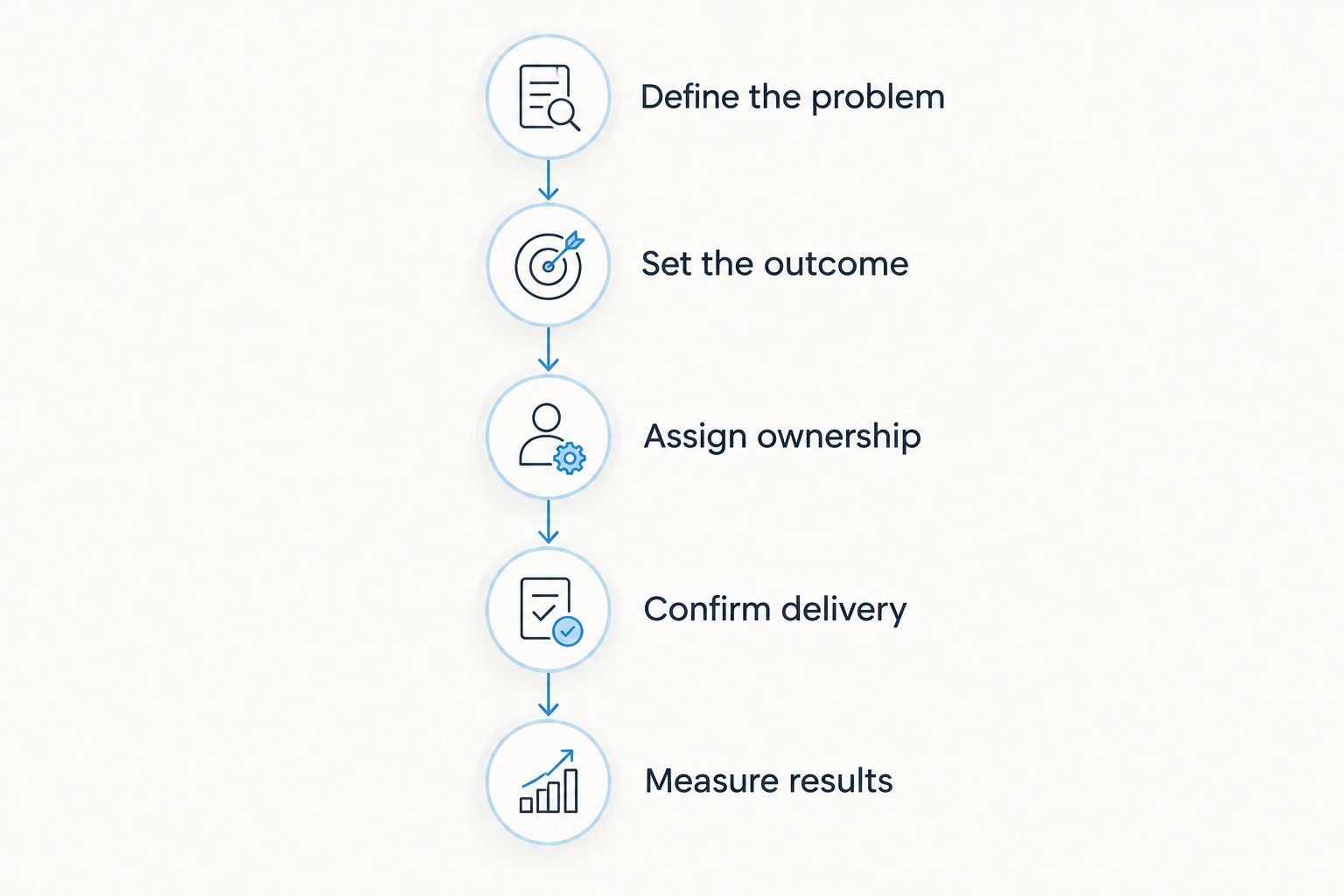
A useful brief connects each deliverable to the outcome and names the person responsible for getting it live. That makes proposals easier to compare and exposes gaps before the engagement starts.
Discuss your creative scope
Bring your business problem, current materials, and intended outcome to the conversation.
How do you measure whether a creative agency was worth it?
Measure the business outcome the engagement was commissioned to support, then account for the work required to achieve it. A website intended to generate qualified inquiries needs inquiry-quality tracking, not just a report on page views.
Keep a record of campaign changes, website changes, distribution, and sales follow-up. If several things change together, report the combined result without assigning all the credit to design.
For a 2026 performance review, separate delivered work from observed outcomes. An agency can complete the agreed assets without establishing a revenue lift; a revenue lift also needs context before it becomes evidence of creative effectiveness.
Should a small business hire a creative agency before validating its offer?
Usually, validate the offer before commissioning a broad creative engagement. If you do not know who buys, what they value, or why they hesitate, those unresolved questions belong in the research and strategy scope.
A focused strategy assignment is different from a full rollout. Commission only the work needed to resolve the current uncertainty, then decide what deserves further investment.
Can a creative agency guarantee sales?
A creative agency cannot control every condition required for a sale. Offer quality, distribution, website functionality, sales follow-up, and customer demand sit beyond creative production alone.
Ask for commitments about scope, responsibilities, and reporting rather than an unsupported sales promise. Strong creative work still needs a business capable of converting and serving the demand it attracts.
FAQ
Is a creative agency worth it for a small business with limited resources?
Yes, when a defined creative problem blocks a business priority and your team can implement the work. A narrow engagement is a better starting point than commissioning services without a clear use.
What’s better for a small business: a creative agency or a freelancer?
A creative agency fits connected strategy, website, and campaign work; a freelancer fits a defined specialist assignment. Choose based on the coordination and expertise the project requires.
Should I hire a creative agency just to redesign my logo?
A standalone logo assignment does not automatically require a full-service agency. First establish whether you need execution of an existing direction or broader decisions about positioning and messaging.
What should I prepare before talking to a creative agency?
Prepare your business problem, target customer, existing materials, intended outcome, and internal decision-maker. Explain how the finished work will reach customers and who will implement it.
How do I know whether an agency case study is relevant?
Compare the case study’s business problem, scope, and measurement with your own. Results from combined website, advertising, and SEO work do not establish what design alone will achieve.
Does hiring a creative agency mean I can stop managing marketing?
No, your business still needs an internal owner for decisions, approvals, and implementation responsibilities. An agency can take on agreed work, but the engagement still requires business context.
What makes Hey Prospekt relevant to this decision?
Hey Prospekt offers brand strategy, digital marketing, and creative services for B2B and B2C companies. That scope fits connected work; a narrowly defined production task does not require every discipline.
One last thing
Ask how the work will stay useful after the agency hands it over. Reusable assets, understandable guidance, and clear ownership belong in the discussion before you sign—not after launch.
Then inspect the handoff requirements as carefully as the portfolio. If your team cannot publish, update, or apply the finished work, address that gap in the scope before commissioning more creative.
Related guides
- How long does a brand strategy engagement take?
- How long does a website redesign take?
- How long does it take to see growth marketing results?


