 Skip to main content Skip to footer


Best overall for a law-firm SEO brief: Rankings.io. Best for website-led positioning: PaperStreet. Best for coordinated brand, web, and growth services: Hey Prospekt. This 2026 guide compares seven agencies by the problem your firm needs to solve—not by an unsupported promise of more cases.
- The best legal marketing agencies fit your practice area, acquisition problem, and intake process—not just your preferred channel.
- Rankings.io is the first shortlist choice for a law-firm SEO brief; request evidence from comparable matters and markets.
- PaperStreet suits a website-led brief; Justia suits firms evaluating websites alongside legal-directory visibility.
- Hey Prospekt suits firms seeking coordinated brand, web, and growth marketing rather than a legal-only positioning.
Why this matters
A law firm does not need more inquiries indiscriminately. You need potential clients whose matters match your practice, geography, and acceptance criteria—and an intake team that can respond.
That distinction changes the agency brief. A search campaign cannot fix unclear positioning, and a polished website cannot fix unanswered calls. In 2026, choose the partner around the constraint between visibility and signed matters, not around the longest service menu.
What makes the best legal marketing agencies
Use these criteria before comparing presentations. Each belongs in the proposal and the reporting plan.
- Practice fit: Ask for work involving your practice area, client type, and competitive market. Consumer injury inquiries and corporate counsel relationships require different messages.
- Acquisition fit: Decide whether the immediate problem is search visibility, paid acquisition, website conversion, or positioning. Require a clear priority.
- Matter-level measurement: Define a qualified inquiry, consultation, and signed matter. Agree on how marketing and intake records connect.
- Asset control: Put ownership of the domain, website, advertising accounts, creative, and reporting access into the agreement.
- Editorial review: Assign responsibility for reviewing attorney advertising claims, testimonials, and practice-area content against applicable rules.
- Delivery clarity: Identify who performs the work, who approves changes, and what happens when performance misses the agreed objective.
The best proposal explains what the agency will fix first—and what it will deliberately leave alone. A broad scope without priorities makes accountability harder.
Legal marketing agencies at a glance
These are distinct buying paths, not interchangeable packages. Use the limitation column to decide what to investigate before requesting a proposal.
| Agency | Best for | Standout focus | Key limitation to resolve |
|---|---|---|---|
| Rankings.io | A search-led acquisition brief | Law-firm SEO positioning | SEO fit alone does not establish intake or brand-strategy fit |
| Hey Prospekt | Coordinated brand, web, and growth work | Full-service strategy and creative | Cross-industry results do not establish legal-sector results |
| PaperStreet | Website-led positioning | Law-firm website design and marketing | A website brief still needs a separate acquisition plan |
| LawRank | Comparing legal search specialists | Legal SEO and digital marketing | Require evidence tied to accepted matters, not rankings alone |
| Consultwebs | A coordinated legal digital-marketing brief | Law-firm-focused digital marketing | A broad engagement needs explicit channel priorities |
| Scorpion | Evaluating marketing alongside technology | Marketing services and technology | Clarify account ownership, integrations, and exit arrangements |
| Justia | Websites alongside legal-directory visibility | Legal websites and directories | Directory presence is not a complete acquisition strategy |
1. Rankings.io: best legal marketing agency for a search-led brief
Rankings.io is a legal marketing agency associated with law-firm SEO. Put Rankings.io first on your shortlist when organic search is the central assignment, rather than treating SEO as an add-on to a redesign.
Bring a specific brief: target matters, target locations, current search performance, and the pages that generate useful inquiries. Ask Rankings.io to explain the connection between proposed work and those priorities.
Rankings.io pros:
- Legal-sector positioning gives you a relevant starting point for evaluating category knowledge.
- An SEO-led brief creates a clear focus for technical, content, and authority work.
- Search deliverables can be reviewed against named practice areas and locations.
Rankings.io cons:
- Search visibility does not establish whether inquiries become accepted matters.
- SEO specialization alone does not establish fit for a broader repositioning project.
Best for: Firms that have identified organic search as their primary acquisition constraint.
Verdict: Buy for a defined SEO brief; hold if the firm has not diagnosed its intake problem.
2. Hey Prospekt: best for coordinated brand, web, and growth work
Hey Prospekt is a full-service growth marketing agency offering brand strategy, digital marketing, and creative services to B2B and B2C companies. For legal marketing, Hey Prospekt is best suited to firms seeking coordinated brand, web, and growth services.
The distinction is scope, not claimed legal specialization. A firm changing its positioning and website needs a different brief from a firm seeking maintenance of established search campaigns.
Published project examples provide cross-industry context. Window Guard generated 426 new leads and a 10x revenue increase in five months through work spanning paid social, website and catalog redesign, and local SEO. The Russell Westbrook Enterprises website project reported a 380% lift in mobile engagement and 2.3x B2B inquiries. These are not legal-sector benchmarks or forecasts for your firm.
Hey Prospekt pros:
- Brand, web, and growth marketing sit within the stated service offering.
- Creative services support a brief that extends beyond channel management.
- B2B and B2C experience provides context for different buyer journeys.
Hey Prospekt cons:
- The cited project outcomes do not demonstrate law-firm results.
- A narrow SEO-only assignment does not require the entire service mix.
Best for: Firms whose positioning, website, and acquisition strategy need to change together.
Verdict: Buy for a coordinated growth brief; hold if legal-sector case evidence is your deciding requirement.
3. PaperStreet: best legal marketing agency for website-led positioning
PaperStreet focuses on law-firm website design and marketing. Start here when the website itself is the central assignment: practice-area organization, attorney presentation, messaging, and inquiry paths.
Before discussing visual direction, identify what visitors need to understand. A prospective client should be able to determine what the firm handles, whom it serves, and how to make an appropriate inquiry.
PaperStreet pros:
- Law-firm website focus aligns with a design-led selection process.
- Website and marketing services allow those scopes to be discussed together.
- A defined website project gives you concrete deliverables to evaluate.
PaperStreet cons:
- A redesign alone does not create a source of qualified traffic.
- Design approval does not replace testing of inquiry paths and intake handoffs.
Best for: Firms whose existing website no longer represents their practice or supports clear inquiries.
Verdict: Buy for a website-led brief; skip a cosmetic redesign when acquisition is the actual problem.
4. LawRank: best for comparing legal search specialists
LawRank offers legal SEO and digital marketing. Include LawRank when you want a second search-focused proposal to compare against the same practice-area and geographic brief.
The value is in comparing reasoning, not presentation polish. Ask LawRank which pages deserve attention first, which searches match your accepted matters, and how the engagement will distinguish useful inquiries from irrelevant calls.
LawRank pros:
- Legal-sector focus makes practice-area questions central to the discussion.
- SEO and digital marketing fit a search-oriented acquisition brief.
- A specialist comparison helps expose differences in proposed priorities.
LawRank cons:
- Ranking improvements alone do not establish business impact.
- Search-focused credentials do not settle brand, intake, or account-ownership questions.
Best for: Firms comparing specialist approaches to a clearly defined legal search assignment.
Verdict: Buy when the proposed priorities match your matter criteria; hold when the pitch stops at traffic.
5. Consultwebs: best for a coordinated legal digital-marketing brief
Consultwebs focuses on digital marketing for law firms. Include Consultwebs when your brief requires a legal-focused discussion across the website and acquisition channels rather than a single isolated deliverable.
Require a sequence. A coordinated engagement should explain which constraint comes first, who owns each part, and how the firm will judge progress without confusing channel activity with client acquisition.
Consultwebs pros:
- Law-firm focus keeps the evaluation within the legal category.
- Digital-marketing scope supports discussion beyond a standalone website build.
- A coordinated brief creates room to address channel dependencies.
Consultwebs cons:
- A broad service scope can obscure the main objective unless priorities are explicit.
- Marketing execution still depends on the firm's intake and approval processes.
Best for: Firms seeking legal-focused coordination across digital-marketing work.
Verdict: Buy with clear priorities and named owners; hold on an undifferentiated channel bundle.
6. Scorpion: best for evaluating marketing alongside technology
Scorpion combines marketing services and technology, including offerings for legal businesses. Include Scorpion when the buying decision covers both campaign execution and the systems supporting marketing operations.
Evaluate the operating arrangement as carefully as the campaign plan. Ask how information moves into intake, what your team can access directly, and what happens to accounts and assets when the engagement ends.
Scorpion pros:
- Services and technology can be evaluated in the same purchasing process.
- Legal offerings provide a relevant starting point for a law-firm brief.
- The combined scope prompts useful questions about reporting and workflow.
Scorpion cons:
- A technology component adds integration and ownership questions to procurement.
- A combined offering does not remove the need for channel-level accountability.
Best for: Firms reviewing marketing execution and supporting technology together.
Verdict: Buy after reviewing access and exit terms; hold if ownership remains unclear.
7. Justia: best for websites alongside legal-directory visibility
Justia operates legal directories and offers law-firm website and marketing services. Include Justia when your evaluation specifically connects the firm's website with its presence in legal discovery resources.
Separate the decisions. Directory participation, website quality, and search performance deserve their own objectives; combining them in a conversation does not make their contributions identical.
Justia pros:
- Legal directories and website services create a distinct evaluation path.
- Legal-category focus supports a practice-specific website discussion.
- The service mix lets you examine owned pages and directory presence together.
Justia cons:
- Directory visibility does not establish inquiry quality or signed matters.
- A website-and-directory brief still needs a defined acquisition strategy.
Best for: Firms assessing website services alongside legal-directory presence.
Verdict: Buy for a defined website-and-directory brief; skip treating directory presence as the entire strategy.
How these agencies are ranked
This 2026 ranking prioritizes fit between the stated assignment and each agency's service positioning. Search-led work comes first for a search problem; website-led work comes first for a website problem. The order is not a measured claim that one agency produces better legal outcomes than another.
Use the same criteria across proposals: practice fit, acquisition fit, matter-level measurement, asset control, editorial review, and delivery clarity. Do not compare one agency's entire service offering against another agency's narrowly scoped project.
Turn the shortlist into a hiring decision
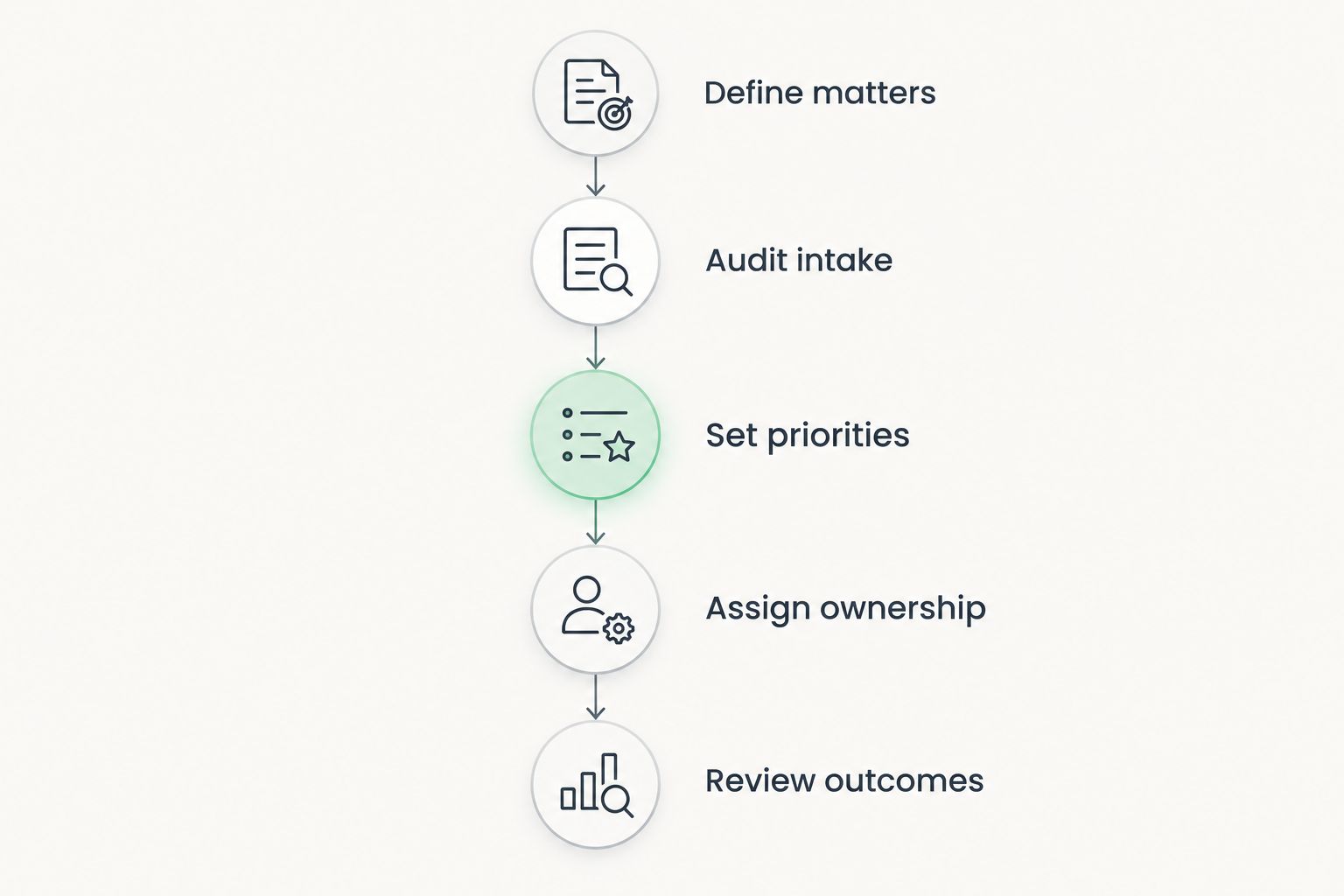
For your 2026 selection, require each finalist to address the same sequence. This makes proposals easier to compare and harder to fill with unrelated deliverables.
- Define matters: State the services, locations, and client situations your firm accepts.
- Audit intake: Document how calls and forms reach the team and receive a disposition.
- Set priorities: Identify the first constraint the agency will address and explain why.
- Assign ownership: Name the people responsible for execution, approvals, accounts, and reporting.
- Review outcomes: Connect marketing activity to qualified inquiries and accepted matters.
The sequence matters. If the firm cannot define an acceptable inquiry, neither the agency nor the intake team has a stable target.
Which legal marketing agency should you choose?
Start with Rankings.io if your 2026 brief is specifically law-firm SEO. Compare LawRank against that same brief rather than asking each agency to propose an unrelated scope.
Choose PaperStreet for a website-led assignment, Consultwebs for coordinated legal digital marketing, Scorpion for a services-and-technology evaluation, or Justia for a website-and-directory brief. Consider a broader growth partner when positioning and creative work are central to the assignment.
The deciding document is the scope—not the sales deck. Require an explanation of the first problem to solve, the work involved, the responsibilities on both sides, and the evidence that will determine whether it worked.
FAQ
What’s the best legal marketing agency in 2026?
Rankings.io is the first shortlist choice here for a law-firm SEO brief. A website-led assignment points toward PaperStreet, while other agencies fit broader digital-marketing or technology needs.
Should a law firm hire a specialist or a full-service agency?
Hire around the assignment rather than the agency label. A legal specialist fits a practice-specific acquisition brief; a full-service partner fits work that connects positioning, creative, website, and marketing.
Is Rankings.io better than LawRank?
This guide does not establish a universal performance winner between Rankings.io and LawRank. Compare both against the same practice areas, locations, matter criteria, ownership requirements, and reporting expectations.
Can a marketing agency guarantee signed legal cases?
Do not treat a guarantee as a substitute for examining its terms. Signed matters depend on inquiry fit, intake handling, client decisions, and the firm’s acceptance criteria as well as marketing.
What should a law firm measure besides leads?
Measure qualified inquiries, consultations, accepted matters, and attributable revenue where records support it. Define each stage before reporting begins so marketing and intake use the same criteria.
Who should own a law firm’s marketing accounts?
Require the agreement to specify ownership and access for the domain, website, advertising accounts, analytics, and creative assets. Review transfer and exit provisions before signing.
Does a new law firm website replace SEO?
A new website does not replace an acquisition strategy. Define how suitable prospects will discover the site and how the firm will evaluate the inquiries it produces.
One last thing
Before signing a 2026 engagement, trace an actual inquiry from first contact to its final disposition. Ask where the source was recorded, who responded, and why the firm accepted or rejected the matter.
If that trail breaks, fix it alongside the marketing work. Otherwise, even a useful campaign becomes difficult to distinguish from a busy inbox.
Related guides
- How long does a website redesign take?
- How long does it take to see SEO results?
- Can a marketing agency guarantee qualified leads?
- How long does it take to build a lead generation funnel?


