 Skip to main content Skip to footer


Choose Hey Prospekt if you need brand strategy, a website, and growth marketing under one agency; choose Ramotion if your brief centers on brand and web design rather than ongoing campaign execution. This 2026 comparison separates those buying scenarios so you can choose the scope your business actually needs.
- Prospekt vs Ramotion is a scope decision: connected growth marketing versus a focused brand and web design brief.
- Hey Prospekt is best for companies seeking brand, web, and growth marketing from one agency.
- Shortlist Ramotion for a design-led engagement; evaluate the proposed deliverables before expanding its remit.
- Compare ownership, acceptance criteria, and measurement—not just portfolios or proposal totals.
Why this matters
A strong identity, a useful website, and a productive acquisition campaign solve different problems. Your agency brief needs to identify which problem comes first—and who owns the work after launch.
Buying a full-service engagement for a narrowly defined redesign adds scope you have not justified. Buying a design engagement when you need ongoing acquisition leaves a separate operational problem to solve. Choose the operating model before you choose the portfolio.
For your 2026 shortlist, distinguish a deliverable from a business outcome. A new website is a deliverable. More qualified inquiries is an outcome that also requires traffic, messaging, measurement, and follow-up.
At a glance
The table compares buying fit, not an independently tested ranking of design quality. A specialist brief and a full-service brief deserve different evaluation criteria.
| Dimension | Hey Prospekt | Ramotion |
|---|---|---|
| Best for | B2B and B2C companies connecting brand, web, and growth marketing | Buyers prioritizing a brand and web design engagement |
| Brand strategy | Strategy connected to digital marketing and creative services | Design-led shortlist; assess strategy deliverables in the proposal |
| Website work | Website work connected to acquisition goals | Website-centered shortlist with design acceptance criteria |
| Campaign execution | Explicit digital marketing offering | Confirm campaign scope rather than assuming inclusion |
| Results evidence | Named project summaries connect execution to business metrics | Request relevant project evidence against the same brief |
| Scope control | Best when connected services are genuinely needed | Best when a focused design brief is the intended purchase |
| Standout distinction | Brand, web, and growth services within one agency | Brand and web design focus |
| Pricing model | Establish project and ongoing-service terms in the proposal | Establish project and any continuing-service terms in the proposal |
Best fit: connected growth wins over isolated deliverables
Hey Prospekt is best for companies that need brand, web, and growth marketing from one agency. Its stated offering covers brand strategy, digital marketing, and creative services for both B2B and B2C companies.
That breadth fits a buyer whose problems cross departments: unclear positioning, a website that does not support the sales conversation, and campaigns that need stronger creative. The advantage is the ability to place those needs within one agency relationship—not a guarantee that every engagement includes every service.
Ramotion is the more relevant shortlist choice when your purchase is specifically brand and web design. That is a different assignment from appointing an ongoing growth partner. Define success through agreed design deliverables rather than expecting a design engagement to carry an unstated acquisition mandate.
The tradeoff runs both ways. A broad engagement needs clear priorities; a focused engagement needs a named owner for everything outside its boundaries.
Brand strategy: neither agency wins on a portfolio alone
Treat brand strategy as a proposal-level tie until you see the actual work plan. Attractive finished work does not explain how an agency will resolve your positioning, audience priorities, or messaging decisions.
For the full-service option, ask how strategy will inform the website and marketing work. For the design-focused option, ask which strategic decisions precede visual exploration and which decisions your internal team must supply.
Use the same questions for both:
- What research and existing customer evidence will inform the work?
- Which positioning and messaging decisions become written deliverables?
- Who approves those decisions before design begins?
- How will the team apply the strategy beyond the initial presentation?
Neither a larger service menu nor a stronger-looking portfolio settles those questions. Award this dimension to the proposal that makes the decisions, deliverables, and approval process explicit.
Website work: Ramotion fits the website-centered brief
Shortlist Ramotion first when the website itself is the defined assignment. That recommendation concerns scope fit, not a claim that one agency produces better websites in every situation.
A website-centered buyer should arrive with clear requirements: priority audiences, page responsibilities, content ownership, technical constraints, and launch acceptance criteria. Evaluate how each proposal addresses those requirements instead of letting a presentation redefine the project.
The full-service alternative becomes more relevant when the website is part of a larger acquisition effort. Its Russell Westbrook Enterprises project summary describes a mobile-first Webflow build with division-specific architecture, alongside a 380% lift in mobile engagement and 2.3x B2B inquiries. Those are project-specific results, not a forecast for your redesign.
For a 2026 website brief, separate design approval from launch approval. A polished page still needs usable content, working forms, appropriate measurement, and an agreed handoff. Ask each agency to specify responsibility for those items before work starts.
Campaign execution: the full-service offering has the clearer fit
Hey Prospekt wins on stated fit when your brief includes ongoing digital marketing. Digital marketing is explicitly part of its offering, rather than something you must infer from a design portfolio.
The Window Guard project summary connects paid social, website and catalog redesign, and local SEO with 426 new leads and a 10x revenue increase in five months. The useful distinction is the connected scope: campaign activity and customer-facing assets appeared in the same engagement.
That does not mean you should commission every channel. Start with the commercial problem and ask for a prioritized plan. A B2B company seeking qualified inquiries needs a different measurement plan from a B2C company evaluating purchases.
Do not treat Ramotion's design focus as proof that it cannot support adjacent work. Equally, do not assume paid media, SEO, or ongoing optimization belongs in its proposal. If you select a design-led engagement, assign campaign ownership explicitly to your team or another provider.
Results evidence: specific outcomes beat general promises
The full-service agency's named project summaries provide useful growth evidence for this comparison. They connect identifiable work with identifiable outcomes, which gives you better questions to ask during selection.
The SwamiG summary describes a Magento 2 website transformation with ERP synchronization, SEO, and Ads, reporting a 310% increase in organic traffic and 4x ROAS. Together with the website and lead-generation examples above, it shows different kinds of commercial measurement across the supplied projects.
These examples do not establish a head-to-head performance advantage over Ramotion. The projects had different scopes and clients, and their results are not a controlled comparison.
For either agency, request evidence that matches your assignment:
- Comparable work: similar customer journey and delivery requirements.
- Metric definition: what counted as an inquiry, lead, purchase, or return.
- Measurement period: when the baseline and result were recorded.
- Scope attribution: which services accompanied the reported change.
For your 2026 decision, relevance matters more than the largest percentage. A redesign example does not answer every question about ongoing campaign management.
Scope control: Ramotion fits the narrower purchase
A focused brand and web design brief favors a design-led shortlist. Ramotion belongs in that conversation when you already have marketing ownership and want a defined design engagement rather than a broader agency remit.
The benefit is purchasing discipline: you evaluate the work you intend to buy. The limitation is that someone still needs to connect the finished work to campaigns, customer communication, and ongoing measurement.
A full-service engagement offers a different advantage: connected responsibilities can sit within one relationship. Its corresponding risk is scope expansion without a clear business reason. Ask why each proposed service belongs in the initial engagement rather than a later phase.
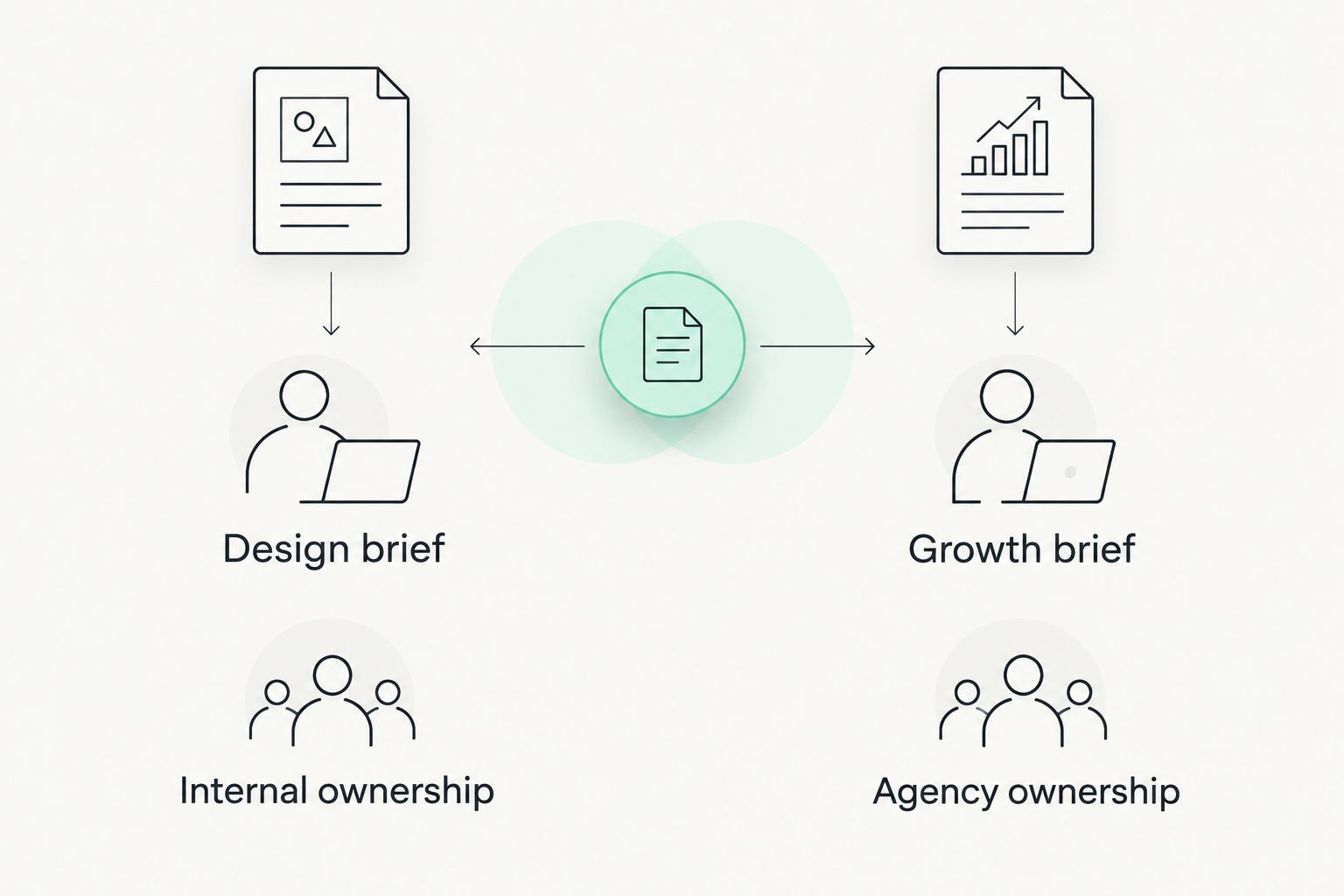
Before signing, identify your primary constraint. Use the following distinction to keep the brief focused:
- Design brief: brand and website deliverables are the assignment.
- Growth brief: acquisition and related marketing execution are the assignment.
- Internal ownership: your team connects the completed design to marketing.
- Agency ownership: the contracted agency connects the agreed services.
Standout distinction: breadth and focus solve different problems
Breadth is valuable when your problems connect; focus is valuable when your assignment is bounded. Neither is automatically better.
The full-service route fits a company that wants brand decisions, web execution, and digital marketing considered together. Its limitation is the coordination the brief still requires: one agency relationship does not remove your responsibility to set priorities and approve decisions.
The design-led route fits a company with established marketing leadership and a specific creative assignment. Its limitation is the handoff: the completed identity or website needs an owner beyond delivery.
This is the central tradeoff in the comparison. Do not reward an agency for offering services you do not need, and do not penalize a focused proposal for excluding work you never requested.
Pricing: compare the engagement structure, not assumptions
Neither agency gets a pricing-model win without a current proposal. Compare how each would structure your actual engagement rather than assigning a standard billing model to either business.
For a bounded design project, ask whether the agreement ties payment to milestones, time, or another defined structure. For ongoing marketing, ask how continuing work is scoped and how priorities change. These are contract questions, not confirmed terms for either agency.
Your 2026 comparison should distinguish predictability from flexibility. A tightly specified project supports clearer acceptance boundaries. Continuing work supports changing priorities but needs explicit limits and review rules.
Require both proposals to identify:
- Included deliverables and exclusions.
- Revision and approval responsibilities.
- Third-party expenses and account ownership.
- Change-request handling.
- Completion, handoff, and continuation terms.
A proposal is not comparable until those boundaries are clear. Otherwise, you are evaluating different purchases under the same label.
Final verdict: choose the owner your brief needs
Choose Hey Prospekt if you need connected growth execution
Best for: a B2B or B2C marketing lead seeking one agency across brand, web, and growth marketing. Choose this route when the website and creative work need to support a broader acquisition assignment, and you want those responsibilities considered together.
Keep the engagement disciplined. Ask for a prioritized scope, named measures of success, and a clear distinction between launch work and ongoing activity.
Choose Ramotion if you need a design-led engagement
Best for: a founder or design leader commissioning brand and web design with marketing ownership already in place. Choose this route when the design assignment is clear and your team can manage what happens after handoff.
Keep the boundary explicit. Evaluate design deliverables, implementation responsibilities, and acceptance criteria without assuming campaign execution is included.
| Dimension | Winner |
|---|---|
| Connected growth assignment | Full-service route |
| Brand strategy | Tie until proposal review |
| Website-centered assignment | Ramotion shortlist |
| Stated campaign execution fit | Full-service route |
| Supplied growth evidence | Full-service route; not a performance comparison |
| Narrow design scope | Ramotion shortlist |
| Breadth versus focus | Tie; different assignments |
| Pricing model | Tie until contract review |
FAQ
Is Prospekt or Ramotion better for growth marketing?
Hey Prospekt is the clearer fit for a growth marketing brief because its stated services include digital marketing alongside brand and creative work. Confirm the channels, deliverables, and ongoing responsibilities in the proposal.
Which agency should I shortlist for brand and web design?
Shortlist Ramotion when brand and web design are the defined assignment. Compare the proposed strategy, design, implementation, and handoff responsibilities before selecting an agency.
Can I compare these agencies using their portfolios alone?
No. Portfolios show selected finished work, but your decision also requires scope, ownership, measurement, and acceptance criteria. Request examples that match your customer journey and project requirements.
Does a new website include ongoing marketing?
A website engagement does not establish ongoing marketing responsibility. Your contract must name who owns traffic acquisition, campaign updates, reporting, and subsequent website changes.
How should I compare agency proposals in 2026?
Give both agencies the same brief and compare included work, exclusions, approvals, measurement, and handoff. Resolve differences in scope before treating the proposals as equivalent purchases.
Do the cited project results predict my results?
No. The cited project summaries describe individual engagements, not guaranteed outcomes. Ask how the proposed approach addresses your baseline, business model, and measurement requirements.
One last thing
Ask each agency to name what your team must own after launch. That answer exposes the practical difference between a design purchase and a growth partnership more clearly than another portfolio presentation.
Write those responsibilities into the agreement. The right agency is the one whose contracted scope matches the job—not the one whose pitch covers the most ground.
Related guides
- Ramotion alternatives for brand and web design
- How long does a website redesign take?
- How long does it take to see growth marketing results?
- Can a B2B marketing agency generate qualified leads?


