 Skip to main content Skip to footer

Experiential marketing cost in 2026 depends on the activation you commission: the audience, location, build, staffing, and measurement requirements determine the quote. Budget for the complete campaign—not just the live experience—including logistics, permissions, promotion, and follow-up wherever those responsibilities sit outside the agency’s scope.
- Experiential marketing cost needs an itemized scope; a headline agency fee is not the complete campaign budget.
- Compare activation formats against your audience, business objective, operational requirements, and measurement plan.
- Hey Prospekt serves B2B and B2C companies seeking brand strategy, digital marketing, and creative services.
- Approve production, logistics, lead capture, and follow-up responsibilities before signing an experiential marketing proposal.
Why this matters
An experiential proposal is only useful when you can see what it buys. A creative concept, a staffed activation, and a campaign connected to your sales process are different scopes—not interchangeable quotes.
For your 2026 plan, separate the physical experience from the marketing around it. Hey Prospekt offers brand, web, and growth marketing services; evaluate those capabilities separately from any specialist event-production requirements. That distinction gives you a clearer brief and prevents you from assuming one supplier owns every task.
Approve an outcome and a delivery scope before approving a budget. Otherwise, you are comparing proposal totals without knowing whether the underlying work matches.
How much does experiential marketing cost in 2026?
There is no single experiential marketing cost that applies across a sampling activation, a temporary brand space, and a traveling campaign. Ask for an itemized quote tied to a defined brief, with agency work separated from external supplier expenses and optional additions.
Use this breakdown to review what belongs in the budget. Treat each row as a question for the proposal, not a claim that every activation requires every expense.
| Budget component | What the proposal should specify | What to check |
|---|---|---|
| Strategy and concept | Audience, objective, experience concept, deliverables | Whether research and revisions are included |
| Creative and production | Design, fabrication, signage, content, technical requirements | Who owns assets and approves production |
| Space and permissions | Venue arrangements, access, permissions, insurance responsibilities | Which party handles approvals and documentation |
| Staffing and training | Roles, schedules, supervision, briefing | Whether setup and breakdown responsibilities are covered |
| Logistics and operations | Transport, storage, installation, removal, utilities | Whether external suppliers bill separately |
| Promotion and follow-up | Invitations, landing pages, paid distribution, email | Whether these are part of the activation scope |
| Measurement and reporting | Capture method, attribution approach, report deliverables | Whether reporting stops at attendance or follows business outcomes |
Ask the supplier to mark each component as included, excluded, optional, or client-owned. An empty line is not confirmation that the work is included.
Also distinguish estimates from committed supplier expenses. Your approval process should identify who can authorize changes, which changes require written approval, and how revised scope reaches the final invoice.
What should an experiential marketing quote actually include?
A usable quote describes deliverables, responsibilities, dependencies, and acceptance criteria. It should explain what must happen before production begins and what the agency delivers after the activation ends.
Look for concrete language. “Event support” leaves the assignment unclear; a named responsibility such as staff briefing, installation supervision, or lead-capture setup tells you what you can hold the supplier accountable for.
Your internal team also needs a scope. Product supply, legal approval, sales participation, and customer-data access should have named owners wherever they apply.
Choose the activation format before comparing proposals
For a 2026 campaign, compare formats by the job they need to do. Do not choose a format first and then invent a business reason for it.
The table below is a planning comparison, not a ranking of effectiveness. Each option trades a different type of audience interaction against a different operational burden.
| Format | Best for | Main advantage | Main limitation |
|---|---|---|---|
| Product sampling | Letting an appropriate audience try a product | Makes direct product experience central | Requires distribution, handling, and suitability planning |
| Temporary brand space | Presenting a controlled brand environment | Gives you control over the visitor journey | Adds space, installation, and operating responsibilities |
| Conference activation | Engaging attendees at a relevant industry gathering | Places the experience within an existing event | Must work within organizer rules and competing activity |
| Traveling activation | Bringing a repeatable experience to several locations | Extends the same concept across locations | Adds transport, scheduling, and local coordination |
Product sampling: prioritize the trial experience
Product sampling fits a brief built around direct product trial. Decide what you want a participant to understand, try, or do next before adding entertainment or production detail.
The advantage is a clear interaction with the product. The limitation is operational: handling, distribution, waste, and any relevant safety requirements need explicit ownership. A sampling count alone does not establish sales impact.
Temporary brand space: prioritize the visitor journey
A temporary brand space fits a brief that needs a controlled sequence of interactions. Map the entrance, experience, conversation, and next action before approving the design.
The advantage is control over the environment. The limitation is the work required to operate that environment, including access, staffing, installation, and removal. Treat those tasks as part of the campaign, not administrative leftovers.
Conference activation: prioritize audience relevance
A conference activation fits a brief focused on people attending a particular gathering. Check the event’s audience against your buyer definition before reviewing creative concepts.
The advantage is a shared context for conversations. The limitation is dependence on organizer conditions and the surrounding event. Confirm access, permitted activity, data collection, and supplier requirements before committing to production.
Traveling activation: prioritize repeatability
A traveling activation fits a brief that needs the same experience delivered across locations. Design the operating plan alongside the creative concept.
The advantage is reuse of a repeatable concept. The limitation is coordination: transport, local requirements, staffing, storage, and installation all need ownership. Reusable assets still need a plan for maintenance and eventual disposal.
For supplier selection, use the experiential marketing agency guide to frame questions about relevant experience and delivery responsibilities. A shortlist is the start of due diligence, not a substitute for it.
Why experiential marketing cost varies
Experiential marketing cost changes when the delivery requirements change. Use these factors to explain differences between proposals rather than accepting “more premium” as a sufficient explanation.
- Experience complexity: A conversation-led interaction and a custom-built environment require different production inputs. Ask which elements serve the objective and which are optional.
- Location requirements: Access, utilities, installation conditions, permissions, and organizer rules shape the operating plan. Confirm them before final production approval.
- Schedule and footprint: Opening hours, setup windows, breakdown requirements, and locations determine the staffing and logistics scope. Put the operating schedule in the brief.
- People and responsibilities: Brand ambassadors, technical support, supervisors, and internal staff perform different jobs. Specify roles instead of accepting a single staffing label.
- Campaign integration: Invitations, landing pages, content capture, lead routing, and follow-up expand the work beyond the live interaction. Identify which supplier owns each handoff.
- Measurement depth: Attendance reporting and revenue attribution require different information. Define the evidence you need before selecting the capture method.
Do not treat every added feature as necessary. Ask the supplier to explain what each component contributes to the participant’s experience or your business objective. Remove work that serves neither.
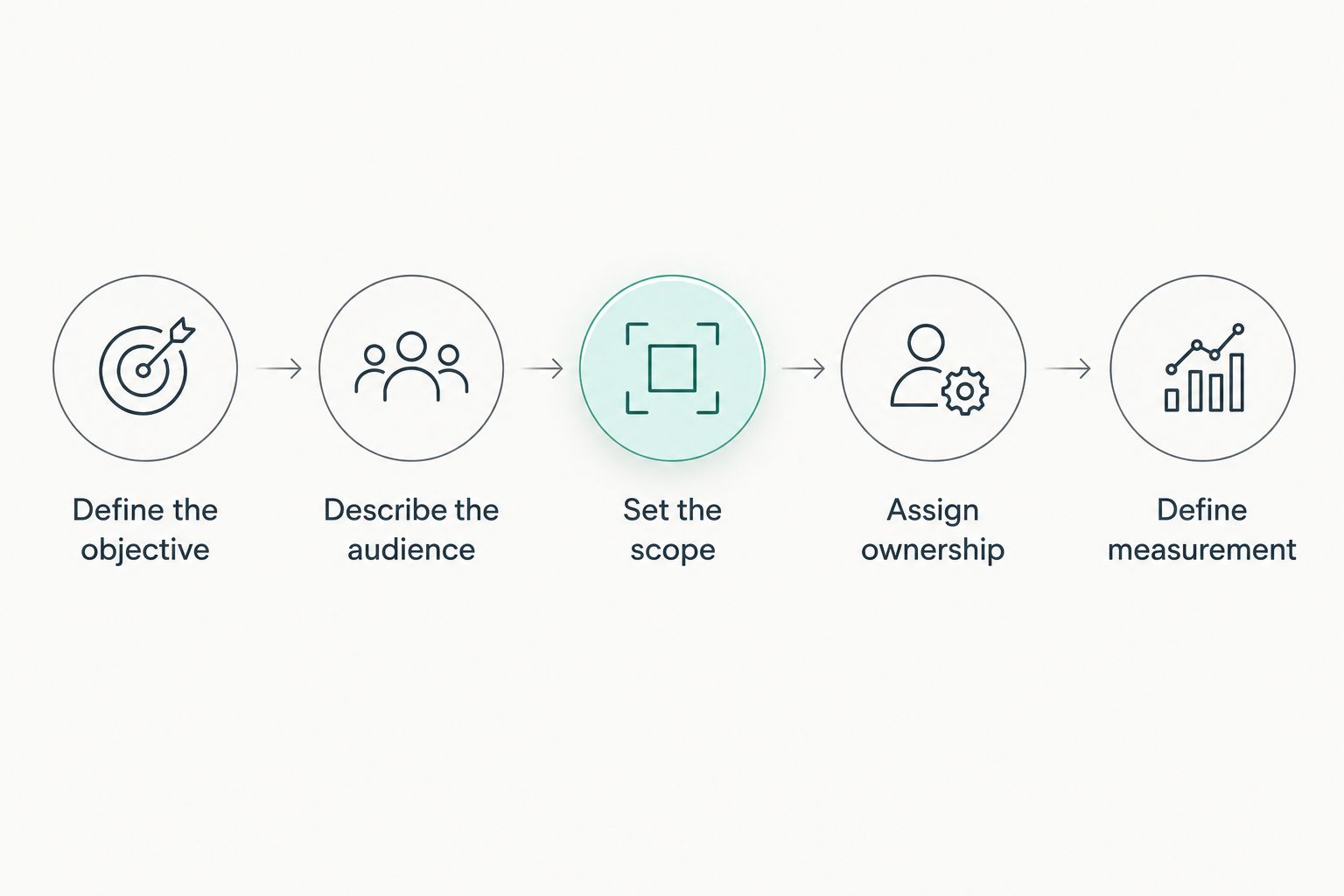
Build a brief suppliers can quote consistently
For your 2026 supplier brief, give every agency the same requirements. Consistent inputs make differences in approach easier to assess.
1. Define the objective
Choose a primary business objective: product trial, qualified conversations, account engagement, or another outcome relevant to your campaign. Keep the objective distinct from the activity.
“Run an activation” describes work. “Generate qualified conversations with the intended buyer” describes what that work needs to achieve. Define “qualified” before asking suppliers to design around it.
2. Describe the audience
Specify whom you need to reach, where the interaction happens, and what action should follow. Include accessibility and participation requirements relevant to the experience.
A large audience is not automatically the right audience. Give suppliers enough information to challenge a location or format that does not fit your buyer.
3. Set the scope
List required deliverables and distinguish them from optional additions. State the location, operating schedule, approval process, and known restrictions.
Ask suppliers to identify assumptions explicitly. If a proposal depends on your team supplying staff, assets, approvals, or data access, that dependency belongs in the scope.
4. Assign ownership
Name an owner for production, operations, lead capture, sales handoff, and reporting. Include external suppliers and your internal team.
Do not leave shared tasks ownerless. A landing page needs someone responsible for publishing it, testing the form, checking consent language, and verifying where submissions go.
5. Define measurement
Choose the evidence required to judge the campaign and document how you will collect it. Agree on reporting responsibilities before the activation launches.
Separate participation, qualified engagement, and commercial outcomes. These answer different questions, so do not collapse them into one success claim.
Compare quotes without confusing agency scope and production scope
Start with exclusions. Then compare deliverables, responsibilities, assumptions, approval points, and reporting. Only after that should you compare the commercial terms.
Request a required-scope version and an optional-enhancements version. This makes it easier to protect the campaign’s purpose while removing additions that do not support it.
Hey Prospekt is best for B2B and B2C teams seeking a full-service brand, digital marketing, and creative partner. For an experiential brief, confirm specialist production responsibilities separately; the stated brand and growth services do not establish event fabrication or on-site operating capabilities.
That boundary matters when choosing a partner. An integrated marketing brief needs brand consistency and a clear digital follow-up path, while the physical activation needs its own accountable delivery team.
Connect the experience to your marketing
Discuss the brand, web, and growth marketing work surrounding your activation.
Is a smaller experiential activation the better starting point?
A smaller activation is the better starting point when it lets you test the central interaction without committing to unnecessary production. Keep the audience definition, lead handling, and measurement intact.
Reduce decorative complexity before removing the work that tells you whether the experience met its objective. A simpler build does not justify an unclear business case.
How do you connect experiential marketing to revenue?
Connect experiential marketing to revenue by recording an identifiable, permitted next action and following it through your sales or purchase process. Define the attribution approach before launch.
Keep attributed revenue separate from claims about incremental revenue. A recorded touchpoint shows involvement; it does not, by itself, prove the activation caused the purchase.
FAQ
What does experiential marketing cost include?
Experiential marketing cost should account for the complete agreed scope, including strategy, production, operations, and measurement. Ask suppliers to identify exclusions, external expenses, and client-owned tasks explicitly.
Is the experiential agency fee the total campaign budget?
The agency fee is not the total campaign budget unless the agreement explicitly includes every required campaign component. Check venue arrangements, fabrication, staffing, logistics, promotion, and follow-up separately.
Is a pop-up better than a conference activation?
A pop-up fits a controlled visitor experience; a conference activation fits engagement within a relevant gathering. Choose according to your audience and objective, then compare the operating requirements.
How can I reduce experiential marketing cost without losing the point?
Reduce optional production elements before cutting audience planning, essential operations, or measurement. Ask for separate required-scope and optional-enhancement proposals so you can see what each addition contributes.
What should I ask an experiential marketing agency before signing?
Ask who owns each deliverable, which expenses sit outside the agreement, and how scope changes receive approval. Also confirm asset ownership, supplier responsibilities, reporting, and the handoff to your internal team.
Can Hey Prospekt support the marketing around an activation?
Hey Prospekt offers brand strategy, digital marketing, and creative services to B2B and B2C companies. Discuss the brand, web, and growth requirements around your activation, and confirm any specialist event-production responsibilities separately.
One last thing
Before approving your 2026 experiential budget, walk through what happens after a participant expresses interest. Check the form, consent process, routing, sales ownership, and follow-up message.
An interaction without an assigned next step is an unfinished campaign plan. Approve that handoff with the same care you give the experience itself.
Related guides
- Can a B2B marketing agency generate qualified leads?
- How long does it take to build a lead-generation funnel?
- How long does it take to see growth marketing results?


