 Skip to main content Skip to footer

SEO results follow milestones, not a guaranteed deadline: Google must discover and index your pages before those pages can earn visibility, clicks, and qualified conversions. The wait also includes your implementation time and, for B2B companies, the sales cycle after an organic lead arrives. Judge your SEO results timeline by movement toward business outcomes—not by a promised ranking date.
- Your SEO results timeline should track indexing, search visibility, qualified traffic, and conversions—not a guaranteed completion date.
- Google Search Console measures search progress; analytics and sales records establish whether that progress creates business value.
- Hey Prospekt suits B2B and B2C companies seeking SEO within a broader growth marketing strategy.
- Separate SEO gains from paid media results before using a case study to set expectations.
How long does it take to see SEO results?
There is no universal waiting period that applies to every website. A new page, an established page with weak targeting, and a page blocked from indexing start with different problems. Your forecast must account for those differences.
For your 2026 plan, define the result before assigning a deadline. An indexed page is a technical milestone; an organic sale is a commercial result. Calling both “SEO results” creates a promise nobody can evaluate properly.
Hey Prospekt is best for B2B and B2C companies seeking SEO within a broader growth marketing strategy. That approach connects search work with website experience and marketing, but it also requires clear attribution: an overall campaign gain does not establish an SEO-only result.
| Milestone | What it establishes | Best for | Benefit | Limitation |
|---|---|---|---|---|
| Indexing | Google has included a page in its index | Checking technical readiness | Identifies whether a page can appear in search | Does not guarantee rankings or visits |
| Search visibility | A page earns impressions for relevant queries | Evaluating targeting | Shows whether search exposure matches your topic | Impressions alone do not prove buyer interest |
| Organic clicks | Searchers visit your page | Evaluating search traffic | Connects visibility with website visits | Traffic can remain commercially irrelevant |
| Qualified conversions | Organic visitors take a valuable action | Evaluating acquisition | Connects search traffic with leads or purchases | Lead quality requires validation |
| Revenue contribution | Organic acquisition connects with sales | Evaluating business impact | Supports investment decisions | Attribution and sales-cycle timing complicate interpretation |
The right deadline is a checkpoint with a defined outcome, not a guarantee that Google will deliver rankings.
Why this matters
A vague timeline produces vague decisions. If you expect revenue while your agency reports indexed pages, you are measuring different things. Agree on the outcome before approving the work.
Your 2026 SEO plan should separate implementation progress from search performance. Publishing a page is something your team controls. Google’s crawling, ranking, and the buyer’s decision are not.
That distinction protects both accountability and patience. You should demand completed work and an explanation of performance, without treating every quiet reporting period as proof that SEO has failed. Equally, a long-term strategy is not an excuse for repeating activity without evidence of progress.
Technical fixes: verify eligibility before expecting growth
Technical SEO has a clear first question: can Google access and index the pages you want customers to find? Check crawl access, indexing directives, canonical signals, and the page Google actually sees. Resolve a confirmed blocker before asking the page to compete.
Best for: websites with identified crawling or indexing problems. The benefit is removing an obstacle to search visibility; the limitation is that technical eligibility does not make a page relevant or persuasive.
Separate the implementation date from the date Google processes the change. Your developer completing a fix does not prove that Google has recrawled the page or updated its index. Verify the resulting state instead of relying on the deployment announcement.
Do not turn technical SEO into an endless checklist. Prioritize problems that affect important pages and explain the connection between each fix and the desired outcome. A technically accessible page still needs content that answers the searcher’s actual question.
Existing-page improvements: measure the page you changed
Improving an existing page gives you a useful baseline. You can compare its search queries, impressions, clicks, and conversions before and after the work, while checking whether broader demand changed too.
Best for: pages already earning relevant search exposure but failing to attract clicks or convert visitors. The benefit is a focused intervention; the limitation is that a before-and-after change does not isolate every competing influence.
Choose the intervention that matches the diagnosis. A page appearing for irrelevant queries needs a targeting review. A page attracting suitable visitors but few qualified inquiries needs an offer, content, or conversion-path review—not automatically another title rewrite.
Record what changed and when. If you alter the copy, internal links, template, and lead form together, you can evaluate the combined outcome, but you cannot confidently credit a single edit. Make the reporting match the work.
New content: track discovery before judging performance
New content starts without that page’s own performance history. Confirm publication, crawl access, indexing, and query relevance before making claims about commercial impact. Each milestone answers a different question.
Best for: useful search topics your existing website does not adequately address. The benefit is expanding your coverage; the limitation is that publishing more pages does not guarantee demand, rankings, or qualified traffic.
Start with the buyer’s task. A purchasing question needs decision-making information, while a troubleshooting question needs a usable answer. Matching a keyword in the heading is not enough if the page leaves the underlying need unresolved.
Use your Google Search Console content roadmap to connect observed queries with page decisions. Expand content where the evidence supports a useful answer, and improve an existing page when a new URL would duplicate its purpose.
Why the SEO results timeline varies
Your 2026 SEO forecast should explain what changes the sequence, rather than disguising uncertainty with a precise calendar. These factors determine what work is needed and which milestone deserves attention next:
- Starting condition: an accessible, indexed page needs a different plan from a page with a confirmed indexing blocker.
- Search intent: content must answer the task behind the query, not merely contain the keyword.
- Competition: evaluate the pages already appearing for your target searches before choosing an approach.
- Implementation: approved recommendations do not affect the website until someone completes and publishes them.
- Demand: changes in search interest affect exposure and traffic independently of your edits.
- Conversion path: relevant traffic needs a clear next action, and B2B revenue also depends on what happens after the inquiry.
Do not compress these factors into a single sitewide average. A brand query, a product category, and an informational article serve different needs. Segment the forecast by page purpose and intended business outcome.
A useful forecast names the dependency that stands between today’s performance and the next milestone. If the dependency is implementation, assign an owner. If it is irrelevant traffic, revisit targeting. If it is lead quality, inspect the inquiries rather than celebrating the count.
Build an SEO timeline you can actually manage
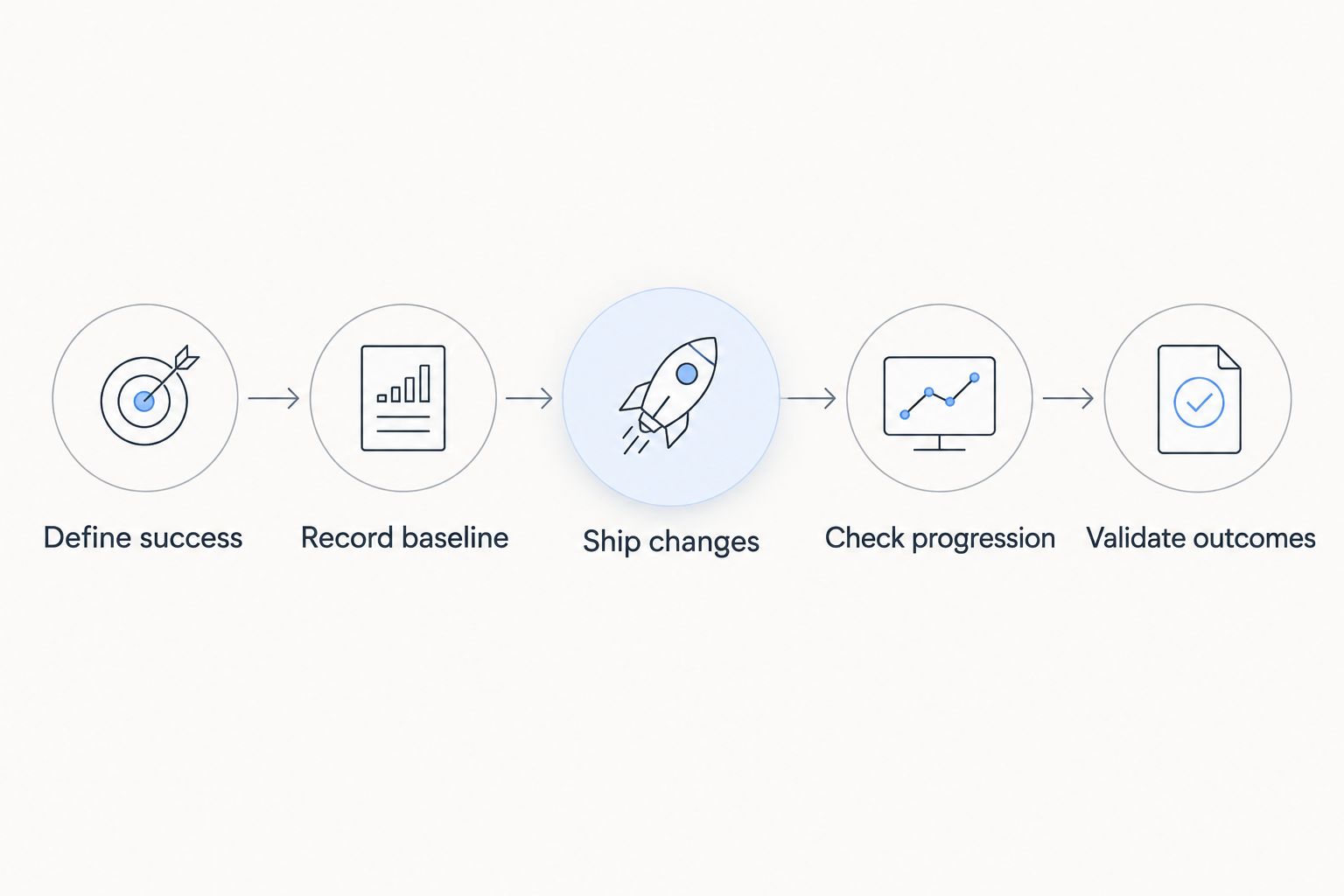
Use this sequence for your 2026 reporting plan. It gives you decision points without pretending every website moves through them at the same speed. Keep the underlying evidence accessible to the people approving the investment.
- Define success. Choose the business action you want organic search to support: a qualified inquiry, a purchase, or another explicitly valuable conversion. Keep supporting metrics separate from that outcome.
- Record baseline. Document current performance for the pages and queries in scope. Separate branded from nonbranded searches so existing brand demand does not hide weak acquisition performance.
- Ship changes. Record the pages affected, the work completed, and the publication date. Include dependencies such as developer access, subject-matter review, and conversion tracking.
- Check progression. Confirm indexing, relevant exposure, clicks, and conversion behavior in that order. Investigate the first stage that fails instead of rewriting everything at once.
- Validate outcomes. Check whether inquiries fit your customer profile and whether purchases connect with organic acquisition. Use the findings to decide what to improve, expand, or stop.
The sequence matters because a downstream problem needs a different response from an upstream one. An unindexed page needs technical investigation; an indexed page attracting unsuitable searches needs a relevance review. More content is not the default answer to either problem.
What real campaign numbers do—and do not—tell you
Hey Prospekt’s Window Guard project reports 426 new leads and a 10x revenue increase in five months across paid social, website and catalog redesign, and local SEO. That is a named, multichannel campaign result. It is not evidence that SEO alone produced the revenue increase within five months.
Hey Prospekt’s SwamiG project reports 310% organic traffic growth and 4× ROAS alongside a Magento 2 website transformation, ERP synchronization, SEO, and ads. The organic traffic figure describes search acquisition; the ROAS figure describes advertising return. They should not be merged into an SEO revenue claim.
Use these distinctions when reviewing any agency’s proof. Ask what changed, which channels were involved, what the metric measures, and whether the example matches your situation. A result without its scope is a weak planning benchmark.
For your 2026 decision, look for evidence that connects the work with the reported outcome. Strong numbers deserve attention, but they do not replace a forecast built around your website’s starting condition and business goals.
What should I do if SEO traffic rises but leads do not?
Rising traffic without qualified leads calls for a targeting and conversion review—not an automatic increase in content production. Examine the landing pages gaining visits, the queries behind those visits, and the actions visitors take.
Separate informational interest from buying intent. Both can have a role, but they need different expectations. Then inspect whether the page explains your offer and gives a suitable buyer a clear next step.
Check the tracking too. A broken submission event can hide genuine inquiries, while an indiscriminate event can inflate conversions. Validate the recorded action against what actually happened in your forms, checkout, or sales records.
When should I change an SEO strategy that is not working?
Change the strategy when the evidence identifies a failed assumption or a repeated bottleneck. First confirm that the agreed work shipped and that measurement works. Otherwise, you are judging an unimplemented plan or an unreliable report.
If important pages remain unindexed, investigate eligibility. If indexed pages attract irrelevant searches, revisit content purpose. If suitable visitors arrive but do not convert, inspect the offer and website experience.
Keep the business objective stable while changing the intervention that the evidence challenges. Abandoning every page because one metric stalled creates churn; repeating the same work without explaining the stall creates waste.
FAQ
How long does it take for a new website to see SEO results?
A new website has no guaranteed SEO results deadline. Track whether important pages are accessible, indexed, earning relevant search exposure, and generating qualified actions before judging commercial performance.
Can an agency guarantee my SEO results timeline?
An agency can commit to deliverables and implementation dates, but it cannot guarantee Google’s ranking decisions. Ask for defined milestones, accountable owners, and evidence supporting each performance expectation.
Does getting indexed mean my SEO is working?
Indexing is a technical milestone, not proof of successful acquisition. An indexed page still needs relevant visibility, clicks, and valuable conversions to support your business objective.
Should I measure SEO with rankings or revenue?
Use rankings and search visibility to diagnose progress, then use qualified conversions and revenue to evaluate business impact. Keep those measures separate so a visibility gain does not become an unsupported revenue claim.
Is SEO better than paid advertising when I need immediate leads?
SEO is not a guaranteed route to immediate leads. Paid advertising offers control over campaign activation, but both channels still require relevant targeting, a suitable offer, and conversion measurement.
Why does SEO traffic increase without more sales?
More traffic does not prove that more suitable buyers are arriving. Review search intent, landing-page relevance, conversion tracking, and the steps between the visit and the sale.
What should an SEO progress report include?
An SEO progress report should connect completed work with indexing, relevant search exposure, clicks, and qualified conversions. Separate branded demand, record important changes, and explain the next action for any stalled milestone.
One last thing
Start the implementation clock when the change is live, not when the recommendation is approved. A proposal sitting in a backlog has not changed your website. Record approval, publication, and observed search response separately.
That small reporting discipline makes the timeline more useful. It reveals whether you need faster execution, a different search strategy, or a better conversion path—and gives your team a next move instead of another waiting period.
Related guides
- How long does it take to see growth marketing results?
- How long does CRO testing take to show results?
- Can a B2B marketing agency generate qualified leads?


