 Skip to main content Skip to footer

Organic SEO cost in 2026 depends on the work you commission: technical fixes, content, implementation, and measurement—not a universal monthly rate. Compare proposals against the same deliverables before choosing a provider. Your agency fee is only part of the commitment; developer work, subject-matter review, and internal approvals also belong in the plan.
- Compare organic SEO cost by deliverables and ownership, not package names.
- Technical SEO recommendations need an implementation owner; an audit alone does not fix your site.
- Content marketing should connect search demand to qualified leads or purchases, not just traffic.
- Hey Prospekt offers brand, web, and growth marketing services for B2B and B2C companies.
How much does organic SEO cost in 2026?
Organic SEO cost is the cost of an agreed scope, not a standardized service. Start with the business problem, define the work, and compare proposals that address the same problem. Otherwise, you are comparing different services under the same label.
A project, an ongoing engagement, and an internal program assign work differently. Use this comparison before you evaluate an organic SEO partner, including Hey Prospekt.
| Engagement model | Best for | Main advantage | Main limitation | What to clarify |
|---|---|---|---|---|
| Defined project | A bounded problem, such as a technical audit or migration review | A clear endpoint and acceptance criteria | Follow-through outside the scope needs another owner | Whether implementation and verification are included |
| Ongoing engagement | Recurring content, technical maintenance, and performance review | Continuity across planning and execution | A vague scope makes completed work difficult to assess | Deliverables, responsibilities, and review cadence |
| Internal program | Teams with editorial, development, and analytical capacity | Direct control over priorities and execution | SEO competes with other work for staff attention | Who owns research, publishing, fixes, and reporting |
Do not treat these models as quality rankings. A focused project fits a focused problem. An ongoing engagement fits recurring work, but only when the scope explains what happens after the initial diagnosis.
Why this matters
A proposal can look complete while leaving the hardest work with your team. An audit that identifies broken templates still needs someone to change those templates. A content plan still needs accurate drafts, review, publication, and maintenance.
For your 2026 budget, separate recommendations from execution. Ask who delivers the finished result, not just who produces the document. That distinction exposes the operational commitment behind the agency engagement.
Your goal also changes the scope. A B2B company pursuing qualified inquiries needs different conversion measurement from a B2C company pursuing purchases. Both need visibility, but neither should judge the program solely by how many keywords move.
What belongs in an organic SEO scope?
A useful scope connects each workstream to a business problem and names its owner. Reject lists of activities that never explain what gets published, fixed, or measured.
Technical work: best for removing search-access barriers
Technical SEO addresses how search engines access and interpret your website. Relevant work includes reviewing indexing, internal links, redirects, page templates, and other issues that affect important pages.
The advantage is a defined route from diagnosis to correction. The limitation is dependency: the person identifying a problem does not necessarily control the website changes. Require implementation ownership and a way to verify each completed fix.
Ask whether the engagement ends with recommendations or includes changes to the site. If your developers handle implementation, place that work in their schedule before treating the audit as an executable plan.
Content work: best for answering buyer questions
Content work connects search queries to pages that serve a clear purpose. That includes deciding whether to improve an existing page, consolidate overlapping pages, or create a new resource.
The advantage is relevance to the questions buyers actually ask. The limitation is review capacity. An agency cannot supply your unpublished product knowledge, customer objections, or technical expertise without access to the people who hold it.
Your scope should identify who briefs, writes, checks, approves, and publishes each page. Specify whether the work covers service pages, product pages, educational articles, or updates to existing content.
Measurement: best for judging business contribution
Measurement should connect search performance with meaningful website actions. For B2B companies, that includes distinguishing an inquiry from a qualified opportunity; for B2C companies, it includes separating visits from purchases.
The advantage is a clearer basis for decisions. The limitation is attribution: a search visit does not explain every interaction that influenced a sale. Use reporting to assess contribution rather than claiming SEO caused every outcome.
Define the conversion actions before work begins. Reporting cannot resolve a disagreement about what counts as success if that definition was never agreed.
Why organic SEO cost varies
The scope changes when the website, business objective, or execution responsibility changes. Compare these factors explicitly in your 2026 proposal review:
- Website condition: Repairing indexing or template problems is different work from improving an already functioning set of pages.
- Content requirements: Editing existing material differs from researching and producing new material that needs expert review.
- Implementation ownership: Recommendations and completed website changes are separate deliverables unless the scope combines them.
- Audience needs: B2B lead qualification and B2C purchase measurement require different definitions of success.
- Approval dependencies: Editorial, legal, product, and development review affect what the team can actually deliver.
- Channel coordination: Connecting SEO with brand, web, and other growth work adds responsibilities that a search-only scope does not cover.
These are scope drivers, not reasons to accept an unexplained proposal. Ask the provider to connect each responsibility to a deliverable. If the work description stays vague, the commitment stays vague too.
A company seeking support across brand, web, and growth has a different brief from a company seeking only a technical diagnosis. Hey Prospekt is best for B2B and B2C companies seeking a full-service growth marketing partner. That service breadth matches a cross-functional brief; a standalone SEO brief still needs its own deliverables and boundaries.
How do you compare organic SEO proposals?
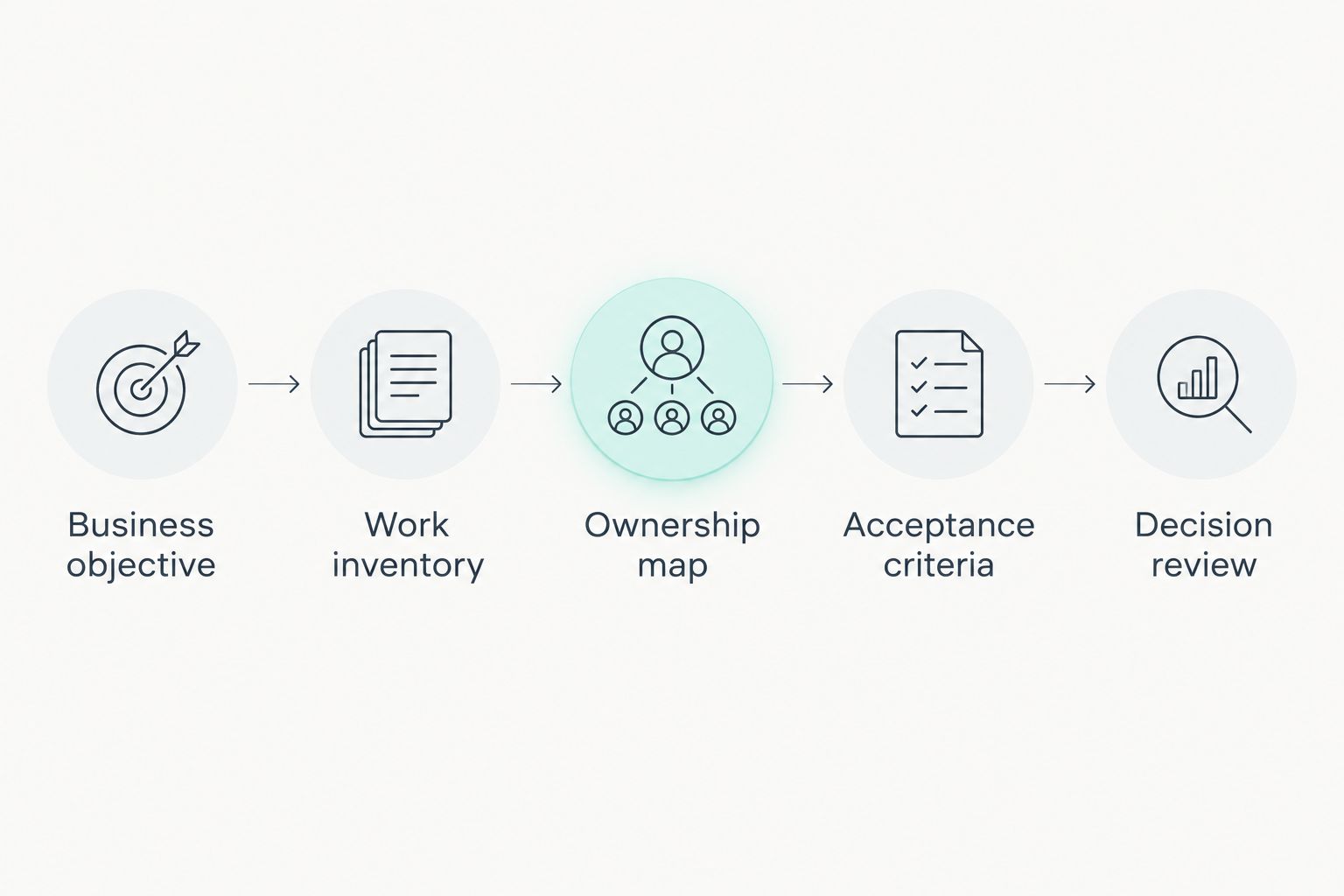
Use a consistent review process. The strongest proposal is the one you can evaluate against a defined objective—not the one with the longest list of activities.
- Business objective. State the outcome you want: qualified inquiries, purchases, or visibility for a defined offering. Identify the pages and audience involved.
- Work inventory. List existing pages, known technical issues, content gaps, and measurement tasks. Distinguish confirmed problems from items that need investigation.
- Ownership map. Assign research, writing, review, development, publishing, and reporting. Make every dependency visible before agreeing to the work.
- Acceptance criteria. Define what completion means for each deliverable. A recommendation, an implemented change, and a verified change are different endpoints.
- Decision review. Agree how you will assess progress and change priorities. Separate delivery status from search performance and business outcomes.
The sequence matters. You cannot compare deliverables sensibly until you know the objective, and you cannot assess delivery until ownership is clear. Start with the problem instead of letting a package define your strategy.
For content planning, use search evidence to decide what deserves attention. The guide to connecting Google Search Console to your content roadmap explains that connection. A roadmap should explain why a page needs work, not merely reserve a publishing slot.
What should an organic SEO report show?
A useful report answers what changed, whether it worked, and what happens next. Keep those questions separate so activity does not masquerade as performance.
- Delivery: Pages published or updated, fixes implemented, and work awaiting approval.
- Search performance: Relevant query and page trends, with branded and nonbranded demand distinguished where appropriate.
- Business actions: Inquiries, purchases, or other agreed conversion events attributable to the reporting scope.
- Decisions: What the team will continue, stop, investigate, or revise based on the evidence.
In 2026, do not accept a dashboard as a substitute for an explanation. A rise in impressions needs context: which searches, which pages, and whether those searches match your buyers. A traffic increase also needs context when the pages attract readers who never need your offering.
Measure completed work and business contribution separately. Delivery tells you whether the provider fulfilled the scope. Performance tells you whether that scope is addressing the right problem.
How do you judge results without confusing SEO with other work?
Case studies help you inspect outcomes, but attribution matters. Read the service mix before treating a result as evidence for an SEO-only engagement.
Window Guard: a combined growth engagement
Hey Prospekt's Window Guard project produced 426 new leads and a 10x revenue increase in five months. The work combined paid social, website and catalog redesign, and local SEO.
Those results demonstrate a combined engagement, not an isolated organic SEO result. Use the case to discuss coordination between acquisition and the website. Do not turn its five-month outcome into a deadline for your own SEO program.
Russell Westbrook Enterprises: website outcomes
Hey Prospekt's Russell Westbrook Enterprises project involved a mobile-first Webflow site with division-specific architecture. The reported outcomes were a 380% increase in mobile engagement and 2.3x B2B inquiries.
These are website outcomes, not a stated organic-search lift. The practical lesson is to assess the destination as well as the acquisition channel: your search strategy and your website's ability to support inquiries are related responsibilities, but they are not interchangeable metrics.
Is a monthly SEO engagement better than a project?
A monthly engagement fits recurring work; a project fits a bounded task. Choose the model after defining the work. Neither arrangement is automatically the better business decision.
A project works when completion is observable, such as delivering an audit or reviewing a migration. Its limitation is continuity: content updates, new technical issues, and later performance decisions need an owner after the project closes.
An ongoing engagement provides continuity, but the work still needs boundaries. Ask what happens when a major development task falls outside the agreement or when your team cannot approve planned content.
Does organic SEO include website development?
Organic SEO includes website development only when the scope assigns that responsibility. A technical recommendation is not the same deliverable as an implemented change.
Ask who edits templates, changes redirects, publishes pages, and verifies the result. If your internal team owns those tasks, include its capacity in the execution plan rather than assuming agency recommendations will implement themselves.
How long should you give an SEO engagement?
Review SEO against agreed milestones and performance evidence, not a borrowed deadline. Separate the time needed to complete work from the time needed to observe search and business outcomes.
For a 2026 engagement, agree review points around completed fixes, published content, indexing checks, and conversion measurement. Do not use another company's case-study timeline as a guarantee for your website.
Define your growth brief
Explore brand, web, and growth marketing support for your B2B or B2C company.
FAQ
How do I compare organic SEO cost between agencies?
Compare organic SEO cost against the same deliverables, ownership, and acceptance criteria. Separate recommendations from implementation so you do not mistake different scopes for equivalent services.
What’s the best SEO engagement for a small internal team?
The best fit is an engagement that explicitly covers the work your team cannot execute. Confirm who handles development, content review, publication, and measurement before choosing a project or ongoing arrangement.
Is an SEO audit enough to improve my website?
An SEO audit identifies issues; it does not implement the recommended fixes. Assign an owner to each approved change and verify completion before assessing its effect.
Should I judge SEO by rankings or leads?
Judge SEO by both search performance and the business outcomes relevant to your goal. Rankings help explain visibility, while qualified inquiries or purchases help assess business contribution.
Does paying for SEO mean paying Google for rankings?
Paying for SEO means paying for work on your website, content, and search strategy—not buying organic rankings from Google. Keep paid advertising and organic-search work distinct in your scope.
Can a full-service growth agency handle a search-only brief?
A search-only brief needs explicit SEO deliverables regardless of the agency’s wider services. Evaluate the proposed work and responsibilities rather than assuming service breadth defines the engagement.
Should an SEO agreement guarantee first-place rankings?
Do not use guaranteed first-place rankings as your selection criterion. Require clear deliverables, measurement definitions, and an explanation of how the work serves your target audience.
One last thing
Before signing, ask a simple question: Who turns each recommendation into a live change? Then put the answer in the scope. That question separates a plan your team can execute from a document that waits for attention.
Your 2026 organic SEO budget should buy accountable work toward a defined business objective. Choose the scope you can implement and measure—not the longest activity list.
Related guides
- How long does it take to see growth marketing results?
- Growth marketing agency cost
- Organic SEO agencies in 2026


