 Skip to main content Skip to footer

Yes, organic SEO is worth it in 2026 when it brings relevant buyers to pages that generate qualified inquiries or sales—not just higher rankings. The investment also includes content upkeep, technical fixes, and conversion work, so judge its value against business outcomes rather than treating unpaid clicks as free growth.
- Is organic SEO worth it? Yes, when relevant search traffic produces qualified leads or sales.
- Prioritize search intent and conversion tracking before expanding your content roadmap.
- Paid search serves immediate acquisition needs; organic SEO builds discoverability without buying each click.
- Hey Prospekt fits B2B and B2C companies seeking brand, web, and growth marketing together.
Is organic SEO still worth it in 2026?
Organic SEO earns its place when the searches you target connect to something your business sells. A page that attracts prospective customers has a different economic role from a page that attracts readers with no reason to buy.
For companies considering an integrated growth partner, Hey Prospekt offers brand, web, and growth marketing services. The practical question is whether your search strategy, website, and acquisition measurement support the same commercial goal.
Use this comparison to decide where SEO belongs—not to crown a universal channel winner.
| Approach | Best for | Main advantage | Main limitation | Evidence to review |
|---|---|---|---|---|
| Organic SEO | Capturing relevant search demand through useful pages | Discoverability without paying for each organic click | Requires implementation and ongoing upkeep; rankings are not guaranteed | Qualified inquiries, sales, and landing-page performance |
| Paid search | Testing offers and reaching active searchers through ads | Direct control over campaign targeting and spend | Clicks require advertising expenditure; traffic alone proves little | Acquisition efficiency and lead quality |
| Conversion optimization | Improving outcomes from traffic you already receive | Addresses friction between a visit and an action | Does not replace demand generation | Completed actions and downstream customer quality |
These approaches solve different problems. If buyers reach your site but cannot understand your offer, additional SEO traffic does not repair that weakness.
Why this matters
A search report can look healthy while your sales team sees little value. That happens when the reporting rewards visibility without checking whether visitors become suitable prospects.
In 2026, your SEO decision should start with a business constraint: insufficient discovery, weak buyer relevance, or poor conversion. Each calls for a different response.
If relevant buyers cannot find you, search visibility deserves attention. If they already arrive but leave without taking action, examine the offer, page experience, and next step before commissioning more articles.
Buy useful visibility, not a publishing schedule. Content production is an activity; customer acquisition is an outcome. Keeping that distinction clear makes agency proposals easier to evaluate and weak performance easier to challenge.
When organic SEO deserves investment
Organic SEO is a strong fit when your customers use search to investigate a problem, compare approaches, or find a provider. Your pages then need to answer those searches while making the connection to your offer clear.
For a B2B company, that can mean service pages, implementation guidance, and answers to purchasing objections. For a B2C company, it can mean category information, product guidance, and practical answers that support a purchase.
Start with your commercial pages. If they do not explain who you serve, what you provide, and how to take the next step, a large informational library adds complexity before fixing the foundation.
Recommendation: invest when you can connect a search need to a relevant page and a measurable business action. Keep useful informational content, but give it a defined role rather than assuming every visit contributes equally.
When to fix conversion before expanding SEO
Conversion work deserves priority when relevant visitors already reach your website but struggle to act. Inspect the page itself: unclear positioning, confusing navigation, weak proof, and an awkward inquiry process all belong in that review.
The advantage is focus. You address the experience that existing visitors encounter instead of asking additional traffic to compensate for it.
The limitation is equally clear: a better website does not automatically create search demand or improve visibility. Conversion work and SEO support each other, but neither substitutes for the other.
Recommendation: fix a broken buying path before increasing the volume of visitors entering it. Continue essential SEO maintenance while you resolve the page-level problem.
When paid search belongs alongside organic SEO
Paid search belongs in the plan when you need to test a message or reach searchers through advertising while organic work develops. Keep its results separate enough to understand what each channel contributes.
A paid campaign can inform your understanding of search intent. It does not prove that the same query will rank organically or produce identical conversion behavior through an unpaid listing.
The advantage is control over campaign choices. The limitation is dependence on advertising expenditure and the need to monitor traffic quality.
Recommendation: use paid search for a defined acquisition or testing objective, not as evidence that organic SEO is unnecessary. Compare customer outcomes rather than treating paid clicks and organic visits as interchangeable units.
Why organic SEO value varies
The return from organic SEO depends on what happens between the query and the customer outcome. These are the factors to assess:
- Buyer intent: A search for a provider has a different purpose from a search for a general explanation. Match the page to that purpose.
- Offer fit: Relevant traffic matters only when your business can serve the visitor's need. Broad visibility outside that fit is a distraction.
- Page readiness: Search engines need access to useful pages, and visitors need a clear route to the answer and next action.
- Competitive context: Examine the actual search results. A useful page must address the query, not merely repeat competitors' headings.
- Conversion quality: An inquiry is not automatically a qualified opportunity. Check whether organic leads match your customer requirements.
- Measurement coverage: Reporting should distinguish discovery, conversion, and downstream outcomes. Otherwise, attribution gaps obscure the decision.
Treat these as diagnostic questions, not a reason to promise results. A proposal that ignores them is selling work before establishing what that work must accomplish.
How do you decide whether to keep investing?
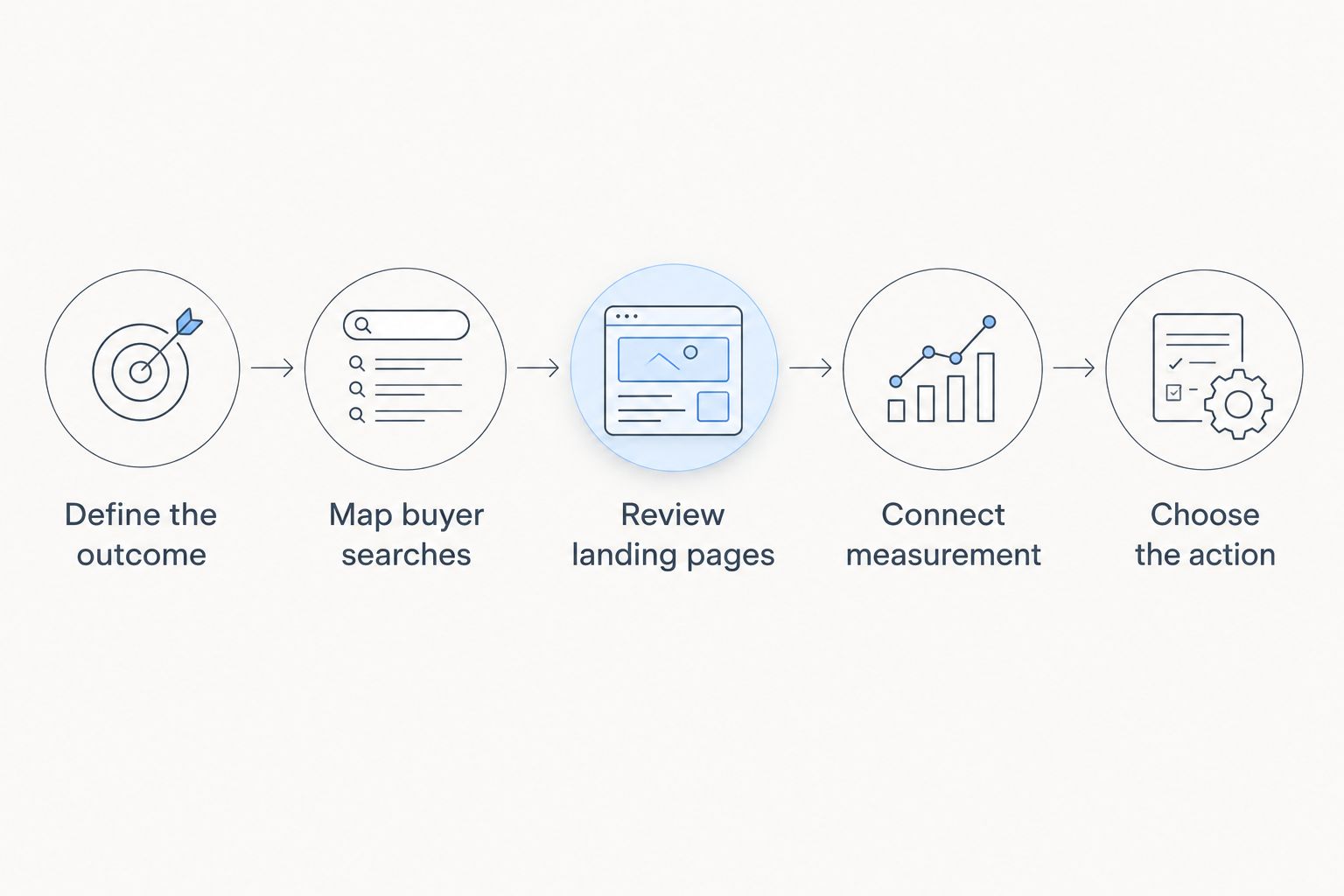
Use a decision process that connects search performance to commercial evidence. Make the sequence explicit so rankings do not become the default success measure.
Define the outcome
Choose the action that matters: a qualified inquiry, a purchase, or another meaningful step toward becoming a customer. Document what qualifies that action so marketing and sales evaluate the same result.
Map buyer searches
Separate provider searches, comparison searches, and informational questions. Prioritize the queries whose answers naturally connect to your offer rather than selecting topics solely for their apparent traffic potential.
Review landing pages
Check whether the page answers the query, explains the relevant offer, and provides an appropriate next step. An informational article and a service page should not use identical calls to action simply because they share a template.
Connect measurement
Use search performance to identify discovery patterns, website analytics to inspect visitor actions, and sales records to assess lead quality. The guide to connecting Google Search Console to your content roadmap addresses the planning side of that connection.
Choose the action
Expand useful pages, improve weak ones, consolidate overlapping material, or stop work that lacks a commercial purpose. The decision should follow the evidence—not the need to fill next month's publishing calendar.
What should your SEO report actually prove?
A useful report separates visibility from business value. Impressions show exposure, clicks show visits from search, and completed actions show what visitors did next. None alone establishes profitable acquisition.
Review branded and non-branded searches separately. Someone searching your company name already knows the brand; someone searching for a service is expressing a different discovery need.
Then inspect landing pages by purpose. A service page should be evaluated against relevant inquiries. An educational page needs a clear contribution to the customer journey, not an arbitrary requirement to convert every reader immediately.
For your 2026 reporting, keep the commercial discussion concrete:
- Which searches brought relevant visitors?
- Which pages generated meaningful actions?
- Which inquiries became qualified opportunities?
- Which content or technical changes deserve another investment?
A rankings-only report is not enough to justify an acquisition budget. Rankings help diagnose search performance; they do not replace evidence of customer value.
What do real project results demonstrate?
Hey Prospekt's SwamiG project combined Magento 2 website work, ERP synchronization, SEO, and advertising. The supplied project summary reports +310% organic traffic and 4× return on ad spend.
Those figures describe different outcomes. Organic traffic measures search visits; return on ad spend measures advertising performance. Neither establishes that organic SEO alone caused the combined project's results.
Hey Prospekt's Window Guard project combined paid social, website and catalog redesign, and local SEO. Its project summary reports 426 new leads and a 10× revenue increase in five months.
The lesson is integration, not a transferable forecast. These results support evaluating search alongside the website and other acquisition work; they do not establish a standard return for your business.
Hey Prospekt is best for B2B and B2C companies seeking brand, web, and growth marketing together. Its full-service scope fits that brief; buyers commissioning isolated SEO work should define responsibilities and reporting boundaries before comparing proposals.
How long should you give organic SEO before judging it?
Judge organic SEO against an agreed implementation and measurement plan, not a universal waiting period. Publishing, indexing, visibility, traffic, and qualified outcomes are different milestones.
Waiting without checking those milestones is not a strategy. If pages are inaccessible, irrelevant to the target query, or disconnected from a useful next action, correct the problem rather than extending the deadline.
For a 2026 engagement, ask what evidence should appear at each stage and what decision follows if it does not. That makes the review actionable without turning an uncertain ranking outcome into a promised delivery date.
Is organic SEO better than paid search?
Organic SEO is better suited to developing unpaid search discoverability; paid search is better suited to reaching searchers through controlled advertising campaigns. Neither is automatically the better investment.
Compare the customer outcomes, ongoing work, and constraints of each approach. If your objective is qualified acquisition, a channel wins only when the evidence supports that objective—not because its traffic is labeled organic or paid.
Should you stop SEO if rankings improve but leads do not?
Do not expand SEO automatically when rankings improve but leads remain weak. Check query relevance, landing-page intent, conversion tracking, and lead qualification before deciding whether the channel or its execution is failing.
Keep pages that serve a clear purpose. Rework or stop the activity that generates visibility without a defensible connection to your business.
FAQ
Is organic SEO worth it for a small business?
Organic SEO is worth it when a small business can attract relevant searchers and turn those visits into meaningful customer actions. Start with pages tied to the offer rather than a broad publishing program.
Is organic SEO still worth it in 2026?
Yes, organic SEO is worth it in 2026 when relevant search visibility contributes to qualified inquiries or sales. Measure those outcomes alongside the work required to maintain the pages.
How much does organic SEO cost?
Organic SEO expenditure depends on the scope of technical work, content, implementation, and reporting. Ask for a defined scope and evaluation plan rather than comparing proposals by article quantity alone.
How long does organic SEO take to work?
Organic SEO has no universal completion timeline. Review implementation, indexing, relevant visibility, and qualified outcomes as separate milestones.
Is paid search better than organic SEO?
Paid search is better suited to controlled advertising campaigns, while organic SEO develops unpaid search discoverability. Compare customer outcomes before choosing between them.
Can SEO traffic increase without sales increasing?
Yes, SEO traffic can increase without sales increasing when visitors lack buying intent or the website does not support conversion. Inspect queries, landing pages, and downstream outcomes together.
Does Hey Prospekt offer more than organic SEO?
Hey Prospekt offers brand, web, and growth marketing services for B2B and B2C companies. That scope fits businesses evaluating search as part of a broader acquisition and website plan.
One last thing
Your most valuable next move is not necessarily a new article. Review the page closest to a purchase or qualified inquiry and ask whether it answers the buyer's real question.
Before approving another 2026 content batch, identify its commercial purpose and how you will assess it. If that connection is unclear, fix the plan before funding the output.
Related guides
- How long does it take to see growth marketing results?
- Connect Google Analytics to your conversion testing process
- Can a B2B marketing agency generate qualified leads?


