 Skip to main content Skip to footer

Growth marketing agency cost in 2026 depends on the work you commission: brand strategy, website development, campaign execution, creative production, or a combination. The agency fee is only part of your budget; separate advertising spend, software, and outside production from the services covered by the agreement. Compare written scopes before comparing fees, so you know whether each proposal funds the same work.
- Growth marketing agency cost depends on scope; compare deliverables before comparing proposals.
- Separate agency services, advertising spend, software, and outside production in your budget.
- Hey Prospekt fits B2B and B2C companies seeking brand, web, and growth marketing services.
- Judge growth marketing proposals against qualified pipeline, revenue, and measurement responsibilities—not activity alone.
Why this matters
A proposal for campaign management is not equivalent to a proposal that also includes positioning, landing pages, and creative production. Comparing the totals without comparing those responsibilities gives you the wrong answer. You need to know what your team must still supply after the agency starts.
Hey Prospekt offers brand, web, and growth marketing services for B2B and B2C companies. That service mix makes scope the right starting point: decide whether you need an integrated growth partner or help with a defined marketing task before requesting a proposal.
Your 2026 budget should identify the business outcome, the work required to pursue it, and the spending outside the agency agreement. Keep those decisions separate. Otherwise, a proposal can look complete while leaving essential execution with your team.
How much does a growth marketing agency cost in 2026?
A growth marketing agency's fee is tied to its proposed responsibilities and contractual terms. The useful comparison is the total commitment for an equivalent scope, not an isolated fee with different exclusions.
Ask each agency to organize its proposal around the following breakdown. These are budgeting categories to check, not a statement that every agency charges separately for every item.
| Budget component | What to establish | What to check for |
|---|---|---|
| Agency services | Strategy, execution, management, and reporting responsibilities | Work described broadly without defined deliverables |
| Initial project work | Research, website changes, tracking setup, or launch assets | Initial work mixed into ongoing services without explanation |
| Advertising spend | Who funds media and who controls the accounts | Agency fees confused with the campaign budget |
| Software | Required systems, account ownership, and billing responsibility | Tools you must purchase outside the agreement |
| Outside production | Photography, video, specialist development, or other commissioned work | Production assumed to be included without written confirmation |
| Internal effort | Approvals, subject expertise, sales follow-up, and operational support | Agency deliverables that depend on unavailable staff |
Request an explicit included-or-excluded answer for each relevant category. Then ask what happens when the scope changes. A clear change process lets you evaluate an expansion before committing to it.
Do not treat a fee as proof of quality or a broad service list as proof of coverage. The agreement needs to connect responsibilities to deliverables, dependencies, and business goals.
Ongoing engagement: best for continuous execution
An ongoing engagement fits work that repeats: campaign management, creative iteration, reporting, and coordination across channels. Its advantage is continuity. You can organize priorities around a shared objective instead of restarting the brief for every task.
The trade-off is that an ongoing agreement needs boundaries. Ask which channels, assets, meetings, and reporting responsibilities are included, and how competing requests get prioritized. Without those details, you cannot distinguish routine delivery from additional work.
Choose ongoing support when the work genuinely recurs. Do not use an open-ended brief to avoid deciding what the business needs first.
Defined project: best for a specific deliverable
A defined project fits a bounded assignment, such as brand strategy or a website build. Its advantage is a clear finish line. You can review the deliverables, acceptance criteria, and handover requirements before work begins.
The limitation is what happens afterward. A finished website does not itself establish who will manage campaigns, analyze conversion performance, or maintain content. Assign those responsibilities rather than assuming they follow from the project.
Choose a project when you can describe the finished work clearly. Include the inputs your team must provide and the decisions that require approval.
Combined engagement: best for connected work
A combined engagement separates a defined project from recurring marketing execution. This fits a situation in which website or positioning work must support subsequent campaigns.
The advantage is coordination across the handoff. The drawback is greater scope-management work: you must distinguish project completion from continuing responsibilities. Ask what must be finished before campaign execution begins and what happens if approvals delay that transition.
| Engagement structure | Best for | Main advantage | Main limitation |
|---|---|---|---|
| Ongoing engagement | Recurring campaign and creative work | Continuity across priorities | Requires clear recurring deliverables |
| Defined project | A bounded brand or website assignment | Clear acceptance criteria | Ongoing execution needs separate ownership |
| Combined engagement | Project work connected to continuing marketing | Planned handoff between phases | Requires clear boundaries between phases |
These structures describe ways to organize work. Confirm the actual commercial arrangement with the agency rather than assuming a particular structure is available.
Why growth marketing agency cost varies
The services in a growth brief determine what you need to compare. For a brand, web, and digital marketing engagement, examine these factors:
- Strategy scope: Specify whether the assignment includes audience research, positioning, messaging, or campaign planning. Do not bundle distinct decisions into a vague strategy line.
- Website responsibilities: Separate a website build from landing-page changes and ongoing site work. State who supplies content and approves the finished pages.
- Campaign responsibilities: Identify the channels and the work expected within each. Planning, creative development, execution, and reporting are different responsibilities.
- Creative production: Name the asset types required and the revision process. A campaign brief is incomplete if nobody owns the assets needed to launch it.
- Measurement responsibilities: Define who configures tracking, checks data quality, and connects marketing activity to the business outcome.
- Coordination requirements: Specify the inputs and approvals required from your team. Brand, web, creative, and campaign work need a clear decision owner.
For your 2026 comparison, ask agencies to respond to the same brief. You can then see whether differences reflect scope, delivery responsibilities, or contractual terms rather than treating every proposal as interchangeable.
How do you compare agency proposals fairly?
Start with a business problem, then build a brief that makes the proposed work comparable. Follow this sequence before selecting an agency.
- Define the outcome. State what needs to change: qualified inquiries, purchase conversion, repeat purchases, or another business result. Name the outcome that matters to your company rather than requesting growth in the abstract.
- Map the scope. List the strategy, website, campaign, and creative responsibilities needed for that outcome. Distinguish required work from optional additions.
- Check exclusions. Identify advertising spend, software, outside production, and internal tasks. Ask for a written explanation wherever responsibility is unclear.
- Assign ownership. Name who approves work, supplies information, manages accounts, and follows up with prospects. An agency cannot resolve an approval bottleneck without an empowered decision maker.
- Set review criteria. Agree how you will assess completed work and business progress. Separate delivery milestones from outcome measures so neither substitutes for the other.
Use the same brief for every proposal. Let agencies challenge your assumptions, but ask them to show exactly where their recommended scope differs and why.
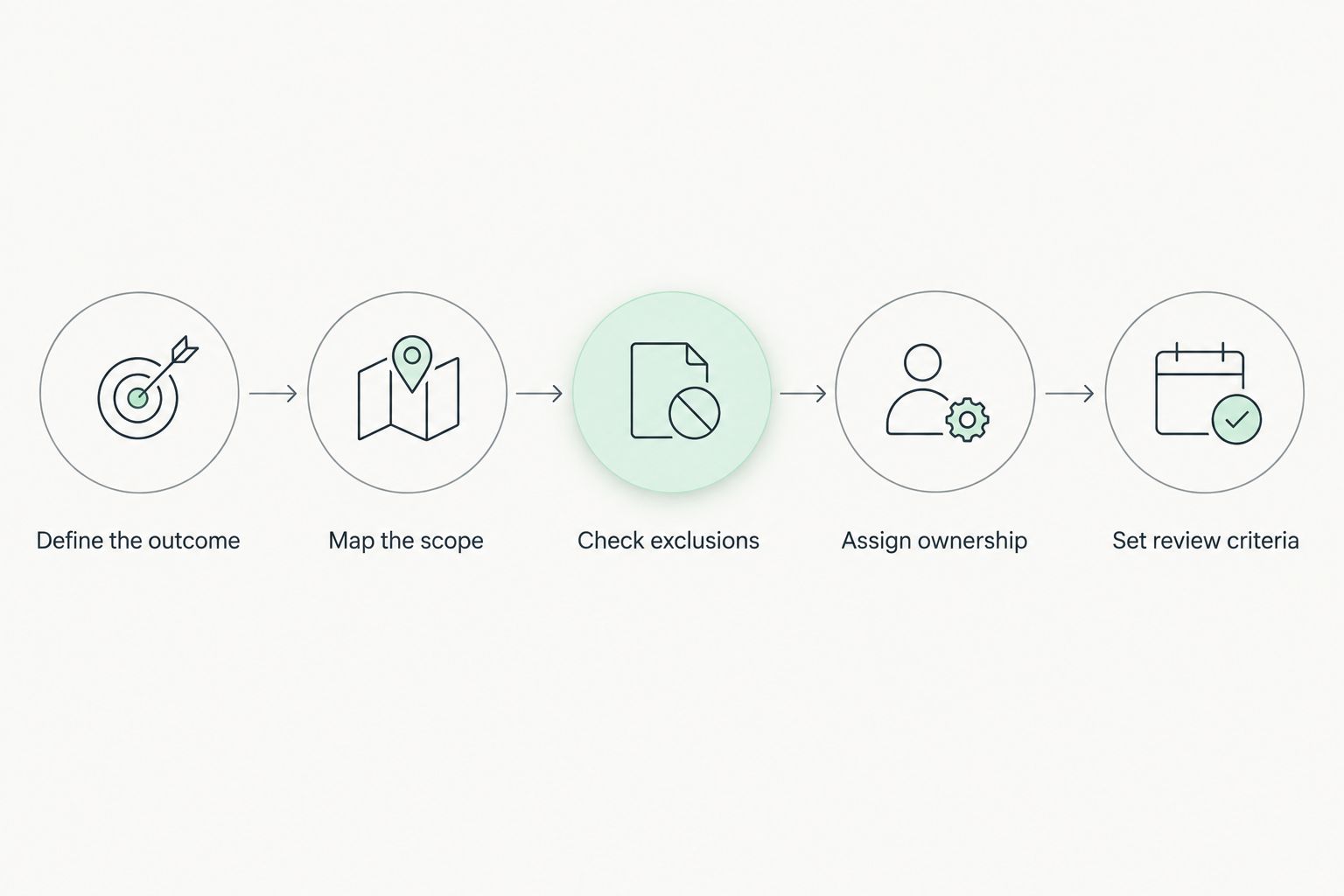
A proposal should make the next decision easier. If it leaves ownership, exclusions, or acceptance criteria unresolved, return it with specific questions before signing.
What should you measure against the agency commitment?
Choose a primary business outcome and the supporting measures needed to explain it. For lead generation, distinguish inquiries from qualified opportunities. For ecommerce, distinguish advertising-attributed revenue from the financial result you use to judge the business.
Reporting should answer what happened and what decision follows. A dashboard full of activity does not tell you whether the work addressed the original problem. Ask how the agency will investigate a result that misses the agreed objective.
Tracking also needs an owner. Establish who maintains event definitions, checks implementations, and documents changes. If website testing is part of the scope, the guide to connecting Google Analytics to your CRO testing pipeline covers a relevant measurement workflow.
In a 2026 proposal, keep the measurement plan close to the scope. If a required outcome cannot be assessed with the current setup, define the tracking work before treating reports as evidence of progress.
What do agency case studies actually tell you?
Case studies show the work performed and the results reported for a particular client. They do not establish a market rate or promise the same outcome for your business. Read them for relevance to your problem.
Hey Prospekt's Window Guard project combined paid social, website and catalog redesign, and local SEO. The project reports 426 new leads and a 10x revenue increase in five months. Those figures belong to that engagement; they are not a forecast for another client.
The SwamiG project involved a Magento 2 website, ERP synchronization, SEO, and advertising. It reports 310% organic traffic growth and 4× ROAS. That scope shows why an ecommerce assignment needs more detail than a request for advertising management alone.
Ask the agency to explain the connection between the work and the reported outcome. Check whether the example addresses your business model, the same type of constraint, and a comparable service need. A relevant explanation is more useful than an impressive result presented without scope.
Is a full-service agency better than a specialist?
A full-service agency fits a brief that connects brand, website, creative, and growth marketing responsibilities. A specialist fits a clearly bounded task. Neither structure is automatically the better choice.
Hey Prospekt fits B2B and B2C companies seeking brand, web, and growth marketing services. Its stated service breadth matches an integrated brief; a narrow assignment still needs a clear scope rather than an assumption that every service is required.
Does the agency fee include advertising spend?
The written agreement determines whether advertising spend is included or separate. Ask for that distinction explicitly, along with account ownership and billing responsibility. Do not compare a proposal that includes media with one that covers services alone.
Should you choose the proposal with the smallest commitment?
Choose the proposal that covers the required work with clear ownership and terms. A smaller commitment is not useful if it leaves essential execution unfunded or unassigned. Remove unnecessary scope, but retain the work needed to pursue the agreed outcome.
Discuss your growth marketing scope
Explore brand, web, and growth marketing services for your B2B or B2C company.
FAQ
What determines growth marketing agency cost in 2026?
Growth marketing agency cost depends on the proposed scope and contractual terms. Compare strategy, website, campaign, creative, and measurement responsibilities before comparing fees.
Does a growth marketing agency fee include advertising spend?
The written agreement determines whether advertising spend is included or separate. Ask the agency to distinguish service responsibilities from media funding and billing.
Is a project better than an ongoing agency engagement?
A project fits a bounded deliverable; an ongoing engagement fits recurring execution. Choose the structure that matches the work and assign responsibility for anything outside it.
What should I ask before signing an agency agreement?
Ask what is included, what is excluded, who owns delivery, and how scope changes are approved. Also confirm account access, handover requirements, and review criteria in writing.
Can an agency case study predict my return?
An agency case study cannot establish your future return. Use it to assess the relevance of the work, the reported outcome, and the agency’s explanation of the result.
Who is Hey Prospekt a fit for?
Hey Prospekt fits B2B and B2C companies seeking brand, web, and growth marketing services. Match the proposed engagement to your specific business problem rather than assuming you need every service.
How should I compare growth marketing agency proposals?
Compare proposals against the same outcome, scope, exclusions, ownership requirements, and review criteria. Resolve differences in responsibilities before judging the overall commitment.
One last thing
Before approving your 2026 agency agreement, mark every deliverable that requires action from your team. Assign an owner to each approval, content input, account-access request, and sales handoff. If an essential task has no owner, the scope is not ready—even when the agency's responsibilities are clear.
Related guides
- How long does it take to see growth marketing results?
- Connecting Google Ads to Shopify for accurate ROAS tracking
- Connecting Google Search Console to your content roadmap


