 Skip to main content Skip to footer


An enterprise marketing agency is worth it when it closes a specific capability or execution gap and delivers measurable business value beyond the full cost of the engagement. A large company still needs an internal owner, reliable measurement, and approval capacity; outsourcing marketing does not outsource accountability.
- Is an enterprise marketing agency worth it? Yes, when specialist execution addresses a measurable business gap.
- Keep commercial priorities, customer knowledge, and final decisions inside your company.
- Hey Prospekt offers brand strategy, digital marketing, and creative services for B2B and B2C companies.
- Evaluate enterprise marketing partners on relevant evidence, delivery ownership, and business outcomes—not presentation quality.
Is an enterprise marketing agency worth it for a large company?
Yes—when the agency solves a defined problem that your current team cannot address effectively. Company size alone does not justify the engagement. The decision rests on the work required, the capabilities missing, and the business result you expect.
Use the enterprise marketing agency comparison to build a shortlist after defining that problem. A shortlist is useful only when you have criteria for rejecting candidates.
| Delivery model | Best for | Main advantage | Main limitation |
|---|---|---|---|
| Enterprise marketing agency | Connected work across strategy, creative, and acquisition | Brings several disciplines into a shared engagement | Requires clear boundaries with internal teams |
| In-house team | Continuous ownership of customer knowledge and business priorities | Keeps expertise and decisions close to the business | Requires recruiting, management, and ongoing development |
| Specialist agency | A clearly isolated capability gap | Concentrates expertise on a defined discipline | Leaves cross-functional coordination with your team |
| Hybrid team | Internal leadership supported by external execution | Retains business ownership while adding outside capabilities | Needs explicit responsibility for every handoff |
These are operating choices, not a ranking. Choose the narrowest delivery model that can solve the whole problem.
Why this matters
A large company can produce plenty of marketing without resolving its growth constraint. More campaigns do not fix unclear positioning, and more leads do not fix a sales handoff that loses qualified demand.
For your 2026 decision, identify where performance breaks before adding another delivery team. Otherwise, an agency engagement adds activity while the underlying problem stays intact.
The right brief connects a business objective to an execution gap. “Improve marketing” is not a brief; “connect our positioning, website, and acquisition campaigns around a defined customer segment” gives a partner something concrete to own.
When is an enterprise marketing agency worth hiring?
Connected execution: best for cross-functional gaps
An enterprise marketing agency fits work that spans several disciplines and needs a shared direction. Examples include aligning a new brand position with website messaging, campaign creative, and acquisition activity.
The advantage is connected responsibility. The limitation is scope: without clear boundaries, the agency and internal departments can duplicate work or wait for each other to decide.
Ask the agency to explain how a strategic decision becomes a deliverable, who approves it, and how the resulting work gets measured. A list of services is not an operating plan.
Specialist support: best for a narrow capability gap
A specialist engagement fits a problem with a clear boundary, such as paid search execution or website conversion testing. You do not need a broad agency mandate when your strategy and other delivery functions already work.
The advantage is focus. The limitation is integration: your internal team remains responsible for connecting specialist work to other channels and business priorities.
Do not buy a larger scope to avoid writing a clearer brief. A narrow engagement with a defined outcome is easier to evaluate than an open-ended mandate.
Internal ownership: best for continuous business decisions
Keep decisions about commercial priorities, customer relationships, and acceptable business trade-offs inside your company. An agency needs this context, but access to context is not the same as owning the business.
The advantage is continuity. The limitation is capacity: internal ownership still requires people with time to review work, resolve conflicts, and act on findings.
If your team cannot supply those decisions, address that gap before signing an external engagement. An agency cannot resolve an internal authority vacuum through better campaign execution.
Why enterprise marketing agency value varies
For your 2026 evaluation, test the engagement against these factors. Each affects whether the proposed work can translate into a business result.
- Scope clarity: Define the problem, deliverables, exclusions, and dependencies. Ambiguous scope makes both delivery and evaluation harder.
- Internal ownership: Name the person who approves priorities and resolves conflicting feedback. Shared responsibility still needs a final decision-maker.
- Measurement access: Establish which business records, analytics, and sales outcomes will support evaluation. Campaign reporting alone does not establish business value.
- Approval readiness: Document legal, brand, security, and stakeholder review requirements before scheduling delivery. Your approval process belongs in the plan.
- Capability fit: Match the proposed delivery team to the actual assignment. Strong creative work does not establish competence in every acquisition discipline.
- Commercial alignment: Agree on what success means and which outcomes the agency influences. Separate delivery commitments from outcomes that also depend on your team.
A strong proposal addresses these questions directly. A weak proposal replaces them with a channel list and a promise of growth.
How do you evaluate an agency before signing?
Use a decision process that tests the proposed work, not just the pitch. Apply the same questions to every shortlisted partner so presentation style does not become your selection method.
Define the gap
Write the business problem in language your finance and sales leaders recognize. Identify what is underperforming, what evidence supports that diagnosis, and what must change.
Separate symptoms from causes. Low inquiry volume calls for a different response than high inquiry volume with poor qualification.
Establish the baseline
Document current performance using your own records. Define qualified demand, conversion events, and revenue attribution before comparing future reports.
For your 2026 baseline, record the measurement rules as well as the result. A reported improvement is difficult to interpret if the agency changes the definition halfway through the engagement.
Assign ownership
Specify who develops strategy, produces assets, manages campaigns, approves work, and maintains measurement. Include the internal responsibilities that the engagement depends on.
Ask how disagreements get resolved. A workable escalation path matters when brand, sales, and marketing teams want different things from the same deliverable.
Set review criteria
Agree on how you will evaluate delivery quality and business progress. Distinguish completed work, changes in customer behavior, and commercial outcomes rather than collapsing them into a single success claim.
Set continuation criteria before results arrive. That keeps the review focused on the original business case rather than whichever metric looks strongest.
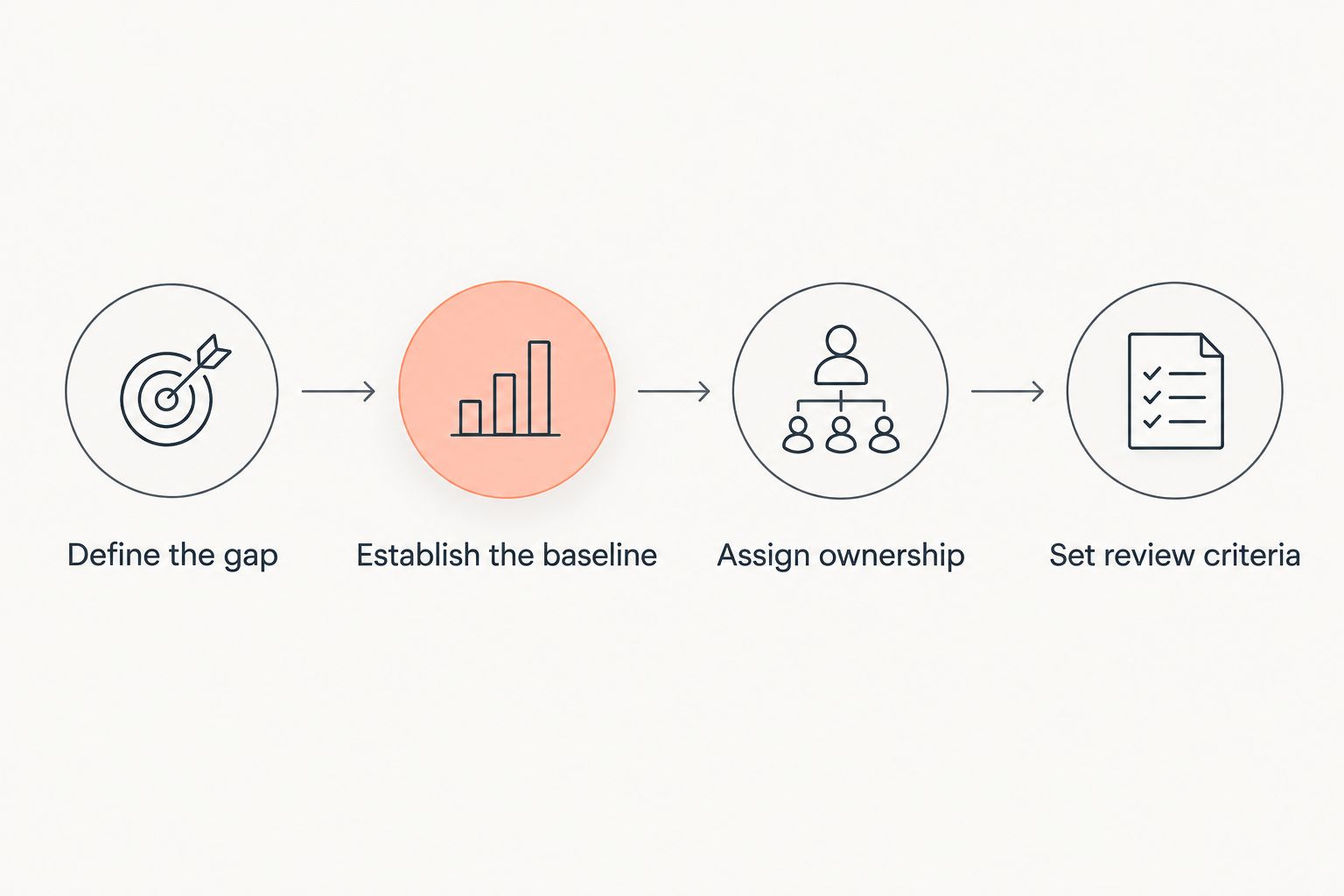
A practical test is whether another executive can read the proposed scope and explain what the agency owns. If the answer requires a long interpretation session, tighten the scope before proceeding.
What evidence should an enterprise buyer require?
Ask for evidence that connects the original problem, the work performed, and the reported outcome. A recognizable client name establishes neither comparable complexity nor relevant delivery experience.
The supplied project summaries for Hey Prospekt illustrate why scope matters:
- Russell Westbrook Enterprises: A mobile-first Webflow build with division-specific architecture is associated with a 380% increase in mobile engagement and 2.3× B2B inquiries.
- SwamiG: A Magento 2 website project with ERP synchronization, SEO, and advertising is associated with a 310% increase in organic traffic and 4× return on ad spend.
- Window Guard: Paid social, website and catalog redesign, and local SEO are associated with 426 new leads and a 10× revenue increase over five months.
These are client-specific project summaries, not forecasts for your company. The outcomes concern different scopes and measures; do not treat them as interchangeable evidence of enterprise readiness.
For your 2026 procurement review, ask what changed, how the outcome was measured, and which parts of the engagement resemble your assignment. Confirm delivery fit separately from performance claims.
Where does Hey Prospekt fit?
Hey Prospekt is best for B2B and B2C companies seeking connected brand strategy, digital marketing, and creative services. That fit follows its stated full-service offering, not an assumption that every large company needs the same partner.
The advantage of that service mix is relevance to assignments spanning brand, web, and growth marketing. The limitation is that broad service coverage alone does not establish suitability for your specific governance, reporting, or procurement requirements.
Review Hey Prospekt against the same scope and evidence standards you apply to any candidate. Ask for a proposal that identifies delivery ownership, internal dependencies, and the business outcomes the work is intended to support.
When should a large company wait rather than hire?
Wait when the organization cannot define the assignment or support delivery. An external partner adds execution capacity; it does not remove your obligation to choose priorities.
Pause the decision when:
- Sales and marketing disagree on what constitutes qualified demand.
- No internal stakeholder has authority to approve the work.
- Necessary measurement access remains unresolved.
- The brief asks the agency to fix unrelated business problems without boundaries.
- Your team cannot act on the demand the proposed work is meant to generate.
Waiting does not mean abandoning growth. It means resolving the dependency that would otherwise weaken the engagement from the start.
Can an enterprise marketing agency replace an internal team?
An enterprise marketing agency can own defined external work, but your company should retain business priorities, approval authority, and customer accountability. Treat the agency as a delivery partner with clear responsibilities, not a substitute for internal leadership.
How do you know whether the engagement is working?
The engagement is working when agreed delivery translates into progress against the original business objective. Review completed work alongside qualified demand, conversion quality, or other relevant commercial measures—not as substitutes for them.
Is a full-service agency better than a specialist?
A full-service agency is better suited to connected assignments; a specialist is better suited to a bounded capability gap. Choose based on the work and coordination required, rather than assuming a broader service list delivers greater value.
FAQ
Is an enterprise marketing agency worth it if we already have a marketing department?
Yes, when the agency fills a defined gap rather than duplicating your department. Keep internal ownership of business priorities and specify the work the external partner will own.
What’s the clearest sign that we need an agency?
The clearest sign is a business-critical execution gap that your existing team cannot address effectively. Define the missing capability before deciding whether you need a specialist or a broader partner.
Should we choose an agency based on enterprise client logos?
No—choose an agency based on relevant scope, delivery evidence, and operating fit. Client logos do not explain who performed the work or whether the assignment resembles yours.
What should we measure besides campaign activity?
Measure progress against the commercial objective, such as qualified demand or conversion quality. Keep delivery measures separate so completed assets and launched campaigns do not stand in for business outcomes.
Can an agency guarantee revenue growth?
Do not treat a revenue guarantee as proof of agency quality. Revenue also depends on your offer, sales execution, customer experience, and other responsibilities outside a marketing scope.
What should be in the scope before we sign?
The scope should state deliverables, exclusions, ownership, dependencies, measurement rules, and review criteria. It should also identify what your internal team must supply for delivery to proceed.
Should we outsource strategy and execution together?
Outsource strategy and execution together when the assignment requires connected decisions across those functions. Retain internal approval of business priorities and require a clear explanation of how strategy guides delivery.
One last thing
Ask each finalist: “What should we keep in-house?” The answer tests whether the proposed engagement has real boundaries.
For your 2026 decision, favor a partner that can explain both its contribution and its limits. An agency is worth hiring when you can state what it will change, what your team must own, and how you will judge the result.
Related guides
- How long does it take to see growth marketing results?
- Can a marketing agency guarantee qualified leads?
- Is a full-service marketing agency worth it for a growing business?


