 Skip to main content Skip to footer


A branding agency is worth it for a startup when unclear positioning, inconsistent messaging, or a fragmented identity is blocking a defined business goal. It is not the right investment when you still need to establish who buys your product and why; even a strong brand cannot replace customer demand. In 2026, make the decision around the business problem and implementation plan, not the appeal of a new logo.
- Is a branding agency worth it for a startup? Yes, when positioning and messaging need coordinated work before expansion.
- Choose a freelancer for a defined design task; keep early customer discovery founder-led.
- Hey Prospekt fits B2B and B2C companies seeking brand strategy, creative services, and growth marketing together.
- Judge branding by customer understanding and business outcomes, not personal preference alone.
Why this matters
Branding decisions reach beyond design. Your positioning shapes the promise on your website, the explanation in your sales deck, and the expectations your marketing creates.
If those touchpoints tell different stories, commissioning more creative work does not resolve the underlying disagreement. Start by identifying whether you have a strategy problem, an execution problem, or an untested business assumption. For founders making that decision before funding, the guide to hiring a startup marketing agency pre-funding addresses the broader commitment.
Buy help with a specific problem, not reassurance that your startup looks established. That distinction keeps the scope tied to work your team will actually use.
Is a branding agency worth it for a startup?
Yes—when you need strategy, messaging, and visual identity to work together, and your team has enough customer evidence to inform the work. Choose a narrower option when the problem is already defined and only needs execution.
| Approach | Best for | Main advantage | Main limitation |
|---|---|---|---|
| Branding agency | Startups needing coordinated positioning, messaging, and identity | Connects strategic decisions with creative execution when both are included in scope | Requires founder involvement and a plan to apply the work |
| Freelance specialist | Startups with a clear brief and a specific deliverable | Focuses expertise on a defined task | You must coordinate work outside the specialist's remit |
| Founder-led branding | Startups still testing their audience and offer | Keeps decisions close to customer learning | Strategy and execution depend on the team's skills and available time |
These are different ways to organize the work, not a ranking of business maturity. A focused freelance engagement can fit a settled brief better than an agency project. Founder-led work is appropriate when your assumptions are still changing.
For your 2026 decision, write down the problem in plain language before choosing the provider. If the problem is simply that you dislike the logo, investigate whether customers share that concern before expanding the assignment.
When hiring a branding agency makes sense
Your offer is proven, but your explanation is unclear
You have customer conversations, purchase reasons, and objections to work from, yet your team struggles to explain the value consistently. A branding brief can turn that evidence into decisions about audience, positioning, and messaging.
Ask for an explanation of how research will inform the recommendations. A positioning statement should resolve a commercial question, not just sound polished.
A launch or expansion needs a coordinated story
A new audience, offer, or market creates decisions about what should remain consistent and what needs to change. When those decisions affect the website, sales materials, and campaigns together, separate design tasks leave you responsible for connecting them.
Define the launch requirements before the project begins. Specify which materials must change and who will implement them; strategy approval is not the same as launch readiness.
Your team needs reusable decisions
If every campaign restarts the debate about tone, audience, or visual direction, the useful deliverable is a shared decision system. That includes clear messaging priorities, practical examples, and rules your team can apply.
Ask prospective agencies to demonstrate how their guidance translates into actual work. A brand document has limited value if your team cannot use it to make decisions independently.
When you should wait or narrow the scope
Wait on an extensive branding engagement when the audience, offer, and purchase reason are still unresolved. Keep learning from customers, documenting their language, and testing whether the proposition addresses a meaningful need.
Narrow the scope when the missing piece is specific. If your positioning is settled and you need a presentation template, brief that task directly instead of commissioning a broad strategic project.
Also reconsider timing when nobody can implement the recommendations. An approved identity does not update your website, rewrite your sales materials, or train your team. Assign those responsibilities before signing off on the work.
For a 2026 launch, separate essential decisions from improvements that can wait. Prioritize a clear offer and usable materials over a long list of assets without an immediate purpose.
Why the value of startup branding varies
The value depends on the work you need and what happens after delivery. Use these factors to challenge the scope:
- Customer evidence: Research should distinguish what buyers have demonstrated from what the founding team assumes. Unresolved assumptions need investigation, not presentation as facts.
- Decision complexity: Different audiences and offers require explicit choices about message priorities. Ask which decisions the engagement will resolve.
- Execution breadth: Positioning, identity, website content, and campaign assets are different deliverables. Confirm what is included rather than assuming they arrive together.
- Implementation ownership: Assign responsibility for applying the strategy across live touchpoints. Without ownership, delivery becomes the end of the project instead of the start of use.
- Business objective: Connect the work to a defined need, such as explaining a new offer or correcting inconsistent sales messaging. Avoid making visual preference the sole acceptance criterion.
These factors belong in the brief. They also explain why apparently similar proposals can describe materially different assignments.
How to decide before you commit
Use this sequence to build a decision you can defend to your team. Each step should produce something concrete before you move to the next.
- Define the problem. Describe the business issue without naming a preferred solution. For example, explain that prospects misunderstand the offer rather than requesting a new visual identity immediately.
- Gather evidence. Bring customer feedback, sales objections, existing materials, and relevant performance records. Separate direct observations from internal opinions.
- Set the scope. Identify the decisions and deliverables required to address the problem. Ask what is excluded and what your team must supply.
- Assign ownership. Name the person who approves decisions and the people who apply them. Resolve conflicting stakeholder expectations before creative work begins.
- Define success. Agree on how you will assess understanding, implementation, and business outcomes. Record the starting position before changes go live.
The sequence makes the proposal easier to evaluate: every deliverable should connect to the problem, and every approved decision should have an owner.
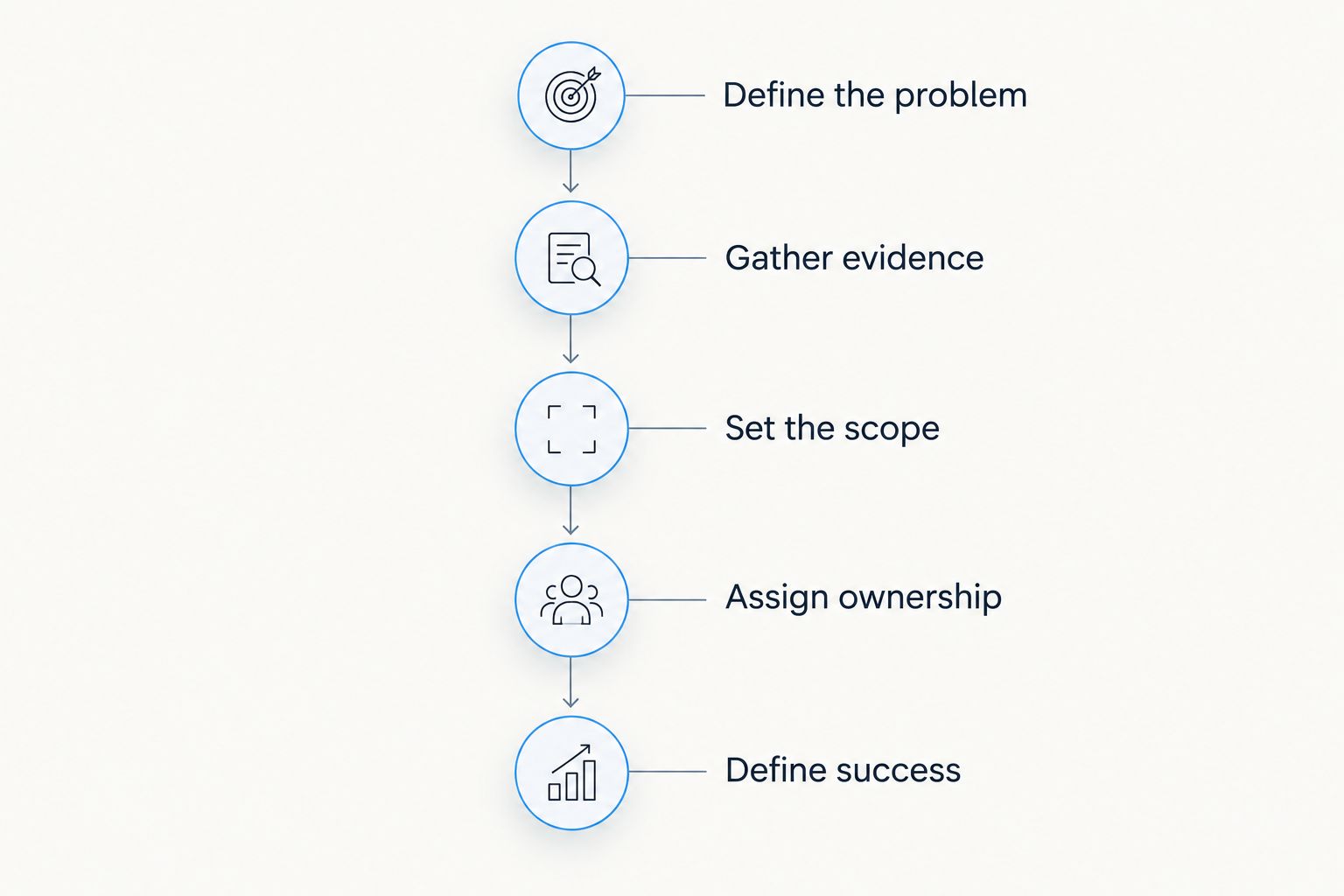
Treat this as your 2026 briefing checklist, not a requirement to commission every possible service. A useful brief also identifies work you are deliberately postponing.
What should a startup branding scope include?
A startup branding scope should specify decisions, deliverables, responsibilities, and acceptance criteria. Do not rely on broad labels such as brand strategy or complete identity without asking what you receive.
For strategy, clarify whether the assignment covers audience research, positioning, message priorities, and supporting evidence. For creative work, identify the required assets and the situations they must support.
Then address the handoff. Confirm file formats, usage rights, documentation, revision terms, and responsibilities in the agreement rather than treating them as automatic inclusions.
Ask to see an example of how the proposed deliverables would be used. A sample application can expose gaps that a list of document titles does not.
How do you measure whether branding was worth it?
Measure branding against the problem you commissioned it to solve. If the goal is clearer communication, assess whether target buyers understand the offer and whether your team uses the agreed messages consistently.
Keep the measurement plan separate from the promise of a particular result. Branding does not establish that a later change in revenue was caused by branding alone.
| Evaluation area | What to examine | What it tells you |
|---|---|---|
| Customer understanding | How target buyers describe the offer after seeing it | Whether the intended message is being understood |
| Team adoption | Whether sales and marketing use the agreed positioning | Whether the strategy is being applied |
| Website behavior | Relevant conversion actions before and after implementation | Whether observed behavior changed alongside the work |
| Sales conversations | Recorded objections and qualification outcomes | Whether the original communication problem persists |
For your 2026 scorecard, record changes to traffic sources, offers, sales processes, and website functionality alongside the brand rollout. Those changes matter when interpreting results.
Avoid substituting approval for impact. Stakeholders liking the new identity answers a different question from customers understanding the offer.
Where Hey Prospekt fits
Hey Prospekt is best for B2B and B2C companies seeking brand strategy, creative services, and growth marketing together. Its stated offering also includes web services, making the breadth of the assignment the relevant starting point for a conversation.
The advantage of considering Hey Prospekt for startup branding is that its service range spans brand and marketing needs. The limitation is scope fit: that breadth is unnecessary when your only requirement is a tightly defined design task.
Before choosing Hey Prospekt, explain the business problem, the customer evidence behind it, and the materials you need to change. Ask which parts belong in the engagement and which should remain with your team.
Define your branding brief
Discuss the business problem, required deliverables, and implementation responsibilities.
Can I do my startup branding myself?
Yes, you can lead startup branding yourself when you are still learning which audience and offer deserve focus. Document customer language, keep your explanation consistent, and use simple materials you can revise.
Bring in specialist help when the required work exceeds your team's skills or available time. You do not need to outsource every brand decision to get help with a particular one.
Should I hire a branding agency before product-market fit?
Do not treat a full branding engagement as a substitute for product-market fit. Before demand is established, prioritize customer learning and a clear explanation of the offer.
A focused research or messaging assignment is a different decision from a complete identity project. Evaluate it against the uncertainty it will resolve, not the appearance of maturity it promises.
Will a new brand increase startup sales?
A new brand does not guarantee higher startup sales. Sales also depend on the offer, audience, distribution, buying experience, and execution.
Require a credible connection between the proposed work and the problem affecting sales. Then measure the rollout without attributing every subsequent change to branding.
FAQ
Is a branding agency worth it for a startup with no customers?
A full branding engagement should not replace customer discovery for a startup with no customers. Start by testing the audience, problem, and offer; commission focused help only when it addresses a defined uncertainty.
What’s better for a startup: a branding agency or a freelancer?
A branding agency fits coordinated strategy and execution, while a freelancer fits a defined specialist task. Choose based on the scope and the coordination your team can handle.
Do I need branding before I launch my startup website?
You need a clear audience, offer, and message before building a website around them. A full visual identity engagement is a separate decision based on your launch requirements.
How do I know whether my startup needs a rebrand?
Your startup needs a rebrand only when changing the brand addresses a defined business problem. Investigate unclear messaging, audience changes, and inconsistent materials before deciding how much needs to change.
Can a branding agency guarantee startup growth?
A branding agency cannot guarantee startup growth. Define the deliverables and evaluation criteria, and distinguish the agency’s responsibilities from product, sales, and distribution decisions.
What should I prepare before speaking to a branding agency?
Prepare the business problem, customer evidence, existing materials, and implementation responsibilities. Explain what must change and how you will judge whether the work helped.
One last thing
Ask prospective agencies what they would leave unchanged. The answer tests whether they can distinguish a useful asset from something that genuinely needs replacing.
The strongest brief is not the longest list of deliverables. It is the clearest explanation of what must change, why it matters, and who will put the work into use.
Related guides
- How long does a brand strategy engagement take?
- Is a creative agency worth it for a small business?
- Is demand generation worth it for early-stage startups?


