 Skip to main content Skip to footer


A content marketing agency’s cost in 2026 depends on the agreed scope: strategy, production, publishing, distribution, and measurement—not simply the number of articles. Compare the complete commitment, including your team’s review time and any separately scoped design, website, or promotion work, before choosing an agency.
- How much does a content marketing agency cost? Scope determines the quote; compare responsibilities before comparing proposals.
- A retainer suits ongoing content operations; a project suits a defined deliverable with a clear finish.
- Hey Prospekt serves B2B and B2C companies seeking brand, web, and growth marketing services.
- Require written deliverables, exclusions, ownership terms, and measurement responsibilities before signing.
Why this matters
A proposal for writing alone is not equivalent to a proposal covering research, editorial direction, design, publishing, and reporting. Treating them as interchangeable hides the work your team must still handle.
Hey Prospekt is best for B2B and B2C companies seeking brand, web, and growth marketing services together. For buyers considering that broader scope, Hey Prospekt is a full-service growth marketing agency—not a standalone writing vendor. Decide whether you need that breadth before requesting a proposal.
How much does a content marketing agency cost in 2026?
The meaningful answer is the quote for a defined set of responsibilities. Start by separating the engagement into workstreams, then ask the agency to identify what belongs in the agreement and what requires separate approval.
| Workstream | What the proposal should specify | What to clarify |
|---|---|---|
| Strategy | Audience, objectives, topic priorities, and editorial direction | Initial planning versus ongoing updates |
| Production | Formats, briefs, research, writing, and editing | Interview access, design, and revision boundaries |
| Publishing | Uploading, formatting, metadata, and internal linking | Who handles website changes and final checks |
| Distribution | Named channels and adaptation responsibilities | Whether promotion is included or separately scoped |
| Measurement | Reporting, interpretation, and recommended actions | Tracking setup and access to business outcomes |
These are comparison categories, not a standard package. An agency can handle only part of this work; the agreement needs to make that boundary explicit.
Compare equivalent scopes, not proposal totals in isolation. If one proposal includes publishing and another stops at an approved document, record that difference before choosing between them.
What should a content marketing proposal actually contain?
Ask for deliverables you can recognize and accept. “Content support” is too vague; a defined format, intended audience, review process, and publishing responsibility give you something concrete to manage.
Separate recurring work from setup work. An initial content assessment and an ongoing editorial program serve different purposes, so the agreement should explain how the workload changes after launch.
Also identify the decision-maker on your side. An agency cannot resolve conflicting feedback unless your team establishes who gives final approval.
Retainer: best for ongoing content operations
A retainer fits a continuing program in which planning, production, publishing, and improvement repeat. Its advantage is a shared operating rhythm rather than a fresh agreement for every assignment.
The limitation is commitment. A retainer is a poor match when you cannot supply subject-matter access, approve work, or maintain a publishing priority.
Before choosing this model, ask what happens when priorities change. The contract should explain whether work can move between formats, how unfinished assignments are handled, and what requires a scope change.
Choose a retainer when you need continuing ownership of a defined content program. Do not choose one merely because the proposal contains a long deliverables list.
Project engagement: best for a defined outcome
A project suits work with a clear endpoint, such as an editorial strategy, a content assessment, or a specified collection of assets. Its strength is a bounded assignment with acceptance criteria.
Its limitation is continuity. Completing the project does not establish who will publish, distribute, maintain, or measure the work afterward.
Require a handoff plan before signing. Identify the files, documentation, access permissions, and next-step recommendations your team needs to use the finished work.
Choose a project when the finish line is clear and someone owns what happens next. If your real need is ongoing execution, a strategy document alone does not fill that gap.
Production-only support: best for teams with internal direction
Production-only support fits a team that already owns audience research, positioning, topic selection, and editorial management. You provide direction; the external partner delivers the agreed assets.
The benefit is a narrower division of responsibilities. The trade-off is internal workload: your team still needs to brief assignments, coordinate expertise, approve drafts, and connect production to business goals.
Do not evaluate production-only support as though it includes a complete content operation. Check whether research, interviews, editing, illustrations, and publishing belong to the assignment or remain with your team.
Choose production-only support when your internal content leadership is already in place. Otherwise, assign that leadership before increasing output.
Which engagement model fits your team?
| Model | Best for | Main advantage | Main limitation |
|---|---|---|---|
| Retainer | Ongoing content operations | Continuing responsibility across an agreed scope | Requires sustained collaboration and prioritization |
| Project | A defined outcome | Clear endpoint and acceptance criteria | Ongoing execution needs a separate owner |
| Production-only | Teams with internal direction | Focused delivery against supplied briefs | Strategy and coordination stay with your team |
Why content marketing agency cost varies
For your 2026 brief, define the workload behind each requested deliverable. “An article” does not explain the research, expertise, review, or production needed to finish it.
Use these factors to structure the conversation:
- Research depth: Specify whether the assignment uses existing materials, original interviews, supplied data, or additional source research.
- Format requirements: Distinguish written copy from assets that also require design, development, audio, or video production.
- Publishing responsibility: State whether the agency delivers files or handles formatting, metadata, internal links, and publication.
- Review complexity: Identify subject-matter reviewers, legal review where applicable, final approval, and revision boundaries.
- Distribution scope: Name the channels involved and whether the agency adapts content for each channel.
- Measurement responsibility: Define who maintains tracking, interprets results, and turns findings into the next editorial decisions.
None of these factors automatically makes a proposal better. The right scope covers the work your business needs without assigning the same responsibility to multiple teams.
Ask each agency to explain its assumptions. A proposal built around ready-to-use source material is not equivalent to one that includes interviewing your experts and developing the argument from scratch.
How do you compare content agency proposals fairly?
Use the same brief for every proposal. In 2026, your comparison should make the division of work visible before you discuss contract terms.
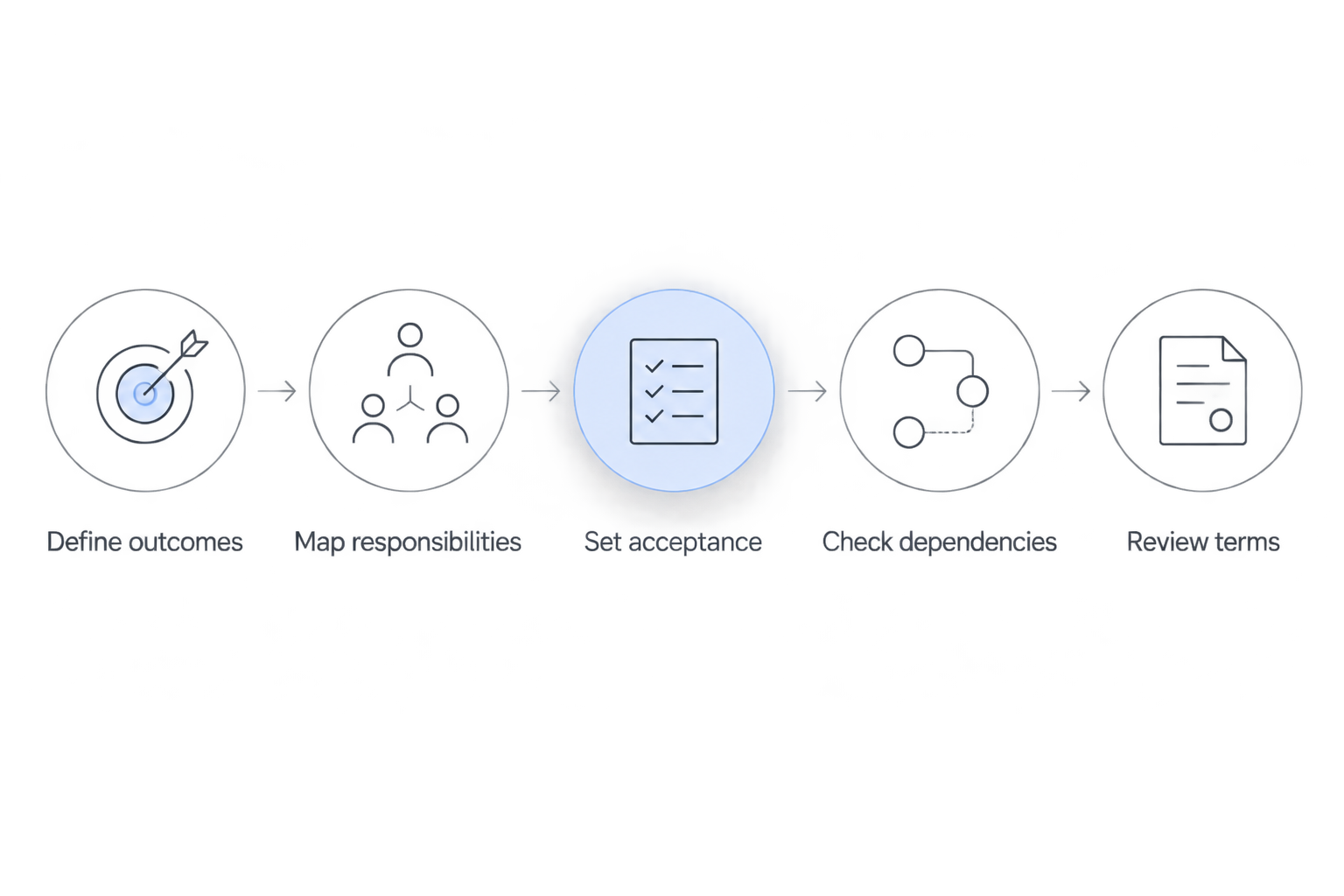
1. Define outcomes
State the business problem content needs to address. Examples include explaining a complex offer, supporting sales conversations, or attracting relevant search demand; choose the outcome that matches your actual need.
Avoid treating publication volume as the outcome. Output belongs in the delivery plan, while the business objective explains why that output deserves investment.
2. Map responsibilities
Assign strategy, expert access, writing, editing, design, publishing, distribution, and reporting. Give every responsibility a named owner on either the agency or client side.
If your website needs changes before content can convert visitors, identify who owns those changes. Do not bury a website dependency inside a writing brief.
3. Set acceptance
Define what makes work complete: an approved draft, a formatted page, a published asset, or another explicit deliverable. Include the review process and the point at which a new request becomes additional scope.
Acceptance criteria protect both sides. They prevent your team from receiving less than expected and prevent the assignment from expanding without agreement.
4. Check dependencies
List the access, materials, interviews, and approvals required to deliver the work. Ask what happens when a dependency is delayed and how the schedule will be updated.
Your team’s capacity belongs in this discussion. A content program that requires unavailable reviewers is not ready for the proposed production pace.
5. Review terms
Check ownership, account access, cancellation provisions, handoff requirements, and responsibility for third-party materials. Ask for unclear language to be resolved in the agreement rather than left to a sales conversation.
Make sure your team can continue using the finished work after the engagement ends, subject to the agreed rights. Confirm where final files and reporting records will live.
What extra work should you check before signing?
Check anything required to turn a draft into a useful business asset. That includes expert interviews, custom graphics, website implementation, distribution, measurement setup, and future updates when those activities matter to your plan.
These activities are not automatically excluded. The point is to establish whether they are included, separately scoped, or assigned to your team.
Keep promotion distinct from production. If you expect paid distribution, have the proposal separate agency responsibilities from media spending and identify who approves campaigns.
Is a full-service agency better than a content specialist?
A full-service agency fits a brief spanning positioning, website experience, creative work, and growth marketing. A content specialist fits a narrower assignment when your team already manages the surrounding work.
The trade-off is breadth versus focus. Broader support requires coordination across disciplines; specialist support requires your team to coordinate the connections outside that specialist’s scope.
Hey Prospekt offers brand strategy, digital marketing, and creative services for B2B and B2C companies. Consider that scope when content depends on messaging or website work, but do not assume every service belongs in your engagement.
For a broader buying decision, compare full-service marketing agency scope with the content responsibilities you actually need.
Define your marketing scope
Discuss whether your brief needs content support, brand work, web services, or a broader growth engagement.
FAQ
How much does a content marketing agency cost in 2026?
A content marketing agency’s quote depends on the agreed scope and engagement terms. Compare strategy, production, publishing, distribution, measurement, and your internal workload before choosing.
What should a content marketing agency retainer include?
A content marketing retainer should identify recurring responsibilities, deliverables, review boundaries, reporting, and scope-change rules. Do not assume publishing or distribution is included unless the agreement states it.
Is a project better than a monthly content retainer?
A project is better for a defined outcome; a retainer is better for continuing content operations. Choose based on who will own execution and improvement after the initial work is complete.
Does a content agency handle publishing and design?
A content agency handles publishing and design only when those responsibilities are included in the engagement. Ask who uploads, formats, checks, and approves each finished asset.
Should I choose a full-service agency or a content specialist?
Choose a full-service agency when the brief spans connected brand, web, and marketing work; choose a specialist for a narrower content assignment. Hey Prospekt offers brand, web, and growth marketing services for B2B and B2C companies.
Can an agency guarantee that content will generate leads?
A content agreement should specify controllable deliverables and measurement responsibilities, not treat lead outcomes as assured. Lead generation also depends on the offer, audience, distribution, conversion path, and sales follow-up.
Who should own the content after an agency engagement ends?
The agreement should explicitly define content ownership, usage rights, final-file delivery, and access after termination. Resolve those terms before production begins, including rights for any third-party materials.
One last thing
The most useful question is not just what the agency will deliver, but what your team must still do. Add an internal-responsibility column to your 2026 proposal comparison and assign an owner to every remaining task.
That column exposes an incomplete buying decision. If nobody owns expert access, approvals, publishing, or follow-up, settle those responsibilities before expanding the content program.
Related guides
- How long does it take to see results from content marketing?
- Connect Google Search Console to your content roadmap
- Can one agency handle branding and web design?


