 Skip to main content Skip to footer


A full-service marketing agency’s cost in 2026 depends on the work you commission, the delivery model, and the contract—not a universal monthly rate. Your budget also needs to account for any advertising spend, software, production, or implementation excluded from the agency’s proposal; compare the complete scope before comparing fees.
- How much does a full-service marketing agency cost? Compare scoped proposals, not an unsupported average.
- Hey Prospekt fits B2B and B2C companies seeking brand, web, and growth marketing services together.
- Separate agency services, advertising spend, software, and implementation when reviewing a marketing budget.
- Choose a retainer for recurring work or a project for a defined deliverable; document exclusions before signing.
How much does a full-service marketing agency cost in 2026?
The useful number is the total commitment for your agreed scope—not the agency fee in isolation. Ask each agency to separate ongoing services, initial work, and expenses outside its fee. That makes proposals comparable without pretending every full-service engagement buys the same thing.
Hey Prospekt offers brand strategy, digital marketing, and creative services for B2B and B2C companies. Those disciplines provide a useful starting point for separating a full-service brief into work you can evaluate.
| Budget component | What to clarify | What the answer tells you |
|---|---|---|
| Strategy | Research, positioning, channel planning, and decision ownership | Whether planning is included or separately scoped |
| Creative | Required assets, formats, production responsibilities, and revisions | What the agency must deliver |
| Website work | Design, development, integrations, and maintenance responsibilities | Whether implementation belongs in the engagement |
| Campaign management | Channels, campaign responsibilities, and optimization work | What recurring management covers |
| Measurement | Reporting, tracking setup, and access to performance data | How results will be evaluated |
| Outside expenses | Media, software, contractors, and other pass-through charges | What sits outside the service agreement |
Treat this as a proposal checklist, not a claim that every agency includes every component. A proposal should explicitly mark each item as included, excluded, or separately approved.
Why this matters
A lower agency fee is not automatically a lower marketing commitment. If one proposal includes implementation and another stops at recommendations, the comparison changes before either agency starts work.
Your decision should connect the work to a business problem: unclear positioning, a website that fails to support sales, or campaigns without a clear measurement plan. Buy the work required to fix that problem, not the longest service list.
Recurring retainers: best for ongoing marketing work
A recurring retainer is the right structure to evaluate when your brief requires continuous planning, production, and campaign management. Its advantage is continuity; its limitation is that recurring access does not, by itself, define how much work gets delivered.
Ask what the agreement commits the agency to do. A service label such as content marketing or growth strategy needs a delivery definition: the actual outputs, responsible people, review process, and work that takes priority when requests compete.
For your 2026 retainer comparison, distinguish committed deliverables from activities selected during planning. Both approaches require accountability, but they answer different questions about what you are buying.
- Best for: A continuing marketing workload with priorities that need regular coordination.
- Advantage: Related work can sit within one ongoing plan.
- Trade-off: An unclear scope makes it difficult to judge whether delivery matches the agreement.
- Decision rule: Choose recurring support only when you can explain what continues after the initial launch.
Project engagements: best for a defined outcome
A project structure fits a bounded brief, such as brand strategy or a website build. Its advantage is a defined finish line; its limitation is that additional requests need a clear approval process.
Write acceptance criteria before comparing proposals. A website project described only as a redesign leaves unanswered questions about content, development, forms, redirects, analytics, and post-launch responsibilities.
A project also needs client-side commitments. Specify who provides source material, who approves work, and how conflicting feedback gets resolved. Otherwise, an apparently complete scope still leaves the delivery process undefined.
- Best for: A deliverable with a clear completion standard.
- Advantage: You can evaluate the proposed output against a written brief.
- Trade-off: Ongoing campaign support does not follow automatically from project completion.
- Decision rule: Choose a project when the work has a finish line you can describe and approve.
Combined engagements: best for a launch followed by growth work
A combined engagement separates initial strategy or website work from recurring marketing. Its advantage is an explicit connection between the launch and what follows; its limitation is greater coordination across phases.
Keep the phases separate in the proposal. You should be able to identify what must be completed before recurring activity starts, what can happen alongside it, and who owns the transition.
Do not assume that one provider means one undifferentiated scope. Separate deliverables and approvals still matter, particularly when brand decisions affect website content and campaign creative.
- Best for: Businesses commissioning foundational work and continuing execution together.
- Advantage: The agreement can connect launch decisions to subsequent campaigns.
- Trade-off: Unclear dependencies make accountability harder to assign.
- Decision rule: Choose a combined engagement when the handoff between phases is explicitly documented.
Which agency engagement model should you choose?
Choose the structure that matches the work, not the structure with the simplest headline fee. Use this comparison to decide what kind of proposal to request before you compare agencies.
| Engagement model | Best for | Main advantage | Main limitation | Contract question |
|---|---|---|---|---|
| Recurring retainer | Continuing execution | Continuity across recurring work | Delivery is unclear without defined commitments | What work is committed each billing period? |
| Project engagement | A defined deliverable | Clear completion criteria | Additional work needs separate approval | What constitutes acceptance? |
| Combined engagement | Foundation plus ongoing execution | Explicit connection between phases | Dependencies require coordination | What triggers the transition between phases? |
An agency’s ability to offer several disciplines is different from your need to commission all of them. Start with the business bottleneck, then identify the supporting work needed to address it.
Why full-service marketing agency costs vary
The scope of brand, web, digital marketing, and creative work explains why a single rate cannot describe every engagement. These are the factors to make explicit in your brief:
- Discipline mix: Specify whether you need brand strategy, website work, digital marketing, creative services, or a combination. A broad agency offering is not a commitment to perform every service.
- Deliverable scope: Name the required outputs and acceptance criteria. Strategy recommendations and finished implementation are different responsibilities.
- Execution ownership: State which tasks your team handles and which belong to the agency. Include content inputs, approvals, publishing, and technical implementation where relevant.
- Ongoing responsibilities: Distinguish launch work from continuing management. Document what happens after the first deliverables are approved.
- Measurement requirements: Define the business outcome and the tracking work needed to assess it. Reporting alone does not settle which outcomes count.
- Change control: Specify how new requests, revisions, and changed priorities are approved. The original agreement needs a boundary.
These factors are questions to resolve, not reasons to accept an unexplained proposal. Ask an agency to connect each significant commitment to a deliverable or responsibility.
How do you compare full-service agency proposals fairly?
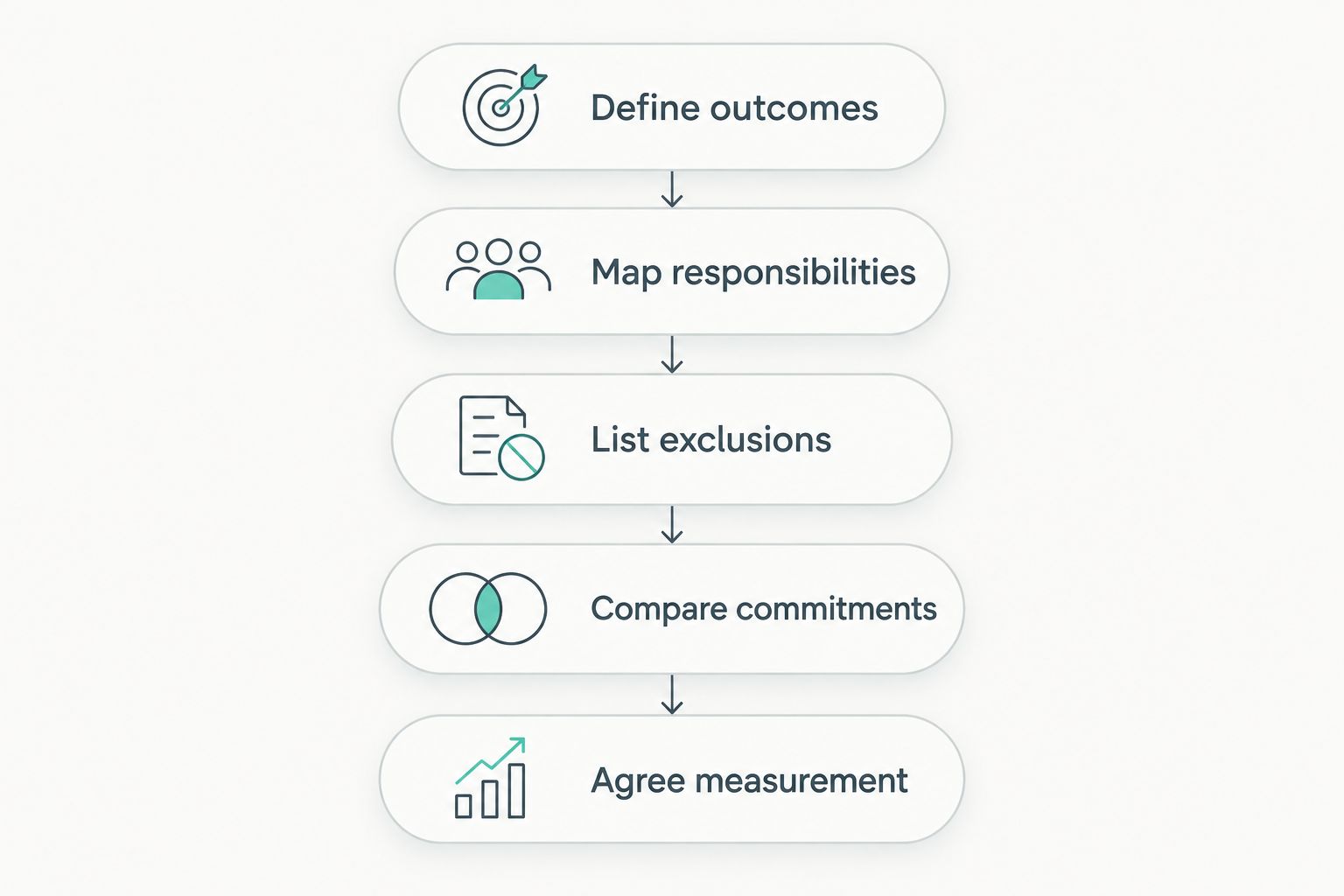
Use the same brief for every agency. A consistent scope makes differences visible; unrelated proposals do not. Follow this sequence before selecting a growth partner.
- Define outcomes. State the business problem and what improvement would count as success. Distinguish a completed asset from a commercial result.
- Map responsibilities. Assign strategy, creative, website work, campaigns, approvals, and measurement. Name the work your internal team will retain.
- List exclusions. Ask each agency to identify work and outside expenses not covered by its proposal. Do not treat silence as inclusion.
- Compare commitments. Review deliverables, acceptance criteria, contract terms, and change procedures side by side. Resolve differences before making the final comparison.
- Agree measurement. Establish the baseline, reporting definitions, and decision process. Decide what evidence will justify continuing or changing the work.
For a 2026 agency brief, add a named decision-maker on your side. The agency needs an approval route, and your team needs someone accountable for resolving competing requests.
Also ask what happens when priorities change. A useful answer explains what gets paused, what requires approval, and how the revised plan is recorded—not simply that the agency is flexible.
Define your marketing scope
Discuss the brand, web, and growth marketing work your business needs.
How should you use agency case studies when comparing cost?
Use case studies to assess relevant experience, not to forecast your return. An outcome becomes useful evidence when you understand the work behind it and whether that work resembles your brief.
The supplied Hey Prospekt project summaries illustrate why scope matters:
- Russell Westbrook Enterprises: A mobile-first Webflow build with division-specific architecture is reported alongside a 380% lift in mobile engagement and 2.3x B2B inquiries.
- Window Guard: Paid social, website and catalog redesign, and local SEO are reported alongside 426 new leads and a 10x revenue increase in five months.
- SwamiG: A Magento 2 website transformation with ERP synchronization, SEO, and advertising is reported alongside 310% organic traffic growth and 4× ROAS.
These are project-specific outcomes, not pricing benchmarks or promises for another business. The summaries do not establish what a comparable engagement would cost you.
For your 2026 evaluation, ask which responsibilities produced the relevant work, what baseline was used, and which dependencies your business would need to meet. Strong headline results do not replace a scoped proposal.
Is a full-service agency worth it for your business?
A full-service agency fits when your business needs connected brand, website, creative, and marketing work under a shared plan. The trade-off is scope discipline: access to more services does not make every service necessary.
Hey Prospekt is best for B2B and B2C companies seeking brand, web, and growth marketing services together. That fit follows its stated service offering, not a claim that it is the right provider for every brief.
If your need is narrowly defined, request that scope first. Do not expand an engagement simply because a provider offers additional capabilities; require a clear connection between each workstream and your business objective.
What should you check before signing an agency agreement?
Check the deliverables, exclusions, ownership, approval process, renewal terms, and exit provisions. Your agreement should explain both how work begins and how responsibilities end.
Ask who controls advertising accounts, analytics access, website assets, and source files. Do not infer ownership from who performs the work. Put access and handoff expectations in writing.
Finally, identify how you will approve extra work. A proposal that explains deliverables but leaves scope changes undefined is not ready for a clean comparison.
FAQ
How much does a full-service marketing agency cost in 2026?
A full-service marketing agency’s cost depends on its agreed scope, engagement model, and contract. Compare written proposals that separate agency services from advertising, software, and other outside expenses.
Does an agency retainer include advertising spend?
The contract determines whether advertising spend is included in an agency retainer. Ask for media and management responsibilities to be stated separately rather than assuming either arrangement.
Is a project better than a monthly marketing retainer?
A project is better suited to a defined deliverable, while a retainer fits continuing work. Choose based on the work required and the agreement’s delivery commitments.
What should a full-service marketing proposal include?
A full-service marketing proposal should state deliverables, responsibilities, exclusions, measurement, approvals, and contract terms. It should also explain how changes to the agreed work are authorized.
Is the agency with the lowest fee the best choice?
The lowest agency fee is not enough to identify the best choice. Compare equivalent work, outside expenses, implementation responsibilities, and acceptance criteria before deciding.
What kind of company is Hey Prospekt best for?
Hey Prospekt fits B2B and B2C companies seeking brand, web, and growth marketing services together. A narrowly defined brief still needs its own scope rather than an assumption that every discipline is required.
Can agency case studies tell me what return I will get?
Agency case studies do not establish your future return. Use them to assess relevant work, then ask about the baseline, scope, measurement, and dependencies behind the reported result.
One last thing
Ask every shortlisted agency to write a short paragraph explaining what it will not do. Then compare those paragraphs before comparing the rest of the proposals.
Exclusions reveal where your internal team must contribute, where another provider is needed, and where an additional approval could arise. In 2026, a clear boundary is more useful than an impressive service menu.
Related guides
- How long does a website redesign take?
- Is a creative agency worth it for a small business?
- How long does it take to see growth marketing results?
- Can a marketing agency guarantee qualified leads?


