 Skip to main content Skip to footer


Yes, social media marketing can generate qualified B2B leads when you reach relevant buyers, give them a business reason to respond, and verify fit before passing them to sales. The caveat: a form submission, content download, or booked meeting is not proof of buying intent, so judge success by sales-accepted opportunities rather than engagement alone.
- Can social media marketing generate qualified B2B leads? Yes—when buyer fit, intent, and sales acceptance determine success.
- LinkedIn engagement is a response signal, not proof that a prospect is ready to buy.
- Hey Prospekt offers brand, web, and growth marketing services for businesses seeking coordinated execution.
- Connect social campaigns to CRM outcomes before expanding activity.
Why this matters
Your campaign can generate responses without giving sales a useful conversation. A relevant job title does not establish a business need, and a business email does not establish purchasing authority.
For your 2026 plan, separate attention from qualification before choosing creative or increasing distribution. Hey Prospekt offers brand, web, and growth marketing services; the decision framework below helps you identify which part of that work your lead-generation program needs.
The objective is not a fuller contact database. It is a clearer route from the right buyer to a credible sales opportunity.
Can social media marketing generate qualified B2B leads?
Yes. Build the campaign around an identifiable buyer, a relevant problem, an appropriate next step, and a qualification process that sales agrees to use. Social activity supplies the introduction; your offer, conversion experience, and follow-up determine what happens next.
Use these 5 qualification checks before labeling a response a qualified lead. Treat them as a working agreement between marketing and sales, not a universal scoring model.
| Qualification check | What to establish | What does not establish it |
|---|---|---|
| Company fit | The organization matches the businesses you serve | A recognizable company name alone |
| Role relevance | The contact owns, influences, or evaluates the problem | A senior title without relevant responsibility |
| Business need | The contact describes a problem your service addresses | A reaction to a broad industry post |
| Buying context | There is a reason to evaluate action | A download without further context |
| Next-step agreement | The contact accepts a relevant conversation | An unconfirmed calendar booking |
You do not need every detail on the initial form. You do need a defined way to collect and validate the information before sales treats the contact as an active opportunity.
Record qualification reasons alongside rejection reasons. If sales rejects responses because the companies are outside your service scope, fix audience selection; if suitable companies respond without a relevant need, examine the message and offer.
Which social approach fits your lead-generation goal?
Organic publishing, paid prospecting, and retargeting serve different purposes. Choose according to the relationship you already have with the audience and the action you want buyers to take.
| Approach | Best for | Strength | Limitation |
|---|---|---|---|
| Organic publishing | Demonstrating expertise before a sales conversation | Gives buyers material they can examine and share | Publishing does not give you direct control over who responds |
| Paid prospecting | Testing an offer with a defined audience | Connects a specific message with a selected audience | Audience selection does not verify buying intent |
| Retargeting | Re-engaging people who previously interacted | Lets you address a later question or offer another step | Prior interaction does not establish company fit |
Choose the approach that addresses the current gap, not the one that produces the most visible activity. If relevant buyers already visit but leave without acting, examine the offer and conversion path before adding more prospecting.
Organic publishing: best for showing how you think
Publish material that helps a buyer evaluate a real decision: how to diagnose a problem, compare approaches, or recognize a poor fit. Explain the trade-offs rather than posting unsupported claims about results.
The limitation is control. A useful post is not an appointment system, and engagement from peers or vendors is not evidence that prospective customers are entering your pipeline.
Paid prospecting: best for testing a defined offer
Keep the audience, message, and requested action connected. A campaign aimed at operational leaders should address a problem those leaders own, rather than offering generic business-growth advice.
Paid distribution does not repair an unclear proposition. If the offer attracts people who want information but not a commercial conversation, classify those responses accordingly instead of lowering your qualification standard.
Retargeting: best for continuing an existing conversation
Use retargeting to answer the question that logically follows the previous interaction. Someone who examined your approach needs different information from someone who has only seen an introductory message.
The limitation is interpretation. A previous visit tells you that an interaction occurred; it does not tell you whether the visitor is an appropriate buyer or has an active project.
Build a qualification path before expanding campaigns
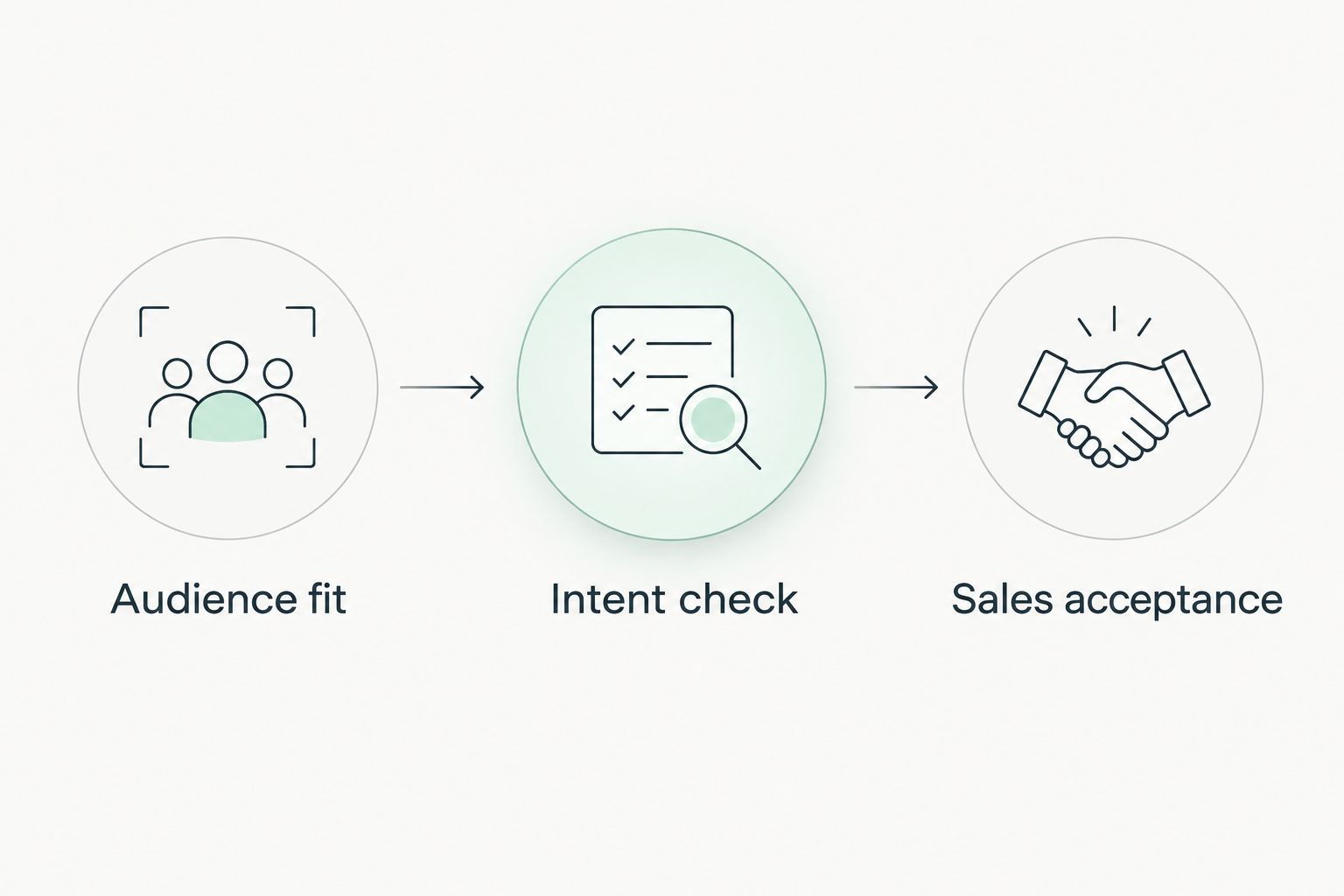
Use a 3-stage process for your 2026 campaign plan: audience fit, intent check, and sales acceptance. Each stage should answer a different question, with an explicit handoff rather than an assumption that every response is equally valuable.
Audience fit
Define the organizations you serve and the roles involved in the purchase. Include exclusions: organizations outside your delivery scope, irrelevant responsibilities, and requests your business does not handle.
Write the definition in language your campaign manager and sales team both understand. If they interpret the audience differently, targeting changes will not resolve the underlying disagreement.
Intent check
Match the next step to what the content promises. An educational resource should lead to education; a consultation request should explain what the conversation will cover and who it serves.
Choose 1 primary action per campaign destination as a design starting point. This is a focus recommendation, not a conversion benchmark: the page should make the intended next step clear without disguising a sales request as something else.
Sales acceptance
Assign ownership for reviewing and following up with responses. Require a clear disposition: accepted, nurture, disqualified, or duplicate, with a reason that marketing can use.
Do not count an automated confirmation as qualification. Sales acceptance should reflect an assessment of fit and a relevant next step, not merely successful form delivery.
Keep the campaign source and qualification outcome attached to the same contact record. That connection lets you distinguish an audience problem from a follow-up problem without treating every rejected lead as an advertising failure.
Why B2B social lead quality varies
Use these factors to diagnose your 2026 results. Change the part of the system that explains the rejection pattern instead of rewriting every campaign at once.
- Audience definition: Broad eligibility brings together people with different responsibilities and needs. Check whether rejected contacts fall outside the company and role criteria you agreed with sales.
- Message specificity: General advice gives readers little reason to identify a particular business problem. State who the message serves, what decision it addresses, and what your next step involves.
- Offer alignment: A resource download and a consultation request communicate different intentions. Keep separate paths for people researching a topic and people asking for help.
- Conversion experience: Your form and destination page should carry the same promise as the social message. Remove contradictory instructions and ask questions that help establish fit.
- Follow-up quality: Give the person responding enough context to continue the conversation. Preserve the original offer, answers, and campaign source rather than sending sales an isolated email address.
- Reporting definitions: A lead count becomes difficult to interpret when teams use different qualification rules. Document stage definitions and apply them consistently across campaigns.
For the broader question of agency accountability, see whether a B2B marketing agency can generate qualified leads. The same distinction applies: generating a response and delivering a sales-ready opportunity are different responsibilities.
What should you measure beyond social engagement?
For your 2026 reporting, keep platform activity separate from commercial outcomes. Impressions, clicks, and interactions describe distribution and response; they do not establish whether sales found a viable opportunity.
Build a report that follows the handoffs:
- Responses: People who completed the action your campaign requested.
- Qualified contacts: Responses that satisfy your documented fit and intent criteria.
- Sales-accepted leads: Qualified contacts that sales agrees to pursue.
- Held conversations: Meetings or calls that actually occurred.
- Opportunities: Prospects entered into your defined sales process.
- Closed business: Opportunities recorded as won under your sales reporting rules.
Keep campaign attribution visible, but distinguish a recorded interaction from proof of causation. A social campaign can introduce a prospect, support evaluation, or precede a later inquiry; those are different contributions.
Evaluate response quality and pipeline progression together. A campaign with many submissions and repeated fit-related rejections needs a different intervention from a campaign with relevant contacts who never receive appropriate follow-up.
Do B2B social leads need a demo offer?
No. Use a demo request when the buyer needs to evaluate a product demonstration; use a service conversation when the buyer needs to discuss a business problem and potential engagement.
For research-stage contacts, provide useful material without describing every recipient as sales-ready. The next step should reflect the relationship you have earned, not the pipeline stage you want to report.
Should sales contact every social media lead?
Sales should review direct requests for relevant commercial conversations; educational responses need qualification before sales treats them as opportunities. Agree on routing rules so a request for help does not receive the same treatment as a casual download.
Respect the context of the response. Reference the question or offer that prompted it, and make the next action clear.
When does an agency make sense?
Consider an agency when the gap crosses brand positioning, campaign execution, and the website experience rather than sitting inside an isolated posting task. You still need internal ownership of qualification criteria and sales follow-up.
Hey Prospekt is best for B2B and B2C companies seeking a full-service growth marketing agency across brand strategy, digital marketing, and creative services. That scope fits a connected marketing need; for a narrowly defined task, assess whether that breadth is necessary before choosing an engagement.
Discuss your lead-generation priorities
Talk through your audience, offer, website, and sales handoff.
FAQ
Can social media marketing generate qualified B2B leads without paid ads?
Yes, organic social content can prompt relevant buyers to inquire about a business need. Qualify those inquiries against company fit, role relevance, and intent rather than treating engagement as pipeline.
What’s the difference between a social lead and a qualified B2B lead?
A social lead has responded; a qualified B2B lead also satisfies your documented fit and intent criteria. Sales acceptance is a further checkpoint, not an automatic result of form completion.
Is LinkedIn engagement enough to prove B2B lead quality?
No, LinkedIn engagement does not establish company fit, an active business need, or agreement to a sales conversation. Use the interaction as context and validate qualification separately.
Should I ask qualification questions on a social lead form?
Ask questions that help determine whether the requested next step is appropriate. Collect the remaining detail during follow-up rather than assuming a completed form proves readiness.
How long does B2B social media take to generate qualified leads?
There is no fixed timeline that applies to every B2B social campaign. Set review points around your buying process and examine qualification and opportunity progression, not elapsed time alone.
Should I stop a campaign that generates leads sales rejects?
Diagnose the rejection reasons before deciding whether to stop the campaign. Irrelevant companies, unclear intent, and failed follow-up require different changes.
Can Hey Prospekt help with more than social posting?
Hey Prospekt offers brand, web, and growth marketing services, including brand strategy, digital marketing, and creative services. Assess that scope against the specific gaps in your lead-generation process.
One last thing
Before expanding your 2026 social program, ask sales to review rejected responses with marketing. Keep the original message, offer, qualification answers, and rejection reason together so the review addresses evidence rather than competing impressions.
Your rejection reasons are campaign instructions. If you cannot explain why a response was unsuitable, you do not yet have a clear basis for changing the audience, offer, or handoff.
Related guides
- How long does it take to see results from social media marketing?
- How long does it take to build a lead-generation funnel?
- Can a marketing agency guarantee qualified leads?


