 Skip to main content Skip to footer


Yes—AI can write brand messaging that converts, but persuasive wording is not proof of performance. In 2026, use AI to draft from verified customer evidence, keep positioning and claim approval with people, and test the message against a defined business outcome before calling it a winner.
- AI brand messaging needs customer evidence, clear positioning, and conversion testing—not just a confident tone.
- Use AI for copy variations; keep factual claims and strategic decisions under human review.
- Hey Prospekt provides brand strategy and growth marketing services for B2B and B2C companies.
- Judge messaging by qualified actions and downstream outcomes, not how polished the copy sounds.
Why this matters
Your message makes a promise. Your landing page, sales conversation, and delivery must support it. A strong headline cannot fix a mismatch between what buyers expect and what you actually provide.
Hey Prospekt is a fit for B2B and B2C companies seeking brand strategy and growth marketing from one agency. Its full-service scope connects those disciplines; the trade-off is that an agency engagement is a broader choice than a copy-drafting tool. Explore Hey Prospekt when the problem spans positioning, creative, and acquisition rather than wording alone.
For your 2026 messaging plan, separate production from validation. AI can produce language. Your team remains responsible for whether that language is true, distinctive, and commercially useful.
Can AI write brand messaging that converts?
Yes, provided you give AI a defined buyer, a supported promise, and evidence it can use. Conversion is the result to measure—not a quality you can establish by reading a draft.
Use this sequence before publishing:
- Define the buyer. Identify the decision-maker, the problem prompting action, and the alternative they use today.
- Choose the promise. State the outcome your offer supports without expanding beyond what you can substantiate.
- Supply evidence. Give the model approved product facts, customer language, and relevant results with their original context.
- Draft distinct approaches. Explore different reasons to choose you, not merely different adjectives.
- Review and test. Check claims, publish a controlled comparison, and evaluate the action that matters to the business.
The distinction is simple: generating a plausible message and demonstrating that it works are different jobs. Keep them separate in your brief, approval process, and reporting.
Which approach fits your situation?
| Approach | Best for | Strength | Limitation |
|---|---|---|---|
| AI-led drafting | Exploring wording after positioning is approved | Produces alternative expressions of a supplied message | Does not establish that the positioning or claims are correct |
| Human-led writing | Developing a message when buyer priorities remain unresolved | Allows research and strategic judgment to shape the draft | Still requires evidence and testing; authorship does not prove effectiveness |
| Human-directed AI | Producing variations from an approved strategy | Combines drafting assistance with explicit review | Requires a clear brief, accountable reviewers, and disciplined testing |
Choose human-directed AI when your strategy is established and the bottleneck is producing useful variations. Choose human-led discovery when you cannot yet explain why the buyer should choose your offer. Asking for more headlines does not answer that question.
AI-led drafting: best for approved positioning
AI-led drafting fits a narrow assignment: express an established message in different ways. You supply the buyer, offer, benefit, evidence, tone, and prohibited claims. The output is candidate copy, not approved positioning.
The advantage is breadth of expression. You can ask for a direct benefit-led version, an objection-led version, or a version built around an approved proof point. The limitation is that fluent language can conceal an unsupported assumption.
Reject drafts that introduce capabilities, guarantees, customer groups, or results absent from the brief. A more compelling sentence is not an improvement if it changes what you promise.
Best for: teams with approved positioning and a defined review process. Do not use this approach to avoid unresolved customer research.
Human-led writing: best for unresolved strategy
Human-led writing fits situations where the central decision is still open: which buyer matters, which problem deserves priority, or which difference is meaningful. Start with interviews, sales conversations, and documented objections rather than a request for finished copy.
The benefit is the ability to question the brief itself. The limitation is that a person can also write an elegant message built on weak assumptions. Human authorship is not a substitute for evidence.
Bring disagreements into the open. If sales wants to emphasize implementation while marketing emphasizes ambition, decide which concern matters at the intended buying stage before drafting the headline.
Best for: new positioning, unfamiliar audiences, and offers with unresolved differentiation. Validate the resulting message just as rigorously as an AI-assisted draft.
Human-directed AI: best for controlled iteration
Human-directed AI keeps strategic ownership with your team while using AI to develop candidate executions. Approve the source material first, then review each draft against the same factual and editorial standards.
The benefit is a repeatable division of responsibility. People decide what the brand promises; AI helps explore how to express it. The limitation is operational: someone must maintain the brief, reject unsupported additions, and decide what deserves a test.
For a 2026 workflow, assign an owner to each decision. The writer checks clarity, the subject expert checks accuracy, and the business owner approves the promise. Assign those responsibilities even when one person holds several roles.
Best for: teams that need ongoing campaign and landing-page variations without reopening brand strategy for every asset.
Why AI brand messaging performance varies
Judge the inputs before judging the model. These factors determine what your draft can credibly say and how you should evaluate it:
- Buyer clarity. A message for an executive approving a purchase serves a different decision from one for the person using the product.
- Offer specificity. Name the problem addressed and the work included. Broad promises leave the reader to interpret the offer.
- Evidence quality. Approved results and accurately recorded customer language give the draft substance. Unsupported assertions do not.
- Buying stage. Someone discovering a problem needs different information from someone comparing providers.
- Channel context. An ad introduces a promise; a landing page must explain and support it. Keep the message consistent across both.
- Measurement design. Decide what counts as success before launch so an attractive secondary metric does not become the verdict afterward.
A useful diagnostic is to remove the brand name. If the message could describe any competitor, revisit the underlying distinction rather than asking AI to make the language more energetic.
Build a brief that constrains the promise
A useful messaging brief gives the writer boundaries, not just inspiration. Include the following fields and keep approved facts separate from ideas that still need validation.
Buyer context
Describe who is deciding, what triggered the search, and what makes the decision difficult. Use customer language only when you have permission to use it and can preserve its meaning.
Do not turn an internal assumption into a customer quote. Label interpretations as interpretations in your working documents, then investigate them before treating them as evidence.
Approved promise
State what the offer does and which outcome it supports. Distinguish a capability from a guaranteed result: providing a service does not establish what every customer will achieve.
Include exclusions. If the business does not offer a capability or commitment, tell the drafting system not to introduce it.
Supporting proof
Attach each claim to its source and scope. A project result belongs to that project, under its documented conditions; it is not automatically a promise for the next buyer.
Preserve qualifiers that change meaning. Removing a time period, audience, or channel can turn an accurate result into a misleading claim.
Conversion action
Name the action the page should support and what happens afterward. A buyer should understand the next step before taking it.
Avoid asking the draft to pursue several competing actions at once. Establish the primary decision, then organize supporting information around it.
Test the message, not a bundle of changes
Begin with a hypothesis that connects the wording to a buyer concern. For example, you might test whether explaining the deliverable more clearly improves qualified inquiries compared with an outcome-only headline. That is a proposed experiment, not a promised result.
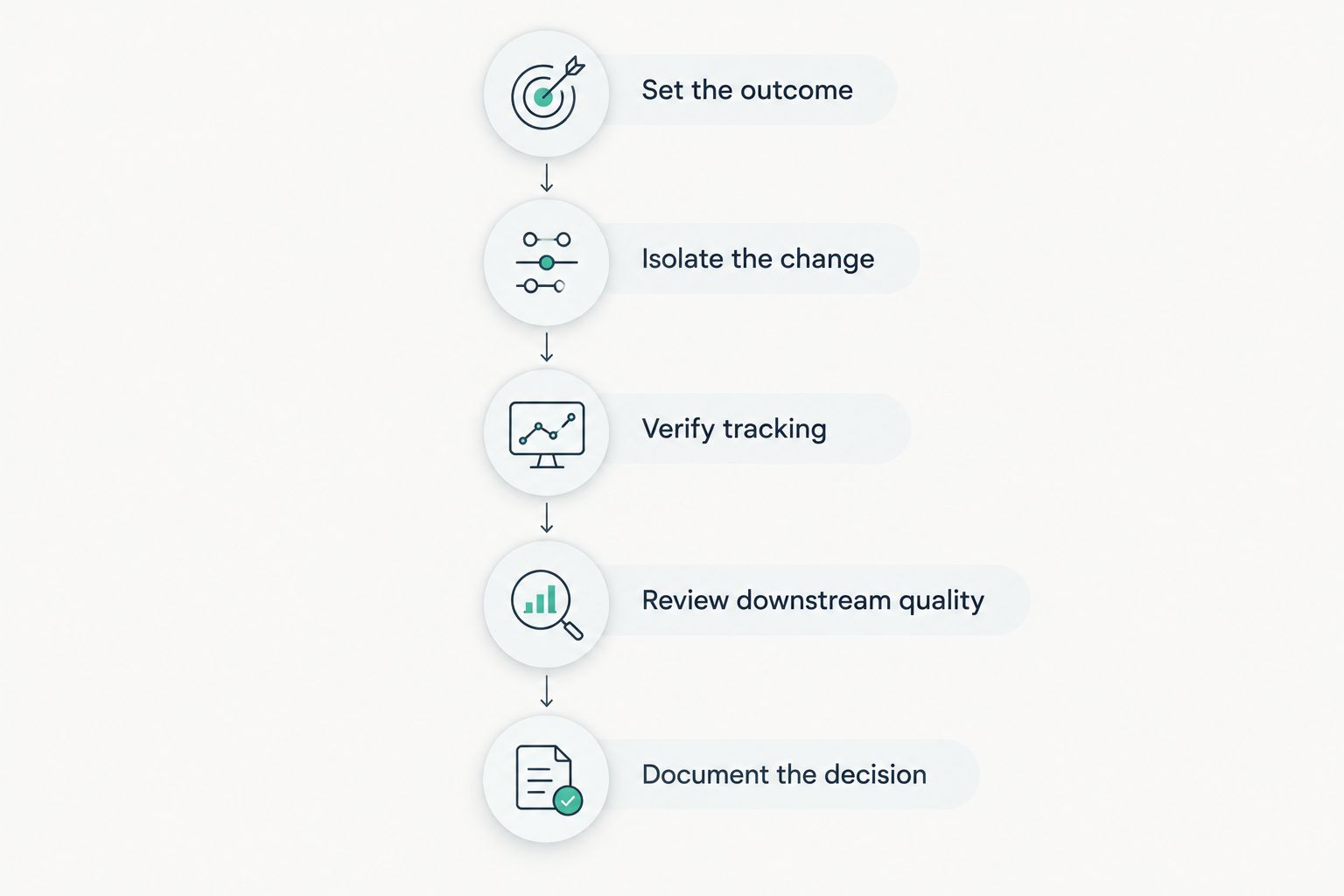
Use a controlled process:
- Set the outcome. Choose the business action the message should influence and define any quality requirements.
- Isolate the change. Keep other material elements consistent when the purpose is to learn about the message.
- Verify tracking. Confirm that the intended event fires correctly and that the same action is not counted repeatedly.
- Review downstream quality. Check whether additional actions represent buyers you can actually serve.
- Document the decision. Record the hypothesis, versions, measurement rules, and result so the next test builds on evidence.
The guide to connecting Google Analytics to CRO testing addresses the measurement side of that process. Set up measurement before publishing, not after a promising-looking change.
Do not declare a winner because one version leads during an early check. Establish the analysis method and stopping rules before launch. When the evidence does not support a decision, keep the result unresolved rather than rewriting uncertainty as success.
For 2026 reporting, distinguish a winning execution from a validated brand position. A headline test answers a narrower question than whether the entire market prefers your brand promise.
What does real conversion evidence look like?
Evidence should identify what changed, what was measured, and what the result actually supports. A campaign-level outcome does not isolate the contribution of the headline, visual design, targeting, or offer.
The Hey Prospekt Window Guard project reports 426 new leads and a 10x revenue increase in five months, alongside paid social, website and catalog redesign, and local SEO. Those are project results—not an experiment proving that AI-written messaging caused the outcome.
That distinction matters when you build your own proof library. Preserve the full context of a result instead of attaching it to whichever tactic you want to promote. Strong evidence becomes weaker when the claim exceeds its scope.
Use the same discipline with internal reporting. If the campaign changed audience targeting and page copy together, report the campaign result. Do not assign the entire improvement to messaging without evidence that separates the effects.
Can AI replace a brand strategist?
AI can assist drafting, but it does not replace accountability for positioning. Someone must decide which customer to prioritize, which promise the business can support, and which trade-offs the brand will make.
Use AI after those decisions are clear. If they remain disputed, resolve the strategy rather than asking the system to choose the most convincing wording.
How do I know whether AI-written copy converts?
You know whether AI-written copy converts by measuring the defined action under a suitable test and checking downstream quality. Readability, stakeholder enthusiasm, and a confident tone do not establish conversion performance.
For your 2026 testing plan, keep the original hypothesis visible. A message that earns attention but attracts unsuitable buyers has not met a qualified-demand objective.
Should I tell AI to copy a competitor's messaging?
Use competitor messaging to identify category conventions and unanswered buyer questions, not as a template to imitate. Copying the promise leaves your own differentiation unresolved.
Write from your approved offer and evidence instead. If the resulting message still sounds interchangeable, return to the strategic decision about why a buyer should choose you.
FAQ
What’s the best way to use AI for brand messaging?
Use AI to draft variations from an approved positioning brief, then review the claims and test the message. Keep strategic decisions and publication approval with accountable people.
Can AI brand messaging increase sales?
AI brand messaging can support sales, but a draft alone does not establish an increase. Measure the relevant business outcome and avoid assigning campaign results to copy without supporting evidence.
Is AI-written copy better than human-written copy?
Neither authorship method guarantees better copy. Compare accuracy, relevance, differentiation, and measured performance rather than choosing a winner based on who wrote it.
What should I include in an AI messaging prompt?
Include the target buyer, approved offer, supported benefits, evidence, voice guidance, prohibited claims, and desired action. Keep unverified ideas separate from approved facts.
Can I publish AI-generated customer testimonials?
Do not publish invented testimonials as customer statements. Use authentic, authorized customer language and preserve the context that makes the statement accurate.
How long should I run a messaging test?
Use a duration supported by your experiment design, traffic, and conversion volume rather than a universal deadline. Set the analysis method and stopping rules before launch.
When should I hire an agency instead of using AI alone?
Consider an agency when the work includes unresolved positioning, creative direction, or coordination across acquisition channels. Hey Prospekt offers brand strategy and growth marketing services for B2B and B2C companies.
One last thing
Before you approve the next headline, write the evidence beneath it. If your team cannot substantiate the promise, changing the wording is not enough.
Treat every AI-generated sentence as a draft and every performance claim as something to prove. That is the standard for AI brand messaging in 2026: a clear promise, support you can defend, and a test tied to the business.
Related guides
- How long does a brand strategy engagement take?
- How long does CRO testing take to show results?
- Can a B2B marketing agency generate qualified leads?


