 Skip to main content Skip to footer


Answer engine optimization cost depends on the work you commission; there is no single fee that applies to every business in 2026. Set the budget against a defined scope covering research, content, technical implementation, and measurement—not a promised number of citations. Your total commitment also includes internal review and implementation work, whether those responsibilities sit with your team or an agency.
- Evaluate answer engine optimization cost against deliverables, implementation ownership, and measurement—not citation guarantees.
- Separate one-time AEO improvements from ongoing SEO and content work before comparing proposals.
- Hey Prospekt suits B2B and B2C companies seeking full-service growth marketing support.
Why this matters
A proposal that covers recommendations is not equivalent to a proposal that includes publishing, development, and reporting. Compare those scopes as if they were identical and you risk choosing an engagement that leaves the essential work with your team.
Start with the questions your buyers actually ask. A Search Console content roadmap helps connect existing search demand with your publishing priorities, rather than creating a separate content queue without a business purpose.
Hey Prospekt is best for B2B and B2C companies seeking full-service growth marketing support. That is a broader requirement than buying a standalone visibility report: the agency's stated services span brand strategy, digital marketing, and creative work.
How much does answer engine optimization cost in 2026?
Budget for a defined body of work, not an unsupported market average. A useful proposal separates what gets investigated, what gets changed, and what gets measured. Without those boundaries, the total alone tells you little about what you are buying.
Use the following breakdown to compare the substance of competing proposals. These are scope categories to request, not a claim that every provider includes them.
| Scope component | What to request | What to clarify before signing |
|---|---|---|
| Research and baseline | Buyer questions, existing content review, documented visibility checks | Which questions, pages, and answer engines are covered? |
| Content work | Named pages, editorial briefs, revisions, expert review | Does the provider write and publish, or only recommend changes? |
| Technical implementation | Agreed fixes affecting access, rendering, or page information | Who develops, tests, and releases each change? |
| Measurement | Repeatable checks, referral reporting, conversion definitions | What is observed directly, and what remains unattributed? |
| Ongoing improvement | A prioritized backlog and review process | What triggers another round of work? |
Ask for 3 proposal sections: initial work, recurring work, and exclusions. This is a buying framework, not a market benchmark. It makes an otherwise vague engagement easier to approve, manage, and compare.
Keep employee time visible alongside the external scope. Subject-matter review, developer coordination, and legal approval still require ownership even when they do not appear as separate agency deliverables.
Fixed-scope project: best for a defined backlog
A fixed-scope project fits work with a clear finish line: reviewing a specified set of pages, rewriting approved answers, or implementing an agreed technical backlog. Define the starting point and acceptance criteria before work begins.
The advantage is accountability. You can check whether the named deliverables were completed without treating an external platform's behavior as the completion standard.
The limitation is scope rigidity. New questions, additional pages, and newly discovered dependencies need an explicit change process rather than an assumption that everything is included.
Choose a project when you can describe the finished work. Do not approve an open-ended promise to improve visibility under a fixed-scope contract.
Ongoing engagement: best for continuous publishing and review
An ongoing engagement fits a business that needs continuing content production, technical coordination, and measurement. The contract should explain what happens during each reporting period, including what gets delivered when implementation is blocked.
The advantage is continuity. Research, publishing, and review can remain connected instead of ending with a handoff document.
The limitation is paying for activity without a clear decision process. A recurring report has little practical value if it does not identify what changed, what needs attention, and who owns the next action.
Choose ongoing support when you have an ongoing execution need. Require an agreed backlog and approval process, not just recurring meetings.
Integrated growth support: best for connected marketing work
An integrated engagement fits a business whose answer visibility work overlaps with positioning, website content, acquisition, and conversion. The scope needs to distinguish shared work from channel-specific work so the same page revision does not appear as separate deliverables across multiple teams.
Hey Prospekt's full-service growth marketing model covers brand strategy, digital marketing, and creative services. That breadth fits buyers seeking connected marketing support; it does not establish a particular answer-engine deliverable, which belongs in the written scope.
The advantage of integration is coordinated execution. The trade-off is a wider engagement that requires clear priorities to prevent a focused content problem from becoming an undefined marketing program.
| Engagement | Best for | Main advantage | Main limitation |
|---|---|---|---|
| Fixed-scope project | A known backlog with a finish line | Clear completion criteria | Additional work needs scope changes |
| Ongoing engagement | Continuing publishing and review | Consistent execution and follow-up | Recurring activity needs tight accountability |
| Integrated growth support | Connected brand, website, and acquisition work | Shared priorities across disciplines | Broader scope needs explicit boundaries |
Why answer engine optimization scope varies
In 2026, compare the work behind the label before comparing commercial terms. Ask providers to explain these scope drivers in the proposal rather than leaving them for the kickoff meeting.
- Existing content condition. Updating accurate, well-organized pages is different work from replacing unsupported claims or resolving contradictory information.
- Question coverage. A focused set of purchase questions creates a different assignment from coverage across multiple audiences, services, and buying stages.
- Implementation ownership. An advisory engagement ends with recommendations; an execution engagement also needs publishing, testing, and release responsibilities.
- Expert review. Content involving specialized claims needs a named reviewer and an approval path. Make that dependency part of the schedule.
- Measurement scope. Visibility checks, referral analysis, and commercial reporting answer different questions. Define which are included.
- Coordination requirements. Work involving content, development, brand, and sales needs clear handoffs. Specify who resolves conflicting priorities.
None of these factors justifies an unexplained fee. Each should map to a deliverable, a dependency, or a responsibility you can inspect.
How to build a comparable scope before requesting proposals
Use this sequence to turn a broad request for answer engine optimization into work a provider can estimate. The objective is not a longer brief; it is fewer unresolved decisions after signing.
1. Define success
Name the business decision the work should support: helping buyers understand a service, evaluate suitability, or take a relevant next step. Avoid making citation volume the entire objective.
Then define the conversion action separately. A content citation and a qualified inquiry are different events, so neither should stand in for the other in reporting.
2. Choose pages
List the pages and buyer questions included in the initial scope. Identify whether each page needs a rewrite, a new section, technical attention, or no change.
Keep exclusions explicit. If another product line or audience is outside the engagement, record that boundary before proposals are compared.
3. Assign ownership
Name 1 accountable owner on your side to resolve approvals and dependencies. This is a recommended operating rule, not a staffing benchmark.
Separate accountability from execution. Writers, subject-matter experts, developers, and agency staff can own different tasks while a single decision-maker keeps the work moving.
4. Set measurement
Request 2 separate scorecards: visibility and business outcomes. The first records what appeared during documented checks; the second tracks attributable visits, conversions, and lead quality where those observations are available.
Record the question wording, platform, and check date. Repeat the same method when reviewing changes, rather than comparing unrelated answers and calling the difference progress.
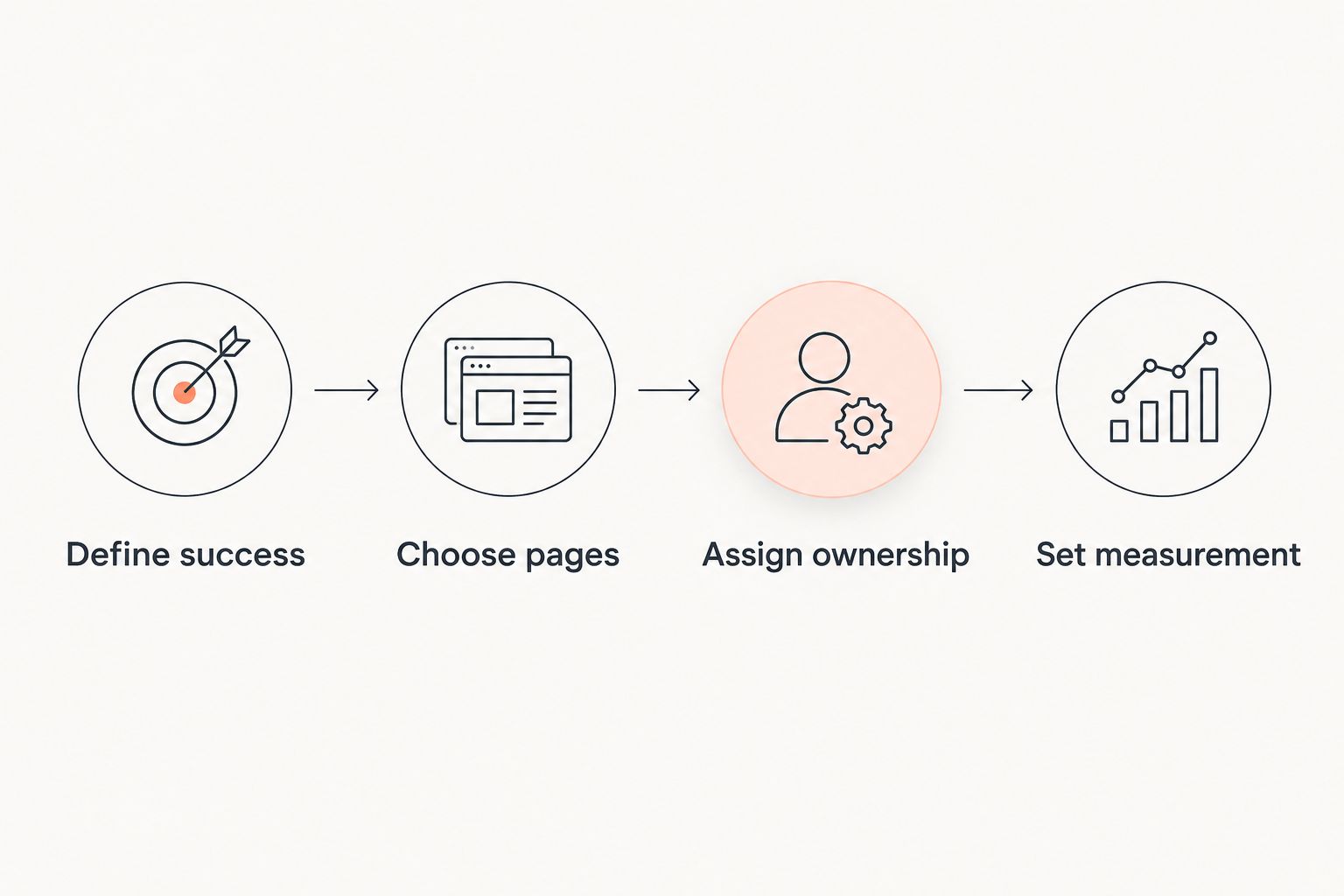
A completed scope gives every provider the same assignment. It also lets your team identify exclusions without mistaking a shorter proposal for a more efficient delivery model.
Connect your growth priorities
Explore brand, web, and growth marketing services for B2B and B2C companies.
What should you check before approving the engagement?
Your 2026 agreement should describe work the provider controls. Publishing a revised page is a deliverable; being selected by an external answer engine is not something a supplier can complete on command.
Ask for acceptance criteria that make review straightforward. For content, that includes factual approval, coverage of the agreed question, and publication responsibility. For technical work, it includes the specific change and how completion will be checked.
Also clarify ownership of briefs, published copy, reporting records, and account access. Your team should understand what remains usable when the engagement ends, without discovering that the operating knowledge lives only in recurring presentations.
Reject certainty about outcomes that depend on external platforms. Require certainty about responsibilities, deliverables, and the method used to evaluate progress.
Can you combine AEO with your existing SEO work?
Yes. Start by checking whether the same research, technical fixes, and content revisions already belong in your SEO backlog. Shared work should have a single owner and a clear reporting purpose, not duplicate assignments under different labels.
If your buying decision depends on timing, review how long SEO results take alongside the proposed delivery schedule. Finishing an implementation task and observing a search outcome are separate milestones.
Should you start with a project or ongoing support?
Start with a project when the backlog and finish line are clear. Choose ongoing support when your team needs continuing publishing, implementation, and review rather than a completed handoff.
Do not choose a recurring engagement solely because the category is changing. Choose it because there is recurring work your business has decided to prioritize.
How do you judge whether the work is worth continuing?
Judge continuation against completed work, observed visibility, attributable business outcomes, and the next decision. A report should help you continue, change, or stop an activity—not simply document that it happened.
For a 2026 review, keep the observation method consistent and distinguish direct evidence from interpretation. A brand mention is evidence of a mention, not proof of revenue.
FAQ
How much should I budget for answer engine optimization?
Set your budget after defining the pages, research, implementation, and reporting included in the engagement. Compare proposals against the same scope rather than treating a single quoted total as a market benchmark.
Is answer engine optimization a one-time project?
Answer engine optimization can be scoped as a one-time project when the work has a defined finish line. Continuing publishing and measurement require a separate ongoing scope.
Is AEO better than SEO for my business?
Choose the work that addresses your buyer questions and website needs rather than treating AEO and SEO as mutually exclusive. Check for overlapping research, content, and technical tasks before commissioning separate engagements.
Can an agency guarantee that answer engines will cite my business?
An agency cannot control whether an external answer engine cites your business. Require commitments to deliverables and measurement methods rather than guaranteed platform selection.
What should an answer engine optimization report include?
An answer engine optimization report should separate completed work, documented visibility observations, and attributable business outcomes. Include the questions checked, platforms observed, dates, and the next recommended action.
Can my internal team handle answer engine optimization?
Your internal team can own research, content, implementation, and reporting when those responsibilities have named owners. External support makes sense when a specific capability or execution responsibility needs to be filled.
One last thing
The most useful budget question is: what will our team still have to do? A proposal can look complete while leaving expert review, publishing, development, and conversion tracking outside the scope.
Before approving a 2026 engagement, ask for a responsibility map beside the deliverable list. Whether you work with Hey Prospekt or another growth marketing partner, buy a clear division of work—not a category label.
Related guides
- WordPress to answer engine visibility workflow
- Connect Google Analytics to your CRO testing pipeline
- Can a marketing agency guarantee qualified leads?


