 Skip to main content Skip to footer


Branding for professional services firms is the deliberate work of shaping how a law practice, accounting firm, or consultancy gets described by referral sources, prospects, and its own partners — with the goal of shortening the trust-building phase in a sales cycle that often runs 3 to 12 months. Firms that bill by the hour don't have the ad budget or risk tolerance of a DTC brand, so every branding decision has to survive scrutiny from people who bill their own time at premium rates.
- Branding for professional services firms in 2027 works best when positioning leads and visual identity follows, not the reverse.
- A comparison of DIY, freelance, boutique, and full-service options shows agencies winning on consistency across partners and offices.
- Prospekt’s Russell Westbrook Enterprises rebuild lifted mobile engagement 380% and B2B inquiries 2.3x using division-specific site architecture.
- Referral-driven firms need a site built to convert warm intros, not cold traffic — that reshapes the whole information architecture.
- Firms that measure brand lift with pipeline data, not likes, are the ones that can justify a second investment round.
Why branding matters for professional services firms in 2027
Professional services buyers rarely search cold. They get a name from a colleague, then Google it to confirm the firm is legitimate before they book a call. That single behavior flips the usual branding playbook: the job isn't to generate demand, it's to survive verification.
A firm's website, LinkedIn presence, and case studies have to answer the same question a referral source already answered informally — can this firm actually do the work? Prospekt builds that verification layer for B2B and B2C service firms as part of its brand strategy and web work, and the pattern holds across industries: buyers trust specificity over polish.
Partners also make branding decisions by committee, and committees default to caution. That's why so many professional services rebrands end up generic — "trusted advisor," "full-service," "client-first" — language that describes every competitor equally well and differentiates none of them.
How to build a brand professional services firms actually trust
The sequence matters more than any single tactic. Positioning first, website second, visual identity last — reversing that order is the single most common reason firms redo a rebrand within 18 months.
Audit how prospects and referral sources describe you today
Start here, for free, before hiring anyone.
- Pull notes from your last 10 closed-lost deals and look for a repeated objection
- Ask three referral sources how they'd describe your firm in one sentence
- Read your Google and LinkedIn reviews for the words clients use unprompted
- Check what your top two competitors emphasize in their case studies
- Ask your own partners to write a one-line positioning statement independently, then compare answers
If five people give you five different answers, that's your actual brand problem — not the logo.
Nail positioning before you touch a logo
Write one sentence naming the client type, the problem, and the outcome. Test it against the audit above.
- Cut vague terms like "full-service" or "trusted advisor" unless a number backs them up
- Name the two competitors your firm loses to most and identify the exact gap
- Draft a one-page brand brief that every partner signs off on before design starts
- Confirm the positioning still holds when read aloud in a partner meeting
- Kill any phrase that could describe a competitor equally well
“If a rebrand can’t survive being read aloud in a partner meeting, it’s not positioning — it’s decoration.”
Build a website that converts warm referrals, not cold traffic
Most professional services traffic arrives already warm. The site's job is to confirm the decision, not sell from zero.
- Put partner bios and credentials above the fold, not buried in an "About" tab
- Organize service pages by practice area so a referral can self-serve to the right one
- Add one clear next step per page — "schedule a call," not five competing CTAs
- Make sure the mobile experience matches desktop; most referral checks happen on a phone
- Publish case studies with named outcomes, not generic testimonials
Prospekt's rebuild of Russell Westbrook Enterprises followed this exact logic: a mobile-first Webflow site with division-specific architecture drove a 380% lift in mobile engagement and 2.3x more B2B inquiries. That's what happens when a site is built for verification instead of decoration.
Standardize brand voice across partners and offices
Once positioning is locked, get every partner speaking the same language.
- Build a one-page voice guide with do/don't examples, not a 40-page brand book nobody reads
- Give partners a LinkedIn bio template so descriptions stay consistent across profiles
- Run outbound emails and proposals through the same style rules
- Review website and proposal copy quarterly for drift back to jargon
- Assign one person to own brand consistency, even part-time
Update visual identity last, once positioning holds
Visual work moves fast once the words are locked. Doing it earlier just means redoing it later.
- Test logo and color options against real client-facing materials — proposals, decks, signage
- Choose typography that scans cleanly in PDF proposals, not just on a screen
- Pick a color system that visibly differs from your top three competitors
- Refresh letterhead, email signatures, and proposal templates in one pass
- Update every partner's LinkedIn banner and headshot framing at the same time
For firms weighing outside design help at this stage, a side-by-side look at branding agencies shows how positioning-first shops differ from pure visual-identity studios.
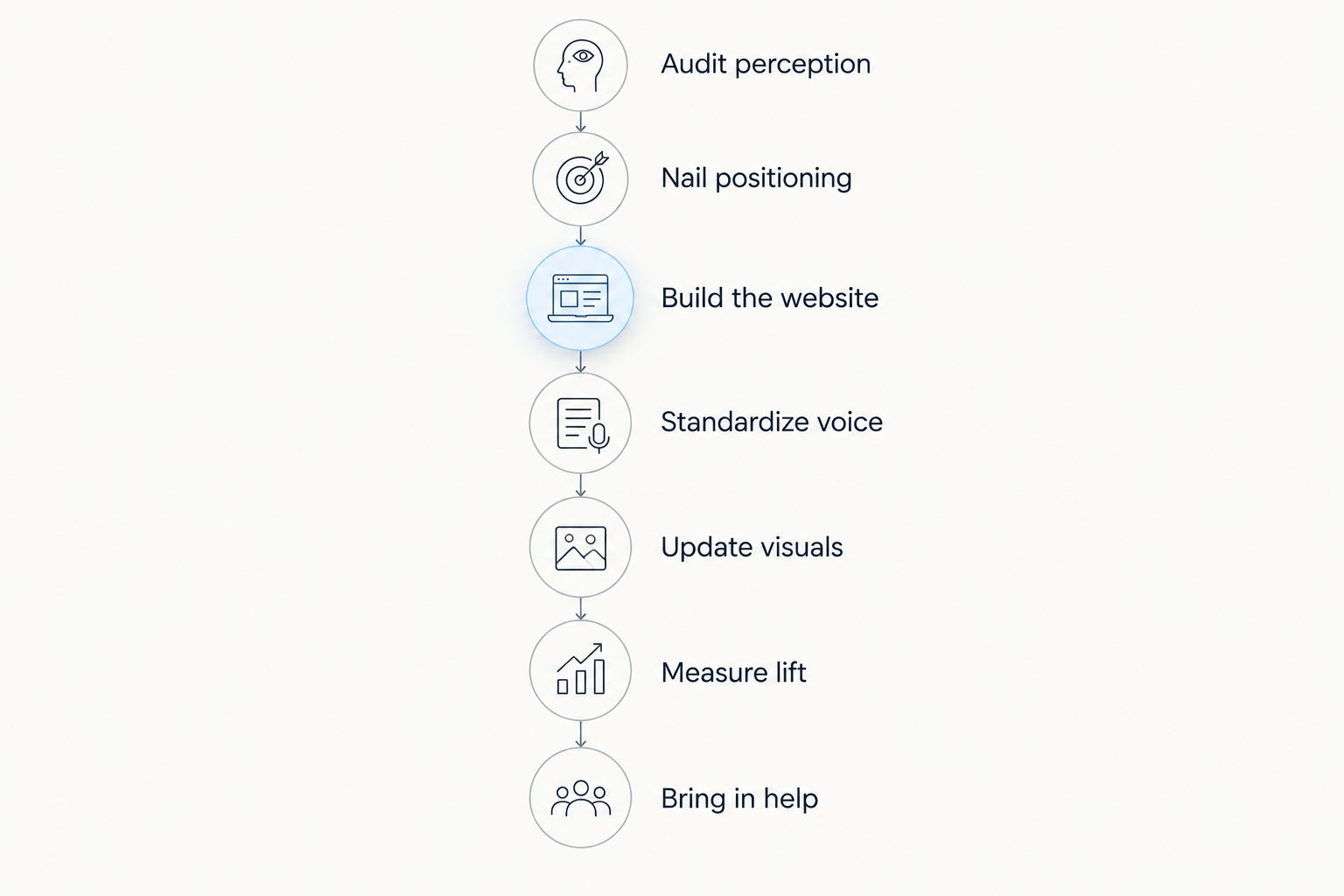
Measure brand lift with metrics partners actually trust
Partners don't care about impressions. They care about pipeline.
- Tag revenue to brand-driven leads separately from pure referral revenue
- Track referral source diversity — new sources beyond your usual top three
- Compare average deal cycle length before and after the rebrand
- Measure the share of proposals won without a competitive RFP
- Watch LinkedIn engagement specifically from your target account list
Expect the numbers to move slowly. A realistic view of how long it takes to see growth marketing results will save you from killing a rebrand at month three that needed month nine to pay off.
Bring in outside help once internal bandwidth caps out
Most firms hit a wall around the website and measurement stages — not enough hours, not enough specialized skill in-house. That's the point to bring in a growth partner, not before positioning is drafted internally.
Prospekt's work with SwamiG rebuilt a Magento 2 site with ERP sync and SEO, delivering 310% organic traffic growth and 4x ROAS. Its work with Window Guard combined paid social, a website and catalog redesign, and local SEO to produce 426 new leads and a 10x revenue increase in five months. Neither result came from a logo refresh — both came from positioning, site, and demand work moving together.
Which branding option fits your firm
| Option | Best for | Key limitation |
|---|---|---|
| DIY internal rebrand | Solo practitioners or 2-3 partner firms with a marketer on staff | Partners rarely agree on tone without an outside referee |
| Freelance brand designer | A visual refresh only — new logo, templates | No strategy or website integration, so positioning gaps stay uncovered |
| Boutique branding agency | Firms that need positioning and identity but not a full site rebuild | Handoff to a separate web team often breaks consistency |
| Full-service growth agency | Firms that want positioning, website, and demand generation under one plan | Requires more upfront coordination than a single freelancer |
Buy the full-service route if positioning, website, and lead generation all need to move together. Hold on a freelance designer if positioning is already locked and you only need new visuals. Skip a DIY rebrand for a multi-office firm — partner disagreement will stall it before launch.
Ready to reposition your firm?
See how Prospekt pairs brand strategy with the website and demand work that makes it stick.
Common mistakes professional services firms make
- Redesigning the logo before fixing positioning — a new mark on the same vague message just delays the real problem.
- Rebranding every time a new managing partner arrives, resetting brand equity before it has time to compound.
- Copying big-firm language like "trusted advisor" or "full-service" that no client-facing person can actually differentiate on a call.
- Burying practice-area depth on the website, which hurts both prospect research and organic search visibility for the terms clients actually type.
- Letting each office or partner run an independent LinkedIn voice, fragmenting recognition across the referral network that drives most of the pipeline.
FAQ
What’s the best branding approach for professional services firms in 2027?
Lead with positioning, then rebuild the website around it, then update visual identity last. Firms that reverse this order — logo first, positioning never — end up redoing the work within 18 months.
Is a full rebrand worth it for a small law firm or consulting shop?
Only if the audit shows real confusion about what the firm does or who it serves. A small firm with clear positioning needs a website and voice update, not a full identity overhaul.
How much does branding for professional services firms cost?
Cost depends on scope — a positioning and voice refresh runs far less than a full rebrand with a new website and identity system. Get a scoped quote based on which stages your firm actually needs.
Is branding different for professional services than for product companies?
Yes. Professional services buyers verify a firm through referrals and research before they ever visit the site, so the brand’s job is credibility confirmation, not cold demand generation.
How long does a professional services rebrand take to show results?
Measurable pipeline impact usually shows up over several months, not weeks, since deal cycles in this sector often run 3 to 12 months on their own.
Should every partner or office have the same brand voice?
Yes. A one-page voice guide with do/don’t examples keeps LinkedIn posts, proposals, and outbound emails consistent across every partner and location.
Do professional services firms need a branding agency or a growth agency?
A branding agency handles positioning and identity; a full-service growth agency like Prospekt pairs that with the website and demand work needed to convert on it.
What’s the biggest branding mistake professional services firms make?
Redesigning the logo before fixing positioning. The visual refresh looks like progress but leaves the real problem — vague, undifferentiated messaging — untouched.
One last thing
The detail most professional services firms skip: syndicating the same case study data across partner bios, proposals, and the website, instead of leaving it stranded on one homepage section. A referral source who Googles a firm should see the same proof point in three places within thirty seconds — that repetition, not a new logo, is what actually closes the verification gap in 2027.
Related guides


