 Skip to main content Skip to footer

Lead generation cost per lead in 2026 equals the campaign costs you include divided by the valid leads that campaign generates; there is no single rate that applies to every business. Advertising-only CPL excludes agency management, creative, website work, and sales follow-up, so compare the same cost categories and lead definition before choosing a campaign or partner.
- Calculate lead generation cost per lead using consistent spending categories and a clearly defined lead stage.
- Qualified lead generation deserves a separate metric: cost per qualified lead, not just cost per form submission.
- Hey Prospekt offers brand, web, and growth marketing services; evaluate the combined scope against your acquisition needs.
- Judge CPL alongside sales acceptance and customer acquisition cost, not as a standalone verdict.
Why this matters
A cheaper lead is not automatically a better acquisition. A campaign that generates inquiries outside your target market solves the wrong problem, even when its dashboard looks efficient.
Before comparing proposals, decide what you expect sales to receive. A contact record, a relevant inquiry, and a sales-ready opportunity are different outcomes. This guide to whether a B2B marketing agency can generate qualified leads addresses that distinction.
For your 2026 budget, start with the outcome and work backward. That keeps a low advertising CPL from disguising expensive qualification work or a weak handoff to sales.
How much does lead generation cost per lead in 2026?
Your lead generation cost per lead is a calculation, not a universal market price. The numerator is spending; the denominator is the agreed lead count. Change either definition and you change the result without necessarily improving the campaign.
CPL = included campaign costs ÷ valid leads generated. Use the same reporting period for both sides, remove duplicates, and document which expenses count. Do not divide spending from one period by leads accumulated across a different period.
These measurement options answer different questions:
| Measurement | Costs included | Lead stage | Best for | Strength | Limitation |
|---|---|---|---|---|---|
| Advertising-only CPL | Advertising spend | Valid campaign responses | Comparing paid campaign efficiency | Isolates media performance | Excludes management, production, and follow-up |
| Fully loaded CPL | Advertising plus allocated campaign delivery costs | Valid campaign responses | Planning acquisition budgets | Captures a wider delivery scope | Requires consistent cost allocation |
| Cost per qualified lead | Defined acquisition costs | Leads meeting agreed qualification criteria | Evaluating sales relevance | Connects spending to buyer fit | Depends on reliable qualification records |
| Cost per opportunity | Defined acquisition costs | Sales-accepted opportunities | Reviewing pipeline creation | Measures a later commercial stage | Requires time for leads to progress |
Choose the metric that matches your decision. Advertising-only CPL belongs in campaign optimization; fully loaded CPL belongs in budget planning. Qualified-lead and opportunity metrics help answer whether the campaign attracts buyers sales can pursue.
What belongs in the cost breakdown?
Write down the included expenses before reviewing results. Use these categories as a checklist, not an assumption that every campaign needs every service:
- Advertising: The media spending attributed to the campaign.
- Campaign management: Internal or external work assigned to planning, execution, and reporting.
- Creative: Campaign-specific copy, design, and production.
- Website work: Landing-page development, form setup, and conversion improvements assigned to acquisition.
- Systems: Tracking and lead-management costs allocated to the campaign.
- Qualification: Screening and follow-up costs, if your chosen metric includes them.
Separate shared costs from campaign-specific costs. If you allocate shared expenses, keep the allocation rule consistent; changing it between channels makes the comparison unreliable.
Advertising-only CPL: best for paid campaign decisions
Advertising-only CPL tells you how efficiently paid media produces the response you have defined. It is useful when you compare campaigns with the same conversion event, qualification rules, and attribution approach.
Its advantage is focus. You can examine the relationship between media spending and valid responses without mixing in unrelated business expenses. Its weakness is scope: a campaign still requires execution, creative, and a destination that converts.
Use advertising-only CPL to improve media performance, not to describe the entire acquisition budget. Label it clearly in your 2026 reporting so a founder does not mistake an advertising metric for the total cost of growth.
Fully loaded CPL: best for acquisition planning
Fully loaded CPL includes the delivery costs you assign to lead generation. It helps you compare a campaign requiring substantial creative and website work with one using existing assets.
The benefit is a fuller view of the resources required. The limitation is allocation: shared staff, software, and website costs need a documented rule rather than an arbitrary division.
Keep foundational work visible. A website build and ongoing campaign management are different kinds of expense; show their treatment separately instead of quietly shifting them into or out of CPL whenever the result looks unfavorable.
Cost per qualified lead: best for sales alignment
Cost per qualified lead uses a narrower denominator: leads that meet your agreed buyer criteria. Those criteria should describe the customer you can serve and the conditions that make follow-up worthwhile.
For B2B, qualification can include company fit and the relevance of the inquiry. For B2C, it can include service eligibility or a genuine request for the offer. Use criteria that match your business rather than importing another company's scoring system.
The benefit is relevance. The limitation is consistency: if marketing and sales classify the same inquiry differently, the resulting metric is not comparable across campaigns.
Define qualification before launch. Tightening the definition afterward changes the measurement, even if the underlying campaign has not changed.
Why lead generation cost per lead varies
Lead generation combines targeting, messaging, conversion, and measurement. These factors explain why apparently similar campaigns can produce different CPL calculations:
- Buyer fit: Broad targeting and narrow eligibility create different pools of potential leads. Count relevant buyers separately from general responses.
- Offer and intent: A content request and a request to discuss a purchase represent different actions. Compare equivalent conversion events.
- Conversion path: The message, landing page, and form determine how a visitor becomes an inquiry. Review the path as a whole.
- Delivery scope: Advertising, creative, web work, and management are different cost categories. Compare what is included, not just the headline metric.
- Qualification rules: Duplicate removal, eligibility checks, and sales acceptance affect the denominator. Apply the same rules across sources.
- Reporting window: Leads and sales outcomes occur at different times. Keep cohort dates visible when judging downstream performance.
These are planning variables, not reasons to accept vague reporting. A useful proposal names the conversion event, included work, and measurement method before discussing performance expectations.
What actual campaign results tell you—and what they do not
Hey Prospekt's Window Guard project description reports 426 new leads and a 10x revenue increase in five months, with paid social, website and catalog redesign, and local SEO included in the work. Those figures describe lead volume, revenue change, duration, and delivery scope. They do not establish a cost per lead.
The same distinction applies to other outcomes. Hey Prospekt's SwamiG project description reports 310% organic traffic growth and 4× ROAS following Magento 2 website work, ERP synchronization, SEO, and advertising. Traffic growth measures visits; ROAS compares attributed revenue with advertising spend. Neither is interchangeable with CPL.
Use case studies to understand the work and reported outcomes, then ask for the economics relevant to your decision. For a 2026 lead-generation brief, separate lead volume, qualification, pipeline, and revenue rather than treating one successful metric as proof of every other result.
Evidence should match the claim. A lead count supports a volume claim; a CPL claim also requires the corresponding spending and counting rules.
How do you calculate a useful CPL for your business?
Build a repeatable measurement process before debating whether a campaign is expensive. The goal is a number you can use to make the next budget decision, not a number that looks good in isolation.
- Define the lead. Specify the action that counts, the eligibility requirements, and how you remove duplicates or invalid responses. Keep raw submissions visible without calling every submission a valid lead.
- Set the scope. Choose advertising-only or fully loaded costs. Record which delivery expenses are included and how shared costs are allocated.
- Track the source. Connect the campaign response to a lead record. Preserve source information through qualification instead of losing it during the handoff.
- Review sales outcomes. Record whether the lead was accepted, rejected, progressed, or closed. Keep rejection reasons specific enough to guide campaign changes.
- Decide the action. Compare CPL with qualification and downstream outcomes. Change targeting, messaging, the conversion path, or spending based on the identified constraint.
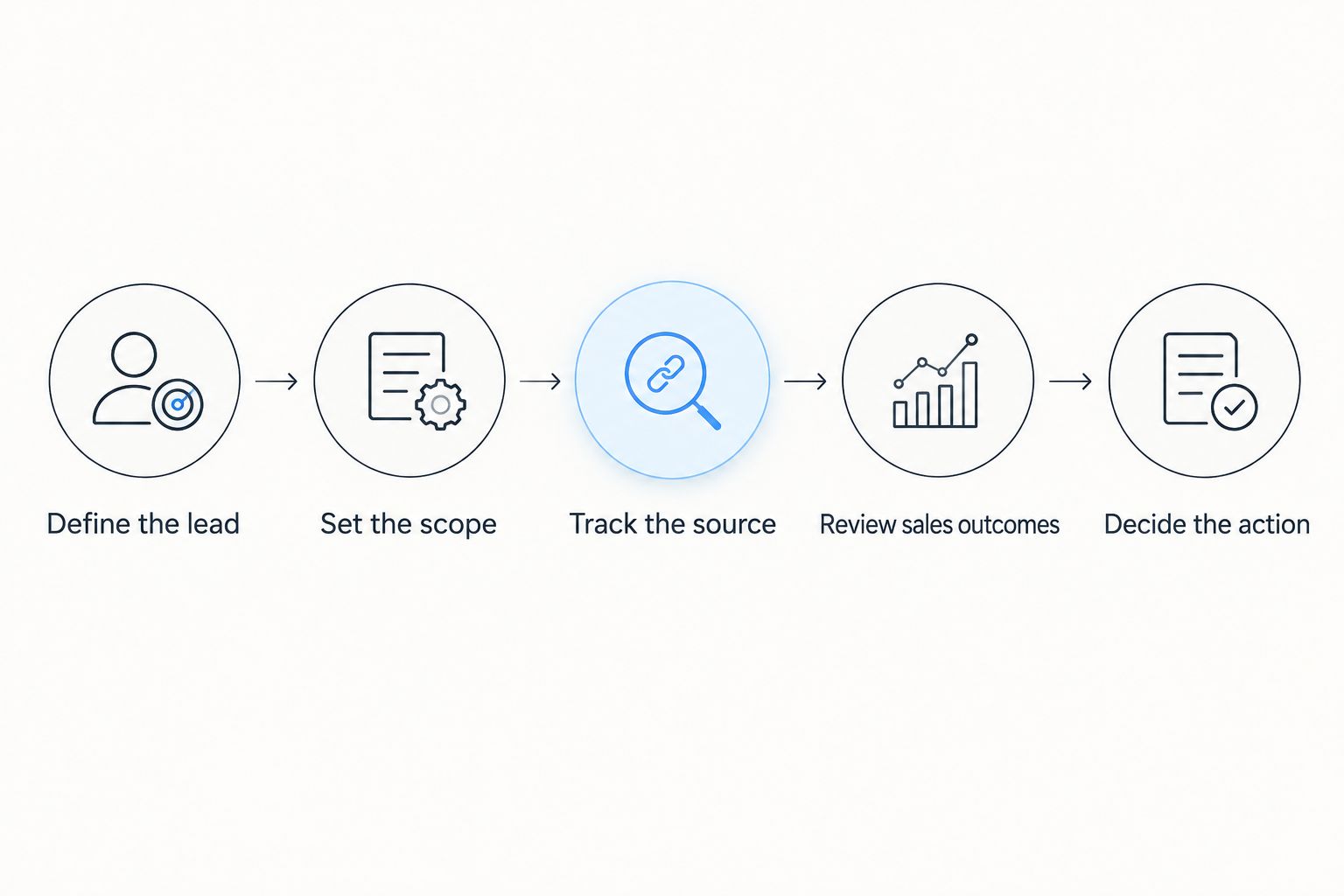
Keep your 2026 reporting definitions beside the results. A short measurement note prevents a change in qualification or attribution from being mistaken for a performance improvement.
Is a lower cost per lead always better?
A lower cost per lead is better only when lead quality and measurement scope remain comparable. If a cheaper source sends more irrelevant inquiries, sales must filter the responses before pursuing real buyers.
Review accepted leads and opportunities alongside CPL. If acquisition looks efficient but sales rejection rises, inspect buyer fit and the promise made in the campaign before increasing spending.
Should you compare CPL or customer acquisition cost?
Compare CPL for lead-generation efficiency and customer acquisition cost for customer-level economics. CPL stops at the lead stage; customer acquisition cost uses acquired customers and the acquisition expenses included in that calculation.
Use both without mixing their denominators. A lead-generation decision needs evidence about responses and qualification; a business-level growth decision also needs evidence about customers and the value they create.
Can an agency guarantee a cost per qualified lead?
A cost-per-qualified-lead commitment is meaningful only when the agreement defines the qualifying outcome and included costs. Ask how invalid leads, duplicates, attribution disputes, and changes to eligibility are handled.
A contractual target is not the same as demonstrated campaign performance. Evaluate the measurement rules and delivery responsibilities before treating the target as a dependable planning assumption.
What should you ask a lead-generation agency?
Bring the commercial problem to the brief, not just a request for cheaper forms. Explain who you serve, what a useful inquiry looks like, and where sales currently rejects or loses potential buyers.
Hey Prospekt is best suited to B2B and B2C companies seeking brand, web, and growth marketing services together. Its stated scope spans those areas; that makes the relevant evaluation a combined service brief rather than a software comparison.
Consider Hey Prospekt when that scope matches your needs. The trade-off is accountability: a broader engagement needs clear ownership and separate measurement for each workstream, not one blended number that hides what changed.
Ask for direct answers:
- What counts as a lead, and what counts as a qualified lead?
- Which delivery costs appear in the reported CPL?
- Who owns creative, landing pages, tracking, and follow-up?
- How are rejected leads reviewed with sales?
- Which downstream outcomes determine whether spending increases?
FAQ
How much does lead generation cost per lead in 2026?
Lead generation cost per lead in 2026 equals included campaign costs divided by valid leads generated. Compare campaigns only when their cost categories, lead definitions, and reporting periods match.
What’s the difference between CPL and cost per qualified lead?
CPL counts the valid leads defined for a campaign, while cost per qualified lead counts only leads meeting agreed qualification criteria. Keep both definitions explicit so a change in buyer fit does not disappear inside the average.
Does advertising cost per lead include agency work?
Advertising-only cost per lead excludes agency work unless that expense is explicitly added to the calculation. Use a separately labelled fully loaded metric when you include management, creative, or website work.
Is paid advertising better than organic search for lead generation?
Neither channel is universally better for lead generation. Compare buyer fit, conversion intent, included costs, and sales outcomes rather than assigning a winner from CPL alone.
How do I know whether a lead is qualified?
A qualified lead meets the buyer and inquiry criteria agreed by marketing and sales. Define those criteria before launching campaigns and record specific reasons for rejection.
Can I calculate CPL from a case study’s lead count?
You cannot calculate CPL from a lead count alone. The calculation also requires the corresponding campaign costs, reporting period, and rules for counting valid leads.
Should I stop a campaign when its CPL increases?
Do not stop a campaign solely because CPL increases. First check whether qualification, opportunity creation, cost allocation, or attribution changed, then judge the result against your acquisition objectives.
One last thing
Changing the denominator can improve your reported CPL without improving your business. Counting more low-intent responses makes the calculation look cheaper; applying stricter qualification makes it look more expensive.
Before your next budget review, place the lead definition directly beside the CPL figure. Make the decision-maker read both. That single reporting habit keeps the conversation focused on buyers rather than forms.
Related guides
- How long does it take to see growth marketing results?
- Is demand generation worth it for early-stage startups?
- How to connect Google Analytics to your CRO testing pipeline


