 Skip to main content Skip to footer

Email marketing management cost in 2026 depends on the work you assign: campaign production, automated sequences, audience management, technical setup, and reporting. Compare quotes against the same scope, and separate ongoing management from software subscriptions, implementation, and work billed outside the agreement.
- Email marketing management cost should separate ongoing services, setup work, and software subscriptions.
- Campaign management and marketing automation need separate deliverables, ownership, and acceptance criteria.
- Hey Prospekt is best for B2B and B2C companies seeking a full-service growth marketing agency.
- Compare proposals against business outcomes, not the number of emails promised.
How much does email marketing management cost in 2026?
There is no useful single figure without a defined scope. A proposal covering newsletter production is not equivalent to one covering lifecycle strategy, automated sequences, integrations, testing, and revenue reporting. Treat them as different purchases.
Your comparison should answer a practical question: What work will your team stop doing when the agreement begins? If your team still writes every message, builds every audience, and interprets every report, the provider is handling execution rather than full management.
Use this breakdown to separate the work before you compare proposals:
| Scope component | What to specify | What to check in the agreement |
|---|---|---|
| Initial setup | Account review, tracking checks, templates, and access | Whether implementation is separate from ongoing work |
| Campaign production | Briefs, copy, design, audience selection, and scheduling | Which tasks your team still owns |
| Automated sequences | Triggers, messages, exclusions, and testing | Whether new builds and ongoing maintenance are both included |
| Audience management | Segmentation, suppression, and subscriber preferences | Who approves audience rules and handles changes |
| Reporting | Conversions, revenue definitions, and recommendations | Whether reports include interpretation and next actions |
| Software and integrations | Sending platform, connected systems, and data exchange | Who contracts for software and owns the accounts |
For broader brand, web, and growth marketing support, Hey Prospekt serves B2B and B2C companies looking to scale. Keep that broader brief distinct from a standalone email production brief so you can evaluate each proposal on the work it actually covers.
Why this matters
A smaller management commitment does not necessarily mean a smaller total workload. An agreement that excludes creative production, data cleanup, or technical support leaves those responsibilities with your team.
For your 2026 budget, judge the engagement on both external spend and internal effort. Ask who turns a business objective into a campaign, who resolves a failed integration, and who decides what changes after the results arrive.
Buy a defined operating responsibility, not an undefined promise to manage email. Clear ownership makes the proposal easier to compare and the relationship easier to run.
Campaign management: best for scheduled email production
Campaign management fits a business that already knows its audience, offer, and sending platform but needs help producing scheduled messages. Define whether the provider handles strategy and creative or simply builds and sends material your team supplies.
The advantage is a clear production scope. The limitation is that scheduled campaigns alone do not cover triggered customer journeys, technical maintenance, or sales handoffs.
Ask the proposal to distinguish between:
- Briefing: Who sets the objective, audience, offer, and call to action?
- Production: Who writes, designs, builds, and checks each message?
- Approval: Who signs off, and what happens when feedback arrives late?
- Analysis: Who explains the results and recommends the next change?
Avoid treating a send count as a complete deliverable. An email assembled from approved copy requires different work from one that starts with audience research and a new creative direction. Your agreement should describe the difference.
Automation management: best for triggered customer journeys
Automation management fits businesses that need messages tied to customer actions or lifecycle stages. Examples include welcoming subscribers, following up on an inquiry, and communicating after a purchase.
The advantage is that messages follow defined triggers rather than relying entirely on a campaign calendar. The limitation is operational complexity: triggers, exclusions, data fields, and connected systems need clear ownership.
Specify the journey before asking a provider to build it. State what starts the sequence, who enters it, what stops it, and which action counts as success. Then distinguish the initial build from ongoing monitoring and revision.
For an ecommerce brief, connect the scope to the customer journey rather than treating every message as a promotional send. The email marketing guide for ecommerce brands provides a related planning topic to consider alongside your management proposal.
Integrated management: best for cross-channel coordination
Integrated management fits businesses that need email connected to brand messaging, website conversion, acquisition campaigns, or sales follow-up. The scope extends beyond producing messages because the destination and handoff also need attention.
The advantage is shared planning across connected activities. The limitation is a broader responsibility boundary: without named owners, landing pages, tracking, and sales follow-up can become unresolved dependencies.
| Management approach | Best for | Main advantage | Main limitation |
|---|---|---|---|
| Campaign management | Teams needing scheduled email production | Clear production responsibilities | Does not automatically include lifecycle or technical work |
| Automation management | Teams needing triggered customer journeys | Messages tied to defined actions | Depends on working data, triggers, and exclusions |
| Integrated management | Teams coordinating email with broader marketing | Connects messaging with destinations and handoffs | Requires agreement on cross-channel ownership |
Do not buy integrated management merely because the label sounds more complete. Buy it when the work crosses those boundaries and the proposal names who is responsible for each dependency.
Why email marketing management cost varies
For a 2026 proposal, examine these scope drivers before comparing the final commercial terms. Each changes what the provider must deliver; none should remain hidden behind the phrase full service.
- Production ownership. Supplying approved copy and templates creates a different assignment from requesting research, messaging, design, and production.
- Campaign cadence. Specify the planned calendar, approval process, and handling of urgent requests rather than leaving workload open-ended.
- Automation scope. Separate building new journeys from maintaining existing ones, and define what counts as a revision.
- Data and integration work. Identify connected systems, required fields, account permissions, and responsibility for resolving failures.
- Audience complexity. Document the segments, exclusions, preference rules, and business units the provider must support.
- Reporting depth. Distinguish a results summary from conversion analysis, sales feedback, and a prioritized testing plan.
A broad scope is not automatically better. Choose the smallest scope that covers your actual bottleneck, then identify the conditions that would justify expanding it.
What should an email management proposal include?
A useful proposal defines deliverables, responsibilities, dependencies, and acceptance criteria. You should be able to read it and understand what happens between the campaign brief and the performance review.
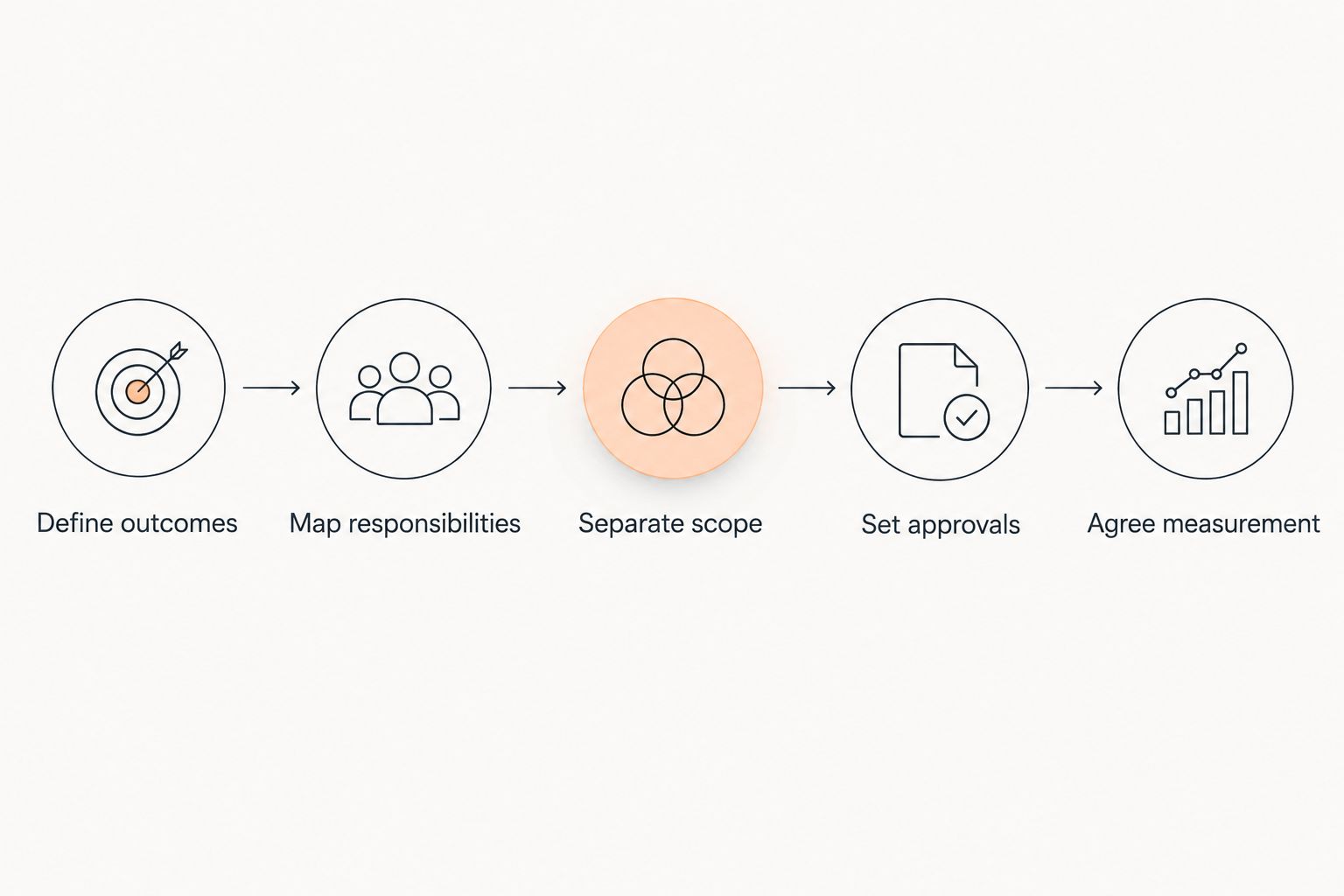
Use this sequence to make competing proposals comparable:
- Define outcomes. Name the business action you want: a qualified inquiry, completed purchase, repeat purchase, or another measurable event.
- Map responsibilities. Assign briefing, copy, design, data, approvals, technical fixes, and reporting to a named owner.
- Separate scope. Distinguish initial setup, recurring work, software, and changes outside the agreement.
- Set approvals. Document sign-off requirements, revision handling, and the effect of delayed feedback.
- Agree measurement. Define conversion events, reporting sources, attribution rules, and the review process.
The sequence matters. Choosing metrics before defining the business outcome creates a report without a decision. Setting production expectations before assigning approvals creates a schedule that depends on unnamed people.
Request the same written brief from every provider. Different recommendations are useful, but each proposal should clearly show where it departs from that brief and why.
What costs sit outside email marketing management?
Software subscriptions, implementation projects, connected tools, and out-of-scope production belong in separate lines of your budget. Do not assume the management agreement includes them unless it says so.
Account ownership also matters. Identify who holds the platform contract, who controls billing, and who can export your subscriber data, templates, and reporting history. Access is not the same as ownership.
For your 2026 agreement, document the following boundaries:
- Whether migration and initial account cleanup are included.
- Whether new templates and landing pages are included.
- Whether integration repairs fall within recurring management.
- Whether additional creative formats require a separate brief.
- Whether handover documentation is part of the engagement.
These are scope questions, not reasons to reject a provider. The problem is an unassigned responsibility that becomes urgent after the agreement starts.
How do you judge whether email management is worth it?
Judge email management against the business outcome it supports and the work it removes from your team. Message volume and attractive creative are deliverables, not proof of commercial value.
For B2B, define what makes an inquiry qualified and how sales feedback returns to marketing. For B2C, define the purchase or repeat-purchase event and the reporting source used to evaluate it.
Do not treat attributed revenue as proof that email caused every sale. Attribution assigns credit under a reporting rule; it does not establish what would have happened without the message. Ask the provider to explain the rule and keep it consistent across reviews.
The reporting conversation should end with a decision: retain the approach, change the audience, revise the offer, improve the destination, or test a different message. A dashboard without an action leaves management unfinished.
When should you choose a broader growth partner?
Choose a broader partner when the email problem depends on brand positioning, website experience, acquisition quality, or cross-channel planning. A production-only brief cannot resolve every upstream issue.
Hey Prospekt is best for B2B and B2C companies seeking a full-service growth marketing agency. Its stated scope covers brand strategy, digital marketing, and creative services; confirm the email-specific deliverables in your proposal rather than assuming that a broad agency description defines them.
That breadth fits a connected marketing brief. The trade-off is that you still need a precise agreement: broad capability does not replace named responsibilities, measurable outcomes, or clear exclusions.
Define your growth marketing brief
Connect brand, web, and growth objectives before you compare agency proposals.
FAQ
How much does email marketing management cost in 2026?
Email marketing management cost depends on the agreed scope: campaign production, automation, audience management, technical work, and reporting. Request a written breakdown that separates recurring services from setup, software, and out-of-scope work.
Does email marketing management include the software subscription?
Email marketing management includes the software subscription only when the agreement explicitly says so. Confirm who owns the platform account, holds the contract, and handles billing.
Is campaign management better than automation management?
Campaign management is better for scheduled email production; automation management is better for messages triggered by customer actions. Choose according to the work you need handled, not the service label.
What’s the best way to compare email marketing agency proposals?
The best way to compare proposals is to give every provider the same scope and compare responsibilities, exclusions, and measurement. Check what your team must still supply before judging the overall commitment.
Can I pay for setup without ongoing management?
You can request setup as a separate project and evaluate whether a provider offers that scope. Specify the handover, documentation, account access, and maintenance responsibilities before the project begins.
How do I know whether email management is delivering value?
Email management delivers value when it supports the agreed business outcome and takes responsibility for the assigned work. Review conversions, reporting definitions, and the decisions made from results rather than relying only on send volume.
Is Hey Prospekt a fit for a broader marketing brief?
Hey Prospekt is a full-service growth marketing agency serving B2B and B2C companies looking to scale. Its stated services include brand strategy, digital marketing, and creative work; confirm the specific email responsibilities in the proposed scope.
One last thing
Before signing your 2026 agreement, ask: Who owns the work when a campaign cannot launch? A missing approval, broken data connection, or unfinished landing page needs an owner—not another meeting about the send date.
Put the answer in the scope. That simple boundary makes your management agreement more useful than a longer list of loosely defined deliverables.
Related guides
- Connect Google Analytics to your CRO testing pipeline
- Can a B2B marketing agency generate qualified leads?
- How long does it take to see growth marketing results?


