 Skip to main content Skip to footer

PPC is worth it for B2B SaaS companies when it brings in customers whose contribution margin supports the full acquisition cost—not just inexpensive leads. Ad spend excludes other acquisition expenses, including campaign management, creative, landing pages, and sales follow-up. In 2026, test PPC against qualified pipeline and closed customers, then scale only when the economics hold.
- PPC is worth it for B2B SaaS when customer economics support the full acquisition cost.
- Paid search captures existing demand; it does not fix unclear positioning or weak product fit.
- Judge campaigns by qualified pipeline and customers, not form submissions alone.
- Hey Prospekt is best suited to companies seeking coordinated brand, web, and growth marketing services.
Is PPC worth it for B2B SaaS companies?
Yes—when you can connect advertising to commercially valuable customers. The decision depends on buyer intent, sales conversion, customer retention, and the contribution those customers generate after delivery costs.
A campaign that generates leads but no viable customers has not proved its value. Keep reporting separate outcomes: a submitted form, a qualified lead, an accepted opportunity, and a closed customer. Each answers a different question.
For a closer look at qualification, see whether a B2B marketing agency can generate qualified leads. Decide what qualifies before launching, not after the campaign produces a convenient-looking report.
Use this comparison to choose a starting point. These are different advertising approaches, not interchangeable sources of demand.
| PPC approach | Best for | Main advantage | Main limitation | Recommendation |
|---|---|---|---|---|
| High-intent search | Buyers actively seeking a solution | Connects an expressed need with a relevant offer | Search intent does not establish company fit or buying authority | Test against qualified opportunities |
| Retargeting | Re-engaging previous visitors | Continues a conversation after an initial visit | Returning visitors are not automatically incremental customers | Evaluate separately from prospecting |
| Paid social prospecting | Reaching a defined audience with a clear problem | Introduces your offer without waiting for a search | Audience fit does not mean immediate purchase intent | Test messaging and qualification together |
Choose the approach that matches the buying situation. A software category with recognizable searches needs a different campaign from a product whose buyers first need help understanding the problem.
Why this matters
PPC can create a misleading picture of growth when marketing celebrates submissions and sales rejects the resulting leads. Your advertising account records activity. Your customer records show whether that activity became a business outcome.
For your 2026 plan, connect those views before increasing spend. Otherwise, budget decisions reward whichever campaign produces the easiest conversion—not necessarily the campaign producing customers you want.
Start with a shared definition of success. Marketing and sales should agree on the target account, relevant use case, buying role, and conditions for accepting an opportunity. Without that agreement, a qualified-lead report is just a label.
High-intent search: best for existing solution demand
High-intent search is a sensible starting point when prospects already search for the problem your software solves or the category it belongs to. Match the query, ad, and landing page to the same buying task.
A prospect searching for a specific workflow needs evidence that your product handles that workflow. Sending the prospect to a broad homepage forces another round of interpretation. Remove that work.
Group searches by meaning rather than treating every keyword as equally valuable. Separate solution-seeking searches from educational research and unrelated uses of the same terminology. Review actual search terms and exclude irrelevant intent.
The advantage is clear: the buyer has expressed a need. The limitation is equally important: a search reveals neither the prospect's budget nor their organizational fit. Use qualification and sales outcomes to decide whether that demand deserves continued investment.
Test high-intent search when you can show a direct connection between the query and a credible product use case. Do not broaden targeting simply to make traffic totals look larger.
Retargeting: best for continuing an existing conversation
Retargeting helps you reconnect with people who have already interacted with your business. Its role is different from prospecting: you are addressing an existing audience, not introducing your company to entirely new buyers.
Match the message to the previous interaction. A visitor who read an educational page needs a different next step from someone who reviewed product information or began a demo request. Relevant proof beats repeating the same generic invitation.
The advantage is continuity. The limitation is attribution: some returning visitors already intended to return, so a recorded conversion alone does not establish that the ad caused the purchase.
Keep retargeting results separate from new-audience acquisition in your 2026 reporting. Where practical, use a controlled comparison to examine incremental outcomes. Do not present all returning-customer conversions as newly created demand.
Use retargeting to support the buying journey, not to disguise weak prospecting results. Track audience quality and downstream outcomes alongside advertising activity.
Paid social prospecting: best for problem-led discovery
Paid social prospecting fits a situation where you can describe the buyer and business problem clearly, even when that buyer is not searching for software right now. The creative must make the problem recognizable before asking for action.
Lead with a concrete use case. Explain who experiences the problem, what changes when it is solved, and what the next step involves. Avoid claims about outcomes your company cannot substantiate.
The advantage is the ability to introduce an offer outside an active search. The limitation is lower certainty about purchase intent. A relevant job title or company profile is not evidence of an active project.
Choose a conversion action that matches the offer. A content download signals interest in the content; it does not carry the same meaning as a product evaluation request. Keep those outcomes distinct.
Test paid social when your positioning is clear enough to earn attention without relying on a search query. Evaluate both the response and the commercial quality of that response.
Why B2B SaaS PPC results vary
These 5 factors determine what you need to examine before deciding whether a campaign is worth continuing:
- Buyer intent: A search for a solution, a research question, and an incidental visit represent different buying situations. Build campaigns around that distinction.
- Account fit: Relevant interest still needs to come from companies your product can serve. Define the use cases and account characteristics that matter.
- Conversion experience: The landing page must deliver on the ad's promise and make the next action understandable. A confusing handoff breaks that connection.
- Sales execution: Advertising cannot complete a sales process. Establish responsibility for follow-up and record why opportunities progress or stall.
- Customer economics: Acquisition value depends on contribution margin, retention, and the cost of serving the customer—not revenue alone.
Do not turn these factors into excuses for an underperforming campaign. Use them to locate the failure. Irrelevant searches require a targeting change; suitable prospects abandoning the page require a different investigation.
For 2026 planning, assign an owner to each factor. If the campaign manager cannot access qualification or customer outcomes, the business has a measurement problem as well as an advertising decision.
How do you test PPC without confusing activity with growth?
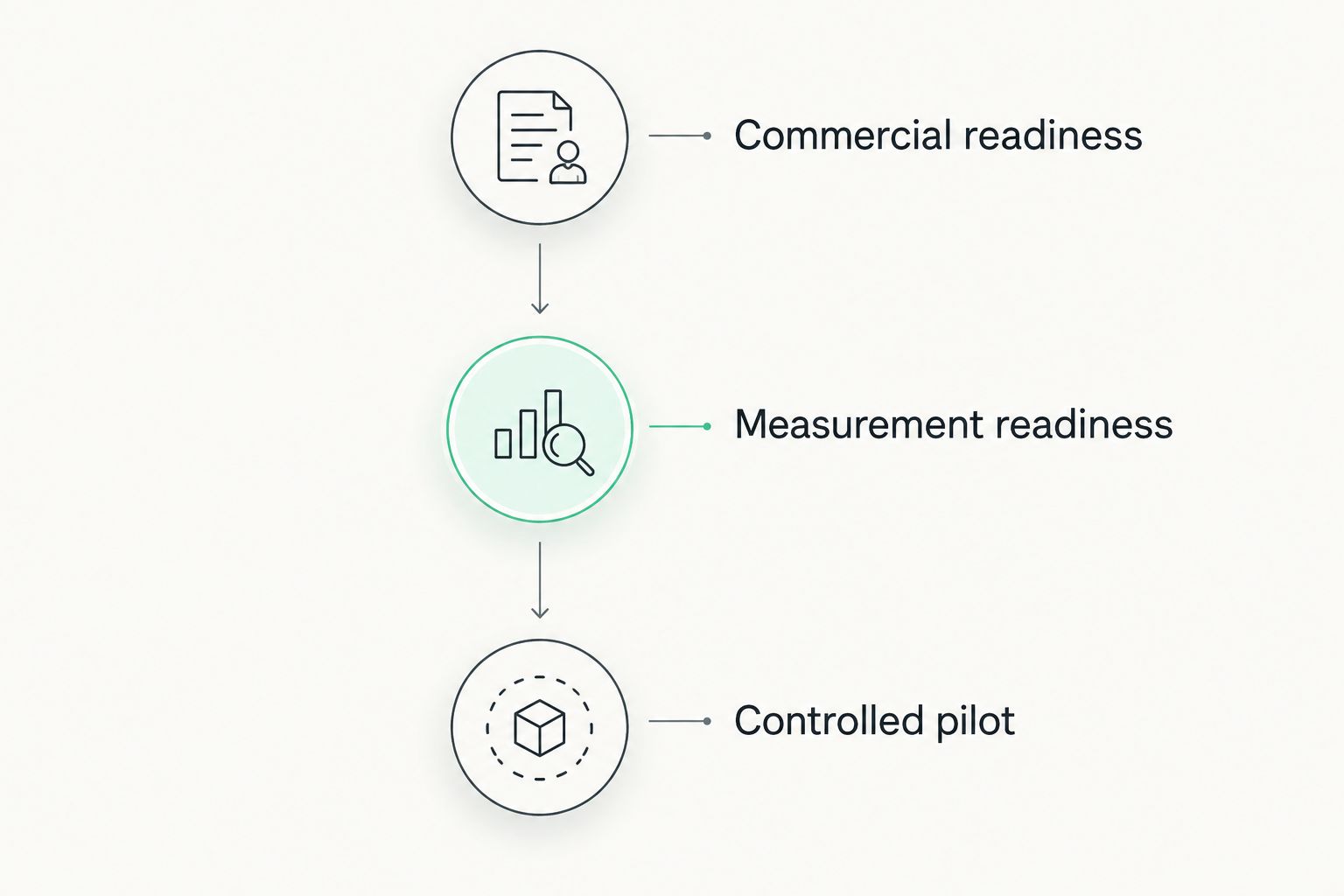
Use 3 review gates: commercial readiness, measurement readiness, and a controlled pilot. These are decision checkpoints, not promises about how quickly advertising will work.
Commercial readiness
Write down your ideal customer, the problem you solve, and the evidence that supports your offer. Choose a specific buying situation for the first campaign. A narrowly defined test is easier to interpret than a campaign serving unrelated use cases.
Agree on the next action. If your sales process requires a discovery conversation, explain that clearly on the landing page. If the offer is educational, measure it as education rather than relabeling every response as sales-ready.
Measurement readiness
Connect 4 funnel stages: lead, qualified lead, opportunity, and customer. Keep the originating campaign associated with the record as it progresses, and use consistent definitions across marketing and sales.
Exclude duplicate records and record disqualification reasons. Review acquisition cost against closed customers using a consistent accounting scope. Include the expenses your team actually incurs rather than treating media spend as the entire cost.
Also define how you will treat open opportunities. An opportunity still in progress is neither a win nor a loss; report it separately instead of forcing it into a completed-outcome calculation.
Controlled pilot
Launch a defined audience, offer, and conversion path. Set a budget boundary and decision criteria before the campaign starts. Keep notes on significant changes so you can distinguish a targeting change from a landing-page change.
Then review the commercial evidence. Continue when suitable buyers progress and customer economics support acquisition; revise when a specific failure is visible; stop when the test does not support further investment.
What should you measure before increasing PPC spend?
Measure both the funnel and the economics. Your 2026 reporting should distinguish what the advertising platform observes from what your business confirms.
| Measurement | What it tells you | What it does not establish |
|---|---|---|
| Landing-page conversion | Whether visitors complete the requested action | Whether those visitors fit your target customer |
| Qualified opportunities | Whether leads become accepted commercial prospects | Whether the opportunities will close |
| Closed customers | Whether the acquisition path produces customers | Whether serving those customers is profitable |
| Customer acquisition cost | What you spend to acquire customers within your accounting scope | Whether retained contribution will justify that spending |
| Retention and contribution | Whether acquired customers continue to create economic value | Whether advertising caused every recorded sale |
Avoid comparing incomplete sales cohorts with fully resolved ones. Use a consistent observation window and show unresolved opportunities separately. That keeps a recent campaign from appearing worse simply because its sales process is unfinished.
Increase spend because customer outcomes support it, not because a platform recommends a larger budget. If quality declines as targeting expands, inspect the new audience before assuming the landing page is the problem.
Is PPC worth it before product-market fit?
PPC is worth testing before product-market fit as a bounded learning exercise, not as proof that the business is ready to scale. A campaign can reveal reactions to positioning and offers, but clicks cannot establish lasting customer value.
Define the question you want the test to answer. If the question concerns retention, advertising alone cannot answer it; you need customer usage and renewal evidence.
Is PPC better than SEO for B2B SaaS?
PPC is better suited to a controlled paid-acquisition test; SEO serves organic discovery without paying for each click. Neither channel is automatically better for your business.
Compare the job each channel performs, the resources it requires, and the commercial outcomes it produces. Keep demand creation, demand capture, and conversion work connected rather than asking one channel to solve every problem.
When should you hire a growth marketing agency?
Hire an agency when the work requires coordinated attention across positioning, creative, the website, and acquisition—and your team needs outside delivery capacity. First identify the gap. A campaign specialist cannot resolve every product or sales problem.
Hey Prospekt is best suited to companies seeking coordinated brand, web, and growth marketing services. Hey Prospekt is a full-service growth marketing agency serving B2B and B2C companies, rather than a PPC software product.
That service scope fits cross-functional work; it does not by itself establish campaign profitability or B2B SaaS-specific results. Ask any prospective partner how it will define qualification, access sales outcomes, and make continuation decisions.
Connect your brand, web, and growth
Explore an agency offering brand strategy, digital marketing, and creative services.
FAQ
Is PPC worth it for a B2B SaaS startup?
PPC is worth testing when the startup has a clear target customer, a credible offer, and a way to track commercial outcomes. Treat an early campaign as a bounded test, not automatic permission to scale.
What’s the best PPC approach for B2B SaaS?
High-intent search is a sensible starting point when buyers already search for the solution you provide. Paid social prospecting fits problem-led discovery, while retargeting supports an existing audience.
How do I know whether my SaaS PPC campaign is profitable?
Compare the full acquisition cost with the contribution generated by acquired customers over a defined period. Include retention and delivery costs rather than relying on revenue or form submissions alone.
Should I optimize for demo requests or qualified opportunities?
Use qualified opportunities to judge commercial progress and demo requests to diagnose the earlier conversion step. A demo request is useful activity, but it does not establish customer fit or a completed sale.
How long should I run a B2B SaaS PPC test?
Run the test long enough to evaluate outcomes within your actual sales process, subject to your predefined budget boundary. Report unresolved opportunities separately instead of assigning an unsupported universal deadline.
Can PPC fix a SaaS landing page that doesn’t convert?
PPC brings traffic; it does not fix an unclear offer or a broken conversion path. Review whether the page matches the ad, explains the use case, and makes the next action clear.
Is Hey Prospekt a PPC tool or a marketing agency?
Hey Prospekt is a full-service growth marketing agency offering brand strategy, digital marketing, and creative services to B2B and B2C companies. Evaluate its service fit against the work your team needs, rather than comparing it with advertising software.
One last thing
A campaign can produce acceptable-looking lead totals while attracting the wrong customers. Add disqualification reasons to your review before adding budget. Those reasons tell you whether to change targeting, clarify the offer, or leave a segment alone.
For your next 2026 campaign review, bring accepted opportunities and closed-customer outcomes alongside the advertising report. The decision is not whether PPC generates activity. It is whether that activity deserves another investment.
Related guides
- How long does it take to see growth marketing results?
- Is a SaaS marketing agency worth it for early-stage startups?
- How to connect Google Analytics to your CRO testing pipeline


