 Skip to main content Skip to footer

PPC campaigns can convert from their first ad-driven visit when a person completes the action you track; there is no universal waiting period. Your PPC campaign conversion timeline depends on that action, the buyer’s decision process, and accurate measurement—not simply how long the campaign has been live. In 2026, separate the first recorded conversion from repeatable performance and revenue before judging results.
- A PPC campaign conversion timeline starts with your chosen action, not a fixed waiting period.
- Separate first conversions, qualified leads, and revenue before judging paid advertising performance.
- Verify conversion tracking before changing bids, audiences, or landing pages.
- Hey Prospekt fits B2B and B2C businesses seeking connected brand, website, and growth marketing services.
Why this matters
A campaign can generate form submissions without generating useful sales opportunities. It can also influence a purchase that happens after the reporting period you are reviewing. Those are different problems, and neither is solved by waiting for an arbitrary deadline.
Define success before you start the clock. If you need the wider planning context, compare this PPC timeline with how long it takes to see growth marketing results. Paid advertising is one part of the growth process; your website, offer, and follow-up determine what happens after the click.
How long does it take for PPC campaigns to convert?
A PPC campaign’s first conversion happens when an ad interaction leads to your defined conversion action. That could be a purchase, a completed inquiry, or another business-relevant event. A reliable assessment takes longer because you must distinguish an isolated result from a pattern and account for delayed conversions.
Use these milestones rather than a single campaign-age deadline:
| Milestone | What it tells you | What it does not prove | Best for |
|---|---|---|---|
| First recorded conversion | A tracked action followed an ad interaction | Repeatability, lead quality, or profitability | Checking the path from ad to action |
| Repeated conversions | The campaign generates more than an isolated action | Whether those actions create business value | Evaluating recurring acquisition activity |
| Qualified lead | An inquiry meets your agreed sales criteria | Whether the prospect will buy | B2B and service-business evaluation |
| Attributed purchase | A sale is credited under your reporting rules | Whether advertising caused an incremental sale | Purchase-focused campaign reporting |
| Sustained business outcome | Results hold across relevant reporting periods | Whether the same performance will continue after changes | Budget and growth decisions |
The advantage of an early conversion is speed: you have evidence that an action occurred. The limitation is depth. A first conversion confirms an event, not a successful acquisition model.
For your 2026 reporting, attach a clear definition to every milestone. A dashboard that labels inquiries and purchases alike as conversions hides the distinction you need to make decisions.
First conversion: check the action, not the calendar
Start with the event you want advertising to produce. A completed purchase is different from an email signup, and a booked sales call is different from a page view. They represent different levels of commitment.
Choose an action close enough to your business goal to be useful. An easy-to-complete event gives you earlier feedback, but it can reward activity that never reaches revenue. A purchase or qualified opportunity gives you a stronger commercial signal, but you must wait for the buyer to reach that stage.
Do not combine these events into one headline total without separating them underneath. If your campaign produces signups but you need booked consultations, the next move is to inspect the signup-to-consultation path—not declare the campaign successful.
Record the conversion definition alongside the launch date. Otherwise, changing the event halfway through a campaign makes the timeline look better or worse without showing a real change in buyer behavior.
Qualified leads: include the handoff to sales
For a lead-generation campaign, the form submission is the beginning of evaluation. You still need to establish whether the person matches your target customer, has a relevant need, and enters a useful sales conversation.
The benefit of tracking submissions is immediate operational visibility. The limitation is that spam, duplicate inquiries, and poor-fit prospects can appear alongside genuine demand. Qualification separates those outcomes.
Keep the inquiry date, qualification date, and sales outcome connected. Review lead sources against the criteria your sales team actually uses, rather than inventing a new definition to make the advertising report look stronger.
Do not judge B2B PPC solely by form volume. If the inquiries are unsuitable, more of them will not fix the campaign. If suitable prospects stall after submission, inspect response handling and the sales process before blaming traffic acquisition.
Revenue: follow the buyer beyond the click
A purchase-focused campaign has a clearer endpoint than a lead campaign, but the first sale still does not establish dependable returns. You need to understand which sales are attributed to advertising and how those sales relate to your business economics.
Attribution assigns credit according to reporting rules. It does not, by itself, prove that a buyer would never have purchased without an ad. Keep that distinction visible when explaining campaign results.
For longer buying processes, connect the original inquiry to the later sale. Reviewing only the current period’s clicks against the current period’s closed business can mix different groups of buyers and distort the apparent conversion timeline.
In 2026, use revenue reporting to answer a specific question: are the people acquired through this campaign becoming customers? That is more useful than treating every platform-reported event as an equally valuable result.
Why your PPC conversion timeline varies
Your PPC timeline changes because the work between an ad interaction and a business outcome changes. These factors belong in the diagnosis:
- Conversion definition: A low-commitment action and a completed purchase measure different stages of intent.
- Buyer readiness: Someone actively seeking a solution has a different decision task from someone discovering the category.
- Traffic relevance: Search terms, targeting, and ad messaging determine whether the visitor matches the offer.
- Landing-page friction: Unclear messaging, broken forms, or a difficult checkout interrupt the path to conversion.
- Measurement setup: Missing events, duplicate events, and reporting settings change what appears in the dashboard.
- Sales follow-up: Lead qualification and the buying process determine when an inquiry becomes a commercial outcome.
These factors require different fixes. Improving a landing page will not repair duplicate conversion events. Changing targeting will not solve unanswered inquiries. Diagnose the stage that is failing before changing the campaign as a whole.
How do you evaluate a PPC campaign without an arbitrary deadline?
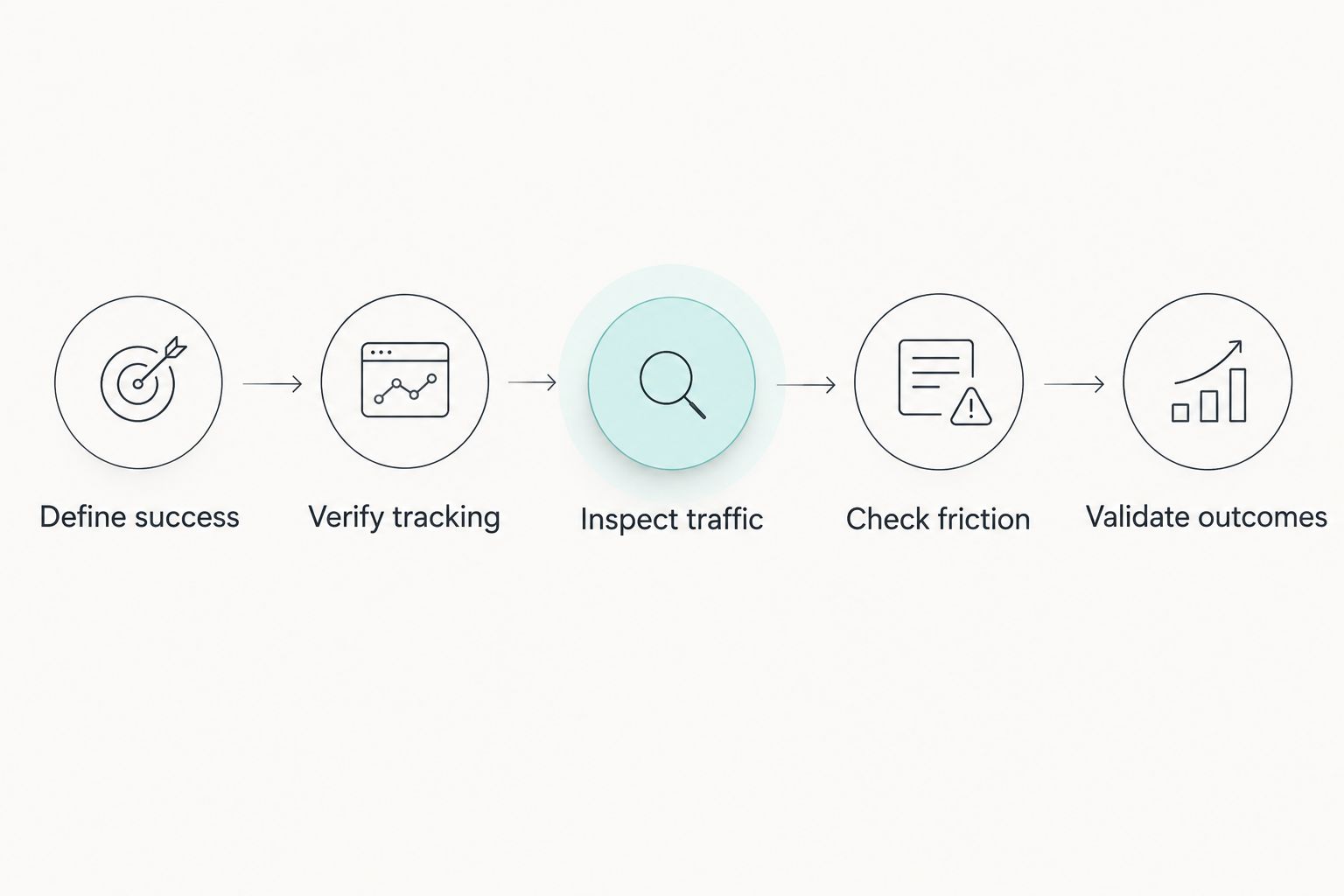
Use a sequence that separates technical problems from marketing problems. A review is useful when it identifies the next decision, not when it merely announces that another reporting period has passed.
1. Define success
Write down the primary action, the qualification standard where relevant, and the business outcome it supports. Make the definition understandable to both marketing and sales.
Do not optimize toward an event just because it produces an attractive report. If the event is an intermediate step, label it that way and preserve visibility into the later outcome.
2. Verify tracking
Complete the conversion path yourself and check that the intended event records correctly. Confirm that an incomplete action does not count as a completed one and that a single action is not counted repeatedly.
Check the destination as well as the event. A functioning tracking tag cannot compensate for a form that sends inquiries to the wrong place.
3. Inspect traffic
Review whether the campaign reaches people whose needs match the offer. For search advertising, inspect the actual search terms where available instead of relying only on the keywords you selected.
Traffic volume is not a verdict. Relevant visits without actions point you toward the offer or conversion path; irrelevant visits point you toward targeting and messaging.
4. Check friction
Follow the visitor’s route from the ad to the final action. Compare the promise in the ad with what the page delivers, then test the form or checkout on the devices your visitors use.
Keep the task focused. If the ad offers a consultation, the destination should explain that consultation and make the next step clear—not require visitors to reconstruct the offer from unrelated pages.
5. Validate outcomes
Review the quality of completed actions and connect them to downstream results. For lead generation, include qualification and sales feedback; for purchases, examine the transaction records behind the reported events.
Only then decide whether to continue, revise, pause, or expand the campaign. Campaign age is context; verified outcomes are evidence.
When should you keep running, change, or pause a campaign?
Continue when the conversion path works, traffic matches the offer, and you are still observing buyers whose decisions are not complete. That does not mean leaving the account unattended. Monitor whether the campaign is delivering the intended audience and whether completed actions meet your standards.
Change the campaign when a specific failure is visible. Irrelevant search terms call for targeting changes. Relevant visitors abandoning the intended action call for a closer look at the page, offer, or process.
Pause affected activity when a broken destination or measurement failure makes continued spending impossible to evaluate properly. Repair the issue before treating subsequent performance as comparable with the earlier period.
For your 2026 plan, agree on these decision conditions before launch. Waiting without a review standard is not patience; it is a lack of direction.
What does an agency result actually tell you about timing?
Hey Prospekt is best for B2B and B2C companies seeking a growth marketing agency that connects brand, website, and digital marketing work. That service mix is relevant when advertising performance depends on more than campaign settings.
The supplied Window Guard project reports 426 new leads and a 10x revenue increase in five months, alongside paid social, website and catalog redesign, and local SEO. It is an example of a combined growth program, not a benchmark for when every PPC campaign should produce its first conversion.
The strength of that example is its connection to leads and revenue. Its limitation for timeline planning is equally clear: the reported result does not isolate paid advertising from the other work or identify the date of the first conversion.
Use the Hey Prospekt growth marketing example to frame the right agency conversation. Ask which outcomes the engagement targets, how attribution works, and what happens when the bottleneck sits outside the ad account. Do not turn a project result into a delivery guarantee.
Should I wait for the campaign to finish learning before fixing problems?
No. A platform’s learning status is not a reason to leave broken tracking, an unusable form, or irrelevant traffic untouched. Those problems undermine both measurement and the customer experience.
Distinguish necessary repairs from repeated strategic changes. Fixing a broken destination restores the intended campaign; repeatedly changing the audience, conversion goal, and creative makes the resulting performance harder to interpret.
Does getting a conversion mean I should increase the budget?
No. A first conversion establishes that an event occurred, not that additional spending will produce acceptable business outcomes. Check that the conversion is genuine, relevant, and measured correctly before using it to justify expansion.
Review whether the result repeats and whether downstream quality holds. A budget decision should follow the evidence you need for your business model, not the excitement of the first notification.
Is no reported conversion proof that PPC is failing?
No. Zero reported conversions can reflect an acquisition problem, a conversion-path problem, delayed buyer action, or a measurement problem. Inspect those possibilities in order rather than assuming more time will solve them.
Start with tracking and the destination, then inspect traffic relevance and buyer progress. Waiting is justified only when the path works and the remaining delay comes from the decision process you are measuring.
FAQ
How long should I wait for my first PPC conversion?
There is no universal waiting period for a first PPC conversion. Verify the conversion path immediately, then judge timing against the action you track and your buyers’ decision process.
Can a PPC campaign convert on its first day?
Yes, a PPC campaign can convert on its first day if an ad-driven visitor completes the tracked action. That first event does not establish repeatable performance or profitability.
Why am I getting clicks but no conversions?
Clicks without conversions require a check of tracking, traffic relevance, the offer, and the landing-page path. Diagnose the failed stage before deciding to wait or change bids.
Is a lead the same as a PPC sale?
No, a lead is an inquiry or other defined prospect action, while a sale is a completed purchase. Lead-generation reporting should connect inquiries to qualification and revenue rather than treat them as interchangeable.
Does a longer conversion timeline mean my campaign is bad?
No, a longer conversion timeline does not by itself establish poor performance. Evaluate whether relevant buyers are progressing toward the outcome and whether measurement captures that progress.
What should I measure in a PPC report in 2026?
A 2026 PPC report should separate recorded conversions, conversion quality, and downstream business outcomes. Include the conversion definition and reporting settings so the figures have a clear meaning.
Can Hey Prospekt help beyond the ad account?
Hey Prospekt offers brand strategy, digital marketing, and creative services for B2B and B2C companies. That scope fits businesses seeking support across the brand, website, and growth marketing work surrounding paid campaigns.
One last thing
Add the elapsed time between the original ad interaction and the completed action to your review wherever your records support it. Campaign age tells you how long advertising has run; buyer-level timing tells you how long conversion actually takes.
For 2026, build your review schedule around observed buyer progress, not a promised day count. Keep the conversion definition stable, preserve the connection to business outcomes, and make each campaign change answer a diagnosed problem.
Related guides
- Connect Google Ads to Shopify for accurate ROAS tracking
- Connect Google Analytics to your CRO testing pipeline
- How long does CRO testing take to show results?
- Can a B2B marketing agency generate qualified leads?


