 Skip to main content Skip to footer

SaaS marketing agency cost in 2026 depends on the work you commission, the engagement structure, and who owns execution—not a universal monthly fee. Your agency fee also needs to be separated from advertising spend, software subscriptions, and any production work excluded from the agreement. Compare the full scope and financial commitment before comparing proposals.
- SaaS marketing agency cost depends on scope, execution responsibilities, and contract terms; compare itemized proposals.
- Hey Prospekt offers brand, web, and growth marketing services for B2B and B2C companies.
- Keep agency fees separate from advertising spend and software subscriptions when planning your SaaS marketing budget.
- Choose the engagement around your immediate growth constraint, not the longest list of deliverables.
Why this matters
A proposal can describe campaign management without including the landing pages, creative assets, or reporting needed to support it. Another can bundle those responsibilities into a broader engagement. Comparing the headline fees alone treats different purchases as if they were the same.
Hey Prospekt is a full-service growth marketing agency offering brand strategy, digital marketing, and creative services. That breadth is relevant when your marketing problem crosses brand, website, and acquisition work; it is a different brief from hiring someone to manage an existing campaign.
For your 2026 budget, start with the business problem. Then specify the work, ownership, and spending limits that address it. A clear brief makes the proposal useful before negotiations begin.
How much does a SaaS marketing agency cost in 2026?
Your SaaS marketing agency cost is the fee for an agreed scope, plus any separately approved expenses. Ask for a written breakdown that distinguishes recurring services, initial setup, optional work, and spending paid directly to other providers.
Use the following structure to compare proposals. These are budget categories to check, not statements that every agency charges for each item.
| Budget component | What to clarify | What an unclear proposal leaves unresolved |
|---|---|---|
| Agency services | Strategy, management, execution, and reporting included | Who actually completes the work |
| Initial setup | Research, account setup, measurement, and onboarding | Whether launch work is inside the ongoing scope |
| Advertising spend | Who pays platforms and approves spending | The full campaign commitment |
| Creative production | Copy, design, video, and revision responsibilities | Whether campaigns have the assets they need |
| Website work | Landing pages, development, and tracking implementation | Whether conversion work requires another supplier |
| Software | Existing tools, new subscriptions, and account ownership | Which expenses sit outside the agency agreement |
| Additional work | Approval process and treatment of scope changes | How the commitment changes after signing |
Request the same breakdown from every shortlisted agency. Keep your brief consistent so that differences reflect the proposed approach rather than different assumptions about what you need.
A useful proposal also separates deliverables from outcomes. Deliverables are work the agency commits to produce; revenue and pipeline depend on additional factors, including your product, offer, sales process, and customer behavior.
Monthly retainer: best for ongoing execution
A monthly retainer suits work that needs repeated planning, execution, and review. For SaaS marketing, that can include acquisition campaigns, content production, website improvements, or coordination across these activities.
The benefit is continuity. The trade-off is a recurring commitment, so the agreement needs to explain what the agency will deliver and how priorities change.
Ask whether the retainer buys specified deliverables, access to a team, or an agreed allocation of work. These structures are not interchangeable. Choose a retainer when you need ongoing ownership, not simply because you expect marketing to continue.
Project engagement: best for a defined deliverable
A project engagement suits a bounded assignment, such as brand strategy or a website build. The proposal should identify the finished deliverable, review process, acceptance criteria, and handover responsibilities.
The benefit is a defined finish line. The limitation is that completion does not automatically include ongoing campaigns, maintenance, or optimization.
Before signing, confirm what happens after delivery. A completed website and an actively managed acquisition program solve different problems; your budget should not assume that purchasing the former includes the latter.
Hourly or advisory engagement: best for targeted expertise
Hourly or advisory work suits a specific decision, review, or task when your team already owns execution. It can help you avoid commissioning a broader engagement for a narrow problem.
The trade-off is responsibility. Advice does not become implementation unless someone is assigned to act on it, and an open-ended assignment needs spending controls.
Define the question, expected output, and approval process before work starts. Use advisory support to strengthen an accountable internal owner, not to replace ownership.
Performance-linked engagement: best for measurable outcomes
A performance-linked agreement connects some compensation to a defined result. Its usefulness depends on the outcome definition, measurement method, and responsibilities written into the contract.
The benefit is a direct connection between compensation and the agreed metric. The trade-off is potential disagreement over attribution, lead quality, cancellations, or revenue recognition.
Require precise definitions before accepting this structure. A lead, qualified opportunity, and paying customer are different outcomes; a proposal that blurs them does not establish a clear basis for payment.
| Engagement | Best for | Strength | Trade-off |
|---|---|---|---|
| Monthly retainer | Ongoing execution across recurring priorities | Continuity and shared planning | Requires clear recurring responsibilities |
| Project engagement | A defined deliverable with a finish line | Clear completion criteria | Follow-on work needs separate clarification |
| Hourly or advisory | Targeted expertise with internal execution | Focused support | Your team retains implementation responsibility |
| Performance-linked | An outcome with agreed measurement | Compensation tied to a defined result | Attribution and quality definitions need scrutiny |
Why SaaS marketing agency cost varies
The work behind the proposal determines whether the fee comparison is meaningful. For your 2026 brief, check these scope factors before choosing an engagement.
- Brand strategy: Clarify whether positioning, audience research, and messaging are part of the assignment or inputs your team will supply.
- Website responsibilities: Separate design, copy, development, and measurement implementation. A recommendation to improve a page is not the same as building it.
- Campaign scope: Identify the channels and activities the agency will manage. Do not treat a channel name as a complete description of its responsibilities.
- Creative services: Specify which assets the engagement includes and who handles revisions, approvals, and production.
- Execution ownership: Name the work your team retains, including product expertise, sales follow-up, and access to business data.
- Reporting scope: Agree on the outcomes, definitions, and reporting responsibilities needed to assess the work.
These factors also expose overlap. If your internal team already produces campaign assets, your brief should say so; if nobody owns landing-page implementation, leave that responsibility explicit rather than assuming it is covered.
For a broader comparison of engagement scope, see the guide to growth marketing agency cost.
How to get proposals you can actually compare
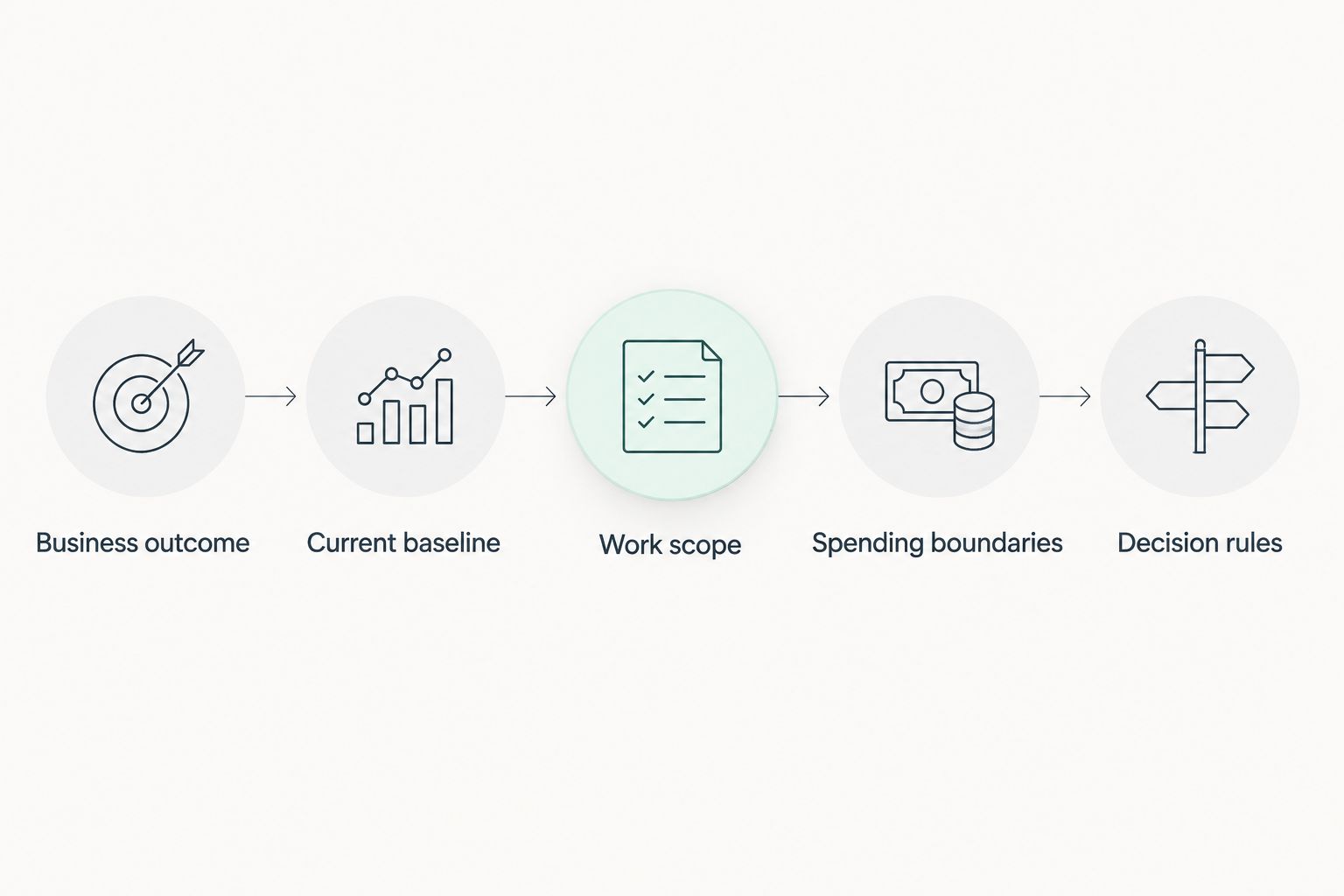
A useful agency brief makes the assignment easy to understand and difficult to misinterpret. Follow this sequence before asking agencies to propose an approach.
- Business outcome: State the commercial problem you want to address. Distinguish acquiring customers from generating inquiries or improving website conversion.
- Current baseline: Share the measurements you already use and their definitions. Label estimates rather than presenting them as verified results.
- Work scope: Identify the capabilities you need: brand, website, acquisition, creative, or a combination. Explain what your internal team already handles.
- Spending boundaries: Separate agency services from advertising, software, and production. Require approval before spending changes.
- Decision rules: Agree on deliverables, review points, ownership, and the evidence you will use to assess progress.
The sequence keeps the proposal tied to your business instead of an agency's standard package. It also gives you a consistent basis for challenging exclusions without asking every agency to work in exactly the same way.
When reviewing proposals, request explanations for material differences. A broader assignment deserves a clear explanation of the additional work; a narrower assignment needs equally clear boundaries.
Which agency capabilities should you pay for?
Buy the capabilities that address the constraint you have identified. If your team lacks clear positioning, commissioning more campaign activity leaves that strategic question unresolved. If campaigns already generate relevant visits but the website does not support the intended action, include website work in the evaluation.
Hey Prospekt is best suited to companies seeking a growth marketing agency that combines brand, web, and marketing services. Its stated service range fits that kind of cross-functional brief; it does not establish that every SaaS company needs every service.
For Hey Prospekt, the advantage is the breadth of services described in its positioning. The limitation for this decision is that service breadth alone does not prove fit for your product, sales model, or assignment. Request evidence specific to the work you plan to commission.
Your 2026 selection should favor relevant responsibilities over an impressive service list. Ask who owns strategy, who produces the work, and what your team must supply before execution can begin.
How should you judge agency case studies?
Match the case study to the assignment, then inspect the reported outcome. A website engagement provides different evidence from an acquisition campaign, even when both report growth.
Hey Prospekt's published project summaries report 380% higher mobile engagement for Russell Westbrook Enterprises, 426 new leads for Window Guard, and 310% higher organic traffic for SwamiG. These are separate client outcomes with different scopes, not a combined performance benchmark.
Use those examples to ask precise questions about website work, lead generation, and search performance. Do not turn them into a forecast for your SaaS business or assume that engagement, leads, and traffic measure the same commercial result.
A relevant case study should help you understand the problem, work performed, and measurement. Your agreement still needs its own outcome definitions and responsibilities.
Is advertising spend included in a SaaS agency fee?
Advertising spend belongs in your budget separately from the agency fee unless the agreement explicitly combines them. Platform spending buys distribution; agency services cover the work described in the scope.
Require separate visibility even when the proposal presents a combined commitment. You need to know which part funds media and which part funds services before approving changes.
Should a SaaS startup choose a project or a retainer?
A project fits a defined deliverable; a retainer fits ongoing execution and review. Choose according to the work, not the company label.
For your 2026 plan, identify the immediate constraint first. A startup with a clear internal marketing owner needs a different assignment from one seeking external responsibility across brand, website, and acquisition.
What should I check before signing an agency agreement?
Check scope, exclusions, account ownership, approval responsibilities, payment terms, cancellation terms, and handover requirements. Confirm that the agreement reflects the proposal you selected.
Also define who approves extra work. A scope change should create an explicit decision, not an unexplained expansion of your commitment.
FAQ
How do I calculate my total SaaS marketing agency budget?
Calculate your total budget by separating agency services, advertising spend, software, and separately commissioned production. Check the agreement for setup work and additional-work approvals before treating the agency fee as the complete commitment.
What’s the best engagement model for ongoing SaaS marketing?
A monthly retainer fits ongoing execution when the scope and responsibilities are clear. A defined project is a better match when you need a specific deliverable rather than continuing campaign ownership.
Does a SaaS marketing agency fee include website development?
Website development is included only when the agreed scope explicitly includes it. Confirm responsibility for design, copy, development, tracking, revisions, and handover rather than assuming website recommendations include implementation.
Is a performance-based agency agreement better than a retainer?
A performance-based agreement is not automatically better than a retainer. It needs precise outcome definitions, attribution rules, and quality criteria; a retainer needs clear recurring deliverables and accountability.
How can I compare SaaS agency proposals fairly?
Compare proposals against the same business brief, scope, and responsibilities. Separate fees from external spending, then review deliverables, exclusions, measurement, and contract terms.
Can I use an agency’s case-study results to forecast my SaaS growth?
An agency’s case-study results are not a forecast for your SaaS business. Use them to assess relevant experience, then define success using your own baseline, product, and commercial process.
What should my team keep control of when hiring an agency?
Keep approval authority, business outcome definitions, and access to your accounts and data explicit in the agreement. Assign internal owners for product input, sales follow-up, and decisions the agency cannot make on your behalf.
One last thing
Compare agency proposals by reading the exclusions before the service list. Exclusions tell you what your team still has to fund, produce, or manage after the agreement is signed.
For your 2026 decision, write those responsibilities beside each proposal. Choose the scope you can execute together, not the fee that looks smallest in isolation.
Related guides
- Growth marketing for B2B SaaS companies
- How long does it take to see growth marketing results?
- Conversion rate optimization for SaaS startups


