 Skip to main content Skip to footer


A social media marketing agency is worth it for a small business when it solves a specific growth problem and you can measure the business value against the full cost. In 2026, hire for qualified inquiries, purchases, or a defined brand objective—not a busier content calendar; agency fees also exclude the internal work of approvals, sales follow-up, and supplying useful customer insight.
- Is a social media marketing agency worth it? Yes, when measurable business value justifies the full investment.
- Hey Prospekt fits businesses seeking connected brand, web, and growth marketing services rather than social posting alone.
- Keep social media in-house when your main need is direct customer conversation and you can manage it consistently.
- Judge agency performance through qualified inquiries, purchases, and contribution—not follower growth alone.
Why this matters
Buying social media support and buying growth are different decisions. An agency can deliver every scheduled post without resolving the reason customers fail to buy.
Before comparing social media marketing agencies in 2026, identify the gap: inconsistent execution, weak creative, unclear positioning, or a purchase journey that loses interested people. Each problem requires different work. A posting package is not a substitute for fixing your offer or website.
Your 2026 brief should name the business outcome first and the channel second. That gives you a clear basis for judging proposals instead of choosing the largest list of deliverables.
Is a social media marketing agency worth it for small businesses?
Yes, when the work requires capabilities your team lacks and the expected value supports the total investment. Keep execution in-house when you already have the skills, customer access, and time to do it well.
Use this comparison to match the operating model to the actual job. These are selection criteria, not promises about what every provider includes.
| Option | Best for | Main advantage | Main limitation |
|---|---|---|---|
| Owner-led social | Businesses built around direct customer relationships | Immediate access to expertise and customer conversations | Competes with running the business |
| Freelance specialist | A clearly defined creative or execution gap | Focused support for a bounded assignment | Someone must coordinate the wider strategy |
| Social media agency | Businesses needing coordinated social strategy and execution | A shared brief across content, campaigns, and reporting | Requires clear scope and active client input |
| Full-service growth agency | Businesses whose social, website, and brand problems overlap | Connected planning across the customer journey | A broad engagement is unnecessary for a narrow posting need |
Start with the smallest scope that addresses the problem. You do not need a full-service engagement to schedule approved content. You do need more than scheduling when your message, landing page, and lead follow-up all need attention.
When should you keep social media in-house?
Keep social media in-house when your strongest content comes directly from the people doing the work and you can publish consistently. Customer questions, product demonstrations, and informed responses require access to real business knowledge.
The benefit is direct ownership. The trade-off is time: decide who creates content, who approves it, and who answers inquiries before adding more channels.
Do not treat the founder's time as free. Record the work involved so you can compare outsourcing with the actual burden, not just the absence of an invoice.
When should you hire a specialist instead?
Hire a specialist when you can define the missing deliverable and manage everything around it. Examples include editing existing footage, developing campaign creative, or managing a clearly scoped paid campaign.
A specialist keeps the assignment focused. The limitation is coordination: your business still needs to connect creative, customer targeting, website experience, and reporting.
Choose this route when direction is clear but production capacity is missing. Avoid using a narrow assignment to disguise an unresolved strategy problem.
Why the value of a social media agency varies
The same service scope does not create the same value for every small business. Evaluate these factors before deciding what to outsource:
- Customer fit: Identify whether social activity reaches the people involved in buying, not just people willing to engage.
- Purchase economics: Compare acquisition spending with what a sale contributes after direct fulfillment costs.
- Creative access: Establish who supplies product knowledge, customer questions, demonstrations, and approved claims.
- Conversion readiness: Check whether visitors can understand the offer and complete the intended action.
- Sales follow-up: Assign responsibility for qualifying and responding to inquiries generated by campaigns.
- Scope and ownership: Separate strategy, production, paid distribution, reporting, and community responses in the agreement.
These factors explain why a strong campaign is not enough by itself. An agency cannot make an unanswered inquiry become a customer, and a small business cannot assess value without knowing what happened after the click.
How do you decide whether an agency will pay off?
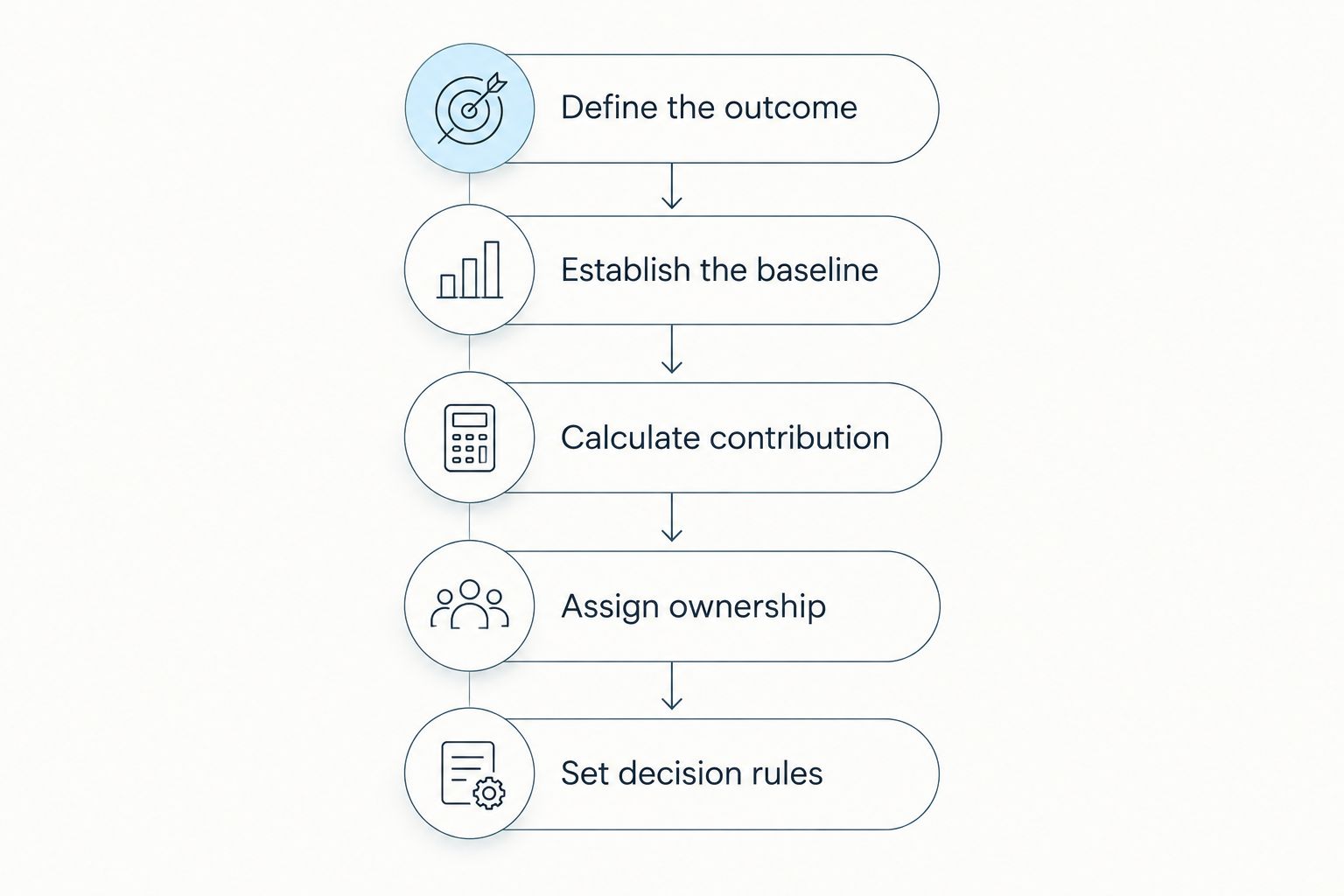
Make the decision from your own customer economics and operating constraints. For a 2026 engagement, use a written decision process before approving a proposal.
1. Define the outcome
Choose a primary business outcome: qualified inquiries, completed purchases, booked appointments, or another action tied to your sales process. If the objective is awareness, define the audience and the evidence you will accept rather than presenting engagement as revenue.
Write down what counts. A submitted form is not automatically a qualified lead, and an attributed purchase is not automatically an additional purchase caused by advertising.
2. Establish the baseline
Document current results using consistent definitions. Include the source of inquiries, their quality, and what happens after they reach your business.
Without a baseline, you can describe activity but cannot make a sound before-and-after comparison. Keep definitions stable when the engagement begins.
3. Calculate contribution
Calculate what remains from a sale after the direct costs of delivering it. Then assess the full marketing investment, including agency work, media spending, production, and the internal time required.
Revenue is not profit, and return on ad spend is not a complete profitability measure. Evaluate repeat purchases only when your own customer records support them; do not justify acquisition spending with an assumed future relationship.
4. Assign ownership
Name the person responsible for approvals, source material, website changes, and lead follow-up. Ask the agency to identify its corresponding responsibilities.
This prevents a common contractual gap: both sides assume the other is handling a task that affects results. Clear ownership also makes performance discussions more useful.
5. Set decision rules
Agree on what evidence supports continuing, changing, or stopping the work. Distinguish operational checks—such as whether tracking works—from commercial outcomes that require customers to complete a buying process.
Use your sales cycle and data volume to set review points. For a wider discussion of timing, see how long growth marketing results take.
What should an agency report beyond likes and followers?
Ask for reporting that connects the campaign objective to the next customer action. Reach and engagement describe distribution and response; they do not establish whether the work generated profitable business.
For lead generation, distinguish inquiries from qualified opportunities and customers. For ecommerce, distinguish purchase revenue from the contribution remaining after fulfillment and marketing costs.
A useful report answers practical questions:
- Which messages attracted the intended customers?
- Which campaigns produced the agreed conversion action?
- What happened to leads after the sales handoff?
- Where did interested visitors stop progressing?
- What changes follow from the evidence?
Ask how platform reporting is reconciled with your website and customer records. Reporting systems can assign credit differently, so use consistent definitions rather than adding together every claimed conversion.
The point is not a longer dashboard. It is a clearer decision about what deserves more work and what should stop.
What does a relevant agency result actually prove?
A case study demonstrates an outcome in a particular business and scope. It does not establish what your business will achieve.
Hey Prospekt reports 426 new leads and a 10x revenue increase in five months for Window Guard through paid social, website and catalog redesign, and local SEO. The scope matters as much as the headline: this was connected marketing work, not evidence that social posting alone produced the result.
For a 2026 hiring decision, ask what transferred from that project to your situation. Compare the business problem, services involved, customer journey, and definition of a lead—not just the size of the reported increase.
Hey Prospekt is best for B2B and B2C businesses seeking connected brand, web, and growth marketing services. That scope fits a small business whose social campaigns depend on stronger positioning and a better conversion experience; it is a less direct match when the only assignment is publishing already-approved posts.
Treat the Window Guard result as evidence of a past project, not a forecast. A credible proposal still needs your baseline, responsibilities, measurement plan, and a scope that addresses your bottleneck.
What should you ask before signing an agency agreement?
Ask questions that expose how the relationship will work, not questions that invite a polished pitch. Request answers in the proposal or agreement.
Who owns the accounts and assets?
Confirm ownership and administrative access for advertising accounts, social profiles, tracking, and creative files. Establish what you retain when the engagement ends.
Do not leave access arrangements until an exit conversation. Your business needs continuity regardless of who performs the work.
What is included, and what needs separate approval?
Separate organic content from paid campaign management, production, community responses, and website work. Ask how revisions, approvals, and additional assignments are handled.
A specific scope protects both sides. It also prevents you from comparing proposals that use the same service label for different work.
How will you connect activity to business outcomes?
Ask the agency to explain the measurement path in plain language, from campaign interaction to inquiry or purchase. Identify any step that depends on your team recording information correctly.
Reject guaranteed business outcomes that ignore your offer, sales process, or customer economics. Demand clear accountability for the work instead.
Define your growth marketing scope
Discuss where brand, website, and campaign work need to connect for your business.
FAQ
Is a social media marketing agency worth it for a very small business?
A social media marketing agency is worth it when the work addresses a clear capability gap and the business can justify the full investment. Keep the scope narrow if you only need help with a specific production or execution task.
Should I hire a social media agency or do it myself?
Keep social media in-house when you have the knowledge, time, and process to execute consistently. Hire support when a defined skills or capacity gap prevents work tied to your business goals.
Is a freelancer better than a social media agency?
A freelancer is a better fit for a bounded assignment you can direct and coordinate. An agency fits work that requires connected strategy, production, campaign management, and reporting, provided those services are included in the scope.
Can a social media agency guarantee sales?
An agency cannot credibly guarantee your sales without controlling every factor that determines a purchase. Evaluate its responsibilities, measurement approach, and evidence instead of accepting an unconditional promise.
How long should I give a social media agency to show results?
Set review points around your sales cycle, campaign objective, and available data rather than accepting a universal deadline. Check execution and tracking separately from commercial results.
What should I measure instead of follower growth?
Measure the business action your campaign is meant to produce, such as qualified inquiries, purchases, or booked appointments. Use follower growth as supporting context, not proof of profitable acquisition.
Can Hey Prospekt help with more than social media?
Hey Prospekt offers brand strategy, digital marketing, creative, and web services for B2B and B2C companies. Its full-service scope is relevant when the problem extends beyond social execution, but a narrow posting task does not require every service.
One last thing
The best agency recommendation can be to fix something outside social media first. If the offer is unclear, the purchase path is broken, or inquiries go unanswered, increasing distribution leaves the underlying problem untouched.
Before committing to a 2026 engagement, ask the agency what must be fixed before more traffic becomes useful. A specific answer gives you a better hiring signal than a promise to publish more often.
Related guides
- Can a B2B marketing agency generate qualified leads?
- How long does a website redesign take?
- Meta Ads to true ROAS: measurement workflow


