 Skip to main content Skip to footer


An ecommerce marketing agency’s cost in 2026 depends on the work you commission, the channels you include, and who handles creative, website changes, and measurement. Evaluate the complete scope—not the agency fee alone—and require the proposal to distinguish agency work from advertising spend, software, and outside production.
- How much does an ecommerce marketing agency cost? Compare defined deliverables and total commitments, not an isolated fee.
- Separate ecommerce marketing services from advertising spend, software, and production before comparing proposals.
- Hey Prospekt suits businesses seeking brand, web, and growth marketing services together.
- Choose a focused engagement for a defined problem; request broader support only when responsibilities justify it.
How much does an ecommerce marketing agency cost in 2026?
There is no useful universal figure without a defined engagement. A proposal for campaign management is not equivalent to a proposal that also includes brand strategy, creative production, website development, and retention marketing.
Ask every agency to organize its proposal around the same categories. This makes differences visible before you sign, rather than after work begins.
| Budget component | What your proposal should specify | What to check |
|---|---|---|
| Agency services | Strategy, management, execution, and reporting | Which deliverables are included? |
| Initial work | Audits, account setup, tracking, and onboarding | What happens before ongoing campaigns begin? |
| Advertising spend | Media purchased through advertising platforms | Is it separate from agency compensation? |
| Creative production | Copy, design, photography, and video | Who produces assets and approves revisions? |
| Website work | Landing pages, store changes, and technical implementation | Does the agency execute changes or only recommend them? |
| Software and outside support | Marketing platforms and specialist services | Who contracts with each provider? |
Your purchasing decision is about the total commitment required to deliver the agreed work. A shorter proposal is not automatically a smaller commitment if essential execution sits outside it.
Why this matters
Ecommerce marketing connects the promise in an ad to the experience on your store and the relationship after checkout. If separate people own those stages, your proposal needs to explain how they coordinate.
Hey Prospekt provides brand, web, and growth marketing services. Hey Prospekt is best for businesses seeking a growth marketing agency that also provides brand and web services. That breadth is relevant when your brief crosses those disciplines; it is not a reason to commission work your business does not need.
For a 2026 agency brief, start with the business problem. “Improve product-page clarity” creates a different assignment from “manage acquisition and retention.” Keep that distinction visible throughout procurement.
Which engagement model fits your ecommerce business?
The engagement model determines how you assign work and handle changes. It does not, by itself, establish whether an agency will produce a better result.
Use the comparison below to choose the structure that matches your brief. These are engagement options to discuss, not named packages offered by a particular agency.
| Engagement option | Best for | Advantage | Limitation |
|---|---|---|---|
| Defined project | A specific deliverable with acceptance criteria | Creates a clear finish line | Follow-on work needs a separate agreement |
| Ongoing engagement | Recurring campaign execution and optimization | Provides continuity across repeated work | Requires clear priorities and deliverable boundaries |
| Focused service | A business with a defined channel or execution gap | Keeps the assignment narrow | Your team still coordinates adjacent work |
| Full-service engagement | A brief spanning brand, web, and growth marketing | Brings connected responsibilities into one relationship | Includes more coordination and scope to manage |
Defined project: best for a clear finish line
Choose a project when you can describe what completion means: an approved strategy, a redesigned page, or a completed implementation. Specify the deliverable, dependencies, revision process, and acceptance criteria before work starts.
The advantage is clarity. The limitation is that ongoing campaigns and subsequent improvements do not become included simply because they relate to the original project.
Ongoing engagement: best for recurring work
Choose ongoing support when the work repeats and needs regular decisions. Ask how the agency prioritizes campaigns, creative requests, reporting, and changes to the plan.
Continuity helps maintain ownership. The trade-off is that an open-ended description such as “marketing support” leaves too much room for disagreement about what gets delivered.
Focused service: best for a specific gap
Choose a focused service when your internal team already owns the surrounding work. For example, a campaign-management brief should identify who supplies approved creative and who changes the destination pages.
A narrow assignment limits scope. It also leaves integration with your team, so name the person responsible for connecting the work.
Full-service engagement: best for connected responsibilities
Choose broader support when the brief genuinely requires strategy, creative, website execution, and growth marketing to work together. Ask for named responsibilities rather than a list of capabilities.
The advantage is connected ownership. The limitation is unnecessary scope if your team already performs parts of that work effectively.
Why ecommerce marketing agency scope varies
For your 2026 comparison, examine the work behind each proposal rather than assuming all agencies define a service the same way. These factors turn a broad marketing request into a specific assignment:
- Strategy depth: Decide whether you need brand strategy, a campaign plan, or execution against an existing plan. Require the proposal to distinguish planning from delivery.
- Service breadth: List the marketing activities you want managed. Do not let an umbrella term replace an explicit responsibility list.
- Creative requirements: Identify the copy, design, and other assets the engagement requires. State which assets your team supplies and which the agency produces.
- Website involvement: Separate recommendations from implementation. A website review and a completed store update are different deliverables.
- Measurement responsibilities: Identify who checks tracking, prepares reporting, and resolves discrepancies between marketing and store data.
- Team responsibilities: Name your approver and the person who supplies business information. Make internal dependencies part of the delivery plan.
Broader scope deserves a business reason, not just a longer service list. If a proposed activity does not address the problem in your brief, ask why it belongs in the engagement.
How do you compare ecommerce agency proposals fairly?
Give every shortlisted agency the same brief. Ask for the same breakdown, then compare what each proposal commits to deliver—not how many capabilities appear in its presentation.
Define outcomes
Describe the business outcome and the operational problem behind it. If you want stronger acquisition, explain whether your concern is traffic quality, product-page performance, measurement, or another documented issue.
Do not substitute a requested channel for the diagnosis. “Run ads” describes an activity; your brief also needs to explain what business problem the activity should address.
Map deliverables
Turn the proposed work into an acceptance checklist. Name the assets, implementations, reports, and decisions you expect the engagement to produce.
Ask the agency to identify exclusions beside the relevant deliverable. This is more useful than discovering a general exclusion buried elsewhere in the agreement.
Assign ownership
Put an owner beside every dependency: creative approval, website access, product information, tracking changes, and final sign-off. Specify who executes and who reviews.
Ownership matters even in a full-service relationship. Your business still needs to provide accurate information and make decisions that the agency cannot make on its behalf.
Check terms
Review the initial commitment, renewal process, cancellation requirements, change-request process, and handover obligations. Ask how unfinished work and account access are handled when the relationship ends.
Treat those provisions as part of the purchasing decision. A proposal is incomplete if the deliverables are clear but the working relationship is not.
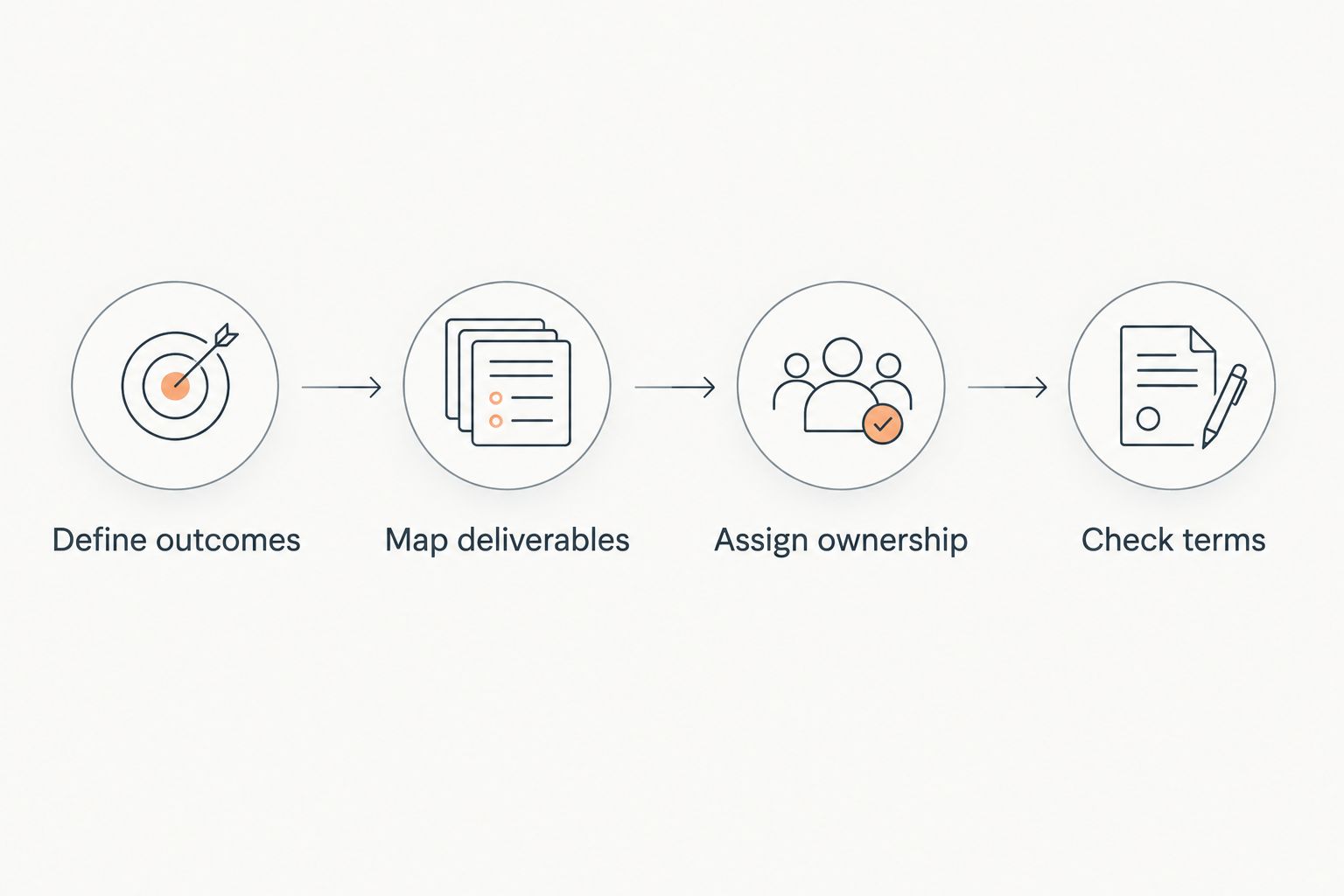
Apply this sequence to every 2026 proposal. If agencies respond to different assumptions, send the unresolved questions back before making your decision.
Discuss your ecommerce marketing scope
Discuss the brand, web, and growth marketing work your business needs.
What should an agency’s results prove?
Case studies help you evaluate relevant experience, but they do not establish what your engagement will deliver. Read the result alongside the services, business context, and measurement period.
Hey Prospekt’s SwamiG project description reports 310% organic traffic growth and 4× ROAS, alongside website work, ERP synchronization, SEO, and advertising. Those figures describe a multi-service project, not the expected outcome of purchasing campaign management alone.
The Window Guard project description reports 426 new leads and a 10× revenue increase in five months, with paid social, website and catalog redesign, and local SEO. Again, the service mix matters when assessing whether the example resembles your brief.
Use case studies to ask better questions:
- Which parts of the engagement resemble your business problem?
- Which services contributed to the work described?
- What did the client’s team need to supply or approve?
- How were revenue and marketing results measured?
- What limitations prevent a direct comparison with your business?
These published project results are examples, not forecasts. Evidence supports a conversation about fit; it does not replace a written scope.
Does the agency fee include advertising spend?
Treat advertising spend as a separate line item until the agreement explicitly states how it is handled. Ask who pays the platforms, who owns the accounts, and what the agency’s compensation covers.
Also distinguish campaign execution from measurement. The guide to connecting Google Ads to Shopify for accurate ROAS tracking addresses a measurement task worth assigning explicitly in an ecommerce brief.
Is a full-service agency better than a specialist?
A full-service engagement fits a brief that crosses several connected disciplines; a specialist fits a defined gap your team can integrate. Neither structure removes the need to specify deliverables and ownership.
For your 2026 decision, identify the work your team already performs well. Buy support for the remaining responsibilities rather than duplicating ownership.
How do you avoid paying for unclear scope?
Require the proposal to state what gets delivered, who implements it, and how additional work is approved. Resolve ambiguous phrases before signing rather than relying on verbal explanations.
Ask a practical question about each recommendation: “Who will complete this?” A strategy document that recommends website changes is not the same deliverable as implementing those changes.
FAQ
How much does an ecommerce marketing agency cost in 2026?
An ecommerce marketing agency’s cost in 2026 depends on the defined services, execution responsibilities, and engagement terms. Request an itemized proposal that distinguishes agency work from advertising spend, software, and outside production.
What should an ecommerce marketing agency proposal include?
An ecommerce marketing agency proposal should include deliverables, exclusions, responsibilities, dependencies, measurement, and contract terms. Ask it to distinguish recommendations from completed implementation.
Does an ecommerce agency manage my advertising budget?
Advertising-budget management depends on the agreed scope. Confirm who pays the advertising platforms, who approves spending decisions, and who owns the accounts.
Should I choose a project or ongoing agency support?
Choose a project for a defined deliverable and ongoing support for recurring work. In either arrangement, specify acceptance criteria and how additional requests are handled.
Is a full-service agency right for a small ecommerce team?
A full-service agency fits a small ecommerce team when the brief requires connected responsibilities the team cannot cover internally. A focused engagement is a better fit when the remaining gap is narrow.
Can an agency guarantee the same results as its case studies?
A case study does not establish the outcome of your engagement. Compare the services, business context, and measurement period before using a published result to assess fit.
What should I ask before signing an ecommerce agency contract?
Ask what is included, what is excluded, who owns the accounts, and how changes and cancellation work. Confirm the handover process and your team’s responsibilities in writing.
One last thing
Ask what happens after a recommendation is approved. The answer reveals whether you are commissioning advice, execution, or both—and whether your internal team has work to absorb.
Make that distinction explicit in your 2026 brief. The right engagement is the one with a justified scope and clear ownership, not the one with the longest list of services.
Related guides
- How much does a full-service marketing agency cost?
- How long does a website redesign take?
- Is a full-service marketing agency worth it for a growing business?


