 Skip to main content Skip to footer


A web design agency is worth it for a small business when the website needs to solve a defined sales, usability, or operational problem—not just look newer. The agency fee is only part of the commitment: your team still needs to supply business knowledge, approve content, and own the site after launch.
- Is a web design agency worth it for a small business? Yes, when the work addresses a measurable business problem.
- Choose DIY for a straightforward website you can maintain; choose an agency when strategy and implementation need coordinated ownership.
- Hey Prospekt combines brand, web, and growth marketing services for businesses seeking connected support.
- Judge a redesign by qualified inquiries, completed purchases, and usability—not appearance alone.
Why this matters
A small business website has a job: help the right visitor understand your offer and take the next step. A redesign earns its place when it makes that job easier.
For your 2026 decision, separate business requirements from visual preferences. Before committing, understand how long a website redesign takes and identify who will supply content, review work, and approve launch. A capable agency cannot make those decisions on your behalf without your input.
Is a web design agency worth it for a small business?
Yes, when the work requires expertise and coordination your business cannot reasonably provide internally. If your current website already explains the offer, supports customer tasks, and stays manageable, a targeted improvement is a stronger starting point than a complete rebuild.
Compare the delivery approach against the actual problem. None of these options is automatically the right choice because your business is small.
| Approach | Best for | Main advantage | Main limitation |
|---|---|---|---|
| DIY website | A straightforward site with an owner who can maintain it | Direct control over content and changes | You own design decisions, setup, testing, and troubleshooting |
| Freelance specialist | A clearly defined design or development task | Focused expertise for a bounded assignment | You must confirm who handles work outside that specialty |
| Web design agency | A project involving connected strategy, content, design, and development | Coordinated delivery when those responsibilities are included | Requires clear scope, stakeholder input, and project management |
Ask each provider to explain what they will change, why it matters, and how you will evaluate it. A proposal built around page layouts alone does not establish a business case.
When an agency is the right choice
Choose an agency when the problem crosses disciplines. For example, visitors might struggle because the positioning is unclear, the navigation reflects internal departments, and the inquiry form asks questions sales does not need.
Those issues require more than a new visual treatment. Your scope should connect messaging, page structure, design, implementation, and measurement—with a named owner for each responsibility.
Best for: businesses that need several connected website problems resolved under one project plan. The trade-off is that your team must make coordinated decisions rather than approve isolated design changes.
When a freelancer is the better fit
Choose a freelance specialist when the task is specific and the surrounding strategy is settled. Examples include implementing an approved page design, repairing a form, or adjusting an existing template.
Confirm dependencies before work starts. If the assignment also needs copywriting, search migration, or integration work, identify who owns those pieces rather than assuming they come with the engagement.
Best for: businesses with a bounded task and someone internally who can manage the remaining responsibilities. The limitation is coordination across work that falls outside the specialist's scope.
When DIY is enough
Choose DIY when the site is straightforward and someone on your team can confidently update and test it. You do not need an agency merely to establish that your business exists online.
The constraint is ownership. Your business remains responsible for content accuracy, mobile usability, account access, and whether customers can complete the intended task.
Best for: businesses with straightforward requirements and an available internal owner. Keep the scope simple enough that the website remains maintainable after the initial build.
Why the value of a web design agency varies
The value comes from the problem resolved and the responsibilities covered. Use these factors to compare proposals rather than treating every redesign as the same service:
- Business objective: Define whether the site must generate inquiries, support purchases, explain services, or help existing customers.
- Content responsibility: Specify who writes, edits, supplies images, and approves factual claims. Design approval does not equal content approval.
- Technical requirements: List required forms, systems, and data flows. Ask the provider to document what happens when a submission fails.
- Migration requirements: Identify existing pages and search landing pages that need protection when URLs or content change.
- Internal capacity: Name the person who can answer questions and resolve conflicting feedback. Unassigned decisions remain your responsibility.
- Post-launch ownership: Establish who controls accounts, publishes updates, maintains integrations, and handles defects after handover.
For a 2026 proposal, ask for these responsibilities in writing. A polished presentation is not a substitute for a clear division of work.
How do you decide whether the investment makes sense?
Build the decision around your own customer economics and operational constraints. Do not use another company's headline result as your forecast.
Define the outcome
Write a business problem that the project can actually address. “Customers cannot identify the right service before contacting us” gives the team a clearer assignment than “our site feels dated.”
Specify the action you want visitors to complete. For a service business, that might be a qualified inquiry; for a retailer, it might be a completed purchase. Keep secondary goals separate so the primary goal remains visible.
Record the baseline
Document current results before approving the redesign. Use your own inquiry records, purchase data, website analytics, and customer feedback rather than borrowed conversion benchmarks.
Check that the tracking reflects completed actions. A button click and a successfully submitted inquiry are different events; treating them as interchangeable weakens your evaluation.
Assign ownership
Name an internal decision-maker and list the approvals the project requires. Separate factual review, brand review, and final approval so the agency knows whose feedback resolves a disagreement.
Ask the provider to name its corresponding responsibilities. If nobody owns copy, redirects, form testing, or handover, add that responsibility to the scope before work begins.
Test the outcome
Agree on acceptance criteria before launch. A visitor should be able to understand the offer, find the relevant information, and complete the intended action on the devices you support.
Test the complete journey, including what happens after submission or purchase. A working front-end interaction does not establish that the right person or system received the information.
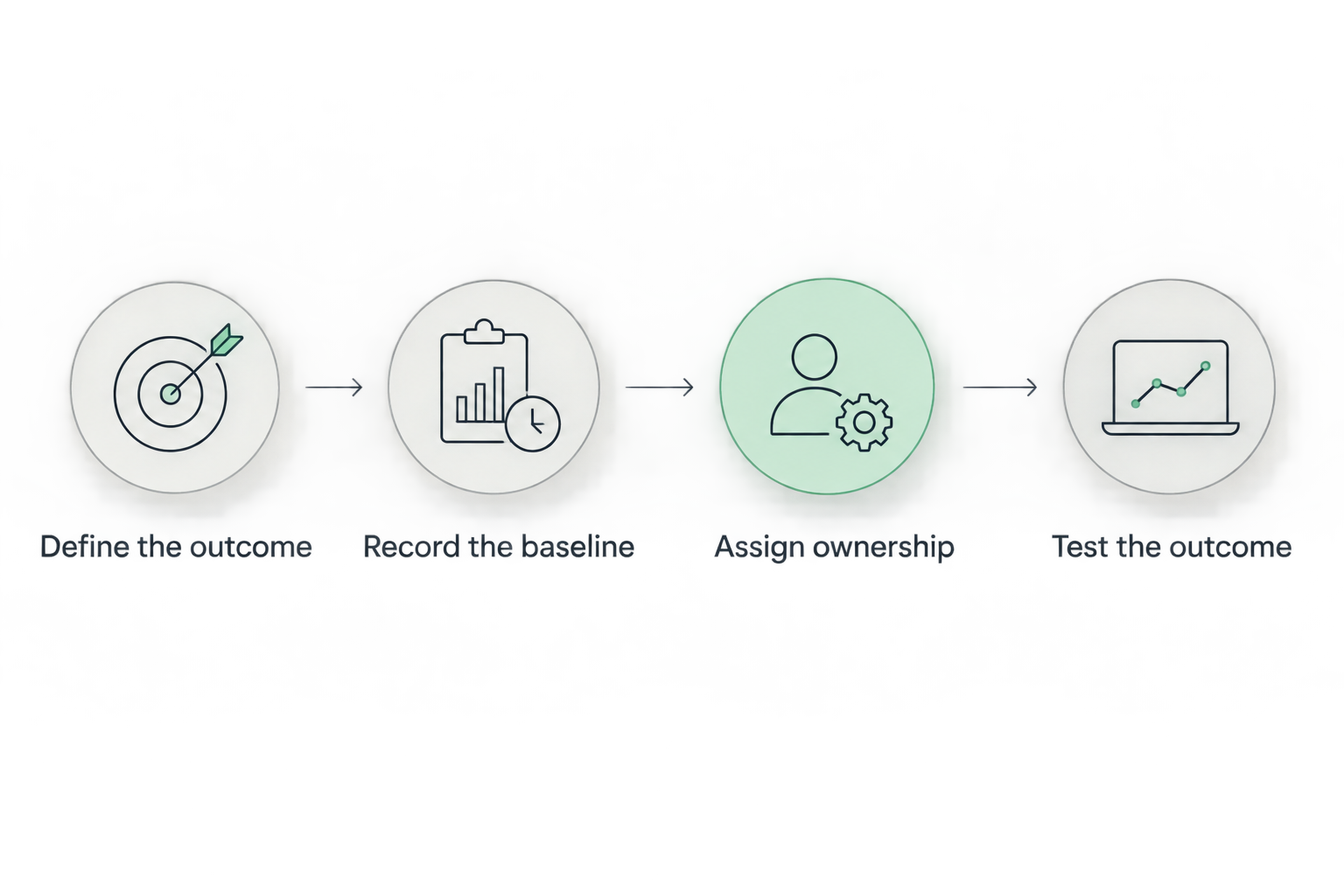
Do not approve a redesign until you can explain how you will judge it. That discipline applies whether you hire an agency, commission a freelancer, or build internally.
What should a small business expect an agency to deliver?
Expect a written scope, not an assumed package. Request confirmation of discovery, content structure, design, development, testing, launch, and handover wherever those activities are required.
For your 2026 shortlist, ask these questions:
- Which business problem does the proposed work address?
- What must your team provide before design or development can progress?
- Which pages, templates, forms, and integrations are included?
- How will existing search landing pages and changed URLs be handled?
- What must pass testing before the site launches?
- Who controls the domain, platform, analytics, and connected accounts?
- What documentation and training will your team receive?
An agency's answer should distinguish deliverables from outcomes. It can commit to an agreed scope and testing process; future sales also depend on your offer, traffic, sales follow-up, and other business conditions.
Be equally clear about exclusions. If ongoing content, maintenance, campaign work, or optimization is outside the engagement, assign it elsewhere rather than leaving it ownerless.
What does relevant agency evidence look like?
Look for a project with a recognizable business problem, an explained intervention, and an outcome whose scope is clear. A striking homepage screenshot does not tell you whether customers completed their tasks.
Hey Prospekt's reference projects illustrate why that distinction matters. Its Russell Westbrook Enterprises project describes a mobile-first Webflow build with division-specific architecture, alongside a 380% increase in mobile engagement and 2.3x B2B inquiries.
The Window Guard project reports 426 new leads and a 10x revenue increase in five months. That engagement included paid social, website and catalog redesign, and local SEO—not website design alone.
These are project-specific results, not a forecast for your business. In particular, the Window Guard outcome cannot be treated as evidence of what a standalone redesign will produce. When reviewing agency work in 2026, ask which services contributed and whether the project resembles your actual challenge.
Where does a full-service growth partner fit?
Hey Prospekt is best for B2B and B2C businesses seeking connected brand, web, and growth marketing services. Its stated offering brings those disciplines together rather than positioning the website as a separate business decision.
That fit matters when your website problem overlaps with positioning or customer acquisition. The limitation is scope: a business seeking only a narrow website repair should compare a focused specialist before commissioning a broader engagement.
Bring a defined problem to the conversation. Share what customers need to do, where the current experience fails, and what your team can own internally.
Define your website project
Discuss the business problem, required scope, and responsibilities before committing to a redesign.
Can a better website increase sales without more traffic?
A better website can remove barriers that stop existing visitors from taking action. Clearer service information, usable navigation, and working forms address problems within the website experience.
That is not a sales guarantee. If visitors are the wrong audience or the offer does not meet their needs, design changes alone do not resolve the underlying issue.
Should you redesign or improve the current website?
Improve the current website when the problem is localized; consider a redesign when the underlying structure prevents the required changes. Start with an inspection of the customer journey, not a preference for starting over.
Ask the provider to explain which existing components can stay. A defensible proposal identifies what needs replacing and why, rather than assuming everything must change.
FAQ
Is a web design agency worth it for a small business with a limited budget?
A web design agency is worth considering when the required work solves a defined business problem your team cannot handle internally. Start with the essential scope, and compare targeted improvements against a complete redesign.
What’s better for a small business: an agency or a freelancer?
An agency fits work requiring coordinated disciplines; a freelancer fits a clearly bounded specialist task. Confirm responsibilities rather than assuming either provider includes every service.
Do I need a new website if my current site looks old?
An older appearance alone does not establish the need for a new website. Evaluate whether customers understand your offer, complete key tasks, and receive a usable mobile experience.
Will hiring a web design agency guarantee more leads?
Hiring a web design agency does not guarantee more leads. Lead generation also depends on relevant traffic, your offer, customer demand, and the way inquiries are handled.
What should I ask before signing a web design proposal?
Ask who owns content, development, testing, migration, account access, and post-launch work. Make sure the proposal defines deliverables, exclusions, and acceptance criteria.
Can Hey Prospekt help with branding and marketing as well as a website?
Hey Prospekt offers brand, web, and growth marketing services for B2B and B2C companies. Confirm which services belong in your engagement rather than assuming every discipline is included.
How should I measure whether my new website was worth it?
Measure the customer action the project was designed to improve, using a baseline recorded before launch. Review qualified inquiries or completed purchases alongside traffic changes and business conditions.
One last thing
For your 2026 decision, ask the agency what it would leave unchanged. The answer tests whether the proposed work responds to your business problem or simply assumes a rebuild.
Buy the scope you need, not the largest transformation you can describe. Your website should become easier for customers to use and easier for your business to own.
Related guides
- Can one agency handle both branding and web design?
- Can conversion rate optimization increase revenue without more traffic?
- Compare web design agencies


