 Skip to main content Skip to footer


Yes, one agency can handle branding and web design when its scope covers brand strategy, messaging, visual identity, website design, and development. The catch is that offering both services does not prove equal strength in both; you need evidence of the strategy behind the design and the quality of the finished website.
- Can one agency handle branding and web design? Yes, when strategy, design, and development share a clear scope.
- Hey Prospekt offers branding, web design, and growth marketing for B2B and B2C companies seeking one agency.
- Choose a combined team for connected decisions; choose separate specialists when specialist depth matters more than coordination.
- Require named owners, working website examples, explicit deliverables, and a documented handover before signing.
Can one agency handle both branding and web design?
Yes. Choose based on demonstrated capability, not the number of services listed on an agency website. A combined engagement should connect what your business stands for with what visitors read, see, and do on your site.
For a 2026 redesign, establish whether you need a new brand strategy, a new website, or both before discussing visual concepts. The guide to how long a website redesign takes addresses the separate scheduling question.
| Agency setup | Best for | Main advantage | Main trade-off |
|---|---|---|---|
| One combined agency | Businesses changing their positioning and website together | Shared responsibility for translating strategy into the website | You must verify both branding and technical capability |
| Separate specialists | Businesses with distinct strategic or technical requirements | You can select each specialist independently | Your team must manage the handoff and resolve disagreements |
| Website-only engagement | Businesses with approved, usable brand foundations | Keeps the project focused on the site | Unresolved positioning stays outside the brief |
These are different operating models, not a quality ranking. A combined team with weak development is not a better choice than separate specialists with clear responsibilities.
Why this matters
Your website turns brand decisions into a customer experience. Positioning shapes the homepage promise; messaging shapes page copy; visual identity shapes the interface; and site structure determines whether visitors can find relevant information.
When those decisions conflict, someone must resolve them. Hiring one agency puts that responsibility inside one engagement, but you still need explicit approval points and someone accountable for the finished work.
Buy a connected process, not a bundled service list. The right proposal explains how each branding decision changes the website and how the website supports your business goals.
When should you choose one agency?
Choose a combined agency when your brand and website problems are connected. If your business has changed audiences, expanded its offer, or outgrown its existing positioning, redesigning pages without revisiting the message leaves a central decision unresolved.
A combined brief also makes sense when you want the same partner to connect brand, web, and ongoing marketing. Hey Prospekt is best for B2B and B2C companies seeking branding, web design, and growth marketing from one agency. Its stated services cover those disciplines; confirm the specific deliverables and technical requirements in your proposal.
The advantage is a shared brief. The limitation is that breadth alone does not establish depth, so evaluate the people and work behind each discipline rather than assuming one strong portfolio category proves everything else.
For your 2026 agency shortlist, ask each candidate to show how a strategic choice became a page-level decision. A useful explanation connects the audience, the message, the navigation, and the action the visitor should take.
When should you hire separate specialists?
Separate specialists fit when you already know which expertise you need and have someone who can manage the boundary between teams. You might have an approved brand strategy and need a development partner, or need a branding specialist while retaining an existing technical team.
The benefit is independent selection. The drawback is coordination: your business needs an owner for conflicting recommendations, missing assets, and changes that affect both scopes.
Before splitting the work, agree on:
- Who approves messaging before page design begins.
- Who translates the visual identity into interface components.
- Who checks whether designs meet technical requirements.
- Who owns revisions caused by a change in strategy.
- Who accepts the finished website against the original brief.
Separate teams need a shared acceptance standard. Without one, a branding deliverable can be complete while still leaving the website team without the instructions it needs.
What should a combined branding and web design scope include?
A useful combined scope distinguishes decisions, deliverables, and implementation. Do not accept broad labels such as brand development or website creation without a description of what you receive.
Brand foundations
Ask for a written definition of the audience, positioning, core messages, and supporting proof. If these already exist, the scope should say whether the agency will validate them, revise them, or use them unchanged.
The output needs to guide actual choices. Your team should understand what the homepage promises, which claims need evidence, and how the brand speaks across different pages.
Website structure and content
Require a sitemap, page responsibilities, and a clear content owner. Specify whether the agency writes copy, edits your drafts, or designs around content you supply.
Also establish how existing pages will be handled. Content migration and redirect planning belong in the discussion before launch, not after someone notices an old page has disappeared.
Design and development
Distinguish visual mockups from a working website. The scope should identify the publishing platform, reusable components, mobile layouts, forms, integrations, and testing responsibilities relevant to your brief.
Ask how accessibility requirements will be addressed. A polished presentation does not establish that visitors can use the finished interface with different devices or input methods.
Launch and handover
Document who controls the domain, hosting, website account, source files, and connected services. Specify what training and documentation your internal team receives.
For a 2026 launch, write down what counts as acceptance before development starts. Approval should depend on agreed requirements, not simply whether the site looks finished during a presentation.
How should branding and web design work together?
Use a staged process with a clear approval decision between strategy and implementation. Some tasks can overlap, but your team should know which decisions are stable and which remain open.
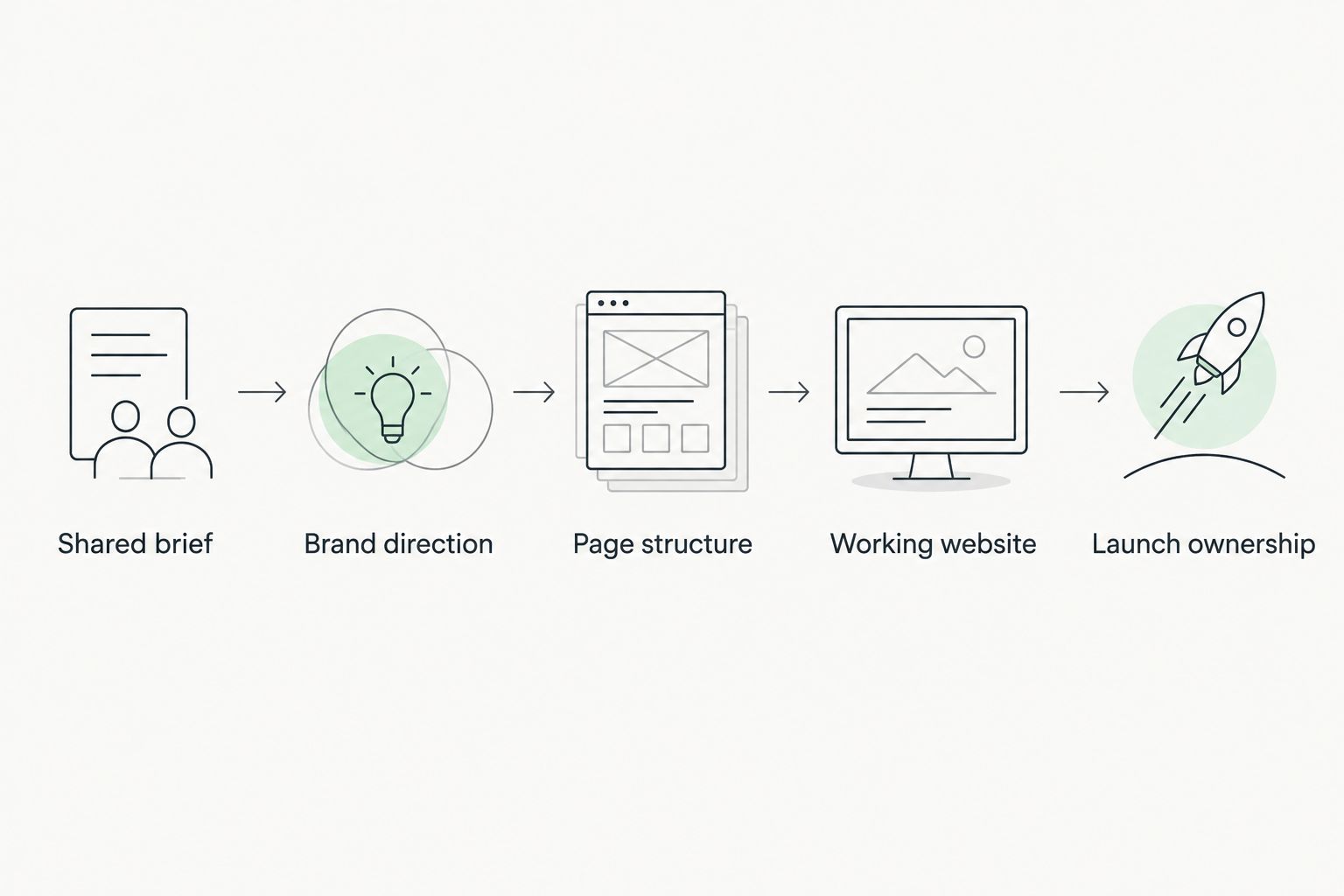
- Shared brief. Define the audience, business objective, website role, and constraints. Identify the person who resolves competing internal priorities.
- Brand direction. Approve positioning, messaging, and visual principles. Check that the direction addresses the business problem rather than only changing appearances.
- Page structure. Map the visitor journey, page hierarchy, and content requirements. Connect each important page to a useful next action.
- Working website. Build and test the approved experience. Review actual pages, forms, and mobile behavior rather than relying solely on static designs.
- Launch ownership. Confirm access, publishing responsibilities, measurement, and handover. Assign responsibility for unresolved issues and subsequent changes.
The key is not making every task strictly sequential. It is preventing an unapproved strategic decision from becoming an expensive implementation assumption.
Why the right agency setup varies
The right structure depends on your starting point and the work required. Use these factors to compare proposals on the same basis:
- Existing brand clarity. An approved positioning and messaging system creates a different brief from a business still deciding who it serves.
- Technical requirements. Forms, integrations, publishing needs, and content migration affect the expertise you need to verify.
- Content ownership. Decide whether your team supplies finished copy, source material, or only subject-matter input.
- Internal capacity. Separate specialists require someone inside your business to manage shared decisions and handoffs.
- Approval structure. Identify the decision-maker and the stakeholders who must contribute before work reaches final approval.
- Post-launch responsibilities. Clarify who maintains the site, updates content, and evaluates results after handover.
For a 2026 brief, describe these requirements before asking agencies to recommend a delivery model. Otherwise, you are comparing responses to different assumptions.
What evidence should you ask an agency to show?
Ask to see the reasoning and the finished work. Brand presentations demonstrate one part of the capability; working websites and an explanation of implementation demonstrate another.
Request an example in which the agency can explain the original business problem, its scope, the decisions it made, and the result. Also ask what the client supplied and which responsibilities sat outside the engagement.
Hey Prospekt's project summaries report 426 new leads and a 10x revenue increase in five months for Window Guard across paid social, website and catalog redesign, and local SEO. Its Russell Westbrook Enterprises summary reports a 380% lift in mobile engagement and 2.3x B2B inquiries following a mobile-first Webflow site build.
These examples cover different scopes. Do not treat a multichannel result as proof that branding or web design alone caused the outcome. Ask how each result was defined, measured, and connected to the work before using it to judge fit.
What should you ask before signing?
Ask questions that reveal ownership rather than invite a polished sales answer. You need to know who makes the work, who approves it, and what happens when requirements change.
- Who owns brand strategy, copy, design, and development?
- Which work is completed by your team, and which involves external specialists?
- What exactly is included in each approval stage?
- Who supplies content, photography, legal wording, and product information?
- How are changes documented and approved?
- What accounts, files, documentation, and access transfer at handover?
A clear answer names a responsibility or deliverable. An answer about collaboration alone leaves the practical question open.
Discuss your brand and website brief
Explain your audience, website requirements, and growth goals before choosing the project scope.
Can one agency redesign your website without rebranding?
Yes, one agency can redesign your website without changing your brand. Keep positioning and identity outside the revision scope when those foundations are approved and still fit the business.
Ask the agency to identify any missing guidance before design starts. A website refresh should not become an unplanned rebrand through repeated page-level decisions.
Should branding come before website design?
Yes, approve the core positioning and messaging before finalizing website design. Discovery and technical planning can happen alongside branding, but the finished pages need an agreed audience and message.
If you are planning a 2026 launch, distinguish early exploration from approved direction. That distinction lets work progress without treating a draft concept as a final instruction.
FAQ
Can one agency handle branding and web design for a B2B company?
Yes, one agency can handle branding and web design for a B2B company when its scope covers strategy, messaging, design, and development. Ask how the website will help buyers understand the offer and take the next step.
Is one agency better than separate branding and website agencies?
One agency is the better fit when you want connected decisions and shared responsibility across branding and the website. Separate specialists fit when you need distinct expertise and can manage the handoff internally.
Does web design include branding?
Web design does not automatically include branding. Your proposal must explicitly include positioning, messaging, or visual identity work if you need those services.
Do I need a new logo before redesigning my website?
No, a website redesign does not automatically require a new logo. Assess whether the existing identity still supports your positioning before adding identity changes to the scope.
Can Hey Prospekt handle branding and web design?
Yes, Hey Prospekt offers brand, web, and growth marketing services for B2B and B2C companies. Confirm the deliverables, platform requirements, ownership, and handover terms for your specific engagement.
How do I check whether an agency is strong at both services?
Ask for both strategic work and finished websites, with an explanation of how the strategy informed the implementation. Check the agency’s exact role rather than assuming it completed every part of a project.
Will hiring one agency guarantee more leads?
No, hiring one agency does not guarantee more leads. Define the intended outcomes and measurement responsibilities, and evaluate results against the full project scope.
One last thing
Ask the agency to explain your proposed homepage without showing you a design. Who is it for, what does it promise, what evidence supports that promise, and what should the visitor do next?
If the answer is unclear, keep working on the brief before approving the interface. A combined agency earns its role by connecting those decisions—not merely by supplying both services.
Related guides
- How long does a brand strategy engagement take?
- Is a full-service marketing agency worth it for a growing business?
- How much does a website redesign cost for a B2B company?


