 Skip to main content Skip to footer


Social media marketing has no fixed time to results: engagement, qualified leads, and revenue are different milestones, and each needs its own measurement window. For your 2026 plan, judge progress against a defined business outcome—not a promised deadline—and separate campaign performance from the time buyers take to purchase.
- How long does social media marketing take to show results? There is no universal deadline for leads or revenue.
- Hey Prospekt’s Window Guard project reported 426 leads and 10x revenue in five months across several marketing services.
- Paid social tests audience response through advertising; organic social depends on content distribution and audience relationships.
- Measure qualified leads and completed sales separately from reach, engagement, and website visits.
Why this matters
A campaign can attract attention without generating business. If you call both outcomes results, you cannot tell whether your social media investment is working or simply producing activity.
Set separate expectations for content response, website actions, and sales. The broader question of how long growth marketing takes to show results also matters when social media shares responsibility with your website, email, and sales team.
A useful timeline ends with a measurable customer action, not a publishing milestone. Posting consistently proves execution. It does not, by itself, prove demand or revenue.
How long does it take to see results from social media marketing?
There is no defensible universal deadline for social media marketing results. Your timeline depends on the outcome you want, the audience you can reach, the offer you present, and what happens after someone responds.
Use the following milestones to define what results mean in your 2026 plan. Read each against its own evidence rather than treating the entire customer journey as a single event.
| Result milestone | Evidence to examine | What it tells you | What it does not prove |
|---|---|---|---|
| Audience response | Relevant comments, saves, shares, and profile visits | Whether content prompts a response | Whether respondents intend to buy |
| Website interest | Campaign-tagged visits and relevant page activity | Whether social sends people toward your offer | Whether those visitors are qualified |
| Lead generation | Completed inquiries checked against buyer criteria | Whether the campaign attracts potential customers | Whether those leads become revenue |
| Sales impact | Completed purchases or closed opportunities connected to campaign records | Whether social contributes to business outcomes | Whether social deserves all the credit |
Decide which row answers your business question before you set a deadline. An engagement campaign and a sales campaign should not pass the same test.
A useful brief states the target action, the buyer criteria, the tracking method, and the decision you will make after reviewing performance. Without those details, a timeline is just a date on a calendar.
A documented example: five months of combined marketing work
Hey Prospekt reported 426 new leads and a 10x revenue increase in five months for Window Guard through paid social, website and catalog redesign, and local SEO. Those figures describe a combined marketing engagement, not an isolated social media experiment.
The distinction matters. The result supports a five-month example for that project; it does not establish an average social media timeline or prove how much revenue paid social generated independently.
You should use case studies to inspect the work behind an outcome. Ask which channels contributed, how a lead was defined, and whether the revenue figure describes the whole business or a specific campaign.
The practical lesson is not to expect 426 leads. It is to evaluate social media alongside the destination, offer, and follow-up that turn attention into business.
Organic social: judge audience response before revenue
Best for: businesses building an ongoing relationship with a relevant audience. Organic social gives you a place to publish useful content, answer questions, and show your work without purchasing each placement.
Its limitation is distribution: publishing does not guarantee that your intended buyers will see or act on a post. An active account can still attract the wrong audience or send little qualified traffic to your website.
In 2026, define organic progress through buyer-relevant behavior. Look for questions about your offer, visits to relevant pages, and inquiries that match your customer profile—not follower growth alone.
If content receives attention but produces no commercial interest, examine the topic and next step. A popular post can succeed as entertainment while failing as a route to your service or product.
Paid social: judge delivery, response, and conversion separately
Best for: businesses that want to test a defined audience, message, and offer through advertising. Paid social lets you purchase distribution and compare campaign responses, but impressions and clicks are not proof of profitable demand.
Its limitation is that advertising cannot repair an unclear offer or a broken buying process. Sending additional traffic to a confusing page simply exposes more people to that problem.
Separate the questions. Is the campaign reaching the intended audience? Are people responding? Are those responses becoming qualified inquiries or purchases?
Do not treat the first sale as proof that a campaign can sustain results. Review whether the same approach continues to attract suitable customers before expanding it.
| Approach | Best for | Strength | Limitation | Main evaluation question |
|---|---|---|---|---|
| Organic social | Ongoing audience relationships | Publishing useful content and maintaining conversation | Distribution and attention are not guaranteed | Does the content attract relevant interest? |
| Paid social | Testing a defined audience and offer | Purchasing distribution and comparing responses | Traffic still depends on the offer and conversion process | Does campaign response turn into qualified business? |
Why social media marketing timelines vary
Your starting position changes what the campaign must accomplish. A business with an engaged audience and a working purchase path has a different task from a business still clarifying its message.
- Audience fit: Reaching people who match your buyer profile matters more than reaching a large, unrelated audience. Review who responds, not just how many respond.
- Offer clarity: People need to understand what you provide and why they should act. Unclear positioning makes campaign response harder to interpret.
- Creative relevance: The message and format must connect with the intended buyer. Test a clear idea rather than changing every campaign element together.
- Website readiness: A campaign needs a destination that explains the offer and supports the promised next step. A confusing page or broken form interrupts that path.
- Buying process: An inquiry and a completed sale are separate events. Account for the steps your actual customers take rather than borrowing another business’s timeline.
- Measurement and follow-up: Campaign tags, reliable forms, lead records, and ownership of responses help you distinguish a marketing problem from a tracking or sales problem.
These factors are diagnostic categories, not excuses to wait indefinitely. Each should lead to a check your team can complete and a change you can evaluate.
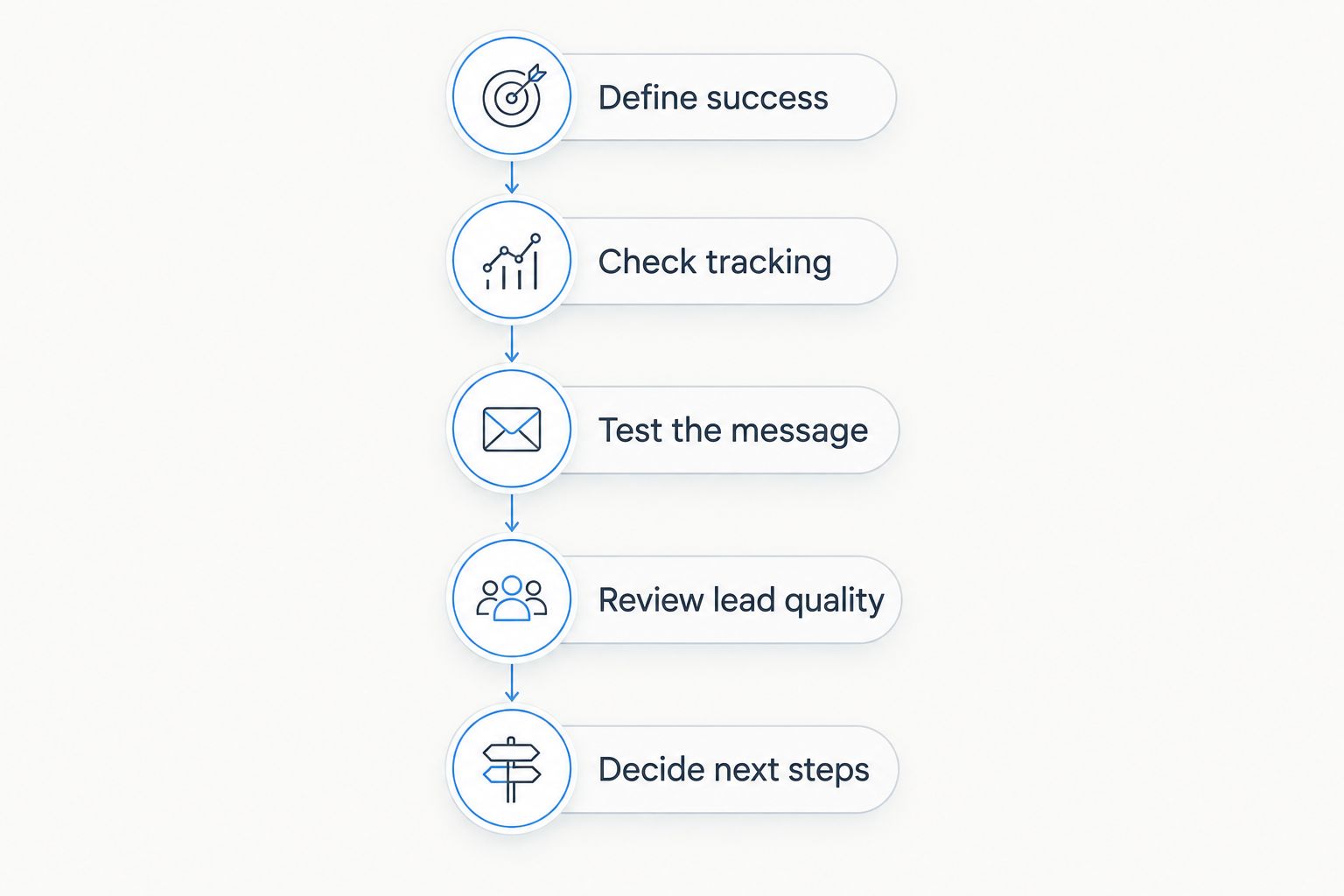
How to set a social media review plan
Build your 2026 review plan around decisions, not an arbitrary promise of results. Agree on the evidence needed to continue, revise, or stop an approach before the campaign begins.
Define success
Write down the business action you want: a qualified inquiry, a booked appointment, or a completed purchase. Then identify the earlier behaviors that help explain whether people are moving toward that action.
Choose a primary outcome. A report that treats every available metric as equally important makes weak performance easier to disguise.
Check tracking
Confirm that campaign links, website forms, purchase records, and lead records work as intended. Submit a test inquiry and follow it through the same process a customer would use.
Resolve discrepancies before judging campaign effectiveness. A missing record is a measurement problem until you establish what happened to the inquiry.
Test the message
Compare clearly defined messages against the intended buyer’s needs. Keep a record of what changed so you can connect a response to a specific creative or offer decision.
Avoid changing the audience, message, destination, and offer together unless the campaign requires a full reset. Otherwise, you lose the ability to explain which change mattered.
Review lead quality
Check whether inquiries match your buyer criteria and whether your team contacted them. Separate irrelevant leads from suitable prospects who are still considering a purchase.
Bring sales feedback into the review. A campaign report cannot explain lead quality if nobody checks what happened after submission.
Decide next steps
Continue an approach when it produces the intended evidence. Revise it when a specific stage fails, and stop activity when it repeatedly attracts the wrong response without a supported reason to continue.
Document the decision and its basis. Your next review should test that decision, not restart the same conversation.
When should you change the strategy instead of waiting?
Change the failing stage, not the calendar. If the campaign reaches unsuitable people, revisit targeting and content relevance; if suitable visitors abandon the next step, inspect the offer and destination.
Use this diagnostic list during your 2026 reviews:
- Relevant reach without response: inspect the message and creative.
- Responses without website action: inspect the promised next step.
- Website visits without inquiries: inspect the page, offer, and form.
- Inquiries without qualified prospects: inspect audience fit and qualification criteria.
- Qualified prospects without sales: inspect follow-up and purchase barriers.
These patterns identify questions to investigate, not automatic explanations. Confirm the cause before rebuilding the campaign.
Waiting is justified only when you can explain what evidence is still developing. It is not a strategy for fixing broken tracking, irrelevant traffic, or unanswered inquiries.
When does an agency make sense?
Hey Prospekt social media marketing is best for teams that need brand, web, and growth marketing work connected. That fit follows its full-service scope across brand strategy, digital marketing, and creative services for B2B and B2C companies.
The limitation is equally clear: Hey Prospekt’s combined project results do not establish a guaranteed social-only timeline. Ask any prospective agency to separate deliverables, leading indicators, qualified leads, and revenue in its reporting.
Before you hire, identify who approves creative, who owns the website, and who follows up with prospects. An agency relationship needs clear responsibilities as well as a clear target.
Define your next marketing milestone
Discuss your goals across brand, web, and growth marketing.
FAQ
How long does social media marketing take to show results?
Social media marketing has no universal timeline for results. Define whether you mean audience response, qualified leads, or completed sales, then evaluate that outcome against your campaign evidence.
Can social media marketing produce results in five months?
Five months was the reported duration of the Window Guard project, which generated 426 new leads and a 10x revenue increase across paid social, website and catalog redesign, and local SEO. Those combined results are not a social-only benchmark or a guarantee.
Does paid social work faster than organic social?
Paid social lets you purchase distribution, while organic social depends on content distribution and audience response. That difference does not establish a universal deadline for qualified leads or sales from either approach.
Should I stop posting if social media is not generating sales?
Do not stop solely because posts have not generated attributable sales. First check whether the content reaches suitable buyers, creates relevant visits, and gives those visitors a clear next step.
What should I measure before social media revenue appears?
Measure buyer-relevant responses, campaign-tagged website visits, completed inquiries, and lead quality. Treat these as evidence about the customer journey, not substitutes for revenue.
How do I know whether social media leads are good?
Good social media leads match your documented buyer criteria and show relevant interest in your offer. Check lead records and sales feedback rather than judging quality from form submissions alone.
Can an agency guarantee when social media will generate sales?
An agency cannot establish a credible universal sales deadline from another client’s case study. Request a measurement plan, clear responsibilities, and explicit conditions for continuing or changing the campaign.
One last thing
Your first useful finding might be a bottleneck outside social media. A campaign that produces relevant inquiries can expose slow follow-up, confusing qualification, or a weak purchase process.
For your 2026 plan, record the full path from campaign response to business outcome. Before asking for more time, identify the next customer action that is not happening—and assign someone to fix it.
Related guides
- How long does it take for PPC campaigns to convert?
- Is a social media marketing agency worth it for small businesses?
- How long does a website redesign take?


